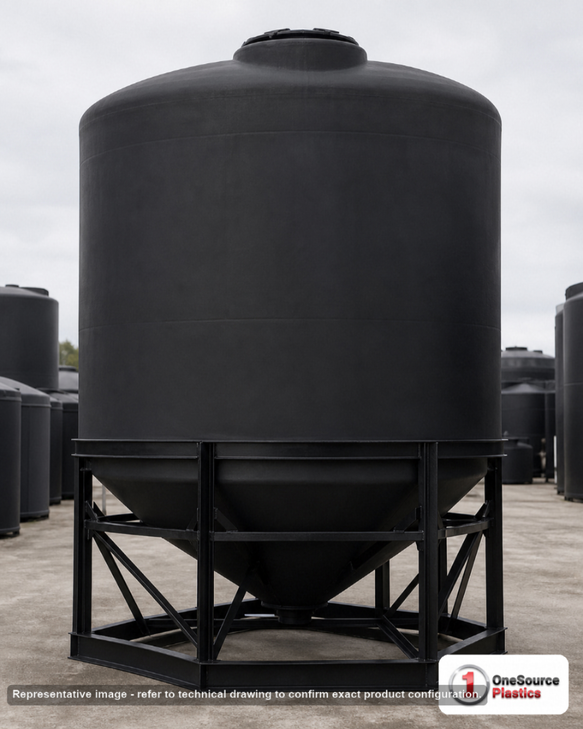
Three thousand six hundred gallons of black cone, rated 1.9
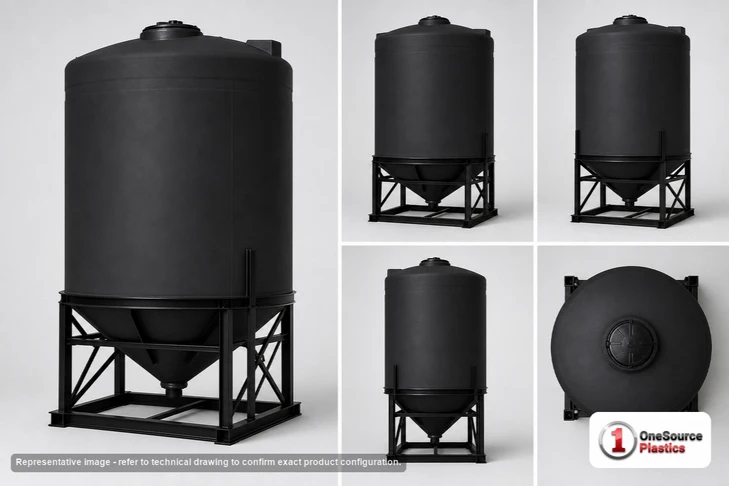
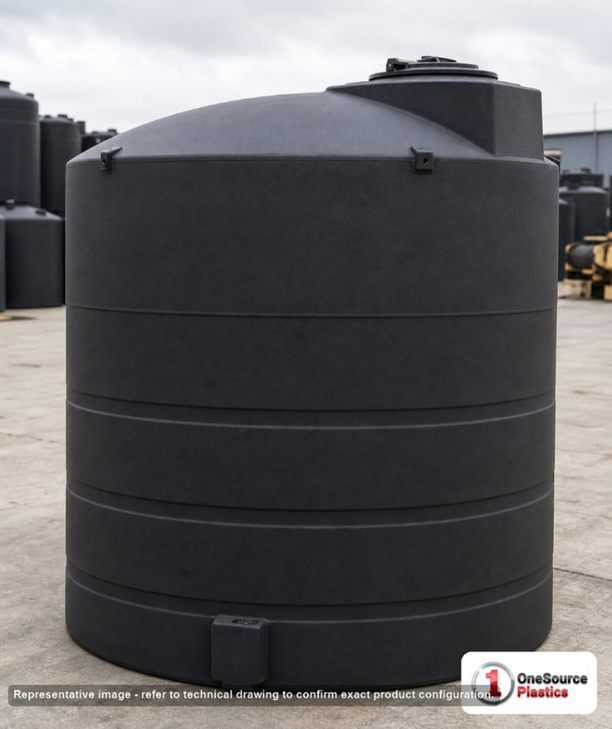
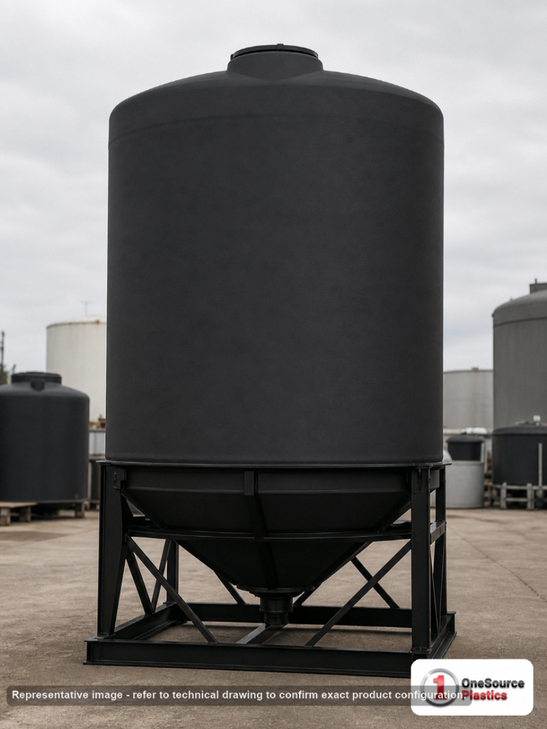
The Snyder 8050000N48 is a 3,600 gallon black cone bottom tank listed 102 inches long, 102 inches wide and 125 inches tall, with the diameter given as 102 inches, at 1,090 pounds empty and 1,090 pounds shipping. The material field reads Crosslinked Linear Polyethylene. Heavy duty is Snyder's own name word for this listing, and on this sheet it arrives with figures rather than adjectives: the wall is rated at a specific gravity of 1.9, and the max contents figure is 57,046 pounds against 30,024 pounds of water at 8.34 pounds per gallon. The opening on top is an 18 inch threaded vented manway. The outlet field reads 1 Manway / Lid, which names an opening rather than a discharge, and no discharge size is published anywhere on the sheet. The service limit is 100 F / 37 C and the warranty field reads 3 Year Warranty. The freight class is 300. The sheet gives no cone angle field, no inlet, no NMFC number, no structural lug detail and no stand, and none of those is claimed on this page.
Engineer on the job? Request a written quote with the spec attached, or get freight to your ZIP and add to cart above; 866-418-1777 answers the technical questions.
A hundred and two inches of circle, and the pad that has to carry it
Start at the ground, because on a cone bottom tank the ground is the part that gets under-built. This vessel has no flat floor. It cannot stand on its own bottom, it never could, and this sheet publishes no stand, no legs, no skirt, no support ring and no bolt pattern. The stand is a separate item with its own drawing, its own lead time and its own price, set and levelled before the tank arrives, and we will not print a height, a rated load or a material for a structure the sheet does not carry. What the sheet does give you is the envelope that structure lives inside and the loads it has to carry, which is what an engineer asks for first. The circle is 102 inches, eight and a half feet across, which is wide for the capacity, and the shell is 125 inches, a little over ten feet. Everything the stand adds goes underneath those 125 inches, so your finished height is the stand plus the shell plus the clearance a person needs above an 18 inch manway to open it and turn a fill line into it. Measure that against the lowest fixed thing over the spot rather than against the roof: a sprinkler main, a crane rail, a duct or a light fitting decides this and it is never the thing people measure first. Then look down. The pad takes 1,090 pounds of empty tank, 30,024 pounds of water and 57,046 pounds at the rating, and on a cone those loads arrive through a handful of stand feet rather than spreading across a slab the way a flat bottomed tank spreads them. That concentration is the whole reason a cone foundation is engineered ground with a designed bearing area at each foot rather than a slab poured to suit a drawing. The wide circle helps here, because feet set further apart carry less each, and it is one of the quiet advantages of a squat shell. Leave clearance under the cone as well, because the discharge has to reach a pump, a tote, a drum or a drain, and the height lost there is height you cannot buy back once the structure is set. Leave an aisle right round it too: at eight and a half feet across, nobody reaches the far side of this tank from one position, and the day somebody changes a gasket under the cone is the day that aisle pays for itself. Work the support out properly with the cone bottom tank stand compatibility matrix before a part number is fixed, settle the volume with the tank sizing calculator, and take the freeboard discipline from the tank sizing guide.
Four listings on one shell, and two sizes either side
| Part | Gallons | Length x width x height | Empty weight |
|---|---|---|---|
| 8050000N48 (this tank, heavy duty, rated 1.9, black) | 3600 | 102 x 102 x 125 in | 1090 lb |
| 8050000N46 (the standard listing on this shell, black) | 3600 | 102 x 102 x 125 in | 1090 lb |
| 8050000N40 (XLPE listing, same weight) | 3600 | 102 x 102 x 125 in | 1090 lb |
| 8050000N43 (further listing on the same shell) | 3600 | 102 x 102 x 125 in | 1090 lb |
| 5150000N40 (narrower circle, taller shell) | 3000 | 90 x 90 x 144 in | 500 lb |
| 5440000N40 (narrower circle, tallest here) | 3900 | 90 x 90 x 180 in | 1100 lb |
Four of these rows are one shell. Same gallons, same 102 inch circle, same 125 inch height, same 1,090 pounds, and the sheet separates them by the part number and the name it prints on each. Take the pair that matter to you: this listing and 8050000N46 are the heavy duty and standard listings on that shell, and the only difference either sheet publishes is the rating and the contents figure that follows from it. This one is rated at a specific gravity of 1.9 with 57,046 pounds of max contents. The standard listing carries its own rating on its own page. Nothing on either sheet describes a wall thickness, a layer count or a construction difference, so this page describes none, and anybody who tells you otherwise from a catalogue is guessing. What that leaves is a clean decision. If your product is denser than water, this is the listing that covers it. If it is not, you are paying for wall you will never load, and the standard listing is the more honest buy. The two lower rows change the problem rather than the price, and they both do it by trading floor for height. 5150000N40 holds 3,000 gallons on a 90 inch circle at 144 inches: less volume, a smaller footprint, a foot and a half more height. 5440000N40 holds 3,900 gallons on that same 90 inch circle but goes to 180 inches, fifteen feet, at 1,100 pounds. This tank sits between them in the way that usually matters most indoors: it holds nearly as much as the tallest option in barely more than two thirds of its height, by taking a wider circle of floor. Ceiling against ground is the trade that decides most cone purchases, and on a low building this shell is why a wide tank exists. The material question sits alongside it rather than underneath it, and the article on when crosslinking matters for a chemistry duty is the place to settle that properly.
Height or floor the limit? The table has both shapes; freight to your ZIP is quoted on each row, or call 866-418-1777 with the site.
The outlet field names an opening, so read the drain as unbuilt
- The outlet field: it reads 1 Manway / Lid on this sheet. That names an opening and not a discharge, and we print it exactly as it reads rather than turning it into a pipe size. No outlet dimension, no thread, no bulkhead and no valve is published or claimed here. Tell us the line size you need to land, the valve type and the product, and we will confirm what this part number carries before anything is ordered.
- The drain path in practice: on a cone the discharge is the low point of the entire vessel and everything hangs off it. Carry the valve, any reducer and the first run of pipe on their own steelwork off the stand, never on the tank, with a flexible connector at the first joint so pump vibration stays out of the wall. With 57,046 pounds of rated contents above it, the bottom of a full column is the wrong place for dead weight.
- The cone angle: this sheet publishes no angle field and the product name carries none, so this page states none. If the way your product drains is what decides the purchase, ask and we will confirm the geometry against the part number rather than reading it off a photograph.
- Access on top: an 18 inch threaded vented manway at 125 inches plus the stand, which is well above head height in every installation. A platform or fixed ladder with a fall protection plan belongs in the same drawing as the structure, and the fill line belongs at a coupling at working level.
- The vent: it arrives with the manway on this sheet rather than as a separate item. On a tank being pumped down, the air path is what protects the wall, so keep it clear, check it whenever the tank is opened, and never blank, tape or wrap it to control a smell.
- Ratings and blanks: a specific gravity rating of 1.9, 30,024 pounds of water at 3,600 gallons, 57,046 pounds of max contents, a limit of 100 F / 37 C and a 3 Year Warranty on the warranty field. No inlet, no structural lug detail and no NMFC number is published, and none is claimed.
On a column this deep the level instrument is the only honest picture of what is in the top of it, and retrofitting the wrong one costs more than choosing well did: the level gauge selection guide for chemical service compares radar, ultrasonic, hydrostatic and magnetostrictive on their failure modes rather than their brochures.
Dense product held in a wide, short column
A 1.9 rated cone at 3,600 gallons goes to operations holding something heavier than water that still has to leave the vessel completely. Concentrated mineral and salt solutions in a process building. Heavy liquid fertiliser and crop input blends at an agricultural retailer. Thickened sludge and dewatering feed at a treatment works. Spent liquor and pickling solution in a metals plant. Wash plant and mineral slurry duty. Process intermediates that carry solids in suspension and cannot afford to leave a heel behind at the changeover. The cone is what makes each of those work, because nothing settles into a corner the vessel cannot reach, and at this volume a residual layer is a disposal ticket and a contamination risk in the next batch rather than a nuisance. The wide shell adds a second advantage worth knowing: a squat vessel stratifies less readily than a tall slender one, so a product that wants to separate is easier to keep honest in this shape than in the 90 inch tanks listed beside it. That costs floor area, which is the trade to weigh against your own site plan rather than against a specification. One honest caution belongs with the rating: 1.9 is a wall rating on this sheet and nothing more. It says nothing about how your particular liquid behaves against polyethylene, and neither will we from a product page. Name the liquid, the concentration and the temperature it genuinely sits at through the year when you enquire, look it up in our chemical compatibility reference before a gasket or a valve is chosen, and let the chemistry decide those rather than the tank.
Service list by chemical
One line per liquid the maker rates for this resin, with the concentration it is rated to and the fitting and gasket to order. Take your own concentration and temperature to the linked page or the chemical compatibility database before ordering.
- Acetic Acid - 60% - fittings PP/PVC, gaskets EPDM
- Aluminum Sulfate - 50% - fittings PVC, gaskets EPDM
- Calcium Chloride - 40% - fittings PVC, gaskets EPDM
- DEF - 32.5% - fittings 316SS, gaskets EPDM
- Ethylene Glycol - 100% - fittings PVC, gaskets EPDM
- Ferric Chloride - 50% - fittings PVC, gaskets EPDM
- Ferric Sulfate - 60% - fittings PVC, gaskets EPDM
- Ferrous Sulfate - 20% - fittings PVC, gaskets EPDM
- Hydrofluosilicic Acid - 26% - fittings PP/PVC, gaskets Viton
- Magnesium Chloride - 30% - fittings PVC, gaskets EPDM
- Polyaluminum Chloride - fittings PVC, gaskets EPDM
- Potassium Carbonate - 50% - fittings PVC, gaskets EPDM
- Potassium Hydroxide - saturated - fittings PVC, gaskets EPDM
- Propylene Glycol - fittings PP/316SS, gaskets EPDM
- Sodium Carbonate - 30% - fittings PVC, gaskets EPDM
- Sodium Thiosulfate - 40% - fittings PVC, gaskets EPDM
- Urea Solution - 50% - fittings PP/PVC, gaskets EPDM
A thousand and ninety pounds shipped, class 300, Marked Tree
This tank is moulded at Marked Tree, Arkansas, and Arkansas is the origin state on the sheet, which puts the mid-South on the short lane and both coasts on a planned one. The freight class reads 300, a numeric class rather than a mode, with LTL as the ship mode, and the sheet publishes no NMFC number. It shipments at 102 inches by 102 inches by 125 inches at 1,090 pounds, which is a large package at a moderate weight, and that combination is normal on hollow moulded goods that fill trailer space without loading it. Price the lane to your ZIP with the freight cost estimator; the listed price is before freight. It travels lying down and somebody stands it up at your end, and that standing operation is the part of the day that goes wrong when nobody has planned it. This sheet publishes no crane, no rigging, no permit and no escort detail, so none is stated here; agree the offload equipment and the delivery window with us before the truck is booked. Have the stand set, levelled and anchored first, because a cone bottom tank with nowhere to stand is a tank lying in your yard occupying the space you needed. Sling under the body, never by the manway, and keep it restrained from the moment it is upright, because eight and a half feet of empty shell takes wind at a speed that surprises people. Then prove the installation with clean water rather than product: hold the 30,024 pound load, read the manway seal, the cone joint, the stand feet and the pad edge in that order, and leave it standing full overnight before anything is connected. Record the warranty start date with the delivery paperwork; the warranty field reads three years and the clock is worth knowing the beginning of. The vent screen is the cheapest part on the tank and the one that saves it; look at it every time the manway opens.
Freight and documents
Ships from: Marked Tree, AR. LTL freight is quoted to your ZIP with the freight cost estimator or by phone at 866-418-1777. The listed price is before freight.
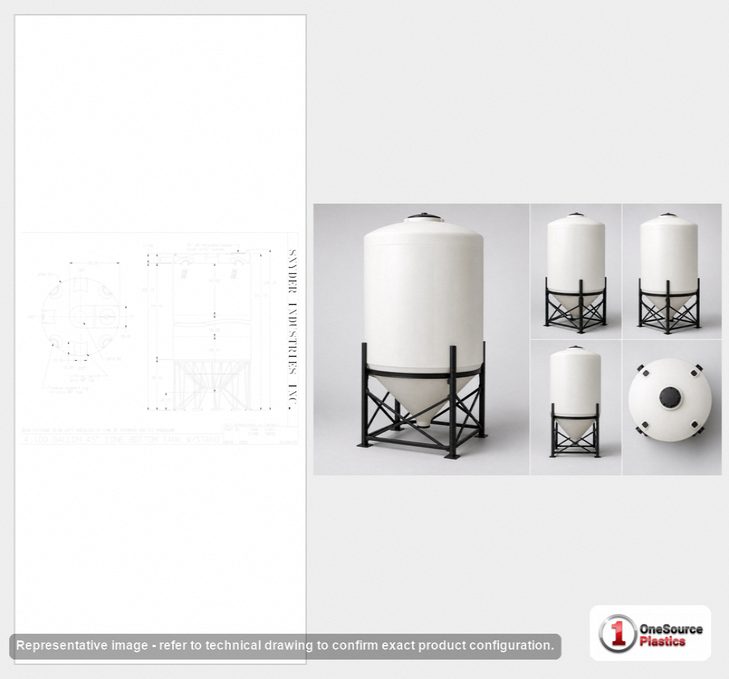
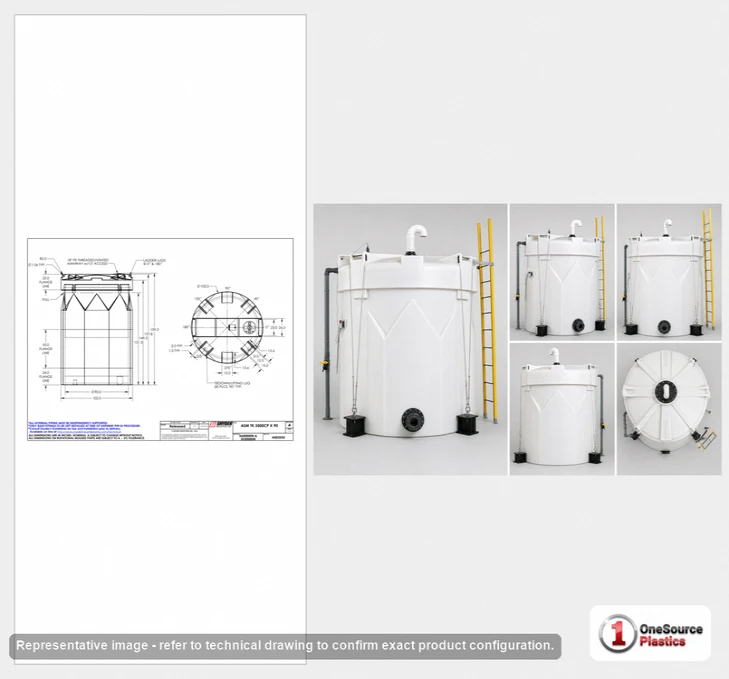
Technical drawing (PDF) for Snyder Industries 8050000N48.
See this tank
Interactive 3D model with live fill. This tank has an interactive 3D model built to its manufacturer dimensions. Rotate it, and set a fill level to see how much liquid it holds at any height. Open the 3D view on the product photo above. Download the 3D model (GLB).
Ready to order?
Add it to your cart at the top of this page, get LTL freight to your ZIP, request a written quote, or call 866-418-1777. The listed price is before freight.