Thirty-six hundred gallons, listed as polyethylene
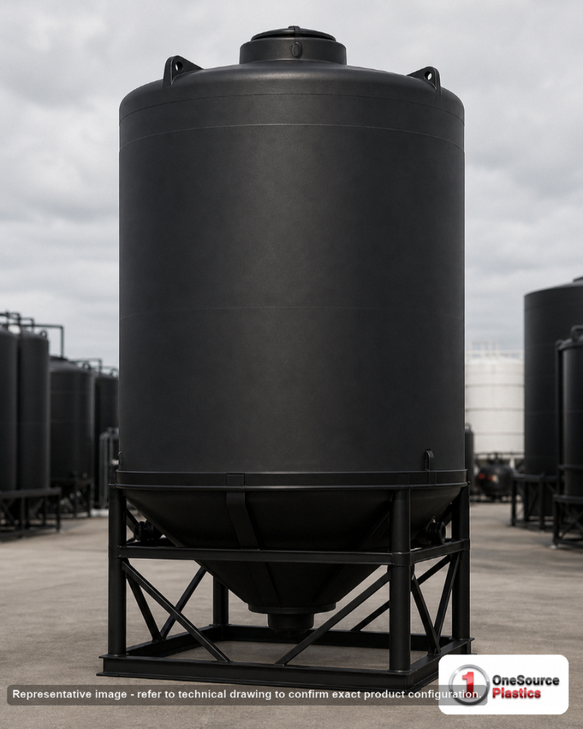
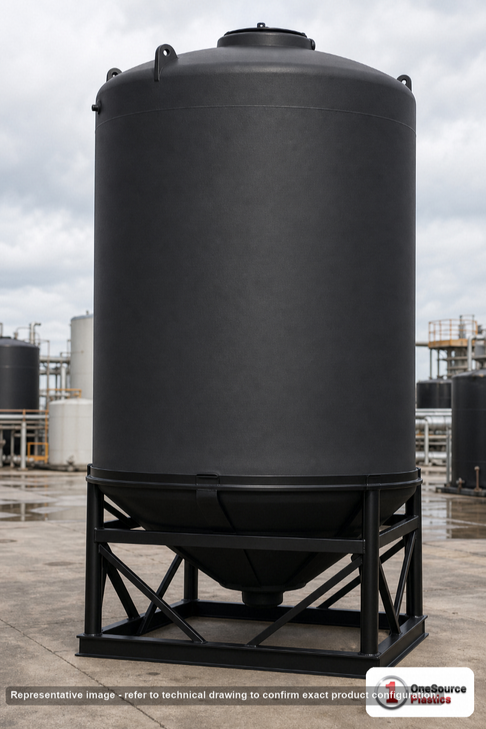
The Snyder 8050000N43 is a 3600 gallon cone bottom tank in natural white, listed at 102 inches long by 102 inches wide by 125 inches tall and 1,090 pounds empty. Its material field reads polyethylene and its wall is rated at a specific gravity of 1.5; the sheet gives 30,024 pounds for 3,600 gallons of water at 8.34 pounds per gallon with 45,036 pounds of max contents. The opening on top is an 18 inch threaded vented manway, and the outlet field reads "1 Manway / Lid", which names an opening rather than a pipe size, so no outlet dimension is claimed here. The service limit is 100 F / 37 C and the warranty is listed as a 3 Year Warranty. The sheet publishes no cone angle, no inlet and no stand, so none of the three is stated on this page. Freight is LTL at class 300 with no NMFC number listed, moulded at Marked Tree, Arkansas.
Replacing a tank that failed? Call 866-418-1777 with what it held and how long it lasted; or check freight to your ZIP and put the 3600 gallon tank in your cart above.
Marked Tree, Arkansas, and the lane to your plant
Where a tank is made matters more on this shape than on almost any other, so start there. Marked Tree, Arkansas is the only plant on this sheet and Arkansas is the only ship-from state, which puts the mid-South, the lower Mississippi valley and the eastern plains on a short lane, and makes every other region a planned move rather than a routine one. That is not a footnote on a cone bottom tank. This one shipments at 102 by 102 by 125 inches and 1,090 pounds: eight and a half feet across and a little over ten feet tall, which is a dimensional load on a trailer whichever direction it travels, and the distance from the plant is the single biggest variable in what it costs to get one. Price your own lane with the freight cost estimator before you finalise the size, because on a vessel this shape the freight can move the comparison between two capacities more than the tanks themselves do. The second half of the lane question is what happens at your end. A load this wide needs a gate, a yard and a route to the final position that will take it, and it needs offloading equipment with the reach and the rating to take the tank under the body. Decide that before the truck is booked rather than on the morning it arrives. Then the structure, which is a separate purchase because this sheet publishes no stand and no structural detail at all. A cone has no flat base, so everything it holds passes through a frame into your floor at a small number of feet: 1,090 pounds empty, 30,024 pounds of water and 45,036 pounds of max contents at the 1.5 rating, all of it as point loads rather than a spread base. The cone bottom stand compatibility matrix is where a site running several makers on common supports starts, and the concrete pad sizing guide for above-ground polyethylene tanks sets out the framework for the surface those feet stand on and where a general recommendation stops. Two more decisions belong to the same survey. Where the vessel stands over a floor or a drain that a release would have to be recovered from, the containment comparison settles that argument properly instead of assuming it away, and where the contents have to be marked for the people working around them, the tank label and signage guide reconciles the several marking schemes that land on one vessel. Confirm 3,600 gallons against your own batch and turnover in the tank sizing calculator, and take the freeboard a warming or gassing product needs from the tank sizing guide.
The same 102 inch shell under four names
| Part | Gallons | Length x width x height | Empty weight |
|---|---|---|---|
| 8050000N43 (this tank, cone bottom name, rated 1.5) | 3600 | 102 x 102 x 125 in | 1,090 lb |
| 8050000N40 (same shell, cross-linked name) | 3600 | 102 x 102 x 125 in | 1,090 lb |
| 8050000N46 (same shell, black cross-linked name) | 3600 | 102 x 102 x 125 in | 1,090 lb |
| 8050000N48 (same shell, black heavy duty name) | 3600 | 102 x 102 x 125 in | 1,090 lb |
| 5150000N40 (narrow shell, far lighter) | 3000 | 90 x 90 x 144 in | 500 lb |
| 5440000N40 (narrow shell, taller) | 3900 | 90 x 90 x 180 in | 1,100 lb |
Four listings share the identical 102 by 102 by 125 inch shell at the identical 1,090 pounds, and the only published difference between them is the name. This one is named simply as a cone bottom tank; one is named cross-linked; two are named black, one of those as heavy duty. The sheet explains nothing further and neither will we, because reading a specification out of a product name is how the wrong vessel gets bought. Two practical notes do apply. Colour is a genuine service difference in daylight: a black wall keeps light out of the contents, a natural white one lets an operator read the level through the shell from across the bay. And the choice between the four is made against the chemistry and the duty you describe to us, not against a table. Where a drawing, a spares list or an existing installation already names one of these part numbers, order that one and we will confirm the published figures against it. The two narrow-shell rows are the real alternatives. 5150000N40 holds 3,000 gallons on a 90 inch circle at 144 inches and just 500 pounds, easily the lightest thing on this sheet to lift and set. 5440000N40 holds 3,900 gallons, three hundred more than this tank, on the same 90 inch circle but at 180 inches tall and 1,100 pounds. Both buy floor space with height. This tank does the opposite: it is the one that fits under a low steel, and at 125 inches it is the shortest cone on the sheet by a clear margin. Decide which of your two constraints is the hard one, ceiling or floor, and the row picks itself.
Want the certified one or the plain one? Call 866-418-1777 and say what the inspector asks for; or request a quote on the row you need.
Filling through an 18 inch threaded vented manway
- The fill opening: an 18 inch threaded vented manway on top is the only opening this sheet publishes, which makes it the fill route, the inspection route and the cleaning route at the same time. Eighteen inches takes a delivery hose, a drop pipe and a lance; plan the fill arrangement around it before the tank is set, because everything you want on top has to share one opening.
- Reaching it: at 125 inches before a frame is added, the manway is the most accessible top of any cone on this sheet, and that is a genuine operating advantage on a vessel that gets rinsed between products. It still needs a platform and a fall protection arrangement designed with the stand rather than improvised afterwards.
- The vent: the manway is listed as vented, and that path is what protects the wall while a pump draws the level down or a delivery pushes air out. Keep it clear, inspect it whenever the manway is opened, and never blank it to hold an odour.
- The outlet: the outlet field reads "1 Manway / Lid", which names an opening and not a pipe size, and no inlet, bulkhead, flange or valve appears on the sheet. Nothing further is claimed. Tell us the line size, the valve type, the pump and the product, and we will confirm what this part number carries before anything is ordered.
- Below the apex: whatever the discharge turns out to be, it is carried on its own steelwork off the frame rather than on the moulding, with a flexible connector at the first joint to keep pump vibration out of the wall.
- Level: no gauge, sight tube or graduation is published. Where the reading has to be reliable or remote, the level gauge selection guide for chemical service compares the technologies on their merits.
- Limits: 100 F / 37 C, a specific gravity rating of 1.5, and a 3 Year Warranty.
Name the product and its temperature at order time; the gasket, the valve body and the seat material all follow from it, and a fitting chosen generically is the part that fails on a vessel that does not.
Bulk holding where the bottom must run clean
This capacity in a low, wide cone goes to operations that empty the vessel on purpose: polymer and coagulant make-up at a water or wastewater works, crop input and liquid fertiliser blending at an ag retail site, pigment, filler and additive holding beside a mixer, mineral and slurry duty at a wash plant, food and beverage settling and fermentation, and small chemical batching lines that change product between runs. It is also a common first cone for a plant graduating from drums and totes, because ten and a half feet goes under a roof that a taller vessel would not and 3,600 gallons is enough to buy in bulk without committing the floor area a five thousand gallon tank wants. The question to settle before ordering is not the capacity, it is the heel: what does your current vessel leave behind at a changeover, what does it cost you to remove it, and how often does it happen. Answer that honestly and the cone either pays for its frame quickly or does not belong in the plan at all.
Chemicals this resin is rated for, with the fitting and gasket to order
These are the chemicals listed for this tank at the concentrations shown. Each links to the full compatibility page; confirm your exact concentration and temperature there or in the chemical compatibility database before ordering.
- Acetic Acid (60%) - PP/PVC fittings, EPDM gaskets
- Aluminum Sulfate (50%) - PVC fittings, EPDM gaskets
- Calcium Chloride (40%) - PVC fittings, EPDM gaskets
- DEF (32.5%) - 316SS fittings, EPDM gaskets
- Ferrous Sulfate (20%) - PVC fittings, EPDM gaskets
- Magnesium Chloride (30%) - PVC fittings, EPDM gaskets
- Sodium Carbonate (30%) - PVC fittings, EPDM gaskets
- Urea Solution (50%) - PP/PVC fittings, EPDM gaskets
- Ethylene Glycol
- Ferric Chloride
- Ferric Sulfate
- Hydrochloric Acid
- Hydrofluoric Acid
- Hydrofluosilicic Acid
- Hydrogen Peroxide
- Peracetic Acid
- Phosphoric Acid
- Polyaluminum Chloride
- Potassium Carbonate
- Potassium Hydroxide
- Propylene Glycol
- Sodium Bisulfate
- Sodium Bisulfite
- Sodium Hypochlorite
- Sodium Thiosulfate
- Sulfuric Acid and
- Zinc Orthophosphate.If your service is on that list, you need a 1.9 SG-rated Snyder cone tank, not this one - call 866-418-1777 for the matching heavier model
What a 1,090 pound cone costs to move
The sheet gives class 300, no NMFC number, a shipment of 102 by 102 by 125 inches and 1,090 pounds, out of Marked Tree, Arkansas. Price the lane to your ZIP with the freight cost estimator; the listed price is before freight. Of the cones on this sheet this is the easiest to move, because ten and a half feet clears gates, overhead lines and low bridges that the taller shells in the same family have to be routed around, but a load eight and a half feet wide is still a load that needs a measured route to its final position. Book the offloading equipment, take the tank under the body with forks or a rated sling arrangement, and never lift it by the manway. The frame should be set, levelled and anchored before the truck arrives so the tank never rests on its apex. Fill it with clean water, hold the 30,024 pound load, and read the manway seal, the apex joint, the frame feet and the pad in that order. Leave the water in overnight where the schedule allows. And before you sign the job off, put the part number and the date of first fill on the shell in paint marker; the tank outlasts the people who ordered it, and the next person to stand in front of it should not have to guess what it is. Keep one spare gasket for the outlet fitting on the shelf; it is the part that fails on a holiday.
Freight and documents
Ships from: Marked Tree, AR. LTL freight is quoted to your ZIP with the freight cost estimator or by phone at 866-418-1777. The listed price is before freight.
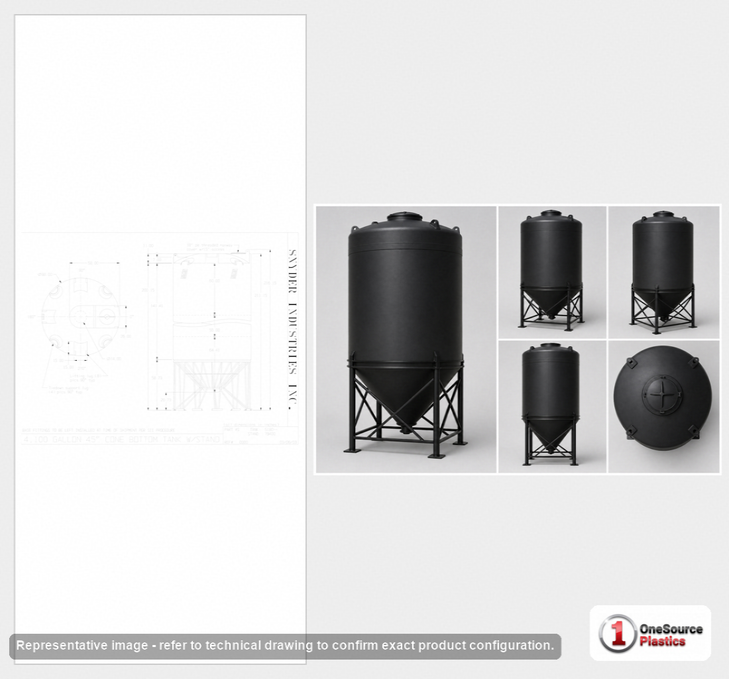
Technical drawing (PDF) for Snyder Industries 8050000N43.
See this tank
Interactive 3D model with live fill. This tank has an interactive 3D model built to its manufacturer dimensions. Rotate it, and set a fill level to see how much liquid it holds at any height. Open the 3D view on the product photo above. Download the 3D model (GLB).
Ready to order?
Add it to your cart at the top of this page, get LTL freight to your ZIP, request a written quote, or call 866-418-1777. The listed price is before freight.