4,900 gallons rated 1.9, sixteen feet ten inches tall, 2,000 pounds empty
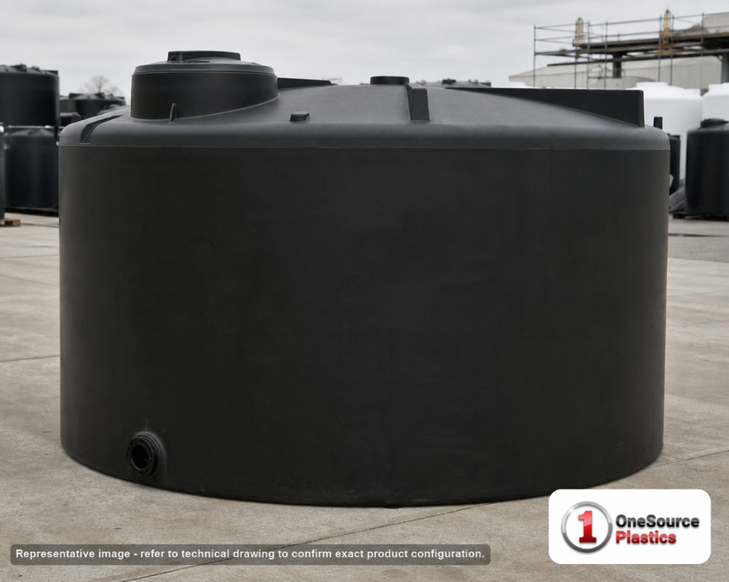
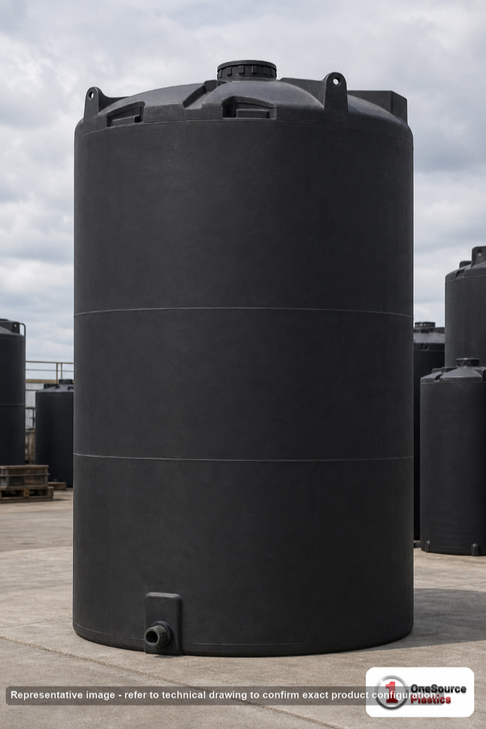
The Snyder 5480000N51 puts 4,900 gallons inside a 90 inch circle standing 202 inches tall and weighs 2,000 pounds empty, black polyethylene molded at Lincoln, Nebraska. Water at 8.34 pounds per gallon fills it to 40,866 pounds, and the sheet rates the wall for a specific gravity of 1.9, which it reads as 77,645 pounds of maximum contents. The sheet lists an 18 inch threaded, vented manway, eight lifting lugs, four tiedown lugs, ladder lugs and three flange lines, gives the outlet field as 14, sets the service limit at 120 F / 48 C, carries a 3 year warranty, and moves as freight at class 250.
Price it in one step. Freight to your ZIP shows in seconds; add the 4900 gallon tank to your cart above, or call 866-418-1777 if the site has a question in it.
The duty: heavy chemistry a tanker at a time, on a seven and a half foot circle
The buyer here has a dense liquid and no floor. A finishing line that needs acid or caustic within a hose run of the machine, a treatment plant adding a coagulant tank to a chemical yard that filled up years ago, a brine operation working off a pad the size of a parking space, a repacker breaking bulk into 4,900 gallon lots. The delivery is one tanker into one vessel, and the tank itself arrives lying on a flatbed and is stood up on site, so the clear height at the gate matters as much as the clear height over the pad: 202 inches of shell plus the lid, the fill line and the vent is what the building has to give back. What the duty then buys is anchorage rather than concrete area. A shell nearly seventeen feet tall on a 90 inch base has a high center of gravity, an empty tank that shape is a sail, and the day the yard gusts is never the day it is full, so the four tiedown lugs get anchors set in the slab rather than bolts into a thin topping, sized by whoever engineers the pad per the concrete pad sizing guide. Tension them on an empty tank, read them after the first windy week, read them again in the fall. The slab underneath carries 40,866 pounds of water on that small circle and this wall is rated for a liquid much heavier, so the pounds per square foot are the highest here of anything holding this volume. A molded floor bears on the whole circle rather than on a ring, so level and full contact are not a nicety. The black wall passes no light to the liquid, runs warmer in the sun than a pale one, and gives away nothing about the level, which is an argument for a sender read at grade. Put 4,900 gallons against your draw in the tank sizing calculator, and take the reserve and the thermal freeboard from the tank sizing guide.
The 202 inch shell in four walls, in two weights
| Part | Gallons | Diameter x height | Empty weight |
|---|---|---|---|
| 5480000N51 (this tank, black, 1.9 SG) | 4,900 | 90 x 202 in | 2,000 lb |
| 5480000N40 (same shell, lighter listing) | 4,900 | 90 x 202 in | 1,450 lb |
| 5480000N42 (same shell, heavier listing) | 4,900 | 90 x 202 in | 2,000 lb |
| 5480000N46 (same shell, lighter listing) | 4,900 | 90 x 202 in | 1,450 lb |
| 8210000N40 (wider, much lower) | 4,650 | 102 x 154 in | 1,200 lb |
| 1002100C34 (wider, larger) | 5,000 | 102 x 154 in | 950 lb |
One shell, four walls, and the sheet sorts the empty weights into two groups: this tank and the 5480000N42 at 2,000 pounds, the 5480000N40 and the 5480000N46 at 1,450 pounds. The reason to take this row is the rating on its own sheet, because 1.9 is what allows a liquid heavier than water into a tall vessel at all, and on that duty the lighter listings are not substitutes; each of them is rated as its own sheet says, and none of those ratings is printed here because none of them appears on this sheet. The real comparison is the pair of wider tanks at the bottom. The 8210000N40 holds 4,650 gallons on a 102 inch base at 154 inches, four feet shorter than this shell, and the 1002100C34 takes that same low footprint to 5,000 gallons at 950 pounds; both are the better answer any time the room has floor and not height, because a low tank needs less strapping, less ladder and less platform, and it is a far easier thing to set. This page is for the opposite site: sky above the pad, nothing beside it, and a liquid that weighs more than water.
Settled on the 4900 gallon tank? Freight to your ZIP and add to cart above; a written quote is one click away for the paperwork.
Sixteen feet ten inches over the suction
- Pump: the column over the base is the deepest of anything holding 4,900 gallons, so a transfer pump set below the outlet runs flooded far into the tank and the last inches move without coaxing. Keep the suction short and straight, fit a low-level float so the pump stops before it draws air, and site the strainer where it can be cleaned from the ground.
- Outlet: the sheet lists the outlet as 14. No diameter, material, thread or gasket appears with that figure, so it is not a pipe size and is not printed as one; the draw-off is specified at order against the liquid and the pipe.
- Access: 18 inch threaded, vented manway 202 inches up, off the ladder lugs the sheet lists. A ladder, a platform and a rail, and whoever opens the lid is tied off.
- Handling: eight lifting lugs for standing the tank up and four tiedown lugs for keeping it there, with three flange lines.
- Service limit: 120 F / 48 C. Warranty: 3 year.
The head that keeps a pump primed is the same head that loads the base connection, and on a dense duty that joint is the most loaded thing on the installation, so nothing rigid bolts straight to it: a flexible connector between bulkhead and hard pipe, the first valve standing on its own support off the pad, and a pipe run that never hangs on the tank wall. Upward the job is the fill and the vent. Run the fill down a dip tube to the floor so a heavy liquid does not free-fall the length of the shell, and size the vent for the delivery pump rather than for the lid, because a truck can push air in faster than a small vent will pass it out. On a tank this tall the practical test of a good installation is what a person can reach without climbing: the level sender reads at grade, the strainer and the drain sit at working height, and the only reason to go up the ladder is to open the manway. Keep it latched between deliveries, put the name of the one liquid on the wall, light the band of wall above the working level whenever the lid does come off, and in freezing country trace or wrap the valve and the first pipe run; the shell takes ice from the top down, a cracked valve body does not.
Yards that are out of room and not out of chemical
Density and a small footprint together are a narrow specification, and the sites that match it are adding storage rather than designing it: metal finishing, municipal treatment, brine and oilfield work, and bulk repacking at 4,900 gallons a load. A fire reserve is a separate discipline with its own sizing rules and belongs in a water-duty vessel, which the fire-water reservoir design guide lays out, not in a dense-duty chemical wall. Where a plant stores a treatment chemical between the stages of a reuse train, the industrial water reuse tank topology article shows where a tall vessel of this size belongs. Whatever the liquid is, name it at order: the bulkhead, the gasket and the bolting are chosen for it, and nothing is drilled at the plant.
Class 250 out of Lincoln, and the headroom at the gate
Molded at Lincoln, Nebraska, moving as freight at class 250 as the sheet lists it, which is the only class 250 listing in this group, and 202 inches long on the deck, which makes the route as much a part of the buy as the pad. The freight cost estimator prices the lane to your ZIP, and the listed price is before freight. Stand 2,000 pounds up off the eight lifting lugs, straps to the lugs or under the body and never a hook in the manway, land it on anchors that are already in the slab, and tighten the tie-downs the same day rather than the next week. Water before product: fill to the manway, hold it a shift, and read the base, the pad edge and the fitting you specified. Walk the delivery route yourself before the truck is dispatched, because a low wire at the gate is a problem nobody can solve on the day. Note the pad height and the outlet height on the site plan while the tape is out; the next pipe run will need both.
Freight and documents
Ships from: Lincoln, NE. LTL freight is quoted to your ZIP with the freight cost estimator or by phone at 866-418-1777. The listed price is before freight.
Technical drawing (PDF) for Snyder Industries 5480000N51.
See this tank
Interactive 3D model with live fill. This tank has an interactive 3D model built to its manufacturer dimensions. Rotate it, and set a fill level to see how much liquid it holds at any height. Open the 3D view on the product photo above. Download the 3D model (GLB).
Ready to order?
Add it to your cart at the top of this page, get LTL freight to your ZIP, request a written quote, or call 866-418-1777. The listed price is before freight.