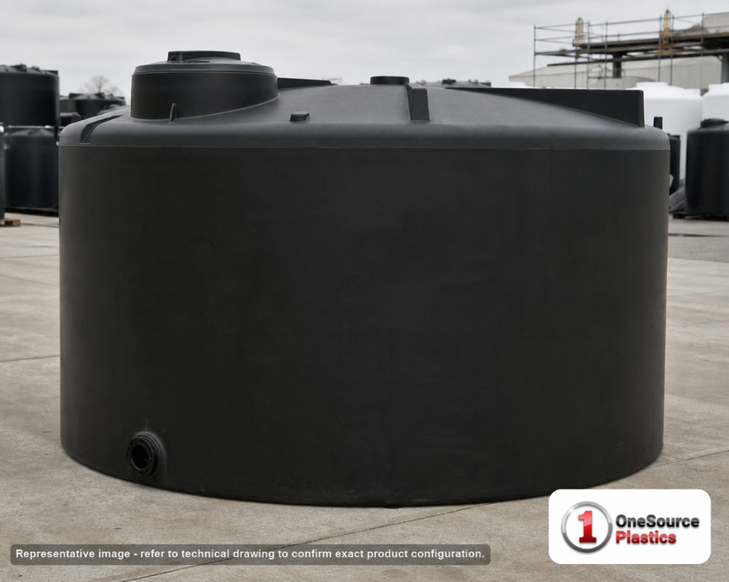
Fifty-five hundred gallons on a ten foot square pad
The Snyder 5660000N49 is a 5500 gallon double wall tank, named on its own sheet as an ASTM Black double wall tank; those name words are the maker's name for the product and nothing is claimed from them. The material field reads polyethylene and the colour field reads black. The shell is listed at 120 inches long by 120 inches wide by 172 inches tall and 3,200 pounds empty. The sheet publishes one capacity, one set of overall dimensions, one empty weight and one rating for the whole assembly: there is no separate inner tank figure, no separate outer containment figure, no annulus dimension and no containment percentage on it, so none appears on this page. The wall is rated at a specific gravity of 1.5, and the sheet gives 45,870 pounds for 5,500 gallons of water at 8.34 pounds per gallon with 68,805 pounds of maximum contents. The only opening published is an 18 inch threaded vented manway. The outlet field reads "1 Manway / Lid", which names an opening rather than a pipe size, and the inlet field is empty. The service limit is 120 F / 48 C and the warranty is listed as a 3 Year Warranty. Freight is LTL at class 250 with no NMFC number, moulded at Lincoln, Nebraska.
Want it on your site? Get LTL freight to your ZIP, add it to your cart above, or call 866-418-1777 and a tank specialist will confirm the fit.
The pad under a ten foot square, and why it decides the order
Start with the ground, because on this listing the ground is the hard part. The plan is 120 inches by 120 inches, a ten foot square, and the tank stands 172 inches tall on it. When it is full the sheet gives 45,870 pounds of water, and at the published rating 68,805 pounds of contents, all of it bearing on that square. That surface has to be flat, continuous and level across the whole 120 inch footprint: a poured slab, cured, with no rails, no timber packing at one corner and no soft edge where the concrete was finished last. A tall polyethylene vessel takes its shape from what it stands on, and every problem people blame on a tank at this size starts with a pad that was two inches out at one edge. Where it sits is also what the second wall is for. This is the tank you buy when the surface underneath is somewhere a release would be expensive: a treatment building floor that drains to the works, a plant room over an occupied space, a containment area in a yard that finds a watercourse. Instead of pouring a bund around a single wall tank, with its own drawings, its own drainage question and its own rainwater problem, the containment arrives as part of the vessel and stands on the same square. That trade is only worth making if you can still prove the first wall has not leaked, so the inspection habit starts in week one and gets written down. The number that separates this part number from its shellmates is the rating line. At a specific gravity of 1.5 this sheet carries 68,805 pounds of maximum contents against 45,870 pounds of plain water, which is a real working margin over water rather than provision for something much denser. The material field reads polyethylene and the service limit is 120 F / 48 C, so this is the listing for ambient and near-ambient duty at 5,500 gallons, not for a warm product. Black keeps daylight off the contents and takes away any chance of reading a level through the wall, which makes the level instrument a specification item rather than an afterthought. Size the volume honestly before you commit the pad: a contained tank does not give you its nameplate figure, and the Captor double wall freeboard sizing guide works through thermal expansion, chemistry and density. Then put your own consumption and drop quantity through the tank sizing calculator and take the freeboard discipline from the tank sizing guide.
One ten foot plan, three listed weights
| Part | Name on the sheet | Gallons | Size and empty weight |
|---|---|---|---|
| 5660000N49 | this tank, ASTM Black, rated 1.5 | 5500 | 120 x 120 x 172 in, 3,200 lb |
| 5660000N40 | ASTM XLPE, same shell, same listed weight | 5500 | 120 x 120 x 172 in, 3,200 lb |
| 5660000N46 | ASTM XLPE Black, same shell, same listed weight | 5500 | 120 x 120 x 172 in, 3,200 lb |
| 5660000N42 | ASTM XLPE, same shell, heavier listing | 5500 | 120 x 120 x 172 in, 3,800 lb |
| 5630000N40 | ASTM XLPE, narrower and taller | 5000 | 102 x 102 x 216 in, 3,600 lb |
| 5670000N30 | Sulfuric Acid, same plan, taller | 6500 | 120 x 120 x 199 in, 5,300 lb |
The first four rows are one moulding sold under several names, and the sheet separates them by listed weight alone: three at 3,200 pounds and 5660000N42 at 3,800. No sheet in this family says what any of the codes mean, so no interpretation is offered here; describe the product and its strength and we will name the part number against it. The interesting rows are the last two, because they are the two ways out of this footprint. 5630000N40 holds 5,000 gallons on a 102 inch square at 216 inches tall, which buys back eighteen inches of floor in each direction and costs you forty-four inches of height. 5670000N30 stays on the same 120 inch plan and adds height to 199 inches for 6,500 gallons at 5,300 pounds. So the real question is which constraint is binding at the position you have chosen: if it is clear height under a roof or a service run, this 172 inch shell is the short answer at bulk volume; if it is floor area in a bunded corner, the narrower 102 inch column is the row to study. Count truck drops second. Fewer, larger drops usually improve the bulk chemical cost per gallon, and over ten years that arithmetic outweighs the difference between any two rows here.
Picked the 5500 gallon tank? Add it to your cart above; freight is quoted to your ZIP before you pay anything.
The outlet field, the manway and what this sheet does not name
- The outlet field: it reads "1 Manway / Lid" and nothing else, and the inlet field is empty. That names an opening, not a pipe size, so no outlet dimension, thread, bulkhead, flange or valve is claimed on this page. Give us the duty, the line size and the pump and we will confirm what this part number carries before pipe is bought.
- What follows from that: with one published opening the discharge route is designed rather than assumed. The usual arrangement on a tank configured this way is a suction line dropped through the manway to a pump standing alongside, with the foot of the line set clear of the bottom so the settled inch is not the first thing it lifts.
- The manway: 18 inches, threaded and vented, and the only opening the sheet publishes. It is the fill route, the inspection route and the cleaning route at once, and it sits at 172 inches, so a fixed ladder, a platform and a fall protection arrangement belong in the installation drawing rather than in a later purchase order.
- The vent: the manway is listed as vented, and that path protects the wall every time a bulk drop pushes air out and every time a pump draws the level down. Keep it clear, inspect it whenever the manway is open, and never blank or restrict it to hold an odour back.
- Level: the wall is black, so nothing is visible through it. Set your working stop level, mark it, and protect it with a low level cut-out chosen with the pump rather than after it.
- Structure: the sheet lists ladder lugs and 1 flange line on this shell and publishes no lifting lug count.
- The space between the walls: no monitoring port, gauge or alarm is published, so how that space is watched and recorded is specified separately.
- Limits: 120 F / 48 C, a specific gravity rating of 1.5, and a 3 Year Warranty. That is the whole of what this sheet publishes about service.
Name the product and its strength at order time, because every wetted part is chosen against the chemistry, and a fitting picked from a catalogue default is the one route a release can take out of a tank that otherwise has two walls.
Bulk storage where the surface below is the whole argument
Fifty-five hundred contained gallons goes to sites that have stopped handling totes and started taking a bulk hose drop: municipal water and wastewater treatment, industrial process chemical holding, food, beverage and dairy plants, power and boiler house chemistry, pulp, paper and metals, mine site water treatment, and agricultural retail. In all of them the second wall is bought for the floor rather than for the liquid, and what it returns is evidence that nothing has left the first wall. That means a written inspection schedule with dates, not an intention. Two pieces of reading pay for themselves before the order. The hardest service a polyethylene wall sees is at the vapour line rather than under the liquid, which the wall thickness at the vapour saturated headspace guide explains, and it is why an inspection done from the liquid side misses what matters. Where the enquiry behind a tank this size is really private fire water storage rather than chemical feed, that duty is sized by different rules and the fire water reservoir design guide for rural and remote sites is where it starts; nothing on this page is a claim about that use. Agree the receiving procedure when you buy the tank rather than on the first drop: where the driver connects, who watches the fill, what the stop level is, and what happens if the vent is obstructed.
Thirty-two hundred pounds out of Lincoln, class 250
Lincoln, Nebraska is the only plant this sheet names and it publishes no ship-from state field at all, so the plant is what we print and nothing further is claimed about the lane. Freight is LTL at class 250 with no NMFC number, and the shipping load is given at 120 by 120 by 172 inches at 3,200 pounds. Price your own lane to your ZIP with the freight cost estimator; the listed price is before freight. The sheet publishes no crane specification, no rigging plan, no permit and no escort requirement, so none is stated here. What it does give you is an envelope a ten foot square in plan and better than fourteen feet tall, and that is what the route and the offloading equipment have to answer. Walk the route before the truck is booked: a ten foot square load finds gate frames, overhead services and door lintels that a pallet never touches, and confirm the equipment at your end has reach as well as rating. Take it under the base and never lift it by the manway. Set it on the finished, cured, level surface in its final position before a single pipe is connected, prove it plumb in two directions while it is empty, then fill it with clean water and hold that 45,870 pound load while you read the manway seal, the base all the way round and the pad beneath it. Drain it, let it dry, open the space between the walls, look in good light and write the date on the shell in paint marker with the part number beside it. On a black tank, stencil the contents and your stop level on the outside the same day, because nobody is ever going to see the liquid through this wall. Keep the delivery paperwork with the tank; the serial number on the shell is what a warranty claim starts from.
Freight and documents
Ships from: Lincoln, NE. LTL freight is quoted to your ZIP with the freight cost estimator or by phone at 866-418-1777. The listed price is before freight.
Technical drawing (PDF) for Snyder Industries 5660000N49.
See this tank
Interactive 3D model with live fill. This tank has an interactive 3D model built to its manufacturer dimensions. Rotate it, and set a fill level to see how much liquid it holds at any height. Open the 3D view on the product photo above. Download the 3D model (GLB).
Ready to order?
Add it to your cart at the top of this page, get LTL freight to your ZIP, request a written quote, or call 866-418-1777. The listed price is before freight.