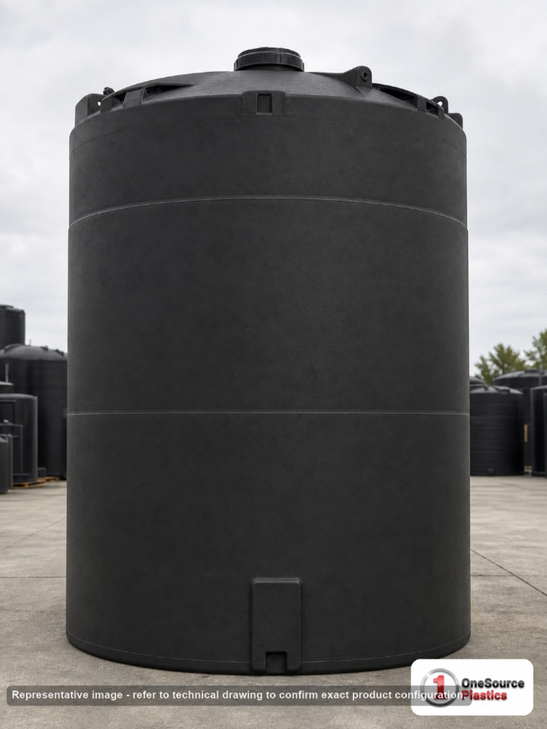
8,500 gallons of 1.9 wall, 3,100 pounds of it empty
The Snyder 7400000N48 is the heavy wall in a 120 by 194 inch shell, and its empty weight says so: 3,100 pounds where the three other moldings in the same shell are listed at 2,400. It holds 8,500 gallons on a ten foot circle, sixteen feet two inches tall, in black cross-linked polyethylene, rated for a specific gravity of 1.9 as the sheet gives it, which reads as 134,691 pounds of maximum contents against 70,890 pounds for plain water at 8.34 pounds per gallon. An 18 inch threaded, vented manway on top, a ladder lug and two flange lines, a 3 year warranty, a service limit of 140 F / 60 C, and class 300 freight out of Lincoln, Nebraska.
Need it before the next delivery? Call 866-418-1777 for the ship date, or get freight to your ZIP and add it to your cart above now.
One 194 inch shell, four walls, and the heavy one
The family here is unusually easy to read because the sheet does the work for you. Four tanks are listed at 8,500 gallons in a 120 inch circle at 194 inches tall: the 7400000N40, the 7400000N46 and the 7400000N49, all listed at 2,400 pounds empty, and this one at 3,100. Seven hundred pounds of extra polyethylene in an identical shell is not a styling difference; it is wall, and wall is what carries a dense liquid. This sheet rates the wall 1.9 and allows 134,691 pounds of contents where plain water in the same vessel is 70,890 pounds, and on a sixteen foot two inch column the density is the load case rather than a footnote, because the pressure at the bottom scales with it. That is the whole reason to buy this molding instead of one of the 2,400 pound walls, each of which is rated as its own sheet says and is the better buy for a lighter liquid. The rest follows from the load and the height. All of it bears on a 120 inch circle, because a rotationally molded floor carries on its whole floor and on nothing else, so the slab is engineered to the concrete pad sizing guide rather than poured by rule of thumb, level and in full contact, inside containment sized to the tank, which on a dense chemical is usually the local requirement and not a preference. Sixteen feet of empty black shell on a ten foot base catches wind, so bands to structure in the upper third and anchors in the slab go on before the first fill and get checked after the first storm and at the end of the first hot summer, because a black wall in the sun grows a little every day and what was tight in spring is loose in August. Black hides the level, so a sender and a local readout are the gauge. Take 8,500 gallons to the tank sizing calculator against the dose rate and the delivery interval, and take the reserve and the thermal freeboard from the tank sizing guide.
The 8,500 tower beside the 8,000 and the wide 8,750
| Part | Gallons | Diameter x height | Empty weight |
|---|---|---|---|
| 7400000N48 (this tank, black, cross-linked, rated 1.9) | 8,500 | 120 x 194 in | 3,100 lb |
| 7400000N46 (black, lighter wall) | 8,500 | 120 x 194 in | 2,400 lb |
| 7400000N40 (cross-linked, lighter wall) | 8,500 | 120 x 194 in | 2,400 lb |
| 7400000N49 (black, lighter wall) | 8,500 | 120 x 194 in | 2,400 lb |
| 5300600N40 (shorter tower, fewer gallons) | 8,000 | 120 x 186 in | 1,900 lb |
| 5360100N40 (wide and low instead) | 8,750 | 142 x 146 in | 2,000 lb |
Four rows of the table are the same vessel, and this one is the only heavy wall among them, which makes the choice within the shell a pure density decision. Outside the shell there are two useful alternatives. The 5300600N40 is the same ten foot circle at 186 inches, fifteen feet six inches, so it is the tank when the roof is a few inches short of taking this one and 8,000 gallons will do. The 5360100N40 goes the other way entirely: 8,750 gallons on a 142 inch circle at 146 inches tall, a wide pad and almost no height, for a site with floor and a low roof. Both are rated as their own sheets say. If the constraint is the building rather than the chemistry, start with those two rows and work back to the wall.
Need a different size? Every tank in the table is in stock programs; ask for a quote on the one that fits, or call 866-418-1777.
Vent sizing on a sixteen foot two inch column
- Vent: the listed opening is an 18 inch threaded, vented manway at 194 inches, and on a dense liquid the vent is both the busiest fitting and the easiest to neglect. Pipe it outdoors on anything that fumes, keep the run clear, size it to the tanker's pump rather than to the port nearest to hand, and confirm it is clear before a delivery rather than during one.
- Fill: a permanent fill line landed at the manway so nobody handles a hose sixteen feet up, with a dip tube carried to the floor so a heavy stream does not fall the height of the shell, foam, and coat the gasket seat as it goes.
- Headspace: the band of wall above the liquid line sees vapour rather than liquid and on a black tank cannot be judged from the ground, so a light goes on it at every opening and the date goes on the log.
- Outlet: the sheet lists the outlet as 24 and gives no pipe size anywhere on it. That bare field is printed as given, not read as a diameter. Name the liquid, its density and the draw-off you want at order and we confirm what this molding accepts, in what material, with what gasket, before anything is drilled.
- Access: a ladder lug and two flange lines, as the sheet lists them. A manway at 194 inches is platform work with a rail and a gate, and the ladder lug is where that hardware anchors.
- Service limit: 140 F / 60 C. Warranty: 3 year. Rating: specific gravity 1.9 as the sheet gives it.
A dense liquid at this height makes the base plumbing the discipline that matters. The static pressure at the bottom of a sixteen foot two inch column of heavy liquid is the largest force anywhere on this tank, so the first valve is carried on its own support off the pad, the connector between the shell and hard pipe is flexible, and nothing rigid is ever bolted to the wall. On the useful side of the same physics, a transfer pump set below the outlet runs flooded deep into the tank; a low-level float stops it before it draws air. Keep the manway threaded shut between deliveries, label the wall with the one liquid inside in letters readable from a truck cab, and keep a spare gasket for the base fitting on the shelf, because it is the part that fails on a holiday.
Dense chemistry where the floor is short and the roof is high
A ten foot circle holding 8,500 gallons is what you buy when the yard is full: a chemical bay at a plant with height to spare, a pad between two tanks already installed, a mine or metals site with a heavy process liquid, a fertilizer dealer holding a dense solution through the season, and a water or wastewater plant dosing something well above the density of water and wanting most of a tanker in one vessel. The specification question to settle before the order, because it is much harder to change than the piping, is whether a cross-linked wall is genuinely right for your chemistry or whether a high-density wall would do the same job for less: our guide to when cross-linking matters for chemistry duty answers it chemical by chemical rather than in generalities. Plain water at 8.34 pounds per gallon is far inside this rating, but a private fire reserve is a different specification in a water-rated vessel, which the fire-water reservoir design guide sets out in detail.
Freight on the heaviest 8,500 in the family
The sheet gives class 300 and 3,100 pounds shipping weight from Lincoln, Nebraska, and that 3,100 pounds is worth planning around, because it is the heaviest shell at this volume and the lifting gear has to suit it rather than the other way round. At 120 inches across and 194 inches long on the deck this is a permitted load, so the lane is quoted rather than estimated: price it to your ZIP in the freight cost estimator, and the listed price is before freight. A crane stands it up with straps under the body, never a sling through the manway, and the bands go to structure before the crane leaves the site. Fill it with water to the manway once and hold it, watching the pad edge and every fitting for movement or a weep, then drain and dry it before a dense liquid ever arrives. Keep the paperwork that came with it, because on a shell that is visually identical to three lighter-walled tanks, the part number on the sheet is the only thing that proves which wall you actually own. Keep the first delivery's paperwork with the tank; strength and date on day one is the baseline for every batch after.
Freight and documents
Ships from: Lincoln, NE. LTL freight is quoted to your ZIP with the freight cost estimator or by phone at 866-418-1777. The listed price is before freight.
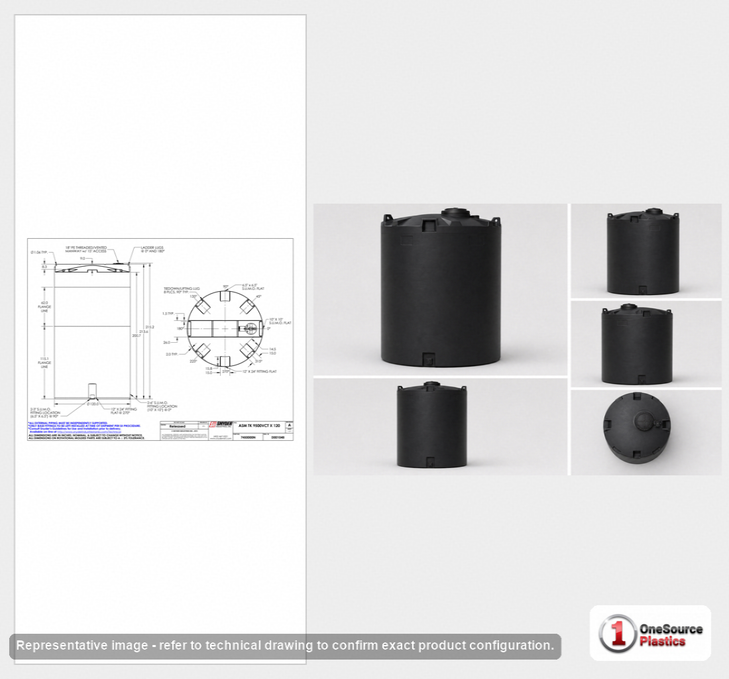
Technical drawing (PDF) for Snyder Industries 7400000N48.
See this tank
Interactive 3D model with live fill. This tank has an interactive 3D model built to its manufacturer dimensions. Rotate it, and set a fill level to see how much liquid it holds at any height. Open the 3D view on the product photo above. Download the 3D model (GLB).
Ready to order?
Add it to your cart at the top of this page, get LTL freight to your ZIP, request a written quote, or call 866-418-1777. The listed price is before freight.