Two hundred and twenty gallons in a tote, forty five inches square
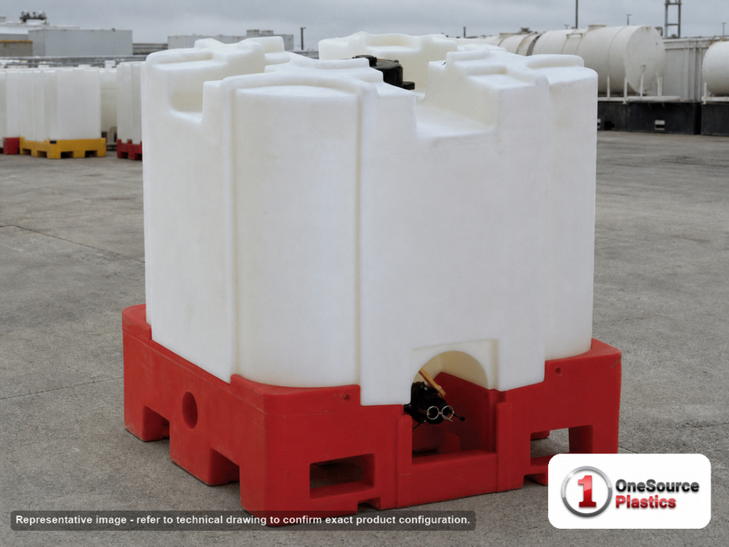
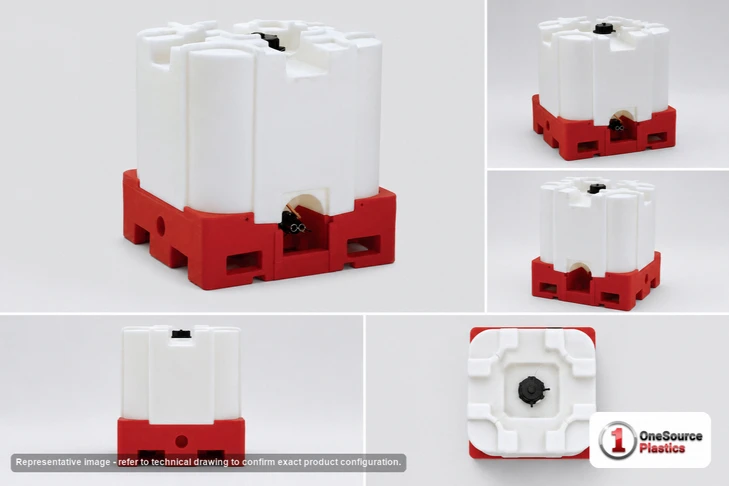
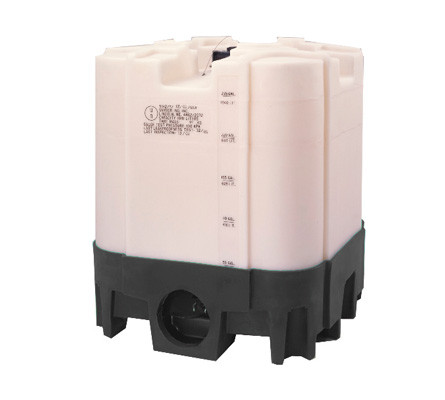
The Snyder SII-6630041B97202 is a 220 gallon stackable IBC tote tank in high density polyethylene, listed 45 inches long, 45 inches wide and 48.5 inches tall at 211 pounds empty. Its name says red while the colour field on the sheet reads white; both are printed as given and neither is explained. The sheet rates the wall at a specific gravity of 1.9 and gives 1,835 pounds for 220 gallons of water at 8.34 pounds per gallon with 3,486 pounds of max contents. It comes fitted: a 2 inch bung as the inlet, a 2 inch ball valve as the outlet, and an 18 inch threaded vented manway with the lid size field reading 18 inches. That is the whole published fitting list. What the sheet does not carry is as important on a tote as what it does: there is no cage, no pallet, no fork pocket, no stacking load, no transport rating, no maximum operating temperature, no warranty and no certification entry, and this page asserts none of them. Stackable is a word in the product's name and it is not a load claim. Freight is class 250 with an LTL ship mode, from one plant.
Engineer on the job? Request a written quote with the spec attached, or get freight to your ZIP and add to cart above; 866-418-1777 answers the technical questions.
Lincoln, class 250, and the lane a tote actually travels
A tote is bought to move, so start with movement. This sheet lists one plant, Lincoln in Nebraska, with Nebraska as the shipping state, and gives the freight as class 250 on an LTL ship mode against a 45 by 45 by 49 inch shipment at 211 pounds. Read those numbers together and the shape of the thing becomes obvious: this is a unit that travels as ordinary freight rather than as an oversize movement, on a standard trailer, inside a standard door opening, at a weight that a forklift or a pallet truck takes in one go. That is the entire argument for buying a tote instead of a tank. A fixed vessel arrives once and never moves again; a tote goes out to a job, comes back, gets rinsed, gets refilled and goes out again, and every one of those trips is only cheap because the unit fits the equipment everybody already has. Forty five inches square is a footprint that fits a truck bed, a trailer deck, a standard doorway and a rack bay, and 48.5 inches of height clears most roller shutters without a conversation. Where it sits between trips matters as much as where it goes. On a floor it wants flat, continuous, level support under the whole base, because a rotationally moulded floor bears on the surface it touches and nothing else, and a tote parked across a drain channel, a cable run or a broken slab edge is a tote bearing on two lines instead of an area. The sheet gives 1,835 pounds of water and 3,486 pounds at the rating, which is a real load on a small footprint and a genuine question on an old mezzanine, a raised platform or a lorry tail lift. Site it where it can be seen from the walkway, not behind a rack, because the whole operational value of a tote is that anybody passing can tell whether it is full, whether the valve is shut and whether there is anything on the floor underneath it. One more thing worth settling before the order rather than after: whether a tote is the right tier at all for your volume and turnover, or whether drums below it or a fixed tank above it would cost less across a year. That is arithmetic on annual volume, handling frequency and floor space rather than a preference, and it is worked through in the break-even analysis across drums, totes and bulk tanks and, more briefly, in the guide to choosing between a tote, a drum, a cube and a tank. Cross-check the volume against your real draw in the tank sizing calculator and take the working reserve from the tank sizing guide.
Five totes at three volumes in three different materials
| Part | Gallons | Plan x height | Empty weight |
|---|---|---|---|
| SII-6630041B97202 (this tote, high density polyethylene) | 220 | 45 x 45 x 48.5 in | 211 lb |
| SII-6630023B97202 (polyethylene, half an inch lower, heavier) | 220 | 45 x 45 x 48 in | 243.1 lb |
| SII-6630023B97203 (polyethylene, black, widest and lowest) | 220 | 45.75 x 45.75 x 46.25 in | 188 lb |
| SII-6820000B97202 (polyethylene, the tallest of the group) | 220 | 46 x 46 x 54 in | 295.9 lb |
| 6984100B51301 (listed as stainless steel) | 180 | 42 x 48 x 29.25 in | 351 lb |
| 6984000B32217 (listed as carbon steel) | 245 | 42 x 48 x 35.25 in | 389 lb |
Four of these six hold 220 gallons and they are not one product in four wrappers. This tote is the lightest of the polyethylene 220s at 211 pounds on a 45 inch square base standing 48.5 inches. SII-6630023B97202 shares the base within half an inch of height and is listed thirty-odd pounds heavier; SII-6630023B97203 is the black listing, marginally wider at 45.75 inches square, lower at 46.25 inches and the lightest of the group at 188 pounds; SII-6820000B97202 is the tallest at 54 inches on a 46 inch base and much the heaviest of the polyethylene four at 295.9 pounds. Where a unit is lifted, racked or stood under a shutter, those inches and those pounds are the whole decision, and the sheet gives them without explaining any of the differences, so neither do we. The last two rows are a different proposition entirely and should be read as such. 6984100B51301 is listed as 304 stainless steel at 180 gallons in a 42 by 48 inch plan only 29.25 inches tall and 351 pounds, and 6984000B32217 is listed as carbon steel at 245 gallons, same plan, 35.25 inches and 389 pounds. Those are metal vessels, not plastic ones, and nothing on this page about polyethylene applies to either. What is worth noticing is the shape: both are long, low rectangles rather than squares, which is a different footprint on a truck bed and a different reach into the top. Choose the material from the chemistry and the duty, and ask us rather than guessing, because the wrong material in a tote is a mistake that travels.
Height or floor the limit? The table has both shapes; freight to your ZIP is quoted on each row, or call 866-418-1777 with the site.
A two inch bung on top, a two inch ball valve at the bottom
- The fill: a 2 inch bung, as the sheet lists the inlet. That is the routine filling point, the one a hose or a drum pump lands on, and it is sized to be opened and closed by hand without tools. Keep it capped between fills; on a unit that travels, an open bung is how rain, dust and somebody else's product get in.
- The access: an 18 inch threaded vented manway, with the lid size field reading 18 inches. Eighteen inches is what makes a tote genuinely cleanable rather than just rinsable, which matters on a unit that changes product, and the vent path is what keeps the wall out of trouble while somebody draws from the valve. Keep it clear.
- The outlet: a 2 inch ball valve at the bottom, as the sheet lists it. That is a hand-operated shut-off and it is the part of the unit most likely to be knocked, so look at it every time the tote is moved and never lift or drag the unit by anything attached to it.
- Discipline on the valve: a tote that travels with product in it travels with a valve that somebody could open. Whatever your site uses to prevent that, a cap, a lock or a procedure, decide it before the first trip rather than after.
- Cage, pallet and lifting: this sheet lists no cage, no pallet, no fork pockets and no lifting points. Nothing of the kind is described here, and how the unit is handled and by what machine is confirmed rather than assumed from the shape.
- Stacking: stackable is a word in the product's name. No stacking load, no stack height, no transport rating and no maximum operating temperature is published, so this page states none of them. Ask for the figures in writing before anything is put on top of anything.
- Limits: the specific gravity rating is 1.9, with 1,835 pounds of water and 3,486 pounds of max contents. There is no warranty term on this sheet.
Name the product when you order. On a unit with a valve at the bottom and a bung at the top, the two seals your liquid touches are small, cheap and the only things standing between the tote and the floor.
The tier between a drum and a bulk tank
Totes exist because of a gap. A drum is small enough to handle and too small to be economic once the volume climbs; a bulk tank is economic and cannot move. Between them sits the unit that holds a useful quantity and still fits on a forklift, and that is where this one lives: chemical distribution and repackaging, water and wastewater plants holding a treatment product beside the pump that meters it, agricultural and horticultural operations moving a mix between blocks, food and beverage plants running a sanitiser or a concentrate, metal finishing and plating lines, car washes and vehicle fleets, and every contractor whose product has to arrive on a job rather than wait at a depot. Two things decide whether a tote is the right tier. The first is turnover: a unit that empties within the working life of the product is an asset, and one that sits half full for a season is a storage problem with a valve on it. The second is what happens if it leaks, which on a travelling unit is a question about where it will be standing rather than where it was designed to stand. Where the answer involves a floor, a drain or a yard that would have to be recovered, secondary containment is a separate decision from the tote itself, and the inspection and leak detection expectations that come with holding certain products are set out in the secondary containment and leak detection guide. Check the product against the shell in our chemical compatibility database before you commit to a material.
Resin compatibility, line by line
Below are the liquids this resin is rated for, the concentration each rating holds to, and the fitting and gasket to specify. Check the exact concentration and temperature you run against the chemical page or the chemical compatibility database before ordering.
- DEF (32.5%) and
- Urea Solution (50%) both of which run on 316SS fittings with EPDM gaskets per the OEM chart.Based on that same chemical-resistance data, this tank also handle
- Acetic Acid (60%) with PP/PVC fittings and EPDM gaskets
- Aluminum Sulfate (50%)
- Calcium Chloride (40%)
- Ethylene Glycol (100%)
- Ferric Chloride (50%)
- Ferric Sulfate (60%)
- Ferrous Sulfate (20%)
- Hydrochloric Acid (37%) with Viton gaskets
- Hydrofluoric Acid (48%)
- Hydrofluosilicic Acid (26%)
- Hydrogen Peroxide (50%) on Viton
- Magnesium Chloride (30%)
- Peracetic Acid (30%) on 316SS with Aflas
- Phosphoric Acid (85%)
- Polyaluminum Chloride
- Potassium Carbonate (50%)
- Potassium Hydroxide (Saturated)
- Propylene Glycol
- Sodium Bisulfate
- Sodium Bisulfite
- Sodium Carbonate (30%)
- Sodium Hypochlorite (under 16.5%) on Viton
- Sodium Thiosulfate (40%)
- Sulfuric Acid (98%) with CPVC fittings and Viton
- Zinc Orthophosphate and Ozonated Water (up to 10 PPM).Concentrations and gasket choices matter: hypochlorite, peroxide, the strong acids, and ozonated water w
Two hundred and eleven pounds, and a shipment half an inch taller than the tote
This tote is moulded at Lincoln, Nebraska, and Nebraska is the only shipping state on the sheet, so the lane runs from the plains outward and the middle of the country gets the short version of it. Freight is class 250 with an LTL ship mode, and the shipping size is listed at 45 inches long by 45 inches wide by 49 inches high at 211 pounds, against a tote listed 48.5 inches tall; both figures are on the sheet and both are printed as given. Price the lane to your ZIP with the freight cost estimator; the listed price is before freight. At 211 pounds in a shipment that fits a standard door it comes off the truck on a forklift or a pallet truck, with nothing oversize to permit and no crane to book, which is the practical advantage of this tier over anything fixed. Take the packaging off where the unit is going to stand, look into the manway in good light before the first fill, and operate the valve through its full travel while it is still empty and still easy to change. Then put the unit through a water fill before any product goes near it, hold the 1,835 pound load on the floor it will actually live on, and look underneath it. The last habit is the one that pays on a unit that travels: write the product and the date on the shell every time it is filled, because a tote whose contents nobody can name from three feet away is a tote that eventually gets topped up with the wrong thing. The vent screen is the cheapest part on the tank and the one that saves it; look at it every time the manway opens.
Freight and documents
Ships from: Lincoln, NE. LTL freight is quoted to your ZIP with the freight cost estimator or by phone at 866-418-1777. The listed price is before freight.
Technical drawing (PDF) for Snyder Industries SII-6630041B97202.
See this tank
Product video. Watch the 220 Gallon HDPE Stackable IBC Tote Tank in Red video (63 seconds) with dimensions, fittings and shipping notes.
Ready to order?
Add it to your cart at the top of this page, get LTL freight to your ZIP, request a written quote, or call 866-418-1777. The listed price is before freight.