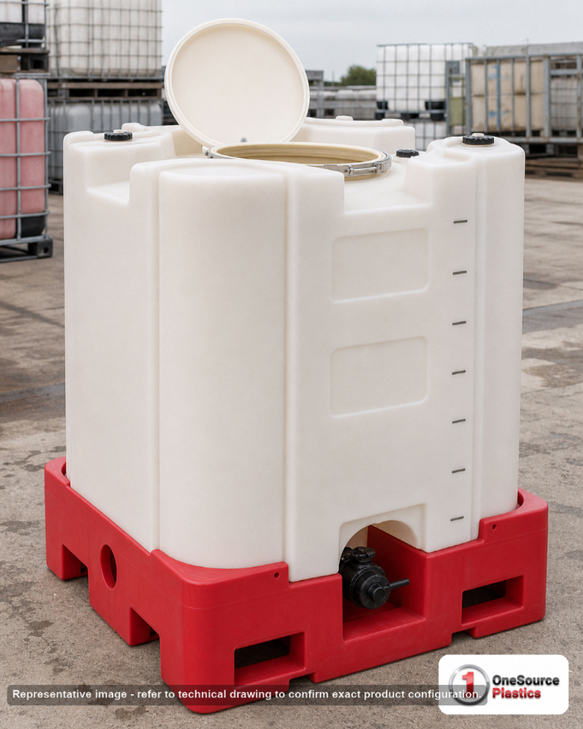
Three hundred and thirty gallons on a forty-eight by forty-six inch footprint
The Snyder 6998200B97203 is a 330 gallon Payloader IBC tote tank listed 48 inches long, 46 inches wide and 60 inches tall, with the colour field reading Natural White and the material field reading Polyethylene. Payloader is Snyder's own name for the listing and we print it as a name, not as a specification. The sheet gives 25 pounds as the empty weight and 297 pounds as the ship weight shipped, and it gives both figures without explaining the difference, so neither do we. Liquid side: 2,752 pounds of water at 330 gallons and 8.34 pounds per gallon, against 5,229 pounds of max contents. The specific gravity field reads 1.5 and the specific gravity rating field reads 1.9; the sheet carries both and this page prints both rather than choosing one. Fittings as published are a 2 inch ball valve outlet, a 2 inch bung inlet and a 6 inch threaded lid, with a separate lid size field reading 8 inches. Freight class reads 250. No max operating temperature, no warranty term, no cage, no pallet, no stacking load and no fork pocket dimension is published on this sheet, and none is claimed below.
Know your ZIP and your ceiling height? Freight to your ZIP takes seconds, and 866-418-1777 will confirm the height; then add it to your cart above.
Where it stands: the floor under it and the fill point above it
Start with the floor, because on a tote the floor is the whole argument. This one occupies 48 inches by 46 inches, which is the size of the square somebody has to keep clear next to a pump, a mixer or a dock door, and it stands 60 inches tall to the top of the lid. Five feet of height is the number to walk out to the building and check before anything is ordered. It decides whether the tote passes under a sprinkler drop, under a duct run, under a mezzanine edge and under the shutter on the way in, and it decides whether the fill hose reaches the lid without a step. A tote that will not go through the door it has to go through is not a bargain at any price. Two more measurements belong on the same walk. The first is the aisle: 48 inches of length only helps if the route from the receiving bay to the point of use is wider than the tote and clear of racking legs, and the turn at the end of that route is what usually stops the job rather than the straight run. The second is the height of whatever you will dispense into, because the outlet on this tote is fixed near the base and gravity is the cheapest pump you will ever own. If the drum, the mix tank or the day tank sits on the floor, you have very little fall to work with and you will end up pumping anyway; if it sits at bench height, you will want the tote on something, and a tote sitting on something is a load the floor and that something both have to take. The sheet publishes no pallet, no cage, no stand and no stacking load, so this page states none of them; what it does publish is the loading, and the loading is what any support has to answer. Full of water that is 2,752 pounds, and at the rating printed on this sheet the contents allowance reaches 5,229 pounds, all of it inside a footprint smaller than a desk. Sealed floors, coated floors and elevated floors all have a limit, and it is worth knowing it before the first fill rather than after. Size the volume properly with the tank sizing calculator and take the freeboard discipline from the tank sizing guide; on a container this small an extra inch at the top is the difference between a clean fill and a wet floor.
One capacity, five footprints, two of them steel
| Part | Gallons | Length x width x height | Weight |
|---|---|---|---|
| 6998200B97203 (this tote, Payloader, natural white) | 330 | 48 x 46 x 60 in | 25 lb empty, 297 lb shipped |
| 6840000B97202 (Ultratainer, taller and narrower) | 330 | 46 x 46 x 70 in | 335 lb |
| 6510101B96002 (Excalibur stackable, the shortest of the five) | 330 | 47 x 47 x 52.125 in | 194 lb |
| 6610056B97204 (stackable, in red) | 330 | 45 x 45 x 63.5 in | 267 lb |
| 6984000B51303 (Supertainer, 304 stainless steel) | 300 | 42 x 48 x 41.25 in | 424 lb |
| 6984300B32224 (Supertainer, carbon steel) | 350 | 42 x 48 x 47.25 in | 469 lb |
Four rows say 330 gallons and no two of them are the same box. This one is the widest and the second tallest at 48 by 46 by 60 inches. The Ultratainer row is 46 inches square and 70 inches tall, so it trades floor for height and is the one to check against a low doorway. The Excalibur row is 47 inches square at 52.125 inches, the shortest of the group by a clear margin, which is what you look at when the ceiling, the shelf or the truck deck is the constraint. The red stackable row is 45 inches square at 63.5 inches. Same liquid, four different squares on your floor, so measure the space first and let the footprint pick the part number rather than the other way round. The last two rows are not polyethylene at all and should never be compared on wall or rating: 6984000B51303 is a 304 stainless steel Supertainer at 300 gallons and 6984300B32224 is a carbon steel Supertainer at 350 gallons, both listed 42 by 48 inches on the floor and both several hundred pounds heavier empty than anything moulded. Steel is a different purchase with different cleaning, different repair and different scrap value at the end, and the sheet gives no rating for either, so this page gives none. Where the question is really whether a tote is the right package at all rather than which tote, two long reads cover it: when to buy a tote, an IBC, a drum, a cube or a tank works through the decision by container type, and the drum against tote against bulk tank break-even analysis does the same arithmetic on annual volume and turnover frequency.
Need two of them? Request a written quote for the pair with freight to your ZIP, or call 866-418-1777 and we will price the truck once.
The two inch ball valve first, then the bung and the lid
- The outlet: a 2 inch ball valve, which is the fitting that decides how this tote is actually used day to day. Two inches will run a gravity draw into a drum or a mix pot at a sensible rate and will feed a transfer pump without starving it. Support the valve body and the first hose coupling on something other than the valve itself, because every time somebody swings a stiff hose off it the load goes straight into the wall around the fitting.
- Dispensing discipline: the valve is the one part of this container an operator touches every shift. Keep it closed and capped when the tote is moved, label what is in the container at the valve as well as at the lid, and check the seat for weeping before each move rather than after a spill.
- The inlet: a 2 inch bung. Same size as the outlet, which keeps couplings and adaptors common across the container and cuts the number of parts your stores has to carry.
- The lid and the lid size field: the sheet gives a 6 inch threaded lid in the lid and manway field and a separate lid size field reading 8 inches. Confirm the opening with us against the part number before you buy a gasket or a closed-loop fill adaptor for it.
- Venting: the sheet does not call the lid vented and publishes no vent fitting, so no vent hardware is assigned to this container. A sealed container being drawn down through a 2 inch valve needs an air path, and that is a question to settle at the order rather than at the first empty.
- Limits: the published figures are 2,752 pounds of water at 330 gallons, 5,229 pounds of max contents, a specific gravity field of 1.5 and a specific gravity rating field of 1.9. No max operating temperature and no warranty term is published, and neither is asserted here.
Nothing on this sheet describes a cage, a pallet, a stacking arrangement or a fork pocket, so this page describes none. Ask us before anything is stacked, strapped or lifted with a fork, and we will confirm what the part number carries.
Bulk liquid moved a tote at a time
Three hundred and thirty gallons is the unit that plants buy when drums have become a nuisance and a bulk tank is too big a commitment. It is one delivery instead of six drums, one connection instead of six, and one label to manage instead of six. Typical duty: process chemistry bought by the tote and drawn down over weeks, cleaning and sanitation concentrate at a food or beverage plant, coolant, cutting fluid and quench oil at a machine shop, water treatment chemistry at a small works, agricultural inputs staged at a yard between applications, and recovered or waste liquid collected at the point it is produced and moved once rather than decanted twice. The shape suits all of that because it sits square on a floor, it dispenses at the base through the 2 inch valve without a pump and it moves in one piece when the job moves. The honest limitations belong on the same page as the uses. This sheet publishes no temperature limit, so hot fills are a conversation rather than an assumption. It publishes no stacking load, so treat the container as a single tier until we confirm otherwise. And 5,229 pounds of allowed contents on a 48 by 46 inch footprint is a concentrated load, which matters on a mezzanine or a raised deck far more than it does on a slab. Where the liquid is regulated the container is only half the question: our read on secondary containment for hazardous waste tank systems covers leak detection options and inspection cadence, and if you are storing in Florida, the Florida DEP aboveground storage tank guide walks registration, containment and closure and the county-level maze underneath them. Name the liquid when you enquire and start the check yourself in our chemical compatibility reference, because the gasket and the valve trim follow the chemistry rather than the container.
Rated chemistries for this tank
The manufacturer lists these liquids for this resin at the concentrations noted, with the fitting and gasket material to specify. Check the concentration and temperature you actually run on the linked page or in the chemical compatibility database before ordering.
- Acetic acid
- Aluminum sulfate
- Calcium chloride
- DEF
- Ethylene glycol
- Ferric chloride
- Ferric sulfate
- Ferrous sulfate
- Hydrochloric acid
- Hydrofluoric acid
- Hydrofluosilicic acid
- Hydrogen peroxide
- Magnesium chloride
- Peracetic acid
- Phosphoric acid
- Polyaluminum chloride
- Potassium carbonate
- Potassium hydroxide
- Propylene glycol
- Sodium bisulfate
- Sodium bisulfite
- Sodium carbonate
- Sodium hypochlorite
- Sodium thiosulfate
- Sulfuric acid
- Urea solution
- Zinc orthophosphate
Twenty-five pounds empty, two hundred and ninety-seven shipped, class 250
This one is moulded at Lincoln, Nebraska, and the sheet gives Nebraska as the state it ships from, which puts the plains and the Midwest on the short lane and both coasts on the long one. The freight class reads 250 and the sheet publishes no NMFC number, so none is quoted here. The shipping size is listed at 48 inches by 46 inches by 60 inches at 297 pounds, and the empty weight field reads 25 pounds; both figures are on the sheet and the sheet does not reconcile them. Price the lane to your own ZIP with the freight cost estimator before you commit; the listed price is before freight. A container this size moves on a standard trailer rather than as an oversize load, which makes it one of the easier things on this site to get to a tight site, but it still needs somebody and something at your end to take it off the truck. Agree the offload arrangement with us before the collection is booked rather than on the day. When it lands, do the boring things in order. Check the container over for transit damage before the driver leaves, with particular attention to the valve and the lid, because those are what get caught on a strap. Set it where it will live rather than where there is room today, since the point of a fixed footprint is that everything around it gets built to suit. Fill with clean water first if the duty allows it, hold the water load, and watch the valve seat, the bung and the lid seal in that order with the container full. Write the product, the date and the fill level on a label at the valve and at the lid, and keep the paperwork that came with the container with it rather than in an office drawer, because the next person to open it will want both. Photograph the outlet fitting from below before the pipe goes on; a slow weep is easier to compare against than to describe.
Freight and documents
Ships from: Lincoln, NE. LTL freight is quoted to your ZIP with the freight cost estimator or by phone at 866-418-1777. The listed price is before freight.
See this tank
Product video. Watch the 330 Gallon Payloader IBC Tote Tank video (69 seconds) with dimensions, fittings and shipping notes.
Ready to order?
Add it to your cart at the top of this page, get LTL freight to your ZIP, request a written quote, or call 866-418-1777. The listed price is before freight.