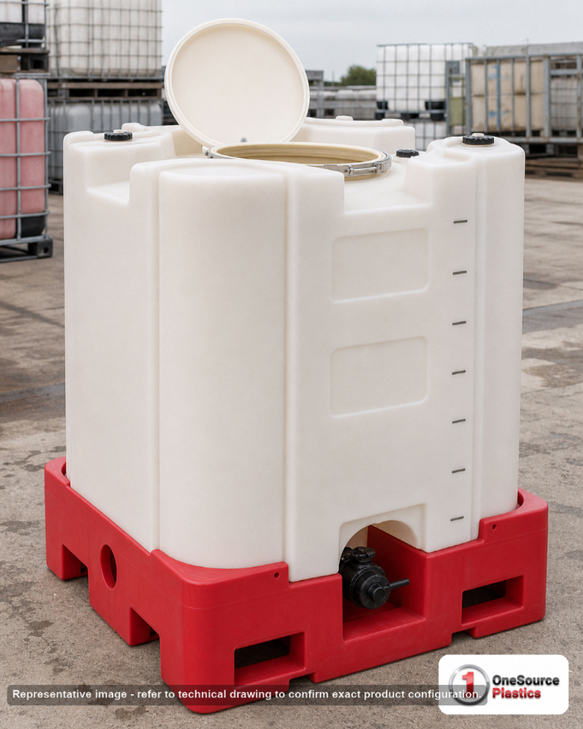
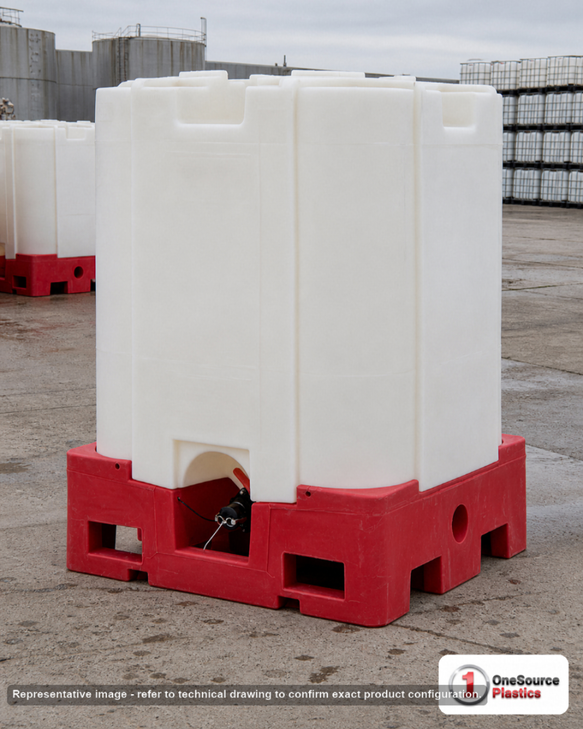
A blue 330 at 70 inches tall and 376 pounds empty
The Snyder SII-6840003B97202 is a 330 gallon stackable IBC tote tank, and the sheet lists its colour as blue, which makes it the only tank of that colour in this group. It is polyethylene, 46 inches long, 46 inches wide and 70 inches tall, at 376 pounds empty against a 377 pound ship weight, which is the heaviest polyethylene tote listed beside it by a clear margin. The outlet is a 2 inch ball valve, the inlet is a 2 inch bung, and the top opening is a 20 inch threaded vented manway with a 20 inch lid size. The wall carries a specific gravity rating of 1.9, and the sheet gives 2,752 pounds for 330 gallons of water at 8.34 pounds per gallon with 5,229 pounds of max contents. The service limit is 120 F / 48 C. No stacking load, cage, pallet, fork pocket or warranty term appears on this sheet, and none is claimed here.
Want it on the pad this month? Check freight to your ZIP, add it to your cart above, and 866-418-1777 will confirm the ship date.
The heavy blue 330 and the duty that justifies the weight
Nobody buys the heaviest container in a family by accident. The duty that lands here is one where the tote stays in service a long time, gets handled by more than one person, and sits somewhere that does not forgive a light container: an outdoor or yard position at a treatment works or a municipal depot, a wash bay or process floor where things get knocked, a warehouse aisle with traffic, a site where the same tank is filled, drawn down and refilled for years rather than swapped out on a contract. At 376 pounds empty this tote is a hundred and eight pounds heavier than the lightest polyethylene 330 on its own sheet, and it is the tallest of them at 70 inches. What the sheet does not do is explain what the extra weight buys, so neither will we; what we will say is that if your site keeps breaking containers, the heaviest listing in the family is the honest place to start, and that the blue colour is a genuinely useful thing when a yard runs several products and wants to tell tanks apart from across the aisle. No light, temperature or service property is claimed from the colour, because the sheet publishes none. Set it on a flat, continuous, level bearing surface carrying the whole 46 inch square: a slab, a solid deck, or rack beams rated for it. Not two pallets, not blocking under one corner. The loaded case is real: 2,752 pounds of water and 5,229 pounds at the rating, standing on about fourteen and a half square feet, which is a number a rack beam has to answer to before anything goes up. Stackable is in the name and no stacking load is published on this sheet at all, so nothing here permits a tote on top of a tote. There is no cage, no integral pallet and no fork pocket published either, so take it from underneath on something that spreads the base. Test the volume against your real draw in the tank sizing calculator, take the freeboard from the tank sizing guide, and if you are stepping up from drums, the container versus tank guide lays the tiers out before you commit a floor position.
Seventy inches tall in a family that mostly is not
| Part | Volume | Length x width x height | Empty weight |
|---|---|---|---|
| SII-6840003B97202 (this tote, blue, heaviest here) | 330 gal | 46 x 46 x 70 in | 376 lb |
| 6840000B97202 (Ultratainer, same plan and height) | 330 gal | 46 x 46 x 70 in | 335 lb |
| SII-6610056B97204 (in red, lower) | 330 gal | 45 x 45 x 63.5 in | 267 lb |
| SII-6510101B96002 (Excalibur, lowest and lightest) | 330 gal | 47 x 47 x 52.125 in | 194 lb |
| 6984000B51303 (304 stainless steel supertainer) | 300 gal | 42 x 48 x 41.25 in | 424 lb |
| 6984300B32224 (carbon steel supertainer) | 350 gal | 42 x 48 x 47.25 in | 469 lb |
The second row is the one to read against this tank, because on dimensions they are identical. The Ultratainer 6840000B97202 is also 46 by 46 inches and also 70 inches tall, and it is listed at 335 pounds against this tote's 376. Same plan, same height, forty-one pounds apart; the sheet gives both weights and explains nothing, so we print what it says and leave the interpretation alone. If your site already runs one of the two, order the matching part number so the rack layout and the handling stay identical. Below them the family drops steadily: the red SII-6610056B97204 at 63.5 inches and 267 pounds on a 45 inch square, and the Excalibur SII-6510101B96002 at 52.125 inches and 194 pounds spread to 47 inches square. That is nearly eighteen inches of height between the tallest and the lowest listing at the same 330 gallons, which is far more than most people expect inside a single volume band, and it is the whole reason to measure the opening a tote has to pass through before ordering by gallons. The steel rows sit either side of the band: a 300 gallon 304 stainless supertainer at 41.25 inches and 424 pounds, and a 350 gallon carbon steel supertainer at 47.25 inches and 469 pounds, both on a 42 by 48 inch plan. Both are steel vessels, both are low and heavy, and this page asserts no polyethylene, resin or specific gravity property for either of them.
Which wall for your chemical? Call 866-418-1777 with the name and the concentration, or send a quote request and we will pick the row.
A 20 inch manway over a 2 inch ball valve
- The discharge: a 2 inch ball valve at the base of a 70 inch body, which is the most head of any tote in this batch. That helps a gravity fill at the start of a draw-down and it does not change the fact that the last few inches still need a pump or a stand to move at a useful rate.
- The pump underneath: on a tall tote the level falls a long way, so a pump mounted below the valve and fed by a short, straight, falling suction is what keeps the rate steady from full to empty. Support the hose off the frame rather than off the valve body, and fit a strainer you can clean without moving the tank.
- Isolation: a full-flow shutoff hard against the valve, a flexible connector after it, and every meter, filter or reel on its own bracket. The tote is a container, not a pipe support.
- The inlet: a 2 inch bung, which is the closed fill point. Filling through it keeps the manway seated and keeps the operator off the top of a 70 inch tank, which is the real safety argument on the tallest tote in a family.
- Access: a 20 inch threaded vented manway with a 20 inch lid size. Twenty inches is a light, a head, an arm and a brush, and it is enough to fit a mixer shaft, a level probe or a dip tube without cutting anything. At 70 inches it is above most people's shoulders, so plan a platform or a step for any routine that involves opening it.
- Limits: 120 F / 48 C is the service limit and the specific gravity rating is 1.9. This sheet publishes no warranty term and nothing further is claimed.
Name the product when you order so the valve seat, the bung and the manway gasket are matched to the chemistry rather than assumed. Where the tank holds something regulated, the arrangement underneath is a separate decision: the RCRA secondary containment guide sets out the containment, the leak detection options and the inspection cadence, and the Captor containment comparison weighs a contained polyethylene vessel against the steel alternative.
Long dwell, hard handling and telling one tank from another
Two things put this tote on a site. The first is dwell: product that sits for weeks between deliveries, in a position that is permanent, where the container is expected to last far longer than the batch inside it. The second is traffic, in the plain sense of things and people moving near the tank. Municipal depots, treatment works, wash bays, yards, busy warehouse aisles and any place where a pallet truck goes past a tote twice an hour are all places where the heaviest listing in a family earns its price over years rather than months. The colour is a working feature in those places too: where a site runs three or four different products in identical white containers, one blue tank is the one nobody fills from the wrong hose. Whether 330 gallons is the right tier at all still turns on turnover and hazard class rather than on the container, and the drum versus tote versus bulk tank break-even analysis is where that gets settled with numbers.
What this tank is listed to hold
Each line is a liquid the resin is rated for, at the concentration shown, with the fitting and gasket to order. Follow the link for the full rating, or search the chemical compatibility database before ordering.
- Acetic Acid (60%) - PP/PVC fittings, EPDM gaskets
- Aluminum Sulfate (50%) - PVC fittings, EPDM gaskets
- Calcium Chloride (40%) - PVC fittings, EPDM gaskets
- DEF (32.5%) - 316SS fittings, EPDM gaskets
- Ethylene Glycol (100%) - PVC fittings, EPDM gaskets
- Ferric Chloride (50%) - PVC fittings, EPDM gaskets
- Ferric Sulfate (60%) - PVC fittings, EPDM gaskets
- Ferrous Sulfate (20%) - PVC fittings, EPDM gaskets
- Hydrochloric Acid (37%) - PVC fittings, Viton gaskets
- Hydrofluoric Acid (48%) - PP/PVC fittings, Viton gaskets
- Hydrofluosilicic Acid (26%) - PP/PVC fittings, Viton gaskets
- Hydrogen Peroxide (50%) - PVC fittings, Viton gaskets
- Magnesium Chloride (30%) - PVC fittings, EPDM gaskets
- Peracetic Acid (30%) - 316SS fittings, Aflas gaskets
- Phosphoric Acid (85%) - PVC fittings, Viton gaskets
- Polyaluminum Chloride - PVC fittings, EPDM gaskets
- Potassium Carbonate (50%) - PVC fittings, EPDM gaskets
- Potassium Hydroxide (saturated) - PVC fittings, EPDM gaskets
- Propylene Glycol - PP/316SS fittings, EPDM gaskets
- Sodium Bisulfate - PVC/PP fittings, EPDM gaskets
- Sodium Bisulfite - PVC/PP fittings, EPDM gaskets
- Sodium Carbonate (30%) - PVC fittings, EPDM gaskets
- Sodium Hypochlorite (under 16.5%) - PVC fittings, Viton gaskets
- Sodium Thiosulfate (40%) - PVC fittings, EPDM gaskets
- Sulfuric Acid (98%) - CPVC fittings, Viton gaskets
- Urea Solution (50%) - PP/PVC fittings, EPDM gaskets
- Zinc Orthophosphate - PP/316SS fittings, EPDM gaskets
Three hundred and seventy-seven pounds on the bill of lading
This tote is moulded at Lincoln, Nebraska, with Nebraska given as the state it ships from. The freight class is LTL under NMFC 156600-03, and it shipments at 46 inches long by 46 inches wide by 70 inches high at a ship weight of 377 pounds against the 376 pound empty weight. Price the lane to your ZIP with the freight cost estimator; the listed price is before freight. At 377 pounds this is forks or a pallet jack at both ends with no two-person option at all, so have the machine and the operator on the dock for the appointment rather than an hour later. Take it from under the base, never by the manway ring or the valve, and watch the height on the way in, because 70 inches on a pallet is taller than people expect a tote to be. Set it in its final position, fill with clean water on the level and hold the 2,752 pound load while you read the valve, the bung and the manway seal. Drain it through the valve so you learn the rate on water first. Then paint the product name and the in-service date on the blue shell where it can be read from the aisle, and the colour coding you bought this tank for starts working on day one. Walk the base after the first hard rain; a pad that shifts shows it at the edge first.
Freight and documents
Ships from: Lincoln, NE. LTL freight is quoted to your ZIP with the freight cost estimator or by phone at 866-418-1777. The listed price is before freight.
Technical drawing (PDF) for Snyder Industries 6840003B97202.
See this tank
Product video. Watch the Snyder Industries 330 Gallon HDPE Stackable IBC Tote Tank video (67 seconds) with dimensions, fittings and shipping notes.
Ready to order?
Add it to your cart at the top of this page, get LTL freight to your ZIP, request a written quote, or call 866-418-1777. The listed price is before freight.