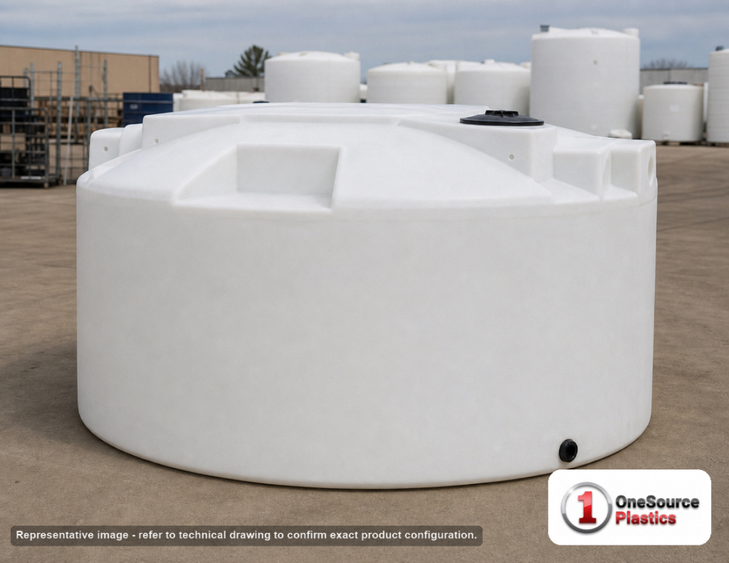
3900 gallons of cross-linked polyethylene, 90 inches across and 163 inches tall
The Snyder SII-5190000N42 is a 3900 gallon vertical in a white cross-linked polyethylene wall, 90 inches across and 163 inches tall, 1200 pounds empty, molded at Lincoln, Nebraska. The sheet rates the wall at a specific gravity of 1.9, and turns that into 61,799 pounds of contents against the 32,526 pounds the same tank weighs full of water at 8.34 pounds per gallon. Access is an 18 inch threaded vented manway on top. Freight is class 400. The sheet lists no outlet and no inlet, no temperature limit and no warranty term for this part number, and the name it carries references a standard the certifications field leaves blank, so this page asserts no fitting size, no service limit and no certification of any kind; ask us and we will get Snyder's current written terms and the fitting drawing for the part number you are quoting.
One tank or a train of them? A single 3900 gallon tank goes straight to the cart above; for several, request a written quote with freight to your ZIP.
Thirteen feet seven inches of tank: the pad, the banding and the wind come first
Start with the site, because at 163 inches this tank decides where it can go before anyone discusses what goes in it. Thirteen feet seven inches clears a low eave and clears a lot of shed roofs by nothing at all, so measure the roof line, the door header, the lowest pipe rack and any overhead conductor on the route in, and measure them before the order rather than on delivery day. Add working room above the 18 inch manway for a lid to swing and a person to stand. Then look down. The base is a 90 inch circle, seven feet six inches across, and every pound of the 61,799 the sheet allows at a specific gravity of 1.9 arrives on it through a rotationally molded floor that bears on the whole surface it touches and nothing else. A hollow under the middle or a low edge is not cosmetic; it becomes the new bearing point and the wall above it carries the difference. Engineer the slab to the framework set out in the concrete pad sizing guide, poured level, in full contact and wider than the 90 inch footprint, and run the overflow away from the pad edge instead of into it. Wind is the other site case, and it is worst before the tank ever does any work: 1200 pounds is heavy to lift and light to push, and an empty shell 163 inches tall on a 90 inch base is a sail. Band or cable it to anchors set with the pad, tight before the first fill, checked after the first storm and again at the end of the first summer, because polyethylene grows in the sun and a strap tensioned in April is slack in August. A tall, narrow shell also loads the wall highest at the bottom and lives hardest at the top, where vapour sits above the liquid line and where premature failures start rather than in the wetted wall everyone inspects; the argument and the wall thickness logic are worked through in the wall thickness at the vapour saturated headspace article. Before you settle on the volume, put 3900 gallons against your real draw and refill interval in the tank sizing calculator, and take the reserve you never dip into and the freeboard a warming liquid needs from the tank sizing guide.
Four ways Snyder lists 3900 gallons, and the two that weigh 1200 pounds
| Part | Gallons | Base x height | Empty weight |
|---|---|---|---|
| SII-5190000N42 (this tank, white, heavier wall) | 3900 | 90 x 163 in | 1200 lb |
| 5190000N48 (black, same shell, same weight) | 3900 | 90 x 163 in | 1200 lb |
| 5190000N40 (white, same shell, lighter) | 3900 | 90 x 163 in | 900 lb |
| 5190000N46 (black, same shell, lighter) | 3900 | 90 x 163 in | 900 lb |
| 8190000C26 (smaller, wide and low) | 3650 | 102 x 126 in | 790 lb |
| 7421100N40 (larger, widest, lowest) | 4000 | 120 x 104 in | 810 lb |
Four part numbers on this sheet hold 3900 gallons in the identical 90 by 163 inch shell, and the only figures the sheet separates them by are weight and colour: 1200 pounds on this one and on the black 5190000N48, 900 pounds on 5190000N40 and 5190000N46. The sheet gives both weights and this page prints what it says without explaining the gap. So the reason to take this part number rather than its siblings is that it is the heavier of the two white walls: the same footprint, the same 163 inch height, the same 18 inch manway, three hundred pounds more polyethylene in the mould, and a white wall when the tank sits where a level has to be read through it rather than off a gauge. The interesting comparison is not inside the shell, it is either side of it. The 3650 gallon 8190000C26 gives up two hundred and fifty gallons to stand 126 inches on a 102 inch base, which is the tank for a site with a roof line that 163 inches will not clear. The 4000 gallon 7421100N40 goes further the same way, 104 inches tall on a 120 inch circle, ten feet of floor for eight feet eight inches of height. Between the three, this is the one that buys volume with air rather than with ground, and it is the buy when the pad is the scarce thing on the site.
Other makers in the running? 866-418-1777 will compare them honestly; Norwesco, Snyder, Chem-Tainer, Enduraplas and Bushman are all here, or price freight on this one.
No outlet on the sheet, an 18 inch manway on top
- Outlet first, because there is not one printed: the outlet field on this sheet is empty, so this page names no outlet size, no fitting style and no material. Specify the discharge with us against the part number before the order, since on a shell 163 inches tall the outlet choice sets the valve, the support and the whole pipe run under it.
- Inlet: also blank on the sheet. A tank filled through the manway from a hose at thirteen feet seven inches is a tank somebody climbs, so settle a fill point at working level at the same time as the discharge.
- Access: an 18 inch threaded vented manway on top, 163 inches up, which means fixed access with a rail for anyone who opens it rather than a ladder leaned on a polyethylene wall. Keep the vent clear at all times; a blocked vent with a pump drawing is how a plastic tank gets pulled in on itself.
- Head: a full shell puts thirteen feet seven inches of liquid over the base, which is real static pressure on whatever fitting ends up there, on the first joint and on the first valve. Put a flexible connector in the first joint, carry the first valve on its own support off the pad, and bolt nothing rigid to the wall.
- Service limits: no maximum operating temperature and no warranty term are published on this sheet, so this page states neither. At a specific gravity rating of 1.9 the wall is rated for a dense liquid, up to the 61,799 pounds the sheet allows, but density is not chemical suitability and it is not temperature; confirm both against the contents by name.
Where the fittings are open, the layout is still decidable. Keep the discharge reachable without a ladder and out of the path of anything that turns on the pad, because the fitting is the only fragile thing on a 1200 pound tank and a trailer tongue finds it. Trace or insulate the valve and the exposed pipe where winter bites, and let the body ice from the top down. Read the level from the ground, not from the lid: on a 90 inch circle every foot of height is a few hundred gallons, and nobody should climb 163 inches to answer a question a gauge answers.
Bulk chemical storage, blend service and reserve volume
A 3900 gallon cross-linked wall rated to a specific gravity of 1.9 is bought where the liquid is heavier than water and the volume is a working stock rather than a day tank: bulk storage at a water treatment plant, a blend or day-stock vessel in a plating, mining or agricultural chemical operation, holding capacity beside a rail or truck unloading point, a reserve that keeps a process running through a delivery gap, and secondary stock where the primary vessel is steel and the backup does not need to be. Standing water kept against a fire is a different engineering exercise entirely, decided by draw rate, connection and freeze protection rather than by gallons in a shell, and the honest version of that argument is in the fire-water reservoir design guide. Where this tank is one stage in a train that collects, bands by quality and re-uses water rather than a standalone vessel, the industrial water reuse tank topology article places a 3900 gallon vessel in the sequence and says what has to be true upstream of it.
Lincoln, Nebraska, class 400, 1200 pounds empty
This part number is molded at Lincoln, Nebraska and rated class 400 as the sheet lists it, shipping at 90 inches by 90 inches by 163 inches. For a buyer in the plains and the upper Midwest that is a short lane, and on a load this shape the lane matters more than the class does: thirteen feet seven inches standing on a deck is a height problem before it is a weight problem, so confirm the overhead lines, the gate, the turn and where the truck can stop. The freight cost estimator prices it to your ZIP, and the listed price is before freight. Take it off with slings under the body and a machine that can stand it upright on the finished pad, never a hook through the manway and never a drag on the base. Have the pad cured and level before the delivery date, because 1200 pounds of empty tank is cheap to place once and expensive to place twice. Then fill it with clean water first, hold it, and read the base, the pad edge and every penetration through the hold before the real contents go anywhere near it. Put the tank's part number on the maintenance log the day it lands; five years on, nobody remembers which shell it is.
Freight and documents
Ships from: Lincoln, NE. LTL freight is quoted to your ZIP with the freight cost estimator or by phone at 866-418-1777. The listed price is before freight.
Technical drawing (PDF) for Snyder Industries 5190000N42.
See this tank
Interactive 3D model with live fill. This tank has an interactive 3D model built to its manufacturer dimensions. Rotate it, and set a fill level to see how much liquid it holds at any height. Open the 3D view on the product photo above. Download the 3D model (GLB).
Product video. Watch the 3900 Gallon XLPE Vertical Liquid Storage Tank with ASTM Certification video (74 seconds) with dimensions, fittings and shipping notes.
Ready to order?
Add it to your cart at the top of this page, get LTL freight to your ZIP, request a written quote, or call 866-418-1777. The listed price is before freight.