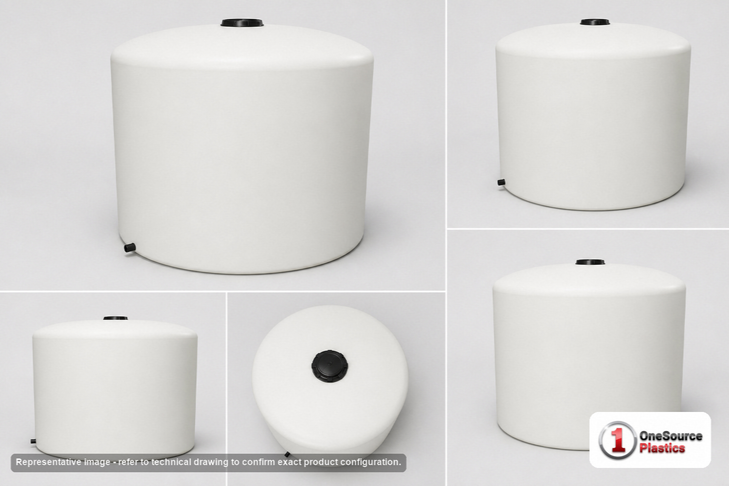
4300 gallons on a ten foot circle, 104 inches tall, out of Chowchilla
The Snyder SII-7421100C26 is the wide, low 4300, molded at Chowchilla, California: 4300 gallons of white polyethylene, 120 inches across and 104 inches tall, 850 pounds empty. The sheet rates the wall at a specific gravity of 1.9, which is 68138 pounds of contents where the same 4300 gallons weigh 35862 pounds as water at 8.34 pounds per gallon. It is fitted with an 18 inch threaded vented manway on top and a 3 inch polypropylene female NPT bulkhead outlet at the base. Freight is class 500 and it moves as an oversize load. This sheet publishes no service limit and no warranty term, so this page states neither; ask us and we will get Snyder's current terms in writing.
Two ways to buy. Add it to your cart above with freight quoted to your ZIP, or request a written quote for a job that needs paperwork.
Chowchilla, California, and the western lane for a wide 4300
Chowchilla is in the San Joaquin Valley, and it is the only plant on this sheet, so the freight map is simple: short lanes into California, Nevada, Arizona, Oregon and the interior west, long ones into the east. For a grower, a district or a plant in that country this is the 4300 that lands cheapest, and on a load like this one the lane is the largest line on the invoice. It has to be a permitted move because the shipping size is 120 inches across, ten feet, which is well outside ordinary freight: the route, the stop and the machine that lifts it are arranged rather than assumed, and a Valley farm entrance or a plant yard with a tight turn decides more of these deliveries than the rate does. Once it is down, the ground does all the work. A rotationally molded floor bears on the whole surface it touches and nothing else, so the 68138 pounds of contents the sheet allows land on a 120 inch circle and are carried by whatever that floor is resting on, and a ten foot circle is a lot of slab to get level and keep level. Engineer it to the framework in the concrete pad sizing guide, in full contact, poured wider than the tank, crowned so the overflow runs away from the base rather than under it, because a wide tank washing out one side of its own pad is the failure this shape actually suffers. At 104 inches the shell is under nine feet, which is the height that keeps it below an eave, inside a shed or under a shade structure, and it is short enough that the wind has little to push on; band it anyway while it is empty at 850 pounds. Then run 4300 gallons against your real draw in the tank sizing calculator, and take the reserve and the thermal freeboard from the tank sizing guide.
The 120 inch shell at 4300 gallons, and the slim 4400
| Part | Gallons | Diameter x height | Empty weight |
|---|---|---|---|
| SII-7421100C26 (this tank, white, wide, rated 1.9) | 4300 | 120 x 104 in | 850 lb |
| 7421100C34 (black, heavy duty, same shell) | 4300 | 120 x 104 in | 850 lb |
| 7421100C37-BLACK (black, same shell) | 4300 | 120 x 104 in | 850 lb |
| SII-7421100C37 (white, same shell) | 4300 | 120 x 104 in | 850 lb |
| 7360000C34 (black, narrower and taller) | 4100 | 102 x 130 in | 850 lb |
| 5210000N40 (crosslink, slim and very tall) | 4400 | 90 x 182 in | 1100 lb |
Four part numbers hold 4300 gallons in this shell and the sheet lists all four at 850 pounds and at 120 by 104 inches, so the silhouette decides nothing. Two of the four are black walls for a liquid daylight spoils, 7421100C34 in the heavy duty group and 7421100C37-BLACK beside it; the other white molding in the shell, SII-7421100C37, carries the figures and limits its own sheet publishes and this page asserts none of them. The case for this part number is the pairing of the widest base in the group with a wall the sheet rates 1.9, which is the dense-liquid buy for a site that has floor and no height. Step away from the shell and the family goes vertical fast: 7360000C34 holds 4100 gallons on a 102 inch base at 130 inches, and 5210000N40 puts 4400 gallons on a 90 inch base and stands 182 inches, better than fifteen feet, at 1100 pounds in a crosslinked wall. That one buys a small footprint with a serious strapping job and a platform. This tank is the opposite trade, and it is the right one under a low roof.
Torn between two rows? Call 866-418-1777 with the liquid and the ceiling height, or ask for a quote on both and compare the freight.
The lid is 104 inches up and the tank is 120 inches across
- Access: an 18 inch threaded vented manway, 104 inches off the pad. Under nine feet is a short fixed platform with a rail rather than a climb, and on a shell 120 inches across the lid also sits a long way in from the edge of the tank, so whatever access gets built has to reach over the shoulder of the vessel and not just up to it. Plan that before the pad is poured, because it is much easier to set a platform base in the same concrete.
- Filling: a dip tube to the floor rather than a delivery dropping nine feet onto the liquid, the lid closed between deliveries, and the vent kept clear at all times and sized for the pump that fills rather than the pump that empties.
- Inspection: light the band of wall just above the liquid line whenever the manway is open. On a wide shell that band is a long way around, and it is the strip that a liquid-side look never sees; the headspace wall thickness article explains why.
- Outlet: a 3 inch polypropylene female NPT bulkhead fitting at the base, as the sheet lists it. Name the liquid at order and the fitting, gasket and bolting are matched to it; make the thread up once and put a union or a flange downstream so valve work never happens on the tank fitting itself.
- Level: on a 120 inch circle the surface drops very little per hundred gallons drawn, so a wide tank hides its own level better than a tall one. Fit a gauge where the operator stands and stop guessing from the lid.
- Limits: the sheet publishes no service temperature and no warranty term for this part number, so nothing is claimed here.
Under nine feet of standing liquid is modest suction head for a tank this size, which makes the pump layout the difference between a good install and a noisy one: below the outlet, on its own base, with a short run falling all the way into the suction port and no high spot for air to sit in. On a wide, low shell that run tends to be long and shallow, so slope it deliberately and support it, break the first joint with a flexible connector, and carry the first valve on a support off the pad. Fit a cleanable strainer and a low level cut-out that stops the pump with liquid still over the fitting, because the last inches of level on a ten foot circle cover a lot of floor and a dry run arrives suddenly. Where the site freezes, protect the valve and the exposed pipe, not the body.
West coast plants that would rather spend floor than height
Height is the scarce thing on a great many western sites, and this tank is the answer to that: an open sided chemical building at a district water or wastewater plant, a shade structure or machine shed on a Valley farm, a packing house or processing plant with a covered dock, a bay whose purlins stop a taller vessel, a pad inside a sightline restriction that keeps tanks low. The duties are bulk storage with a steady draw and a dense load: coagulant, acid or caustic feed at a treatment plant, a concentrated liquid fertilizer or micronutrient at a blending yard or a co-op, a process or wash chemical at a food, beverage or packing plant, a stabilized byproduct stream held before it is hauled. Where the vessel is one stage in a train that collects water from one process and feeds the next, the industrial water reuse tank topology article shows where a tank this size belongs in the sequence and what has to be true either side of it. Stored water kept against fire is a separate design job, decided by draw rate, connection and freeze protection rather than by volume, and the fire-water reservoir design guide works that through honestly.
Class 500 from the Central Valley, a permitted wide load
The SII-7421100C26 ships from Chowchilla, California at class 500 as the sheet lists it, shipping at 120 inches by 120 inches by 104 inches, and it moves as an oversize load. Ten feet of width is the number the carrier cares about: it is wider than the trailer, it is permitted rather than rated, and it will not reverse out of a bad approach. Confirm the gate, the turn, the overhead lines and the place the truck can stand, and confirm the machine and the operator, before the load is booked; a refused delivery on a wide load is charged both ways. The freight cost estimator prices the lane to your ZIP, and the listed price is before freight. Slings under the body or forks long enough to carry the whole floor, never a hook through the manway, and the tank goes straight onto the finished pad rather than onto the dirt beside it, because 850 pounds is easy to move now and impossible once there is liquid in it. Fill with water to the manway, hold, and read the pad edge all the way around before draining and drying. On a base this wide, walk the full circle of the pad edge at the end of the hold and again a week later; settlement shows up there before it shows up anywhere else. The first fill is the only cheap time to find a problem, so do it in daylight with someone watching the base.
Freight and documents
Ships from: Chowchilla, CA. LTL freight is quoted to your ZIP with the freight cost estimator or by phone at 866-418-1777. The listed price is before freight.
Technical drawing (PDF) for Snyder Industries 7421100C26.
See this tank
Interactive 3D model with live fill. This tank has an interactive 3D model built to its manufacturer dimensions. Rotate it, and set a fill level to see how much liquid it holds at any height. Open the 3D view on the product photo above. Download the 3D model (GLB).
Product video. Watch the 4300 Gallon Plastic Vertical Liquid Storage Tank video (72 seconds) with dimensions, fittings and shipping notes.
Ready to order?
Add it to your cart at the top of this page, get LTL freight to your ZIP, request a written quote, or call 866-418-1777. The listed price is before freight.