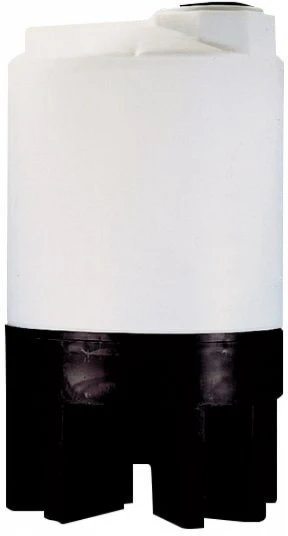
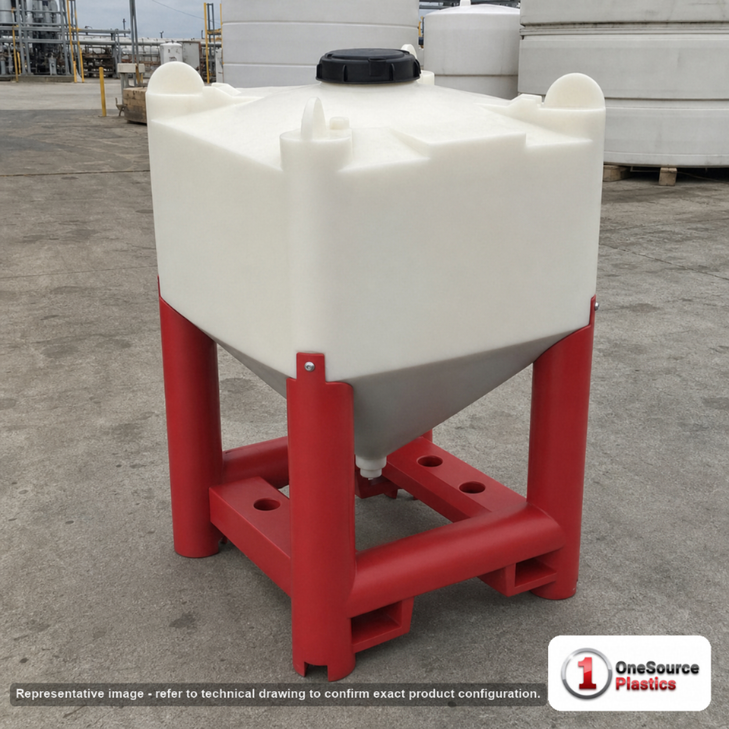
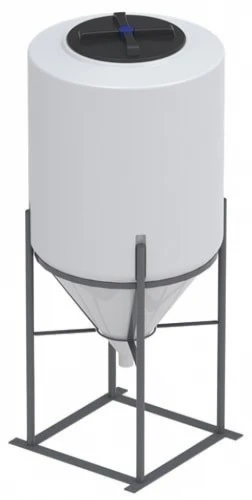
The 200 Gallon Chem-Tainer Cone Bottom Tank with Poly Stand (SKU TC3177JP) is a closed-top, full-drain vessel built for chemical batching, mixing, and metered dispensing where you need the tank to empty completely to the outlet. It stands 77" tall on a 31" diameter footprint, weighs 105 lb empty, and is molded in Natural White polyethylene rated to 1.9 specific gravity. Fluid exits through a 1.5" outlet at the bottom of the cone, and the 8" threaded vented lid up top gives you fill and venting access. This is the version that ships with the matching polyethylene stand, so the cone is supported and the drain is elevated for gravity discharge into a pump, hose, or drum.
Will it work for your process
Rated to 1.9 SG, this tank carries dense chemistries most water-grade tanks cannot, and at 1.9 SG this is the heaviest-duty rating offered in this cone-bottom size — you do not need to step up to a higher-rated shell. Water at 200 gallons weighs about 1,668 lb; at the full 1.9 SG rating the tank supports up to roughly 3,169 lb of contents. Match that against your fluid's specific gravity before you buy — if your chemical is heavier than what a lower-SG tank allows, this higher rating is the reason to choose it. The tank is also FDA approved for food-contact grade polyethylene, which matters for potable, DEF-adjacent, and food-process chemistries. The cone geometry drains toward the 1.5" outlet so solids and heels clear instead of settling on a flat floor. If you are weighing cone angles and residual-heel behavior, our 30° vs 45° drainage comparison walks through it, and the Tank Sizing Calculator plus Tank Sizing Guide help confirm 200 gallons is the right capacity. When you plan the top, our fitting placement guide keeps vent, fill, and level ports from fighting each other.
Chemical compatibility
This tank is molded polyethylene rated to 1.9 SG. The resin is recorded as HDLPE with a question mark, so confirm HDLPE versus XLPE with us before you commit it to chemical service — crosslinked and linear polyethylene behave differently against certain chemistries. Compatibility below is drawn from a published polyethylene chemical-resistance chart and is concentration- and temperature-specific. We do not list a maximum operating temperature for this tank, so confirm your fluid's service temperature with us before ordering, since compatibility ratings degrade with heat. Verify your exact chemical, concentration, temperature, and both fitting and gasket material against the Chemical Compatibility Database before ordering.
At this tank's 1.9 SG rating, the OEM chart supports service for Ethylene Glycol (100%, PVC fittings, EPDM), Ferric Chloride (50%, PVC, EPDM), Ferric Sulfate (60%, PVC, EPDM), Hydrochloric Acid (37%, PVC, Viton), Hydrofluoric Acid (48%, PP/PVC, Viton), Hydrofluosilicic Acid (26%, PP/PVC, Viton), Hydrogen Peroxide (50%, PVC, Viton), Peracetic Acid (30%, 316SS, Aflas), Phosphoric Acid (85%, PVC, Viton), Polyaluminum Chloride (PVC, EPDM), Potassium Carbonate (50%, PVC, EPDM), Potassium Hydroxide (saturated, PVC, EPDM), Propylene Glycol (PP/316SS, EPDM), Sodium Bisulfate (PVC/PP, EPDM), Sodium Bisulfite (PVC/PP, EPDM), Sodium Hypochlorite (<16.5%, PVC, Viton), Sodium Thiosulfate (40%, PVC, EPDM), Sulfuric Acid (98%, CPVC, Viton), and Zinc Orthophosphate (PP/316SS, EPDM). Lower-SG-required chemistries this tank also covers include Acetic Acid (60%, PP/PVC, EPDM), Aluminum Sulfate (50%, PVC, EPDM), Calcium Chloride (40%, PVC, EPDM), DEF (32.5%, 316SS, EPDM), Ferrous Sulfate (20%, PVC, EPDM), Magnesium Chloride (30%, PVC, EPDM), Sodium Carbonate (30%, PVC, EPDM), Urea Solution (50%, PP/PVC, EPDM), and Ozonated Water (up to 10 PPM, PVC, EPDM). Note the gasket callouts: chemistries like hydrochloric, sulfuric, and hypochlorite want Viton, not EPDM — the wrong elastomer at the fitting is the most common failure on an otherwise correctly specified tank.
The mistake to avoid
Do not order fittings and gaskets by habit. The single most common error on a cone-bottom chemical tank is pairing a chemically correct tank with the wrong outlet material or gasket. Three examples from this tank's own chart show why: run Viton where the chart calls for it on hydrochloric or sulfuric service (not EPDM); if this is a DEF tank, order a 316SS outlet, not PVC — DEF (32.5%) and Urea both call for stainless, and a PVC fitting in a DEF loop is a guaranteed miss; and for peracetic acid, the gasket is Aflas with a 316SS fitting — Aflas is not Viton and not EPDM, so a Viton gasket on peracetic service is a failure even though Viton is correct elsewhere. Confirm the resin (HDLPE vs XLPE), match your fitting and gasket to the OEM chart per chemical, and verify your fluid's SG stays within the 1.9 rating at your operating temperature. If you are also selecting or sizing the stand, our stand selection decision tree and stand compatibility matrix cover the tradeoffs.
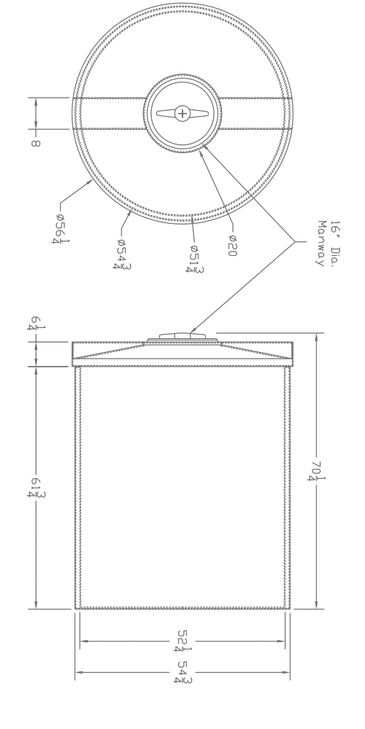
This tank ships LTL freight from Hanford, CA, quoted live to your ZIP through the Freight Cost Estimator — enter your delivery ZIP for a rate, or call 866-418-1777 and we will size the tank, confirm resin and fittings for your chemical, and quote freight in one call. See the technical drawing on this page for outlet position and stand dimensions before you finalize your plumbing.
Freight and documents
Ships from: Merced, CA. LTL freight is quoted to your ZIP with the freight cost estimator or by phone at 866-418-1777. The listed price is before freight.
Technical drawing (PDF) for Chem-Tainer TC3177JP.
See this tank
Product video. Watch the Chem-Tainer 200 Gallon Chem-Tainer Cone Bottom Tank with Poly Stand video (72 seconds) with dimensions, fittings and shipping notes.
Ready to order?
Add it to your cart at the top of this page, get LTL freight to your ZIP, request a written quote, or call 866-418-1777. The listed price is before freight.