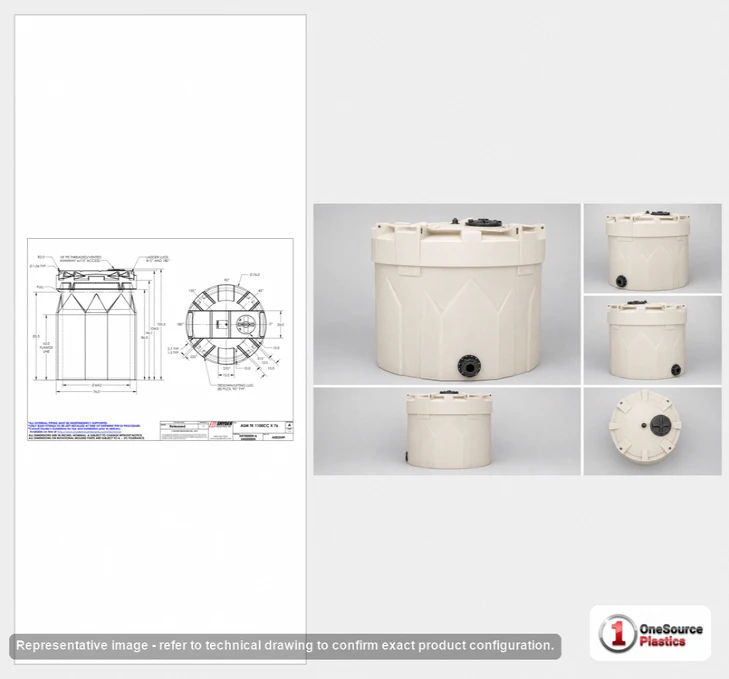
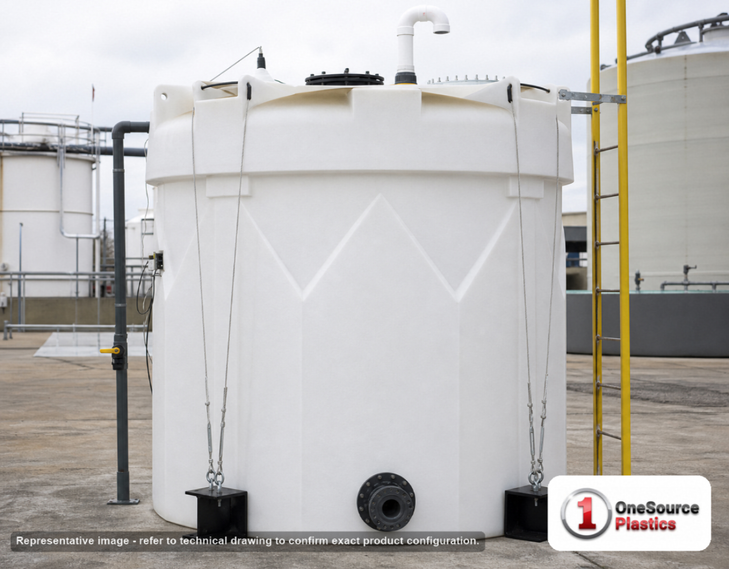
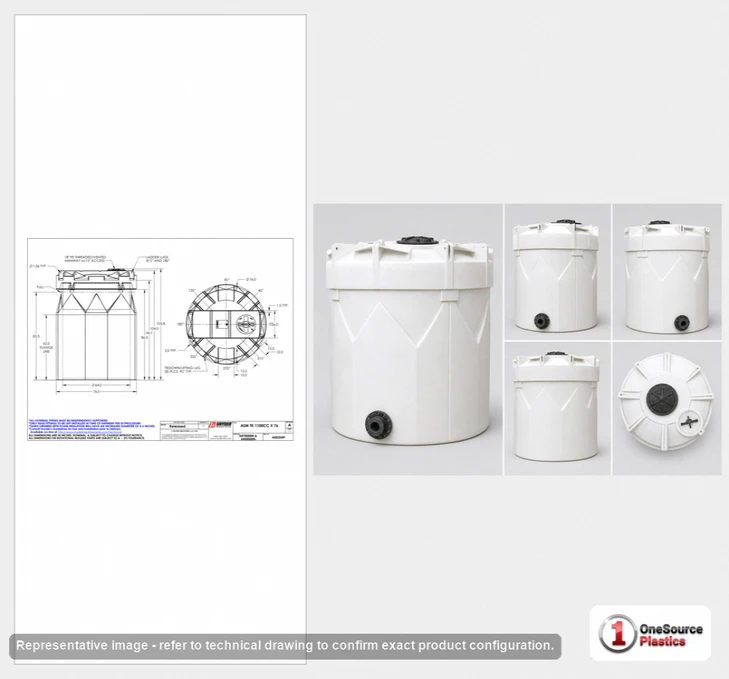
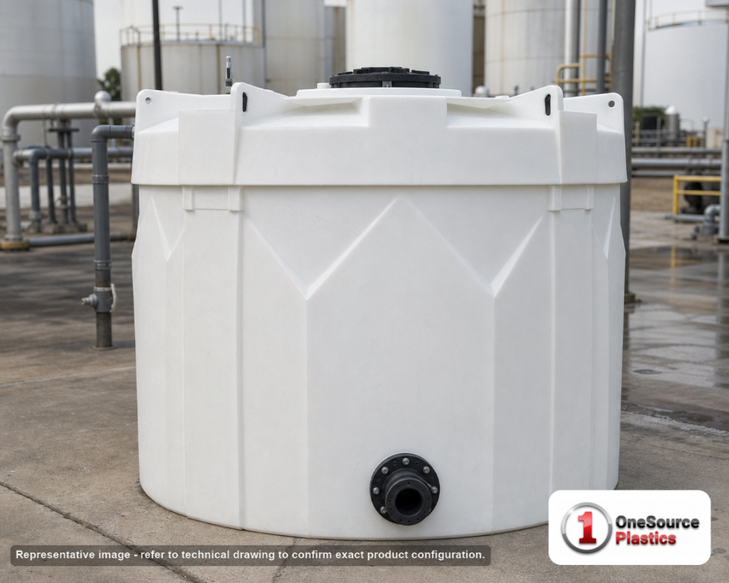
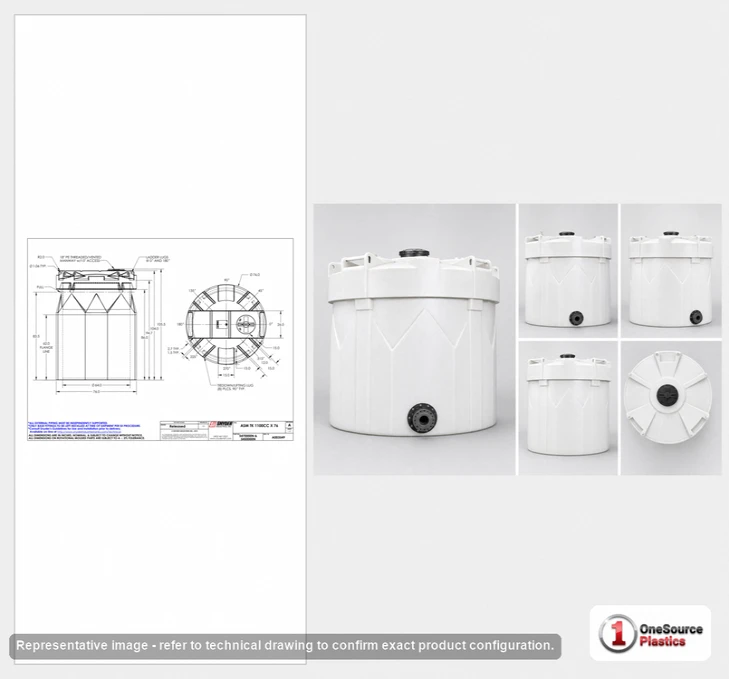
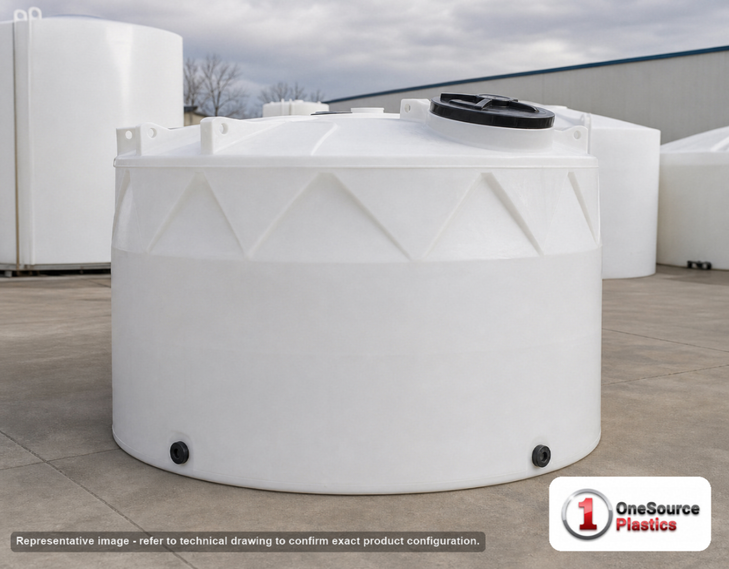
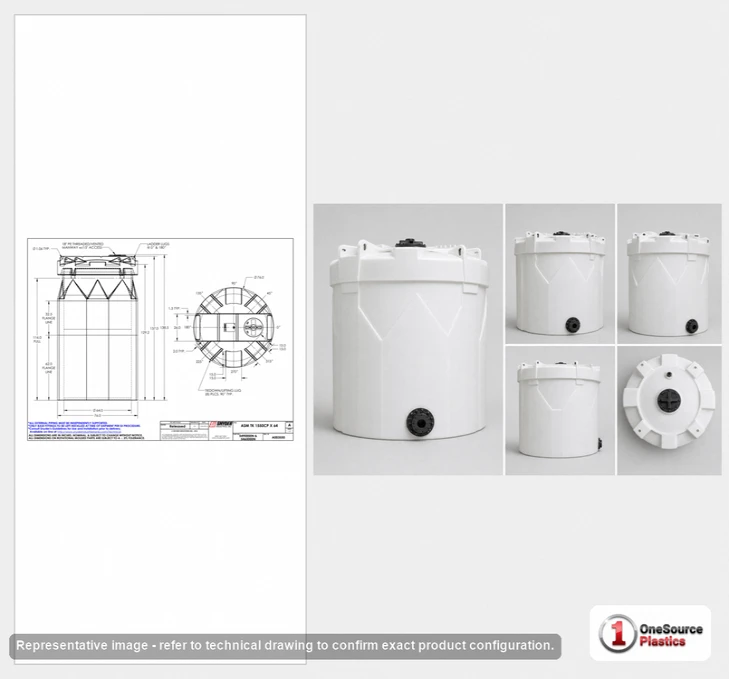
The HDLPE 1,100: 104 inches tall, 650 pounds, contained inside itself
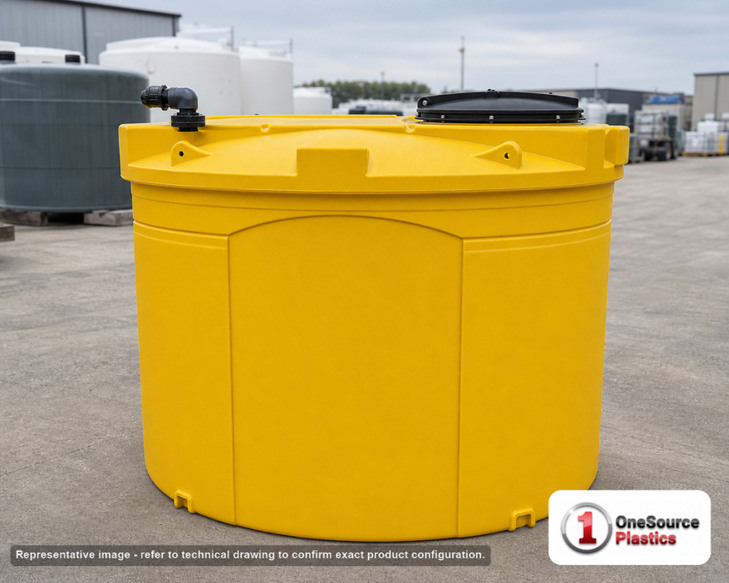
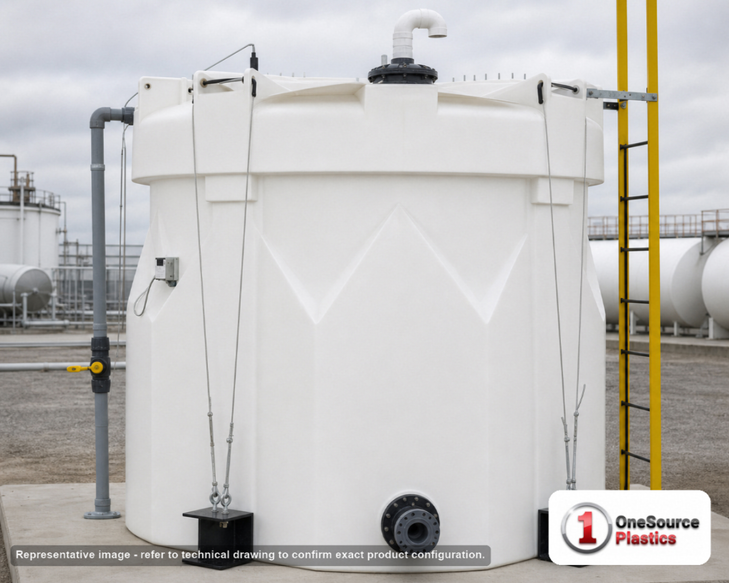
Snyder's SII-5470000N45 is a 1,100 gallon double wall liquid storage tank in high density linear polyethylene: an inner tank held inside an outer containment shell, so the containment is part of the product rather than a structure built around it. The shell is 76 inches across and 104 inches tall, listed at 650 pounds empty and 650 pounds to ship, molded at Philippi, West Virginia. The sheet rates it at a specific gravity of 1.9, which is where the 17,431 pound maximum contents figure comes from, against 9,174 pounds for 1,100 gallons of water at 8.34 pounds per gallon. Access is an 18 inch threaded vented manway, the service limit is 120 F / 48 C, and the sheet gives a 3 year warranty. Freight is class LTL, and no outlet or inlet fitting is published.
Buying for a site, a fleet or a district? Request a written quote with freight to your ZIP, or add it to your cart above and call 866-418-1777 with any question on the fit.
What a West Virginia lane means for an eastern buyer of a contained tank
Freight is the quiet reason this size of contained tank gets specified, and the plant is half of it. Philippi, West Virginia puts this shell within a day's drive of the mid-Atlantic, the Ohio valley, the Carolinas, the Northeast and most of the Southeast, and the sheet gives the class as LTL at 76 by 76 by 104 inches and 650 pounds. That combination is the whole argument: a contained tank that arrives on a standard trailer, comes off with a forklift, and is ordered rather than project-managed. Set it beside the larger tanks in this family, which travel as permitted oversize loads needing a route survey, a crane and a delivery window, and the difference in what it takes to get a tank onto a site is larger than the difference in what it costs to buy. For an eastern buyer that lane is short, and on light freight the lane moves the price more than the class does. On site the tank asks for two things and they are not negotiable. The first is a flat, level, continuous slab poured wider than the 76 inch base, because a rotationally molded floor bears on the whole surface it touches and nothing else: 9,174 pounds of water, or up to 17,431 pounds of contents at the rating, will find a hollow and stay in it. The second is access all the way round. The outer shell and the annulus between the two walls are the reason for buying this product at all, so a tank shoved into a corner where three quarters of it cannot be seen has given away its own advantage before the first fill. At 104 inches tall, a little over eight and a half feet, it fits under most single-storey ceilings while putting the manway out of reach from the floor, so decide the access to the top before delivery rather than after. Freeboard is the number to settle before ordering, since a dense liquid that warms through the day does not leave the nameplate volume to work with; the double wall freeboard sizing guide does that arithmetic. What a contained installation has to satisfy, as against what merely looks contained, is in the Captor double wall containment walkthrough. Check the volume against your draw in the tank sizing calculator, with the reserve and headspace from the tank sizing guide.
One shell, several part numbers, and the two neighbouring sizes
| Part | Gallons | Diameter x height | Empty weight |
|---|---|---|---|
| SII-5470000N45 (this tank) | 1100 | 76 x 104 in | 650 lb |
| 5470000N48 (same shell, same listed weight) | 1100 | 76 x 104 in | 650 lb |
| 5470000N51 (same shell, same listed weight) | 1100 | 76 x 104 in | 650 lb |
| SII-5470000N30 (same shell, same listed weight) | 1100 | 76 x 104 in | 650 lb |
| 5990102N30 (smaller, wider, lowest) | 1000 | 81 x 69 in | 500 lb |
| 5990302N30 (larger, widest, low) | 1500 | 93 x 76 in | 950 lb |
The top four rows are one shell under four part numbers: the same 1,100 gallons, the same 76 by 104 inch envelope and the same 650 pounds, with nothing on the sheet to tell them apart. That is what the manufacturer publishes, so that is what we print, and we will confirm the wall specification behind whichever number your order carries rather than reading meaning into a suffix. Where the real choice lies is in the two rows underneath, and both of them trade height for width. The 1,000 gallon 5990102N30 stands only 69 inches tall on an 81 inch base at 500 pounds: thirty-five inches shorter than this tank, which is the whole reason it exists, because a low ceiling, a beam, a mezzanine or a shipping container turns height into the binding constraint. The 1,500 gallon 5990302N30 is four hundred gallons larger and still shorter than this tank, 76 inches tall on a 93 inch base at 950 pounds, so it adds volume by adding floor. Which means this shell has exactly one job in the group, and it is a good one: hold the most liquid on the smallest circle. Seventy-six inches of base is a little over six feet, and in a crowded bay six feet of floor is often all there is. Measure the ceiling and the floor, in that order, and the row chooses itself.
Comparing against another maker? Send the competing spec to 866-418-1777 or a quote request and we will show the differences honestly.
Filling and venting through the top of a 104 inch double wall
- Access: one opening is published, an 18 inch threaded vented manway on top of a shell 104 inches tall. It is the fill point, the inspection port and the only way into the inner tank, and at that height it needs a platform, a step or fixed access with a rail, planned before the tank lands rather than improvised with whatever ladder is in the shop.
- Filling: bring the fill to a coupling at working level so nobody is lifting a hose over eight and a half feet of tank, and run the line down inside the body rather than letting the product drop onto the surface. Splashing a product into its own headspace aerates it, coats the wall above the liquid and, on a foaming chemical, eats the freeboard you planned for.
- Venting: vented manway, clear vent path, every time. A tank drawn on hard while it cannot breathe will deform, and a tall narrow shell deforms sooner than a wide one.
- The headspace above the liquid: on many chemicals the vapour space is a harsher environment than the liquid itself, and it is the zone an inspection carried out from the liquid side walks straight past. What happens up there and how the wall is sized for it is worked through in the vapour-saturated headspace wall thickness guide, and on a shell 104 inches tall that zone is the part of the wall nobody can see from the floor.
- What is not on the sheet: no outlet, no inlet. Rather than print a size and let your drawing work around a guess, we say what the sheet says and specify the fittings against the liquid, the duty and the containment arrangement with the order. Nothing is cut into either wall in the field, because every penetration of the inner tank has to be made without compromising the shell around it.
- The annulus: the gap between the two walls is the whole reason this tank costs more than a single-wall vessel. Keep it monitored, keep the monitor readable from where an operator walks, and keep the outer shell in view all the way round.
- Limits as the sheet gives them: 120 F / 48 C, a specific gravity rating of 1.9, 17,431 pounds of maximum contents as the arithmetic of that rating against the capacity, and a 3 year warranty. Nothing beyond those numbers is claimed here.
Name the liquid at order and the fitting, gasket and valve materials get matched to it against Snyder's current documentation instead of guessed at the counter; on a contained tank that conversation also decides what the annulus monitoring has to be able to detect. Keep the pipework off the tank: flexible connector at the first joint, first valve on its own support off the slab, nothing rigid bolted between a wall bracket and a shell that moves with temperature and load. Where forklifts pass, a kerb or a bollard between the traffic and the base. In winter, protect the valves and exposed lines and leave the body to look after itself.
Chemical feed, waste holding and contained storage in a tight bay
The work this shell does is the work of a tank that has to be inside a barrier and inside a small footprint at the same time. A chemical feed or day tank on a dosing skid at a water or wastewater plant, filled every week or two and drawn continuously. A supply tank in a plant bay, a laundry, a wash line, a plating shop, a food or beverage works or a laboratory block, where the floor is already full and the ceiling is not. A waste, by-product or spent-solution holding tank waiting on collection, where the containment is the reason the tank is allowed to stand where it stands. An outdoor satellite tank in a yard, where a bermed area would collect rain and need pumping and testing before it could ever act as containment. A step up from a stack of totes for a site tired of moving, tipping and disposing of them, which is usually where this size first gets specified. Two honest notes. A double wall contains what leaves the inner tank; it does not make a liquid safer to handle, and the valves, fittings, alarms and monitoring around it are what turn a contained tank into a contained installation. And the sheet's service limit of 120 F / 48 C covers the liquid and the tank standing in the sun, which in an unshaded yard is a number to plan against rather than assume away.
A single footprint, 650 pounds, and the first fill
This tank is molded at Philippi, West Virginia and the sheet gives its class as LTL at 76 by 76 by 104 inches and 650 pounds. The freight cost estimator prices the lane to your ZIP, and the listed price is before freight. Plan the unloading rather than hoping: 650 pounds in a shipment six feet across and eight and a half feet tall comes off with a forklift or a telehandler and slings under the body, never a hook through the manway, and a site with no dock and no machine gets a curbside drop. Say which you have at order. Have the slab poured, cured and level first, with the surround drained and walking room all the way round, then set the tank down once. Inspect the outer shell in daylight before the driver leaves. Then water-test it: fill with clean water, hold it, and read the base, the slab edge and the annulus through the hold, because the only cheap leak on a contained tank is the one you find with water in it. Log the date of that first fill beside the serial number; it is the start of the inspection record the tank will carry for the next twenty years. Save the pallet; a tank that ever has to move again is easier to move on it.
Freight and documents
Ships from: Philippi, WV. LTL freight is quoted to your ZIP with the freight cost estimator or by phone at 866-418-1777. The listed price is before freight.
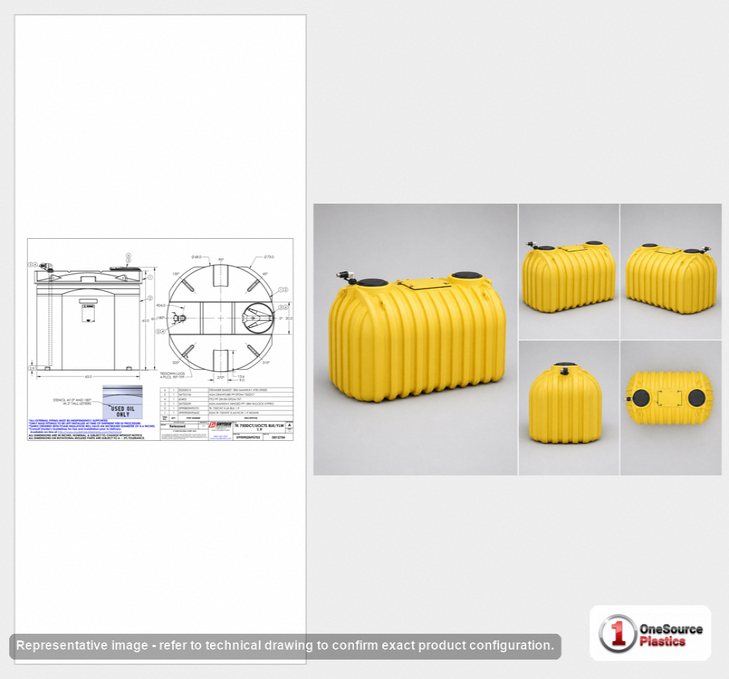
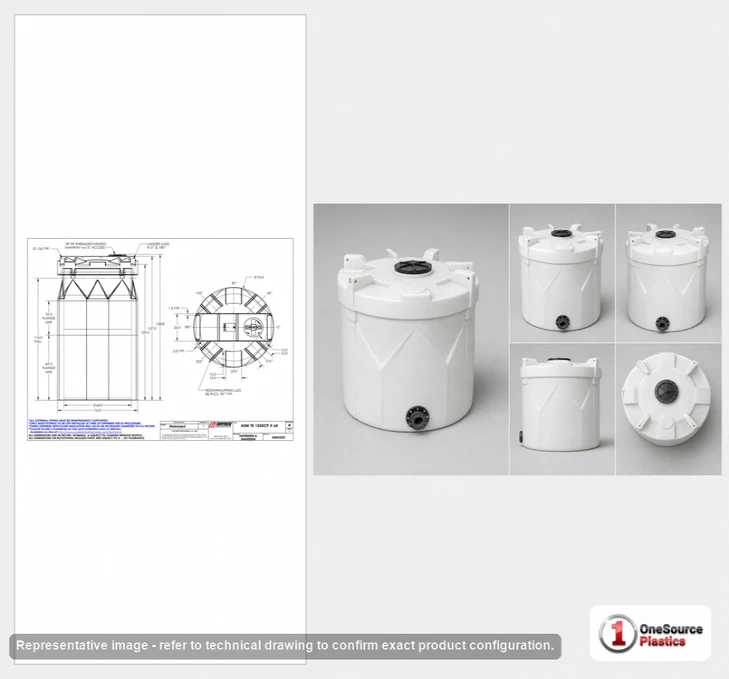
Technical drawing (PDF) for Snyder Industries 5470000N45.
See this tank
Product video. Watch the Snyder Industries 1100 Gallon Plastic HDLPE Double Wall Liquid Storage Tank video (70 seconds) with dimensions, fittings and shipping notes.
Ready to order?
Add it to your cart at the top of this page, get LTL freight to your ZIP, request a written quote, or call 866-418-1777. The listed price is before freight.