Sixteen hundred and fifteen gallons over a center sump
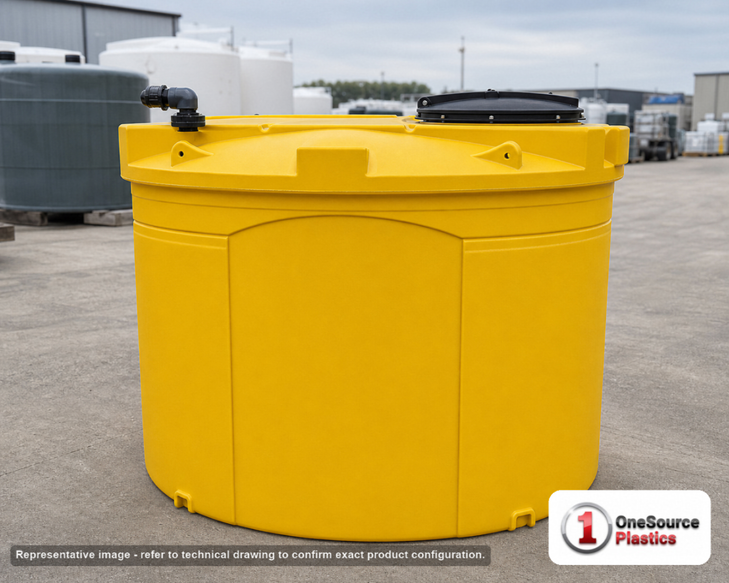
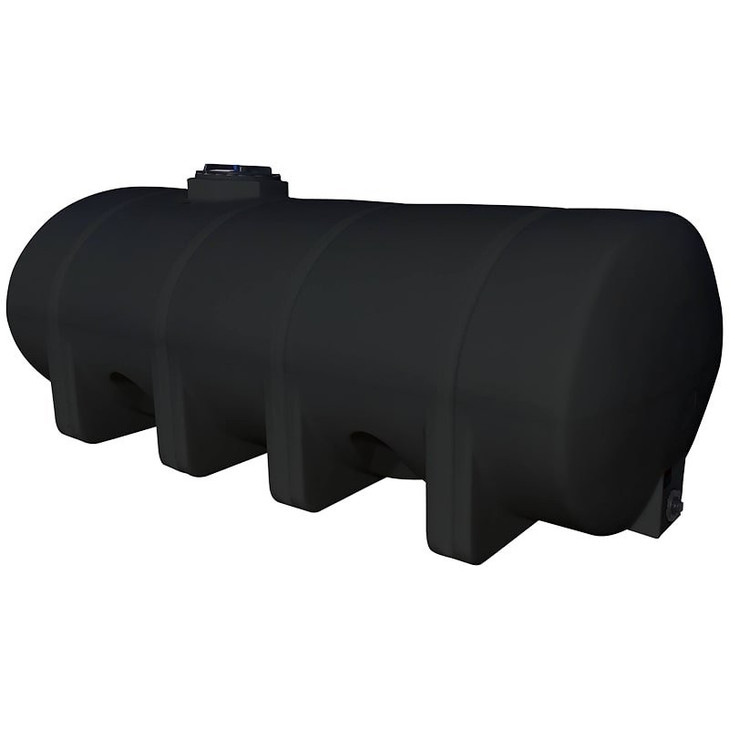
The Snyder SII-10034 is a 1,615 gallon super nurse tank with a center sump: white polyethylene, 140 inches long, 69 inches wide and 61.25 inches tall, weighing 509 pounds empty. The sheet rates the wall at a specific gravity of 1.9, which puts 13,469 pounds of water in it at 8.34 pounds per gallon and 25,591 pounds of max contents at the rating. The outlet field reads a 2 inch total drain, bolted, and the access is an 18 inch lid. The center sump is in the product's own name and the sheet gives no sump dimension, so none is stated here. There is no service limit and no warranty term on this sheet at all, which is unusual in this range and is printed rather than papered over. It is molded at Marked Tree, Arkansas.
Ready for the pad? Quote freight to your ZIP, add the 1615 gallon tank to your cart above, and 866-418-1777 will confirm the truck and the unload.
Marked Tree to the farm: what a 140 inch nurse tank costs to move
Freight is the first honest conversation about a tank this shape, so start there. This one is molded at Marked Tree, Arkansas, which is the short lane into the Mid-South, the Delta and the lower Midwest and a workable one across most of the eastern half of the country. What travels is a box 140 inches long by 69 inches wide by 61.25 inches tall, which is eleven feet eight inches of length and just over five feet in both of the other directions: a full pallet position and then some, carried as LTL freight under NMFC 156600-03. A nurse tank is bought to be filled at a plant or a yard and emptied at a field, so the freight lane, the trailer it will live on and the gate it has to pass through are all part of the specification, not an afterthought. Check the width first. Sixty-nine inches is wider than a pickup bed and wider than many utility trailers between the rails, so this tank generally wants a flatbed, a gooseneck or a purpose-built nurse trailer, and the deck has to bear the tank across its full plan rather than on two rails with an unsupported span down the middle. At 13,469 pounds full of water, and 25,591 pounds at the specific gravity of 1.9 the sheet rates it to, everything under this tank is carrying a load that moves every time the vehicle turns or brakes. The sheet publishes no leg detail, no securing hoop and no mounting hardware for this part, and no over-the-road rating, so none of that is claimed here; ask us and we will put Snyder's own mounting guidance in writing for your part number. Confirm the volume is the one the job needs before the order rather than after: run the field size, the rate and the refill trip through the tank sizing calculator, and take the freeboard a warm blended product needs from the tank sizing guide.
The nurse tank against the 1,025 and the 1,650 leg tanks
| Part | Gallons | Length x width x height | Empty weight |
|---|---|---|---|
| SII-10034 (this one, super nurse tank with center sump) | 1,615 | 140 x 69 x 61.25 in | 509 lb |
| SII-1440000C26 (horizontal leg tank with securing hoops) | 1,025 | 139 x 48 x 50 in | 290 lb |
| SII-1000700C26 (horizontal leg tank with securing hoops) | 1,650 | 142 x 71 x 55 in | 533 lb |
These three are close in length and nothing like each other in what they are for. SII-1440000C26 is described on the sheet as a horizontal leg tank with securing hoops: 139 inches long but only 48 inches wide and 50 inches tall, at 290 pounds, which is the narrow one that fits a trailer deck where 69 inches will not go, and it holds 1,025 gallons. SII-1000700C26 is also a leg tank with securing hoops, 142 by 71 by 55 inches at 533 pounds, and it holds 1,650 gallons, slightly more liquid than this tank in a wider and lower body. The reason to buy this one instead of either of those is the sump. It is a super nurse tank with a center sump in the sheet's own words, and the point of a centered low point on a body this long is that the load leaves the tank from the middle rather than draining toward one end, so a level deck empties it instead of a deck parked on a slope. That is worth real money on a nurse vehicle that fills and empties several times a day and has to be clean between products. What this tank is not is a leg tank: the two siblings above carry securing hoops in their descriptions and this sheet publishes no leg, hoop or saddle detail at all, so nothing of the kind is claimed for it here. For the wider comparison of how applicator, leg and nurse shapes differ and where each belongs on a farm fleet, the applicator and leg tank guide sets them side by side.
Still deciding between these? Freight to your ZIP often settles it; the wider tanks ship differently. Or call 866-418-1777 and we will walk the table with you.
Filling through an 18 inch lid, draining through a bolted total drain
- The fill opening: an 18 inch lid, which is a generous opening on a tank this size and the reason a nurse body is easy to live with. It takes a fill pipe well inside the rim, it takes a hand and a brush for cleaning between products, and it gives an operator a real look at the inside. Fill with the hose end below the rim rather than falling in from the top, and put the lid back on before the vehicle moves.
- Breathing while it fills and empties: keep an air path open whenever anything is moving in or out. A tank being pumped down through a closed lid pulls its own wall inward, and a tank being filled fast through a restricted vent does the reverse.
- The drain: the sheet words the outlet as a 2 inch total drain, bolted. That is printed as it stands and nothing further is inferred from it, no valve type and no thread form. Tell us the product and the pump when you order and the drain arrangement on your part is confirmed in writing.
- Working with a center sump: the low point is centered, so park level to empty the tank rather than nose-down, and flush and drain in the same position when you change products. A nurse tank that is rinsed on a slope keeps the last of the previous load in the end that was uphill.
- Limits: this sheet publishes no service temperature and no warranty term. Neither is asserted here; ask us for Snyder's current written terms rather than assuming the ones another tank in the range carries.
Everything downstream of the drain goes on its own support off the deck, with a flexible connector at the first joint, because a tank that travels feeds every bump into whatever is rigidly bolted to it. Where the load is a blended fertilizer that has to go out on specification, the physics of a long shallow body is worth understanding before the spreader runs: the fertilizer blend stratification article covers thermal layering, density-driven separation and the field checks that catch a stratified tank in the yard rather than in the field.
Nurse duty, blend hauling and the stratification that follows it
A super nurse tank is bought for the shuttle: keeping a sprayer or a spreader working by bringing the product to it instead of sending the machine back to the yard. It carries blended fertilizer and crop protection mixes for custom applicators and co-ops, water for mixing and rinsing, livestock and wash water on farms and feedlots, and bulk liquid between buildings on large operations. Two pieces of reading belong with that duty. The agricultural exemption and classification article sets out the actual scope of the farm exemption rather than implying it covers every trip a farm vehicle makes, and the Captor double wall SPCC walkthrough is where the containment question gets answered properly when a yard stores regulated product alongside the nurse fleet.
Chemical ratings on record for this resin
What the manufacturer lists for this resin, liquid by liquid, with the concentration ceiling and the fitting and gasket material. Your concentration and temperature get checked on the linked page or in the chemical compatibility database before ordering.
- Acetic acid (60%) - PP/PVC fittings, EPDM gaskets
- Aluminum sulfate (50%) - PVC fittings, EPDM gaskets
- Calcium chloride (40%) - PVC fittings, EPDM gaskets
- DEF (32.5%) - 316SS fittings, EPDM gaskets
- Ethylene glycol (100%) - PVC fittings, EPDM gaskets
- Ferric chloride (50%) - PVC fittings, EPDM gaskets
- Hydrochloric acid (37%) - PVC fittings, Viton gaskets
- Hydrofluoric acid (48%) - PP/PVC fittings, Viton gaskets
- Hydrogen peroxide (50%) - PVC fittings, Viton gaskets
- Phosphoric acid (85%) - PVC fittings, Viton gaskets
- Potassium hydroxide (saturated) - PVC fittings, EPDM gaskets
- Sodium hypochlorite (under 16.5%) - PVC fittings, Viton gaskets
- Sulfuric acid (98%) - CPVC fittings, Viton gaskets
- Urea solution (50%) - PP/PVC fittings, EPDM gaskets
Five hundred and nine pounds on an LTL pallet
This tank ships from Marked Tree, Arkansas, and the sheet gives the freight class as LTL, which is a mode and not a numeric class, under NMFC 156600-03. Shipping at its own 140 by 69 by 61.25 inches, it is a long pallet rather than an ordinary one, so confirm the delivery point can take a truck of that length and has a forklift with the reach to take a load off the side. The freight cost estimator prices the lane to your ZIP, and the listed price is before freight. At 509 pounds empty it is a machine lift, not a crew lift: forks under the pallet, never a strap around the lid collar and never a chain hooked into the drain. Have the trailer, the deck or the cradle finished before the tank arrives, because a nurse tank standing in a yard waiting for its mounting is a tank that gets moved four times by people in a hurry. Fill it with clean water on level ground first, watch the lid seal and the total drain through a full load, then drain it from the center and check that it actually empties where you expect. The first load of water is the cheapest test this tank will ever get. Write the outlet fitting size and material on the site plan; the replacement is ordered by those two words.
Freight and documents
Ships from: Marked Tree, AR. LTL freight is quoted to your ZIP with the freight cost estimator or by phone at 866-418-1777. The listed price is before freight.
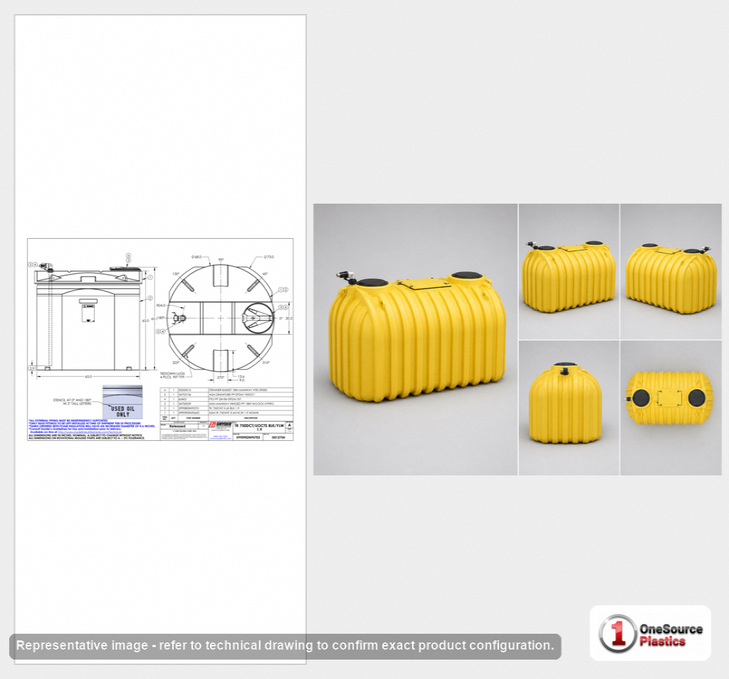
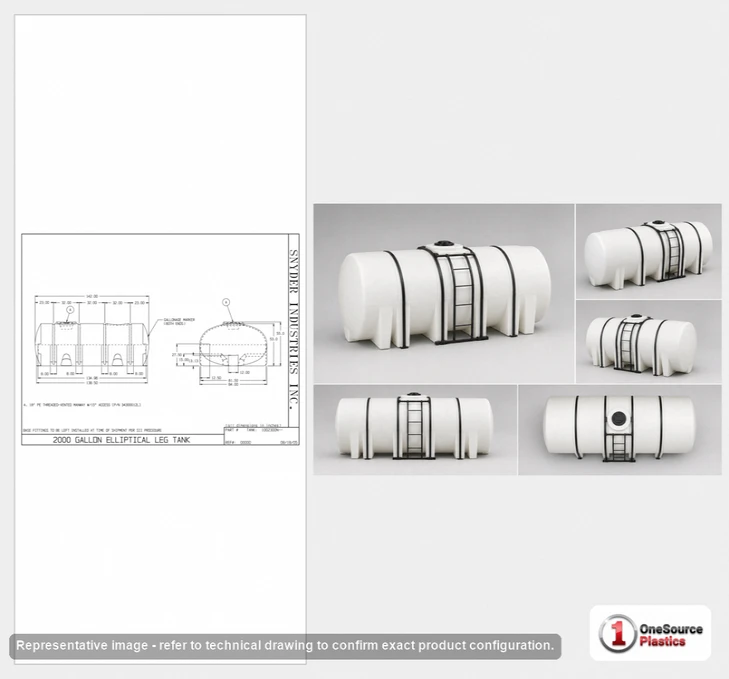
Technical drawing (PDF) for Snyder Industries 10034.
See this tank
Interactive 3D model with live fill. This tank has an interactive 3D model built to its manufacturer dimensions. Rotate it, and set a fill level to see how much liquid it holds at any height. Open the 3D view on the product photo above. Download the 3D model (GLB).
Product video. Watch the Snyder Industries 1615 Gallon Super Nurse Tank with Center Sump video (62 seconds) with dimensions, fittings and shipping notes.
Ready to order?
Add it to your cart at the top of this page, get LTL freight to your ZIP, request a written quote, or call 866-418-1777. The listed price is before freight.