Three hundred and thirty gallons on a 48 by 40 inch base
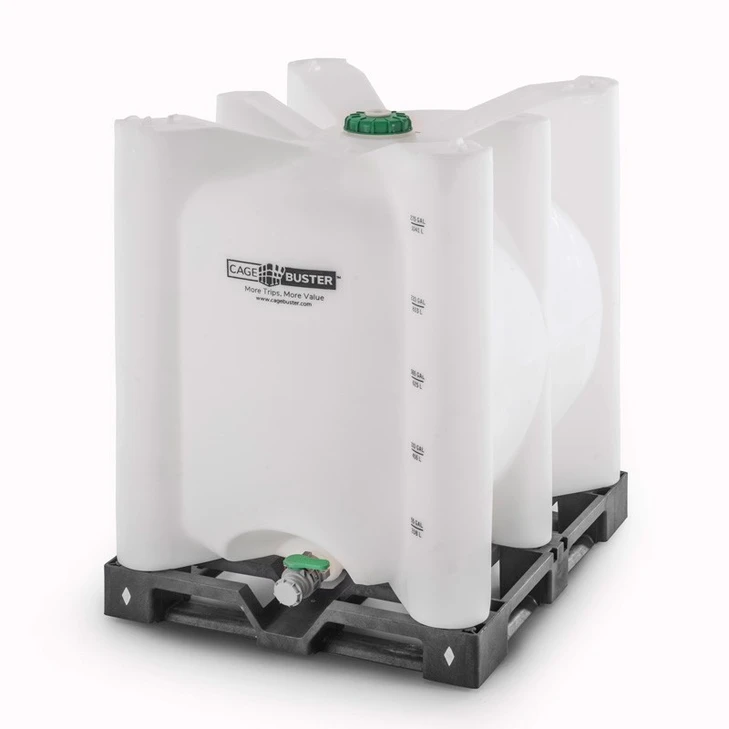
The Snyder SII-6998701B97204 is a 330 gallon stackable CageBuster IBC tote in white high density polyethylene, 48 inches long, 40 inches wide and 58.75 inches tall, weighing 220 pounds empty. The sheet rates the wall at a specific gravity of 1.9, which gives 2,752 pounds for 330 gallons of water at 8.34 pounds per gallon and 5,229 pounds of max contents at the rating. It lists a 2 inch ball valve as the outlet. The service limit is 105 F / 41 C, the lowest in this group, and the sheet publishes no warranty term. Molded at Lincoln, Nebraska.
Want it on the pad this month? Check freight to your ZIP, add it to your cart above, and 866-418-1777 will confirm the ship date.
Lincoln to the dock: a tote that rides where a pallet rides
The whole economic argument for a tote is that it moves like freight everybody already handles, so begin with the lane. This one is molded at Lincoln, Nebraska, ships as LTL freight under NMFC 156600-03, and stands on a base 48 inches by 40 inches. That is the footprint the entire logistics world is built around: it fits a standard pallet position, it goes through a dock door, it sits in a truck next to ordinary palletised freight, and it takes forks from a machine any warehouse already owns. At 58.75 inches tall, a little under five feet, it also clears the door of a box truck and stands under most warehouse racking beams. That is the difference between a tote and a tank. A tank is a delivery project; a tote is a line item on a bill of lading, and a stackable one is a line item that occupies half the floor it looks like it should. Two things follow for a buyer. First, the base is what everything acts through, so set it on a flat, continuous, level surface that carries the whole 48 by 40 inch plan: a solid floor, a rack beam deck rated for the load, or a proper pallet, never on a broken pallet or spanning a gap. At 2,752 pounds full of water and 5,229 pounds at the specific gravity of 1.9 the sheet rates it to, a tote is far heavier than its size suggests and it concentrates that load into a small rectangle. Second, know the limits before you stack or move a full one: this sheet publishes no stacking load, no drop rating and no lifting arrangement, and none is claimed on this page. Ask us and we will put Snyder's own handling guidance for this part in writing. Where the underlying choice is still open, the comparison of totes, IBCs, drums, cubes and tanks lays out which container shape suits which duty, and the volume itself should be sized against your draw and delivery rhythm in the tank sizing calculator, with the freeboard from the tank sizing guide.
Four stackable totes, and the Jet-A Liquitote listed beside them
| Part | Volume | Length x width x height | Empty weight |
|---|---|---|---|
| SII-6998701B97204 (this one, white CageBuster) | 330 gal | 48 x 40 x 58.75 in | 220 lb |
| SII-6998701B97202 (same shell, white, VITON listing) | 330 gal | 48 x 40 x 58.75 in | 220 lb |
| SII-6610056B97205 (stackable tote, red, taller) | 330 gal | 45 x 45 x 64 in | 268 lb |
| SII-6610056B97209 (stackable tote, black) | 330 gal | 45.75 x 45.75 x 61.25 in | 234 lb |
| SII-6620030B97203 (smaller stackable tote) | 275 gal | 45 x 45 x 56 in | 269.5 lb |
| SII-373449 (Jet-A Liquitote aviation JET A fuel tank) | 550 gal | 42 x 48 x 77.75 in | 665 lb |
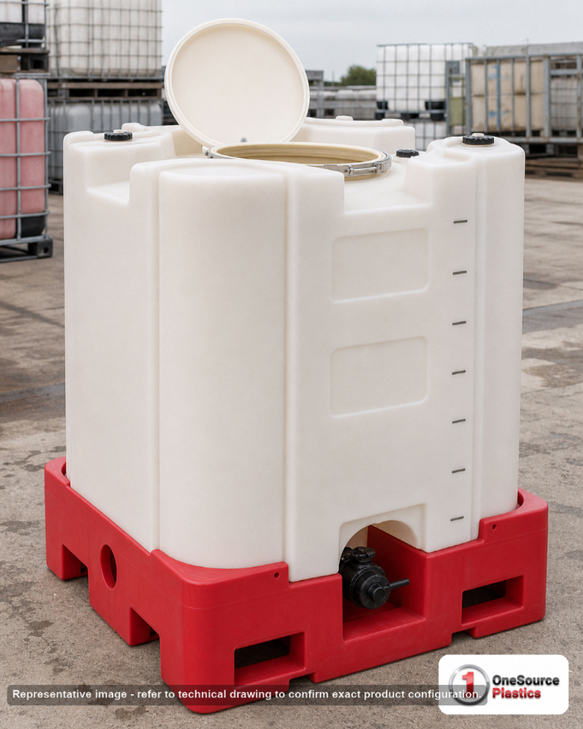
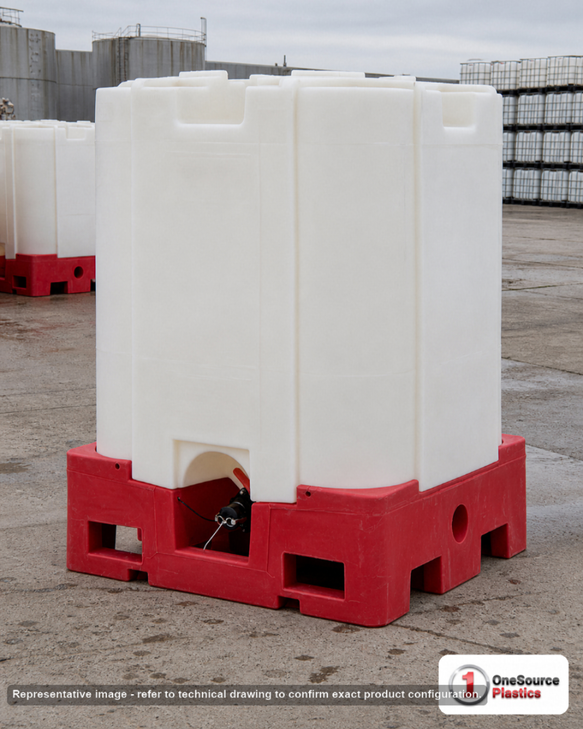
The reason to buy this row rather than any other is the base. This tote and its VITON-listed twin are the only two on the sheet with a 48 by 40 inch plan; the other stackable totes are listed at 45 by 45 or 45.75 by 45.75 inches, which is a square that does not index against a standard pallet footprint the same way in a rack or a trailer. If your handling is built around that rectangle, this is the tote that fits it, and at 220 pounds it is also the lightest of them empty. SII-6998701B97202 is listed at the same 48 by 40 by 58.75 inches and the same 220 pounds, and the sheet distinguishes it only by naming VITON in its description, so that is the only difference stated here; order the part number that matches what your chemistry calls for and ask us to confirm the elastomer in writing. The red SII-6610056B97205 is taller at 64 inches and heavier at 268 pounds, the black SII-6610056B97209 sits between them at 61.25 inches and 234 pounds, and the 275 gallon SII-6620030B97203 is the odd entry on the sheet: less volume than any of the 330s but listed at 269.5 pounds, heavier than all of them. The sheet gives that figure and no explanation, so neither does this page. The last row is a different product entirely and is named exactly as the sheet names it: SII-373449, a 550 gallon Jet-A Liquitote aviation JET A fuel tank, 42 by 48 by 77.75 inches at 665 pounds. It is listed here because it shares the tote family, not because it is interchangeable with this one, and this page makes no compliance, fuel code, bonding or grounding claim for it of any kind.
Which wall for your chemical? Call 866-418-1777 with the name and the concentration, or send a quote request and we will pick the row.
A threaded lid on top, a ball valve at the bottom
- The fill opening, as the sheet gives it twice: the lid size field reads 6 inches and the manway field reads a 5 inch threaded lid. Confirm the opening on your part number with us before you buy a fill adapter or a lid-mounted level device to suit it.
- Filling practice: a threaded lid is a seal, so it has to be seated properly every time or a moving tote will weep from the top. Fill with the hose end inside the rim, do not overfill, and keep an air path open whenever liquid is moving in or out, because a tote is small enough that a fast pump and a closed lid will deform a wall in minutes.
- The outlet: a 2 inch ball valve, which is what makes the tote a dispensing container rather than only a storage one. Fit the valve with a cap or a plug downstream when it is not in use, support any hose or line off the floor rather than off the valve body, and never move a tote with a hose hanging on it.
- Stacking and handling: this sheet publishes no stack rating, no lift point detail and no drop rating, so none is claimed here. Take forks under the base, keep loads low while travelling, and settle the stacking question with us in writing before a full tote goes on top of anything.
- Service limit: 105 F / 41 C, which is lower than most of the tanks in this range, so a tote parked in direct summer sun on a black yard surface is worth thinking about at the design stage. There is no warranty term on this sheet.
The rule with totes is that the container is the easy part and the housekeeping is the job: one chemical per tote for its working life, the contents written on the outside where a forklift driver can read it, the valve capped, and the tote parked somewhere its contents would be caught if the valve were opened by accident. Where the liquid is a regulated waste, that last point stops being housekeeping and becomes a rule with inspection cadence attached; the secondary containment article for hazardous waste tank systems sets out the options and how often somebody has to look.
Bulk liquid in a tote, and the containment the rule asks for
Three hundred and thirty gallons in a tote is the size that replaces a stack of drums without becoming a tank installation. It holds cleaning chemistry at a plant or a wash, water treatment product at a small works, agricultural liquid at a farm shop, food-grade liquid in a production room, ink, coolant or process fluid in a factory, and waste liquid awaiting collection. The two decisions worth making deliberately are what the container will hold for its life, and where it will stand. A tote that gets used for three different chemicals in a year is a tote nobody trusts, and a tote standing on bare yard concrete with no containment beneath it is an incident waiting for a forklift to find it. Dedicate it, label it, and put it inside something that will catch it.
Resin compatibility, line by line
Below are the liquids this resin is rated for, the concentration each rating holds to, and the fitting and gasket to specify. Check the exact concentration and temperature you run against the chemical page or the chemical compatibility database before ordering.
- Sulfuric Acid at 98% (CPVC fittings, Viton gaskets)
- Hydrochloric Acid at 37% (PVC, Viton), and
- Ferric Chloride at 50% (PVC, EPDM) all require a 1.9 SG rating and would not be cleared on a lighter tote.Other cleared aggressive acids include
- Phosphoric Acid (85%, PVC, Viton)
- Hydrofluoric Acid (48%, PP/PVC, Viton)
- Hydrofluosilicic Acid (26%, PP/PVC, Viton - the common water-treatment fluosilicate feed)
- Sodium Hypochlorite (below 16.5%, PVC, Viton)
- Hydrogen Peroxide (50%, PVC, Viton), and
- Peracetic Acid (30%, 316SS, Aflas).On the coagulant and salt side the chart clears
- Polyaluminum Chloride (PVC, EPDM)
- Ferric Sulfate (60%, PVC, EPDM)
- Potassium Carbonate (50%, PVC, EPDM)
- Sodium Thiosulfate (40%, PVC, EPDM)
- Potassium Hydroxide (saturated, PVC, EPDM), and
- Ethylene Glycol (100%, PVC, EPDM).Lighter-duty fluids such as
- DEF (32.5%, 316SS, EPDM)
- Urea Solution (50%, PP/PVC, EPDM)
- Acetic Acid (60%, PP/PVC, EPDM)
- Calcium Chloride (40%, PVC, EPDM)
- Sodium Carbonate (30%, PVC, EPDM), and
- Aluminum Sulfate (50%, PVC, EPDM) are also cleared.Match fittings and gaskets to the chemical, not to habit, and cross-check the full list in our
Two hundred and twenty pounds empty, and the forklift that lifts it
This tote ships from Lincoln, Nebraska as LTL freight under NMFC 156600-03, on its own 48 by 40 inch base and standing 58.75 inches tall, which is ordinary dock freight in every dimension. Price the lane to your ZIP with the freight cost estimator; the listed price is before freight. At 220 pounds empty it comes off with a forklift or a pallet truck rather than by hand, and it should be lifted from beneath the base, never by the lid collar and never by the valve. Check it on arrival before it is put into service: lid threads clean and seating, ball valve moving freely and closed, base flat and unmarked. Then fill it with clean water once, stand it where a spill would not matter, and leave it long enough to look at the valve, the lid and the floor under it before the working liquid goes in. Write the chemical and the date on the tote in paint marker the day it is commissioned, because an unlabelled white tote in a yard of white totes is the one that gets filled with the wrong thing. Walk the base after the first hard rain; a pad that shifts shows it at the edge first.
Freight and documents
Ships from: Lincoln, NE. LTL freight is quoted to your ZIP with the freight cost estimator or by phone at 866-418-1777. The listed price is before freight.
Technical drawing (PDF) for Snyder Industries 6998701B97204.
See this tank
Product video. Watch the Snyder Industries 330 Gallon HDPE Stackable Cagebuster IBC Tote in White video (83 seconds) with dimensions, fittings and shipping notes.
Ready to order?
Add it to your cart at the top of this page, get LTL freight to your ZIP, request a written quote, or call 866-418-1777. The listed price is before freight.