335 gallons in a short, tall, 44 inch wide body
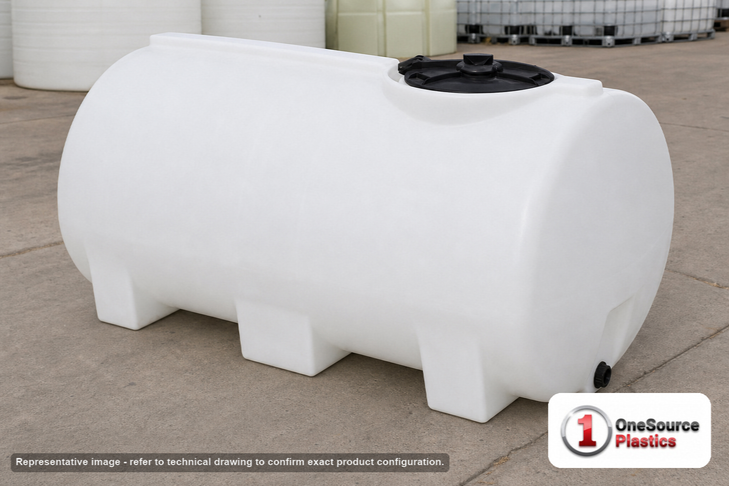
The Snyder SII-1004100C26 puts 335 gallons into a white polyethylene horizontal leg tank only 56 inches long, but 44 inches wide and 49 inches tall, at 116 pounds empty and 116 pounds to ship, molded at Marked Tree, Arkansas. The legs are part of the moulding, flat feet under the body, so it stands on a deck or a floor with no cradle and no stand. The sheet rates the wall at a specific gravity of 1.9, which is where the 5,308 pound maximum contents figure comes from against 2,794 pounds for 335 gallons of water at 8.34 pounds per gallon. It carries a 1.25 inch outlet and a 6 inch threaded vented lid, a service limit of 120 F / 48 C, and a 3 year warranty. Freight is class LTL.
Buying for a site, a fleet or a district? Request a written quote with freight to your ZIP, or add it to your cart above and call 866-418-1777 with any question on the fit.
A compact footprint and 49 inches of height: where the 335 goes
This is the leg tank for a deck that is short. Fifty-six inches of length is less than five feet, which means 335 gallons fits where a six foot tank does not: forward in a pickup bed with the tailgate still usable and the load over the axle, on a compact utility or landscape trailer, on a pallet-sized skid that a forklift sets down and leaves, in a corner of a shop or barn floor as a standing supply, on a three-point carrier behind a tractor. It buys that shortness in the two other directions, and both are real costs to check before you order. Forty-four inches of width is six inches wider than the long tanks in this family, so a mount built between fenders, rails or posts for a narrower tank will not take it. Forty-nine inches of height is over four feet, which is tall for a tank on a bed: it stands above the sides, it is in the mirror's sightline, it will not go under a headache rack or a topper, and filling it through the lid means reaching higher than most people expect. Measure all three before the tank arrives, not after. Underneath, flat and continuous is the requirement. The moulded feet bear through their whole flat area onto whatever they touch, so a bed rib, a toolbox lip, a cupped deck board or a hollow in a slab becomes the bearing point for 2,794 pounds of water, and that is the load that finds every defect in a mounting surface. Plywood or a mat on a ribbed bed, a flat pour on concrete. The compact footprint has one genuine advantage in motion: a short body gives the liquid less run, so the fore and aft surge under braking is milder than on the long tanks, although a part-full load still moves hard enough to need restraint in both directions through the legs. What a leg or applicator tank has to satisfy on the road, and how an agricultural exemption differs from general use, is set out in the applicator and leg tank classification guide. Check 335 gallons against your real duty in the tank sizing calculator, and take the reserve and freeboard from the tank sizing guide.
The 300, the 335 and the 525
| Part | Gallons | Length x width x height | Empty weight |
|---|---|---|---|
| SII-1004100C26 (this tank, shortest, tall) | 335 | 56 x 44 x 49 in | 116 lb |
| SII-1320000C26 (smaller, long and narrow) | 300 | 72 x 38 x 43 in | 92 lb |
| SII-1400000C26 (larger, wider, taller) | 525 | 75 x 48 x 53 in | 124 lb |
The choice between this tank and the SII-1320000C26 is a straight trade of length against width and height, and it is decided by the mount rather than by the thirty-five gallons between them. The 300 is 72 inches long on a 38 inch width at 43 inches tall and 92 pounds: the tank for a long, tight deck. This one is 56 inches long on a 44 inch width at 49 inches tall and 116 pounds: the tank for a short, open deck. Neither is better; they fit different vehicles, and buying the wrong one means fabricating a mount instead of bolting one down. The SII-1400000C26 above is the honest next step when 335 gallons is being refilled too often, at 525 gallons on a 75 by 48 inch base at 53 inches and 124 pounds, and it is worth noting that it only costs eight pounds more empty than this tank while holding nearly two hundred more gallons, which the sheet gives without comment. Against all three, the specification that argues for this tank besides the footprint is the smaller lid it carries: a 6 inch threaded vented lid is a smaller thing to catch, snag or leave loose in transit, and on a tank that travels loaded every day that is a real advantage over a large opening. If instead the liquid is one you will be reaching in to clean, the tanks in this family with larger lids are the better buy and we will say so.
Comparing against another maker? Send the competing spec to 866-418-1777 or a quote request and we will show the differences honestly.
A small threaded vented lid over the largest of the small outlets
- Outlet: a 1.25 inch outlet, as the sheet lists it, at the low end of the body. This is the largest capacity in this family still served by that port size, so it is the one where the arithmetic bites hardest: on 335 gallons a 1.25 inch outlet is a feed fitting for a pump, a spray boom or a hose line, and gravity-draining the whole tank through it takes real time. If the duty is to empty fast into another vessel, tell us at order and we will move you to the tanks in this family with a larger outlet rather than sell you a bottleneck.
- The last gallons: 49 inches of height over a broad floor means a level deck leaves a residue and a tilt toward the outlet does not. Shim the far end of a skid, or park with the outlet end low.
- Valve and first joint: a shut-off valve at the outlet, supported off the deck and never off the tank wall, with a flexible connector before any hard pipe. A short, tall tank has a higher centre of liquid than the long ones, so what reaches the fitting on a hard stop is not gentle.
- No inlet on this sheet, so none is asserted. Filling is through the lid, hose down inside the body, which on a tank standing 49 inches tall means a step and two hands rather than a stretch over the side of a bed.
- Access: a 6 inch threaded vented lid, the smaller opening in this family. Enough for a fill hose, a light and a look; not enough to reach in and scrub. Keep the vent clear, because a tank this size drawn on hard through a blocked vent will pull its own wall in.
- Service limit: 120 F / 48 C, with a 3 year warranty as the sheet gives it.
Give us the liquid at order and the fitting, the gasket and the valve material get matched to it. On a blended fertilizer solution the failure mode is the blend, not the wall: a horizontal body is wide and shallow relative to its volume, which is the geometry in which a blend settles into layers, and a stratified tank will run a spreader off spec long before anybody notices at the fill point. The fertilizer blend stratification guide covers both the physics and the checks, and on a tank with a small lid it is worth reading twice, because the easiest way to verify a blend is to look into the tank and that is precisely what a 6 inch opening makes awkward. In winter, drain the valve, the outlet and the hose and leave the body alone. And get under it at every fill: the feet carry the entire load and they are the part nobody inspects.
Yard tanks, mix stations and job-site transfer
This shape earns its keep where the footprint is fixed and the volume has to be found anyway. The jobs: a yard or mix-station supply tank, filled by bulk delivery and drawn down through the week into smaller rigs; a nurse supply on a compact trailer or a short bed for spraying, fencing or planting crews; water hauled to livestock, to a remote building or to a job site in quantity; wash-down, dust control and equipment rinse water on a construction or landscape deck; starter fertilizer or fluid feed carried to a planter; de-icing brine on a contractor truck where the bed is short; a standing gravity supply on a shop floor, where 49 inches of height puts the outlet comfortably above a pail or a drum. Two limits worth stating rather than implying. There is no secondary containment on this tank, so where the rules say the liquid has to be contained this is not the product and the contained version is a different build entirely. And the 120 F / 48 C service limit on this sheet covers the liquid and the tank standing loaded in the sun, which on an Arkansas or Texas deck in July is a number you can reach. Past that, the thing that ends a leg tank early is never the polyethylene: it is a strap over the body instead of anchors through the feet, rigid pipe bolted to the outlet, or a part-full load driven fast.
What this tank is listed to hold
Each line is a liquid the resin is rated for, at the concentration shown, with the fitting and gasket to order. Follow the link for the full rating, or search the chemical compatibility database before ordering.
- acetic acid (60%)
- aluminum sulfate (50%)
- calcium chloride (40%)
- DEF (32.5%)
- ethylene glycol (100%)
- ferric chloride (50%)
- ferric sulfate (60%)
- ferrous sulfate (20%)
- hydrochloric acid (37%)
- hydrofluoric acid (48%)
- hydrofluosilicic acid (26%)
- hydrogen peroxide (50%)
- magnesium chloride (30%)
- peracetic acid (30%)
- phosphoric acid (85%)
- polyaluminum chloride
- potassium carbonate (50%)
- potassium hydroxide (saturated)
- propylene glycol
- sodium bisulfate
- sodium bisulfite
- sodium carbonate (30%)
- sodium hypochlorite (<16.5%)
- sodium thiosulfate (40%)
- sulfuric acid (98%)
- urea solution (50%)
- zinc orthophosphate and ozonated water (up to 10 PPM). The fitting and gasket materials are not interchangeable across these chemistries - per the chart, hydr
116 pounds out of Arkansas, and how it comes off the truck
The SII-1004100C26 is molded at Marked Tree, Arkansas and moves as freight at class LTL as the sheet lists it, at 56 by 44 by 49 inches, 116 pounds empty and 116 pounds to ship. The freight cost estimator prices the lane to your ZIP, and the listed price is before freight. A hundred and sixteen pounds in a body 49 inches tall is where a leg tank stops being a two-person carry and becomes a two-person carry with a plan: it is tall, it is awkward to get hands under, and it must come down on its feet rather than on a corner. A forklift or a telehandler is better if you have one, and a pallet jack works while it is still on its pallet. Tell us at order whether the address has a dock or a forklift, because a tank this shape at a field gate is a curbside drop. Do not drag it, and do not tip it onto a rim to walk it; both damage feet that carry everything afterwards. Have the mount ready first, then water-test it in place: fill to the lid, stand it, drive it gently if it is mobile, and inspect the feet, the mounting surface, the outlet and the lid seal afterwards. Stencil the outlet size beside the fitting while the tank is still clean; it is the detail the person ordering the replacement valve never has to hand. Save the pallet; a tank that ever has to move again is easier to move on it.
Freight and documents
Ships from: Marked Tree, AR. LTL freight is quoted to your ZIP with the freight cost estimator or by phone at 866-418-1777. The listed price is before freight.
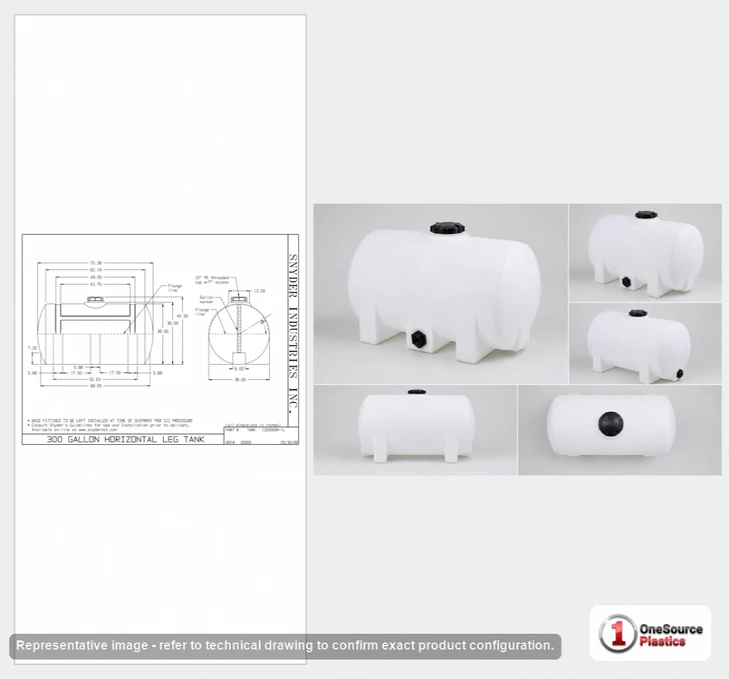
Technical drawing (PDF) for Snyder Industries 1004100C26.
See this tank
Interactive 3D model with live fill. This tank has an interactive 3D model built to its manufacturer dimensions. Rotate it, and set a fill level to see how much liquid it holds at any height. Open the 3D view on the product photo above. Download the 3D model (GLB).
Product video. Watch the Snyder Industries 335 Gallon Plastic Horizontal Leg Tank video (71 seconds) with dimensions, fittings and shipping notes.
Ready to order?
Add it to your cart at the top of this page, get LTL freight to your ZIP, request a written quote, or call 866-418-1777. The listed price is before freight.