525 gallons, and the step up to a 2 inch outlet
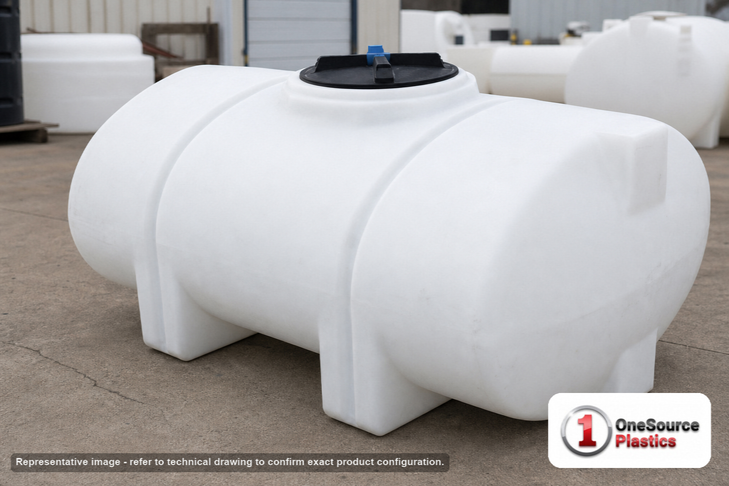
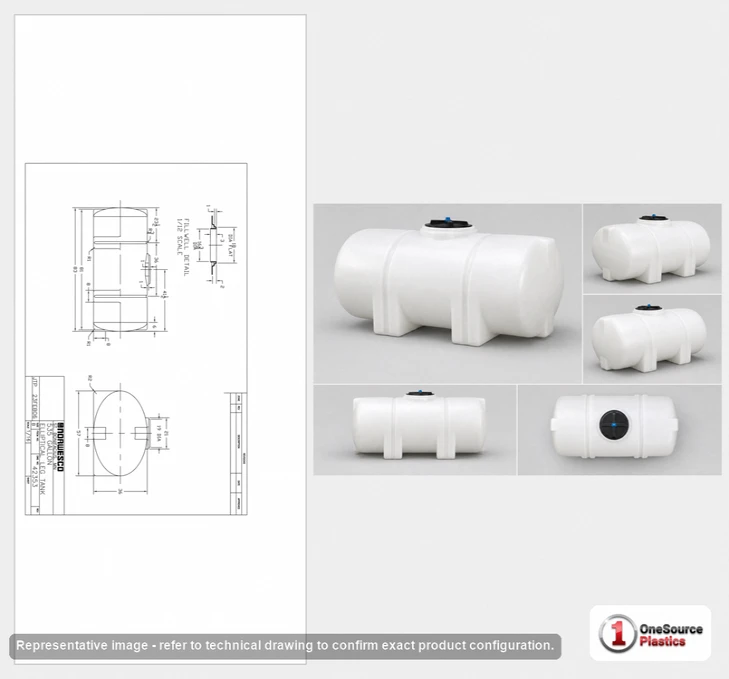
A 2 inch outlet is what separates the Snyder SII-1400000C26 from everything smaller in this family. It is a 525 gallon horizontal leg tank in white polyethylene, 75 inches long, 48 inches wide and 53 inches tall, 124 pounds empty and 124 pounds to ship, molded at Lincoln, Nebraska or Philippi, West Virginia. The legs are moulded into the body as flat feet, so it stands on a deck or a floor with no cradle and no stand. The sheet rates the wall at a specific gravity of 1.9, which is where the 8,319 pound maximum contents figure comes from against 4,378 pounds for 525 gallons of water at 8.34 pounds per gallon. It carries a 10 inch threaded vented lid, a service limit of 120 F / 48 C, and a 3 year warranty. Freight is class LTL.
Ready to price it? The listed price is before freight; quote freight to your ZIP in a few seconds, then add to cart above or call 866-418-1777.
A 75 by 48 inch base: the skid, the flatbed and the pad
At 525 gallons the mount stops being a detail and becomes the purchase. Full of water this tank carries 4,378 pounds, and up to 8,319 pounds of contents at the rating, which rules out most light vehicles immediately: a half-ton pickup is out, a three-quarter-ton with a full load is at its limit, and the honest homes for this tank are a flat-deck or gooseneck trailer with a rated deck, a purpose-built skid that a forklift or a loader sets down, a flatbed truck, or a slab where it stands as a fixed supply. Seventy-five inches long by 48 inches wide is the footprint to plan around, and 48 inches of width is the number that catches people out: four feet across is wider than the tanks below it in this family, so a mount built between fenders or rails for a narrower tank will not take it. Fifty-three inches of height puts the lid above the sides of any bed and out of reach without a step. Where it stands on a slab rather than a deck, treat the slab as the installation: the moulded feet bear through their whole flat area onto whatever they touch and nothing else, so level, continuous and in full contact is the requirement, poured wider than the tank, and the framework for doing it properly rather than by rule of thumb is in the loaf-style portable utility tank guide as far as the road side goes, with the classification question for a travelling tank covered in the applicator and leg tank classification guide. Read both before the tank is mounted, not after the first ticket. The surge is the other design load and it is serious here: 525 gallons running along a 75 inch body under a hard stop puts thousands of pounds into the tie-downs, worst at part-full, so the restraint is engineered through the legs into rated structure in both directions rather than thrown over the top. Confirm the volume is right before you commit to a mount this substantial: run 525 gallons against your draw and refill cycle in the tank sizing calculator, and take the working reserve and the freeboard a warming liquid needs from the tank sizing guide.
525 or 535: the two big leg tanks on this sheet
| Part | Gallons | Length x width x height | Empty weight |
|---|---|---|---|
| SII-1400000C26 (this tank, 48 inches wide, 53 tall) | 525 | 75 x 48 x 53 in | 124 lb |
| SII-1400300C26 (longer, narrower, lower) | 535 | 78 x 47 x 52 in | 124 lb |
| SII-1004100C26 (smaller, shortest) | 335 | 56 x 44 x 49 in | 116 lb |
These two big tanks are listed at the same 124 pounds empty and within ten gallons of each other, so the sheet gives you no help from the weight column and the decision is the rectangle and the lid. This tank is the shorter and wider of the pair: 75 inches long on a 48 inch width at 53 inches tall. The SII-1400300C26 is three inches longer, an inch narrower and an inch lower. On a deck where length is limited and width is free, this is the one that fits; on a deck where the rails are four feet apart or a cover comes down at 52 inches, the other one is. The second difference is access, and it matters more in service: this tank carries a 10 inch threaded vented lid, which is a proper opening for a fill hose and a light, while the other carries a larger lid the sheet lists as a bare size. Choose by the mount first and the lid second. Below both, the SII-1004100C26 is the compact 335 at 56 by 44 by 49 inches and 116 pounds, and the sheet's own numbers make the case for stepping up: eight more pounds empty buys nearly two hundred more gallons, and the bigger tank brings a larger outlet with it. What it also brings is a mounting job an order of magnitude more serious, which is the part nobody budgets for.
Want us to check the fit? Send the site dimensions to 866-418-1777 or through a written quote request and we will confirm the tank, the pad and the freight.
Two inches out, and the pump that finally earns its keep
- Outlet: a 2 inch outlet, as the sheet lists it, at the low end of the body above the legs. This is the specification that makes a big leg tank practical rather than merely large. Two inches will feed a transfer pump at a rate that empties the tank in a sensible time, it will run a spray boom without starving it, and it will gravity-drain into a sump or a smaller vessel rather than trickling. The smaller tanks in this family carry a narrower port; if you have ever waited on one of those to empty, this is the fitting you were waiting for.
- The pump: with 53 inches of body there is better than four feet of standing liquid over the fitting, which is real suction head if the pump is below the outlet. Put it low, on its own base off the deck, with a short run that falls into the suction port; lift the pump level with the tank and the same installation loses prime at the end of every draw and sounds like a failing pump instead of a bad layout.
- Valve and first joint: a shut-off at the outlet carried on its own support, and a flexible connector before any rigid pipe. With 4,378 pounds of water surging along a 75 inch body, a hard line bolted from a 2 inch fitting to a pump bracket is a fitting failure waiting for the first emergency stop.
- No inlet on this sheet, so none is asserted. Filling is through the lid, which at 53 inches up means a step, two hands and a hose run down inside the body rather than a splash across the surface.
- Access: a 10 inch threaded vented lid. Keep it closed in transit and keep the vent clear, because a 2 inch outlet can pull air out of a tank faster than a blocked vent can let it back in, and that is how a polyethylene wall gets drawn inwards.
- Service limit: 120 F / 48 C, with a 3 year warranty as the sheet gives it.
Tell us the liquid at order and the fitting, the gasket and the valve material get matched against Snyder's current documentation. Two cautions specific to this size. On a blended fertilizer solution, a wide, shallow horizontal body is where layers form, and a stratified 525 will run a spreader off spec across a lot of acres before anyone checks, which the fertilizer blend stratification guide works through with the verification methods that catch it. And where the site requires containment, a single-wall leg tank does not provide any, at this volume least of all; the Captor double wall containment walkthrough sets out what a contained installation has to do to count. In winter, drain the valve, the outlet and the hose.
Bulk transfer, brine hauling and fill-station duty
Five hundred and twenty-five gallons with a 2 inch outlet is a transfer tank rather than a supply tank, and the duties change accordingly. A nurse or tender tank on a rated trailer that refills a sprayer in minutes instead of coaxing it through a small port. A brine tank on a contractor or municipal rig, loaded at a plant and discharged through a pump. Bulk water hauled to stock, to a drilling or fencing crew, or to a site with no service. A skid-mounted fill station in a yard, fed by bulk delivery and discharging into smaller rigs through the day. Fluid feed or starter fertilizer moved from a bulk tank to a planter. Wash-down and dust-control water for a construction spread, where the tank lives on a deck all season. A standing supply on a slab where the outlet feeds a fixed pump. The pattern is that something pumps out of this tank regularly, which is exactly what the larger outlet is for and exactly why the mount has to be engineered rather than improvised. Two honest limits. No secondary containment: where the liquid must be contained, this is not the product. And 120 F / 48 C is the sheet's service limit for the liquid and for the tank sitting loaded in the sun, which matters more at this volume because a full tank takes all day to cool down.
Chemical ratings on record for this resin
What the manufacturer lists for this resin, liquid by liquid, with the concentration ceiling and the fitting and gasket material. Your concentration and temperature get checked on the linked page or in the chemical compatibility database before ordering.
- Acetic acid (60%, PP/PVC fittings, EPDM gaskets)
- aluminum sulfate (50%, PVC, EPDM)
- calcium chloride (40%, PVC, EPDM)
- DEF (32.5%, 316SS, EPDM)
- ethylene glycol (100%, PVC, EPDM)
- ferric chloride (50%, PVC, EPDM)
- ferric sulfate (60%, PVC, EPDM)
- ferrous sulfate (20%, PVC, EPDM)
- hydrochloric acid (37%, PVC, Viton)
- hydrofluoric acid (48%, PP/PVC, Viton)
- hydrofluosilicic acid (26%, PP/PVC, Viton)
- hydrogen peroxide (50%, PVC, Viton)
- magnesium chloride (30%, PVC, EPDM)
- peracetic acid (30%, 316SS, Aflas)
- phosphoric acid (85%, PVC, Viton)
- polyaluminum chloride (PVC, EPDM)
- potassium carbonate (50%, PVC, EPDM)
- potassium hydroxide (saturated, PVC, EPDM)
- propylene glycol (PP/316SS, EPDM)
- sodium bisulfate (PVC/PP, EPDM)
- sodium bisulfite (PVC/PP, EPDM)
- sodium carbonate (30%, PVC, EPDM)
- sodium hypochlorite (under 16.5%, PVC, Viton)
- sodium thiosulfate (40%, PVC, EPDM)
- sulfuric acid (98%, CPVC, Viton)
- urea solution (50%, PP/PVC, EPDM), and
- zinc orthophosphate (PP/316SS, EPDM). Ozonated water (up to 10 PPM, PVC, EPDM) is also compatible. Match the listed fitting and gasket materials exactly, and r
Two plants, 124 pounds, and a load nobody lifts alone
The SII-1400000C26 is molded at Lincoln, Nebraska and Philippi, West Virginia, so the middle and the east of the country have short lanes to it, and it moves at class LTL as the sheet lists it, at 75 by 48 by 53 inches, 124 pounds empty and 124 pounds to ship. The freight cost estimator prices the lane to your ZIP, and the listed price is before freight. A hundred and twenty-four pounds sounds manageable and the dimensions are why it is not: better than six feet long, four feet wide and over four feet tall is a load two people cannot get hands around, so arrange a forklift, a telehandler or a loader with straps under the body before the truck is booked, and tell us at order what is available at the address. It comes down on its feet, level, never on a corner and never dragged. Have the deck or the slab finished, cured and level first, with the anchors set, because moving a tank this size twice is the expensive mistake. Then fill it with clean water on its final mount, let it stand, look at the feet, the bearing surface, the 2 inch fitting and the lid seal, and only then trust it with product. Photograph the outlet from below before the pipework goes on; a slow weep is far easier to compare against a photograph than against a memory. A photo of the tank on its pad, full, on day one is worth keeping; it is the baseline every later inspection is compared against.
Freight and documents
Ships from: Lincoln, NE; Philippi, WV. LTL freight is quoted to your ZIP with the freight cost estimator or by phone at 866-418-1777. The listed price is before freight.
Technical drawing (PDF) for Snyder Industries 1400000C26.
See this tank
Interactive 3D model with live fill. This tank has an interactive 3D model built to its manufacturer dimensions. Rotate it, and set a fill level to see how much liquid it holds at any height. Open the 3D view on the product photo above. Download the 3D model (GLB).
Product video. Watch the Snyder Industries 525 Gallon Plastic Horizontal Leg Tank video (65 seconds) with dimensions, fittings and shipping notes.
Ready to order?
Add it to your cart at the top of this page, get LTL freight to your ZIP, request a written quote, or call 866-418-1777. The listed price is before freight.