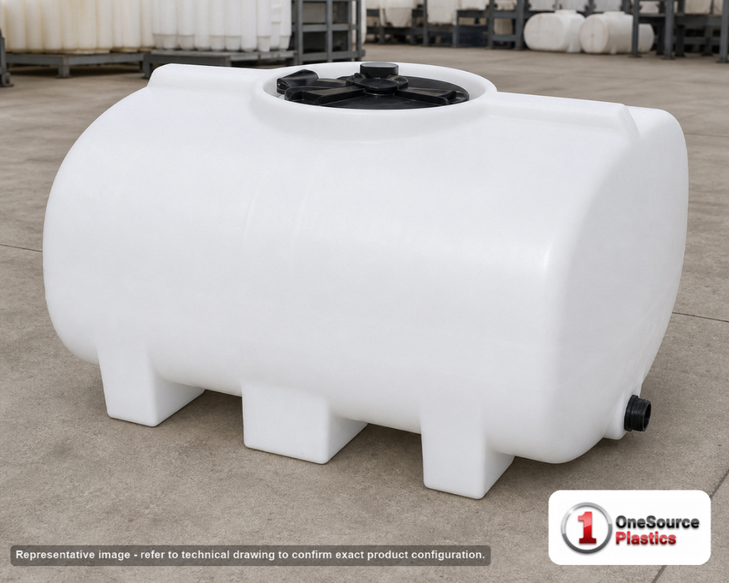
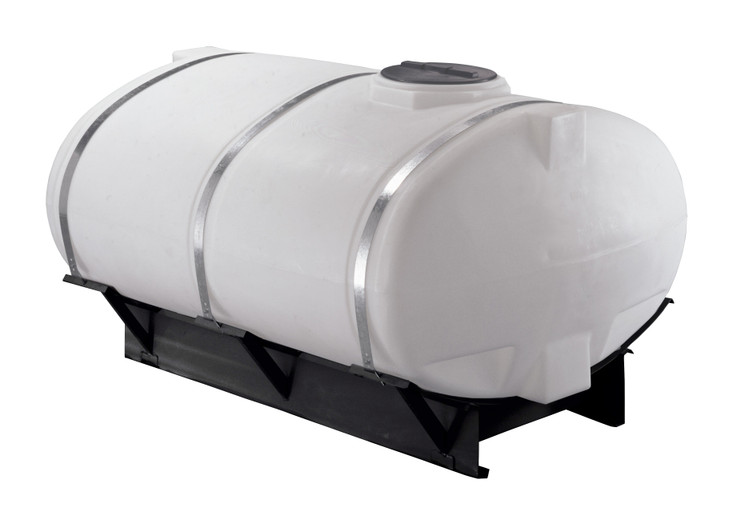
300 gallons on a 72 inch long leg tank body
Six feet of body for 300 gallons: the Snyder SII-1320000N45 is a white polyethylene horizontal leg tank 72 inches long, 38 inches across and 43 inches tall, 91 pounds empty, with legs molded under it. The sheet rates the wall at a specific gravity of 1.9 and lists 4754 pounds of contents against the 2502 pounds that 300 gallons of water weigh at 8.34 pounds per gallon. The fittings it names are one outlet, given as 1.25 inches, and a 10 inch lid; no inlet is listed. The service limit is 120 F / 48 C and the sheet publishes no warranty term. Freight is LTL, NMFC 156600-02, molded at Lincoln, Nebraska and Philippi, West Virginia.
Replacing a tank that failed? Call 866-418-1777 with what it held and how long it lasted; or check freight to your ZIP and put the 300 gallon tank in your cart above.
Same 300 gallons, longer body, heavier tank
Four tanks on this sheet hold 300 gallons and they come in two shells. This one and the SII-1320000N42 are the 72 inch bodies, 38 inches across and 43 inches tall, both listed at 91 pounds; the SII-1321000C26 and the SII-1321000N45 are the 68 inch bodies, taller at 44 inches and listed at 67 pounds. So the choice inside one capacity is a longer, lower body at 91 pounds against a shorter, taller one at 67, and the sheet gives both figures without explaining the gap. Take the 72 inch body when the deck, the frame or the pad is already six feet long and you would rather have the load spread along it than stacked into a shorter, taller shell: a longer body puts less liquid depth over the legs, sits an inch lower, and lines up naturally on a standard utility bed or a six foot trailer frame. Take a 68 inch tank instead if weight is the binding constraint, and accept the extra inch of height. Either way the mount is the job. Legs need bearing along their whole length, on a deck or boards running the full 72 inches rather than two cross members, and on the ground a flat pad rather than dunnage at the ends. Pad the straps and run them over the body, re-tensioning after the first loaded mile. There is no baffle inside, so 2502 pounds of water in a six foot body will shove at every stop; haul it full or haul it empty, never half. Put 300 gallons against your actual draw in the tank sizing calculator, and take the reserve and the expansion allowance from the tank sizing guide.
Four 300s in two shells
| Part | Gallons | Length x width x height | Empty weight |
|---|---|---|---|
| SII-1320000N45 (this tank, long body) | 300 | 72 x 38 x 43 in | 91 lb |
| SII-1320000N42 (same body, cross-linked polyethylene) | 300 | 72 x 38 x 43 in | 91 lb |
| SII-1321000C26 (short body, lighter, taller) | 300 | 68 x 38 x 44 in | 67 lb |
| SII-1321000N45 (short body, lighter, taller) | 300 | 68 x 38 x 44 in | 67 lb |
| SII-1280000N45 (smaller, shortest body) | 230 | 52 x 38 x 43 in | 68 lb |
| SII-1004100N45 (larger, wider, tallest) | 335 | 56 x 44 x 49 in | 116 lb |
The nearest tank to this one is the SII-1320000N42, the same 72 by 38 by 43 inch body at the same 91 pounds, whose own name calls it cross-linked polyethylene; where your specification calls for that material rather than this one, that is the part number, and nothing else on the sheet separates them. The pair of 68 inch tanks are the lighter option at 67 pounds, shorter in the body and 44 inches tall, listed identically as a C26 and an N45. Either side of 300 gallons, the SII-1280000N45 is the compact 230 at 52 inches long and 68 pounds, which is the tank for a short bed, and the SII-1004100N45 is the 335 at 56 by 44 by 49 inches and 116 pounds, which trades length for width and height and is the heaviest of the group. Read that last one carefully if the deck is short: it holds more than this tank in a body only 56 inches long, at the price of a 44 inch width and a 49 inch height. This page is the long, low 300 with a 10 inch lid and a 1.25 inch outlet.
Want the certified one or the plain one? Call 866-418-1777 and say what the inspector asks for; or request a quote on the row you need.
The 10 inch opening and what has to fit through it
- Vent: the sheet gives a 10 inch lid and names no vent in it, so treat a vented lid or a breather as part of the order rather than an assumption. A closed 300 gallon body draining through a small fitting is slow, and slow is exactly when nobody notices the wall pulling in; a clear screen and a breather sized to the draw settle it.
- Headspace: 300 gallons is the rated volume and no separate fill line is published. The air above the liquid is what absorbs expansion and the surge a six foot body makes on a rough road, so leave it and never fill to the rim of the opening.
- Access: 10 inches is an inspection and cleaning opening, not an entry, and on a 72 inch body that means whatever goes in to check or wash the inside has to pass through it, which is worth knowing before you choose a product that settles. A light and a camera on a pole beat guesswork.
- Outlet: the sheet lists one outlet at 1.25 inches, and names no inlet, so the lid is the fill point. An inch and a quarter suits gravity feed, a hand wand or a small pump; it will not empty 300 gallons quickly, and pretending otherwise is how a fitting gets over-torqued.
- Limits: 120 F / 48 C, and 4754 pounds of contents at a specific gravity of 1.9 as the sheet gives it. The sheet publishes no warranty term.
The fitting is the whole maintenance story on a tank this size. Flexible at the first joint, first valve on its own support rather than hanging off the tank, and the valve tucked inboard of the frame where a ramp or a gate cannot find it. Check it after the first loaded mile, then after the first month, then leave it alone. In freezing weather protect the valve and the short exposed run and let the body take the cold. And keep the spare gasket in the truck, not in the stores, because a leg tank that fails does it a long way from a parts counter.
Utility water, mix water and applicator duty
Three hundred gallons on a six foot body is the working size for a vehicle or a small skid: water hauled to stock, a mix and rinse supply on a service truck, a spot sprayer or a weed control rig on a right of way, dust control on a small job, a modest supply of a single process liquid, and nurse duty behind a sprayer on a farm. On blended fertilizer the tank is the easy part and the load is the hard part, because a blend that stands between jobs layers and the spreader is where you find out; the thermal layering, the density-driven salting out, the mixing protocol and the field verification that catch it are all in the fertilizer blend stratification guide. Before a tank this size is mounted on a trailer for applicator work, the applicator and leg tank scope article explains where the non-roadable trailer boundary falls, which is cheaper to read than to litigate. Where the site wants the liquid contained rather than carried, the double wall walkthrough for 40 CFR 112 is the honest comparison between a contained vessel and a single wall inside a berm.
Rated liquids and the fittings to order with them
The resin carries a rating for each liquid below at the concentration shown, and each line names the wetted fitting and gasket to specify. Confirm the service you actually run on the chemical page or in the chemical compatibility database before ordering.
- Acetic Acid (60%, PP/PVC fittings, EPDM gaskets)
- Aluminum Sulfate (50%, PVC, EPDM)
- Calcium Chloride (40%, PVC, EPDM)
- DEF (32.5%, 316SS fittings, EPDM)
- Ethylene Glycol (100%, PVC, EPDM)
- Ferric Chloride (50%, PVC, EPDM)
- Ferric Sulfate (60%, PVC, EPDM)
- Ferrous Sulfate (20%, PVC, EPDM)
- Hydrochloric Acid (37%, PVC, Viton)
- Hydrofluoric Acid (48%, PP/PVC, Viton)
- Hydrofluosilicic Acid (26%, PP/PVC, Viton)
- Hydrogen Peroxide (50%, PVC, Viton)
- Magnesium Chloride (30%, PVC, EPDM)
- Peracetic Acid (30%, 316SS, Aflas)
- Phosphoric Acid (85%, PVC, Viton)
- Polyaluminum Chloride (PVC, EPDM)
- Potassium Carbonate (50%, PVC, EPDM)
- Potassium Hydroxide (saturated, PVC, EPDM)
- Propylene Glycol (PP/316SS, EPDM)
- Sodium Bisulfate (PVC/PP, EPDM)
- Sodium Bisulfite (PVC/PP, EPDM)
- Sodium Carbonate (30%, PVC, EPDM)
- Sodium Hypochlorite (under 16.5%, PVC, Viton)
- Sodium Thiosulfate (40%, PVC, EPDM)
- Sulfuric Acid (98%, CPVC, Viton)
- Urea Solution (50%, PP/PVC, EPDM)
- Zinc Orthophosphate (PP/316SS, EPDM), and Ozonated Water (up to 10 PPM, PVC, EPDM - chart-listed only, no dedicated page yet). Watch how the wetted metal and g
Lincoln or Philippi, and a tank that rides inside the trailer
The sheet lists two plants, Lincoln, Nebraska and Philippi, West Virginia, and gives the freight class as LTL with NMFC 156600-02, shipping at 72 inches by 38 inches by 43 inches. At 91 pounds this is ordinary freight that rides inside a trailer, which is the real difference between a tank this size and the oversize tanks further up the family: no permit, no escort, and no crane at the far end. The freight cost estimator prices the lane to your ZIP, and the listed price is before freight. Ask about the liftgate and the dock before the rate, because six feet of empty tank is awkward rather than heavy and it usually gets unloaded by two people. Once it is here, fill it with water on the mount it will live on and watch the legs and the outlet through the hold rather than testing it on a shop floor it will never see again. Write the date of that first fill on the tank with a paint marker; it is the one piece of history that survives every other record on a vehicle. Keep one spare gasket for the outlet fitting on the shelf; it is the part that fails on a holiday.
Freight and documents
Ships from: Lincoln, NE; Philippi, WV. LTL freight is quoted to your ZIP with the freight cost estimator or by phone at 866-418-1777. The listed price is before freight.
Technical drawing (PDF) for Snyder Industries 1320000N45.
See this tank
Interactive 3D model with live fill. This tank has an interactive 3D model built to its manufacturer dimensions. Rotate it, and set a fill level to see how much liquid it holds at any height. Open the 3D view on the product photo above. Download the 3D model (GLB).
Product video. Watch the Snyder Industries 300 Gallon Plastic Horizontal Leg Tank video (64 seconds) with dimensions, fittings and shipping notes.
Ready to order?
Add it to your cart at the top of this page, get LTL freight to your ZIP, request a written quote, or call 866-418-1777. The listed price is before freight.