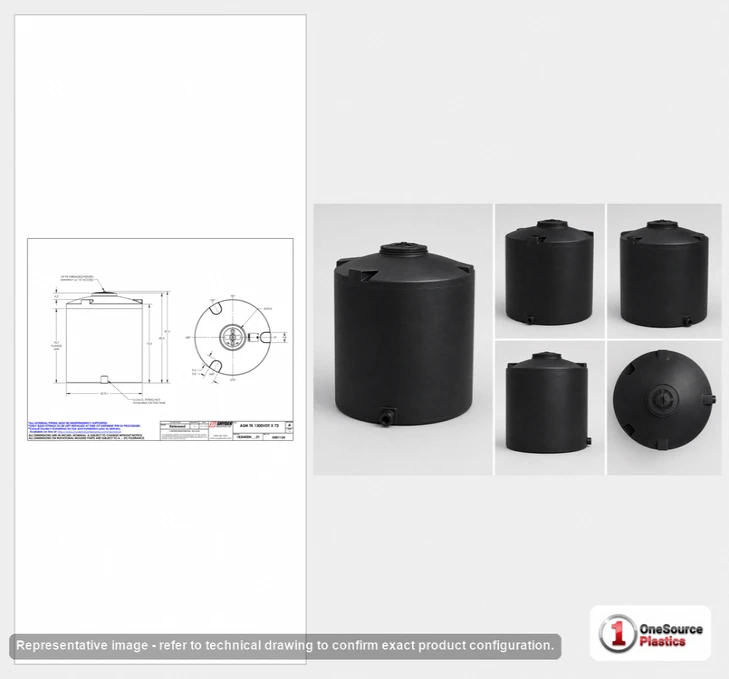
A nine foot tank rated 1.5, holding 1,200 gallons on 60 inches of floor
The Snyder 1830200N46 is the 1.5-rated wall in the tall 1,200 gallon shell: 60 inches across, 109 inches tall, black cross-linked polyethylene, 300 pounds empty. The sheet reads that rating as 15,012 pounds of maximum contents where plain water at 8.34 pounds per gallon puts 10,008 pounds inside. The top opening is an 18 inch threaded, vented manway, the outlet field reads "1 Manway / Lid", the warranty is 3 year, the service limit is 140 F / 60 C, and freight is class 300 out of Chowchilla, California.
Replacing a tank that failed? Call 866-418-1777 with what it held and how long it lasted; or check freight to your ZIP and put the 1200 gallon tank in your cart above.
Same tall shell, the 1.5 wall
Four part numbers share this 60 by 109 inch shell, and the only thing that separates them is what the sheet says the wall will carry. This one says 1.5 and 15,012 pounds of maximum contents, at 300 pounds empty; the heavy-duty part numbers in the same shell are listed at 310 pounds with the ratings their own sheets give. For water, most municipal treatment chemistry, and the fertiliser and wash chemistry a co-op or a fleet shop handles at this volume, 1.5 is the correct wall and the heavier grade is money spent on a margin nobody will use. What it is not is a tank you re-purpose later without checking the density of the new liquid against the rating on the tank card. Everything else about siting it is a consequence of the shape. This is a tank nearly twice as tall as it is wide, so the load concentrates: 10,008 pounds of water and 15,012 at the rating, all of it on a 60 inch circle, because a rotationally molded floor bears on its whole floor and nothing else. That slab gets engineered to the concrete pad sizing guide, level and in full contact, inside a berm sized to the tank where the liquid is regulated. Then band it. An empty shell nine feet one inch tall at 300 pounds has the highest centre of gravity of any 1,200 gallon tank we sell, and it wants anchors in the slab or bands to structure in the upper third on day one, checked again after the first storm and at the end of the first summer, because a black wall grows a little in the sun every day. Black passes no light into the liquid, takes the ultraviolet that ages a white shell, and hides the level, so the gauge is a sender read at eye height rather than a look over the rim. Take 1,200 gallons to the tank sizing calculator against your feed rate and delivery interval, and take the reserve and the warm-weather freeboard from the tank sizing guide.
1,200 gallons four ways, and the neighbours above and below
| Part | Gallons | Diameter x height | Empty weight |
|---|---|---|---|
| 1830200N46 (this tank, black, rated 1.5) | 1,200 | 60 x 109 in | 300 lb |
| 1830200N40 (black) | 1,200 | 60 x 109 in | 300 lb |
| 1830200N48 (black, heavy duty) | 1,200 | 60 x 109 in | 310 lb |
| 1830200N42 (black, heavy duty) | 1,200 | 60 x 109 in | 310 lb |
| 1830400N40 (1,300 gallons, squatter) | 1,300 | 72 x 87 in | 290 lb |
| 1710000C26 (1,100 gallons, flat) | 1,100 | 86 x 55 in | 160 lb |
Within the shell, the decision is the rating and the listed weight, and each of the other three carries what its own sheet gives. Outside it, the decision is the building. The 1830400N40 holds a hundred gallons more in a tank a foot and a half shorter on a 72 inch base, which is the right swap whenever the pad is generous and the ceiling is not. The 1710000C26 gives up the height entirely, 1,100 gallons on an 86 inch base at 55 inches, low enough to see into and light enough at 160 pounds for two people to place. This part number stays the pick when the floor plan is the constraint, the ceiling is clear, and the liquid is no denser than the 1.5 wall is rated for.
Want the certified one or the plain one? Call 866-418-1777 and say what the inspector asks for; or request a quote on the row you need.
Fill, vent and freeboard on the 109 inch shell
- Vent: the sheet lists an 18 inch threaded, vented manway. The vent has one job during a delivery, which is to let air out faster than the pump puts liquid in; on a 60 inch shell the level climbs quickly, so a vent path that is adequate on a wide tank can be marginal here. Size it to the truck's pump and keep it clear of dust and insects between deliveries.
- Fill: a dip tube to the floor. A fill dropped down 109 inches of empty tank foams the liquid, generates static in the products that carry it, and hammers the wall.
- Headspace: leave the freeboard the sizing guide gives for expansion at 140 F / 60 C. In a tall shell, a warm afternoon shows up as inches at the top, and the manway rim is not a level gauge.
- Outlet: the outlet field on this sheet reads "1 Manway / Lid" and gives no bottom fitting size; the draw-off connection is specified at order against the liquid you name.
- Access: a platform with a rail for whoever opens a lid nine feet up, and a hand free while they do it.
- Service limit: 140 F / 60 C. Warranty: 3 year.
Below the tank, the rules are the ones that keep polyethylene alive: the first valve on its own support off the pad, a flexible connector between the tank fitting and hard pipe so thermal movement and pump vibration never reach the shell, a pump below the take-off for a gravity prime, and a low-level float so it stops before it pulls air. Keep the lid closed between deliveries, write the liquid on the wall, and light the band of wall above the liquid line each time the manway is open. In a freezing climate the valve and the first pipe run get the trace heat; the shell can ice from the top down without harm.
Treatment chemicals at 1,200 gallons
A municipal chemical room with a five foot square of floor to spare, a food plant sanitation room, a fleet shop blending wash chemistry, a greenhouse with a fertiliser feed: all buy this volume and all fit what a 1.5 wall is rated to hold. Where the tank is one stage in a reuse train rather than a standalone, the industrial water reuse tank topology article places a tank of this size against the stages around it. Water is well inside the rating, so nothing stops this tank holding it, but a fire reserve is designed to its own rules and the fire-water reservoir design guide explains why that job gets a tank bought for it.
What a nine foot tank costs to move
The 1830200N46 is listed out of Chowchilla, California at freight class 300, and its narrow 60 inch base is why: it takes less deck than a wide tank of the same volume and rides upright inside a standard trailer. The freight cost estimator prices the lane to your ZIP and the listed price is before freight. Take 300 pounds off the truck with a strap around the body, never through the manway, and stand it on the pad with the bands and anchors already in place. Water to the manway first, held while somebody walks the base looking for movement at the pad edge, then drained and dried before the real liquid arrives. Write the date of that first fill on the manway with a paint marker; it is the first thing anyone will want to know about this tank in five years. Keep one spare gasket for the outlet fitting on the shelf; it is the part that fails on a holiday.
Freight and documents
Ships from: Chowchilla, CA. LTL freight is quoted to your ZIP with the freight cost estimator or by phone at 866-418-1777. The listed price is before freight.
Technical drawing (PDF) for Snyder Industries 1830200N46.
See this tank
Interactive 3D model with live fill. This tank has an interactive 3D model built to its manufacturer dimensions. Rotate it, and set a fill level to see how much liquid it holds at any height. Open the 3D view on the product photo above. Download the 3D model (GLB).
Ready to order?
Add it to your cart at the top of this page, get LTL freight to your ZIP, request a written quote, or call 866-418-1777. The listed price is before freight.