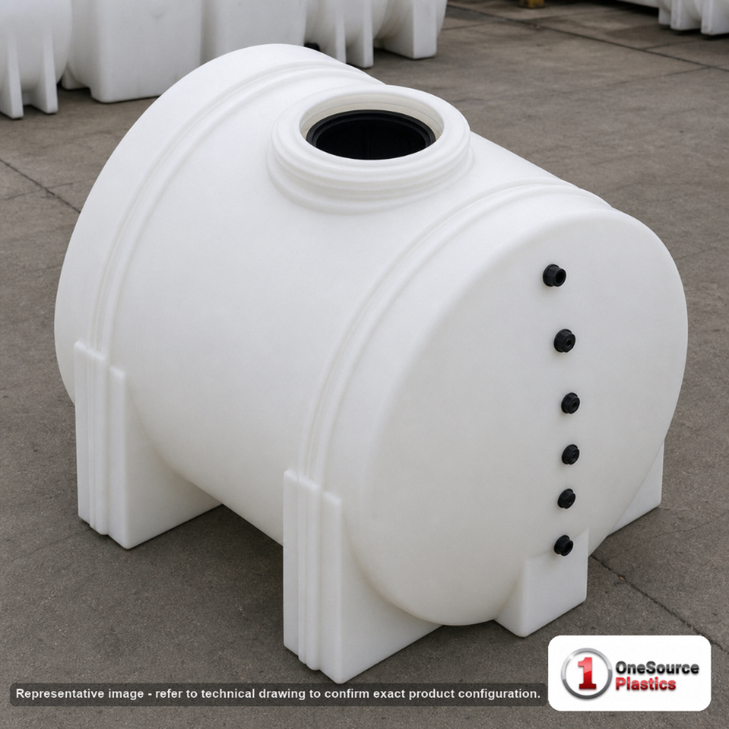
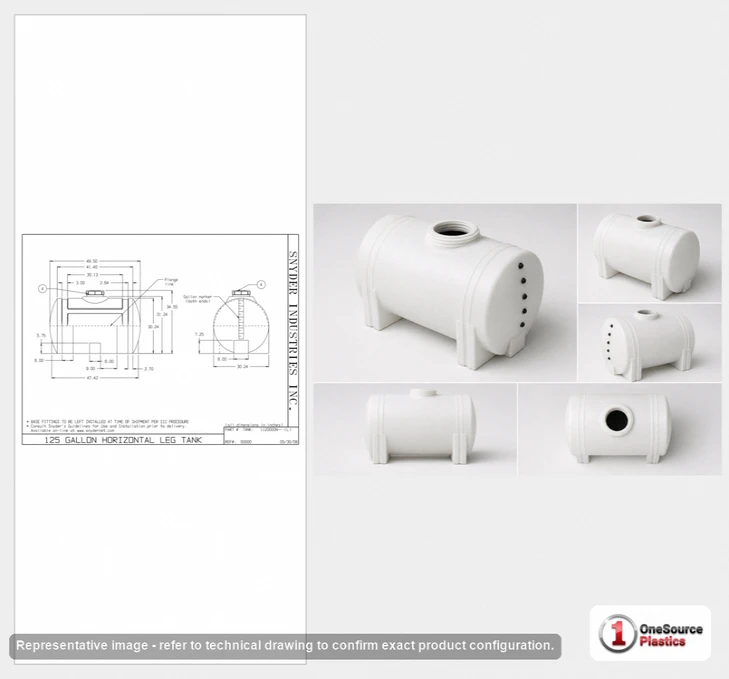
125 gallons on legs, 44 inches long and 32 inches wide
The Snyder SII-1003600C26 is a 125 gallon horizontal leg tank in white polyethylene, 44 inches long, 32 inches wide and 35 inches tall, 55 pounds empty and 55 pounds to ship, molded at Marked Tree, Arkansas. A leg tank is a tank with its own flat-bottomed feet molded into the body: it sits down on a deck or a floor and needs no cradle, no saddle and no stand. The sheet rates the wall at a specific gravity of 1.9, which is where the 1,981 pound maximum contents figure comes from against 1,042 pounds for 125 gallons of water at 8.34 pounds per gallon. It carries a 1.25 inch outlet and a 6 inch threaded vented lid, a service limit of 120 F / 48 C, and a 3 year warranty. Freight is class LTL.
Talk to a person first? 866-418-1777 reaches a tank specialist, not a call center; or see freight to your ZIP and add the 125 gallon tank to your cart above.
Where the legs land: a pickup bed, a skid, or a flat shop floor
Buy this one for the footprint it puts on a deck. Forty-four inches long by 32 inches wide is a compact rectangle, and the legs molded into the underside are what make it usable: they give the body a flat bearing surface, they keep the outlet corner clear of the deck, and they let the tank be bolted or strapped down through its own structure instead of cinched around its middle. Where it goes is a short list and all of it is flat. A pickup bed, sitting forward against the bulkhead where the weight is over the axle rather than behind it. A utility trailer or a flat-deck skid, bolted to the deck so it cannot walk. A three-point or hitch-mounted carrier on a tractor. A shop or barn floor as a standing supply, where the 32 inch width lets it live against a wall in a walkway. In all of those the deck does the work, so the deck is what to inspect: a leg tank on a bed with a toolbox lip, a raised wheel well, a warped board or a rusted-through floor is carried on those points rather than on its legs, and the body will tell you about it eventually. Put a sheet of plywood or a mat under it on a bed with ribs, keep it in full contact, and let it bear evenly. Then think about the liquid moving, because this is the part people get wrong with horizontal tanks: 125 gallons in a body 44 inches long slams end to end under braking with real force, and a part-full tank hits harder than a full one. Strap it down across the body through anchor points rated for the load and add a forward restraint, not just a pair of ratchet straps over the top. How leg and applicator tanks are classified when they go on the road, and the difference between an agricultural exemption and general road use, is worked through in the applicator and leg tank classification guide and in the loaf-style portable utility tank guide, and both are worth reading before the tank is mounted rather than after. Size the volume against the real job in the tank sizing calculator, and take the working reserve and the freeboard a warming liquid needs from the tank sizing guide.
Two 125 gallon leg tanks, and the 65 and the 225 beside them
| Part | Gallons | Length x width x height | Empty weight |
|---|---|---|---|
| SII-1003600C26 (this tank, shorter and wider) | 125 | 44 x 32 x 35 in | 55 lb |
| SII-1120000C26 (same volume, longer and narrower) | 125 | 49 x 30 x 35 in | 46 lb |
| SII-1031500C26 (smaller, lowest) | 65 | 37 x 32 x 20 in | 38 lb |
| SII-1003900C26 (larger) | 225 | 52 x 38 x 42 in | 85 lb |
The real decision on this sheet is between two tanks that hold exactly the same 125 gallons in different rectangles, and the reason to take this one is width. At 32 inches wide and 44 inches long it is the shorter, squarer of the pair, which is the buy when the deck you are mounting to is short: a compact pickup bed with a toolbox already in it, a small trailer, a skid that has to leave room for a pump and a hose reel, a spot on a shop floor between two doorways. The SII-1120000C26 holds the same volume in a body five inches longer and two inches narrower and is listed at 46 pounds against this tank's 55 pounds, so it is the one to take when the width is the constraint and the length is free, and it is the lighter of the two to handle empty. Below them, the SII-1031500C26 gives up sixty gallons and drops to 20 inches tall, which is the choice when the tank has to sit under something or stay out of a mirror's sightline. Above them, the SII-1003900C26 takes the same idea to 225 gallons at 52 by 38 by 42 inches and 85 pounds, and it is the honest answer when you are refilling this tank more than once a day. Between all four the tank does not change in kind, only in rectangle and in the size of lid it carries, so pick the deck first and the volume second.
Neighboring size a better fit? Every row links to its own page; freight to your ZIP is quoted on each, or call 866-418-1777.
A 1.25 inch outlet at the low corner, and nothing else on the sheet
- Outlet: a 1.25 inch outlet, as the sheet lists it. That is the fitting everything else is designed around. It will gravity-drain the tank to a hose or a pail, and it will feed a transfer or spray pump, but 1.25 inch is a moderate port: it suits a hose line and a spray boom, and it is not the fitting for emptying 125 gallons in a hurry into a truck.
- Where the outlet sits: on a leg tank the outlet is at the low end of the body, above the legs, so the tank drains to the fitting when the deck is level and drains to the corner when it is not. Park nose-down toward the outlet and the last gallons come out; park nose-up and they stay in.
- What hangs off it: put a shut-off valve at the outlet and support it off the deck, not off the tank wall. Break the first joint with a flexible connector so brake loads, deck flex and thermal movement do not land on the fitting. On a mobile tank that connector is not optional, because the deck and the tank move relative to each other every mile.
- No inlet on this sheet: there is no inlet fitting listed, so this page asserts none. Filling is through the 6 inch threaded vented lid, and a fill hose belongs down inside the body rather than splashing on the surface.
- Access: a 6 inch threaded vented lid, the smaller of the two lid sizes in this family. It is enough for a fill hose, a light and a look, and it is a smaller opening to lose in transit, which is why the vent matters: keep it clear, because a tank that cannot breathe while a pump draws from it will pull its own wall in.
- Service limit: 120 F / 48 C, and a 3 year warranty as the sheet gives it.
Tell us the liquid at order and we will match the fitting, the gasket and the valve material to it rather than guessing at the counter; the compatibility question is the one that decides whether a tank lasts a season or a decade, and it is worth five minutes on the phone. Where the liquid is a blended fertilizer solution, the thing that will bite you is not the tank but the blend settling into layers in a body that is wide and shallow rather than tall, and the physics of that, plus how to catch it before a spreader runs off spec, is worked through in the fertilizer blend stratification guide. Where the liquid is one that site rules say has to be contained, a single-wall leg tank is not that product, and the Captor double wall containment walkthrough sets out what a contained installation actually has to do. Where it freezes, drain the outlet, the valve and the hose rather than the body; a plastic valve full of ice is scrap and a tank with a crust on the surface is still a tank.
Nurse tank duty, spot spraying and shop transfer
This size of leg tank does the jobs that sit between a jug and a bulk tank. A nurse supply on a pickup or a trailer that tops up a sprayer in the field without driving back to the yard. A spot-spraying rig on a utility vehicle with a pump, a reel and a wand. Water hauling to livestock, a remote building or a planting crew. Fluid feed and starter fertilizer carried to a planter. Dust suppression and wash-down water on a job site. A standing supply of a shop fluid on a barn floor, drawn by gravity into pails. Road and lot de-icing brine on a small truck. In every one of those the tank is on something that moves, or it is on a floor and gets filled by something that moves, which is why the mounting discipline in this page matters more than the wall does. Two honest limits are worth stating. This is a single-wall tank with no containment, so it is not the product for a liquid your site rules say must be double contained. And the sheet gives a service limit of 120 F / 48 C, which is a real number in July on a dark deck, so a tank that sits loaded in the sun all day is a tank that should be shaded, filled cool, or drawn down before the afternoon. Beyond that, the thing that ends leg tanks early is almost never the liquid. It is a bad mount, a strap over the body instead of through the legs, a pump fed from a fitting with rigid pipe bolted to it, or a tank carried half-full at speed.
Listed chemical service for this shell
The maker's list for this resin: each liquid, the concentration it is rated to, and the fitting and gasket that go on the order. Verify your own service on the linked page or in the chemical compatibility database before ordering.
- acetic acid (60%) with PP or PVC fittings and EPDM gaskets
- aluminum sulfate (50%)
- calcium chloride (40%)
- DEF (32.5%) with 316SS fittings and EPDM gaskets
- ethylene glycol (100%)
- ferric chloride (50%)
- ferric sulfate (60%)
- ferrous sulfate (20%)
- magnesium chloride (30%)
- potassium carbonate (50%)
- potassium hydroxide (saturated)
- propylene glycol with PP or 316SS fittings
- sodium bisulfate
- sodium bisulfite
- sodium carbonate (30%)
- sodium thiosulfate (40%)
- urea solution (50%) with PP or PVC fittings
- polyaluminum chloride and
- zinc orthophosphate with PP or 316SS fittings. More aggressive services call for Viton or Aflas gaskets and specific fitting metallurgy:
- hydrochloric acid (37%)
- hydrofluoric acid (48%)
- hydrofluosilicic acid (26%)
- hydrogen peroxide (50%)
- peracetic acid (30%) with 316SS fittings and Aflas gaskets
- phosphoric acid (85%)
- sodium hypochlorite (under 16.5%)
- sulfuric acid (98%) with CPVC fittings and Viton gaskets and ozonated water up to 10 PPM with PVC fittings and EPDM gaskets. See each linked page and the full
Arkansas freight at 55 pounds, with the tie-downs bought before the tank
The SII-1003600C26 is molded at Marked Tree, Arkansas and moves as freight at class LTL as the sheet lists it, at 44 by 32 by 35 inches and 55 pounds. The freight cost estimator prices the lane to your ZIP, and the listed price is before freight. At this size and weight it is a one-pallet shipment and two people take it off; nobody needs a machine, and nobody should drag it on its legs across a deck either, because the legs are bearing surfaces rather than skids. Order the mounting hardware in the same conversation as the tank. The single most common way a 125 gallon leg tank ends up damaged is arriving before the straps, the anchor points or the plywood do, going onto a bed loose for one trip, and coming back with a leg worn or a corner scuffed through. Before the first working load, fill it with clean water on the mount it will live on, drive it slowly, and look at the legs, the outlet and the lid seal afterwards; a tank that shifts with water in it will shift with anything. The last check is the one to repeat every season: get under the deck and look at the anchor points, because the tank outlives the hardware holding it down. Once it is full and holding, leave it alone for a day before the plumbing goes on; a settled tank is a quiet one.
Freight and documents
Ships from: Marked Tree, AR. LTL freight is quoted to your ZIP with the freight cost estimator or by phone at 866-418-1777. The listed price is before freight.
Technical drawing (PDF) for Snyder Industries 1003600C26.
See this tank
Interactive 3D model with live fill. This tank has an interactive 3D model built to its manufacturer dimensions. Rotate it, and set a fill level to see how much liquid it holds at any height. Open the 3D view on the product photo above. Download the 3D model (GLB).
Product video. Watch the Snyder Industries 125 Gallon Plastic Horizontal Leg Tank video (73 seconds) with dimensions, fittings and shipping notes.
Ready to order?
Add it to your cart at the top of this page, get LTL freight to your ZIP, request a written quote, or call 866-418-1777. The listed price is before freight.