150 gallons of charge at 62 inches, 138 pounds on the pallet
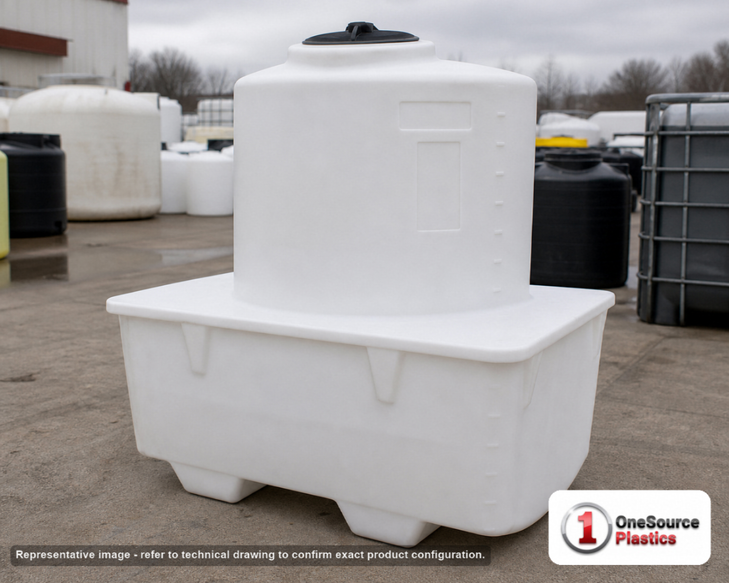
One shipment, 138 pounds, 150 gallons of working charge. The Snyder SII-5710103CF45 is a chemical feed station tank in white high density linear polyethylene, 56 inches long by 43 inches wide by 62 inches tall, standing on the floor rather than on a stand. A feed station is a day tank for a metering pump: it holds the chemical a dosing point will use over a shift or a week, sits where the pump can draw from it, and is charged from a drum, a tote or a delivery hose rather than from a process line. The sheet rates the wall at a specific gravity of 1.9, which gives 1,251 pounds for 150 gallons of water at 8.34 pounds per gallon and 2,377 pounds of maximum contents. The lid is 14 inches and the service limit is 120 F / 48 C. No outlet fitting and no warranty term appear on this sheet, so neither is named on this page.
Want it on your site? Get LTL freight to your ZIP, add it to your cart above, or call 866-418-1777 and a tank specialist will confirm the fit.
Marked Tree to the plant gate in one 56 by 43 inch shipment
Before the chemistry, the logistics, because they are what make a station this size worth buying at all. This part is molded at Marked Tree, Arkansas and it shipments at 56 by 43 by 62 inches at 138 pounds. That is a single pallet on an ordinary LTL trailer, not a project shipment: no crane, no permit, no oversize routing, no escort, and a lane that most of the country is within two or three days of. A plant that needs a bulk charge of one chemical can have this on the floor inside a normal purchasing cycle, and that is the real argument for a 150 gallon station against either a wall of drums or a bulk tank outside. Against drums you stop handling, storing and disposing of containers, and you stop dosing out of a vessel that somebody has to change at three in the morning. Against a bulk tank you avoid the pad, the bund, the outside pipe run, the freeze protection and the capital approval. What you do have to check before the truck is booked is the last hundred feet. At 62 inches tall and 56 by 43 inches on the floor, the shipment will pass most plant doors and most freight elevators, but it will not turn a tight corridor corner with a pallet jack under it, and a loading dock is a very different unloading job from a kerb. Confirm the door, the turn and the lift now rather than on delivery day. Then confirm the charge itself: run your dosing rate and your delivery interval through the tank sizing calculator and take the freeboard and reserve discipline from the tank sizing guide. One hundred and fifty gallons is a shift's charge on one duty and a month's on another, and the wrong answer is expensive in both directions. Where the chemical room is being designed around containment rather than around the tank, the Snyder Captor containment comparison sets an integrally contained vessel against a built bund without pretending either is free.
Four ways to buy 150 gallons, and a 120 below them
| Part | Wall | Gallons | Height | Empty weight |
|---|---|---|---|---|
| SII-5710103CF45 (this tank, on the floor) | Linear | 150 | 62 in | 138 lb |
| SII-5710103CF42 (on the floor) | Cross-linked | 150 | 62 in | 138 lb |
| SII-5710104CFWS45 (with stand) | Linear | 150 | 78 in | 174 lb |
| SII-5710104CFWS42 (with stand) | Cross-linked | 150 | 78 in | 174 lb |
| SII-5700103CF42 (smaller, on the floor) | Cross-linked | 120 | 51 in | 130 lb |
Four part numbers hold 150 gallons on the same 56 by 43 inch plan, and they differ on exactly two things. The first is the stand: this tank and SII-5710103CF42 stand on the floor at 62 inches and 138 pounds, while SII-5710104CFWS45 and SII-5710104CFWS42 are listed at 78 inches and 174 pounds with their stands. The second is the wall: this part is the linear polyethylene one, as the sheet names the material, where the -42 numbers are cross-linked polyethylene. So the case for this specific tank is the plain one. It is the lower of the two heights, which keeps the 14 inch lid at a height a person can charge by hand and keeps the shipment under any door the taller version might argue with; it is the lighter of the two at 138 pounds, which is a two-person or one-forklift job rather than a planning exercise; and it is the linear wall, which is the one to take when the duty is an ordinary treatment chemical rather than something that punishes a tank. Take a stand version instead when the metering pump is fixed at floor level and has to run on a flooded suction, or when the drain must reach a carboy. Take the cross-linked -42 instead when the chemistry or the handling is hard. SII-5700103CF42 is the step down, 120 gallons at 51 inches and 130 pounds on the same floor area, which is worth taking only when the height is genuinely constrained, because it costs thirty gallons of charge and saves almost nothing in floor space or weight. The sheet also lists SII-6370424N95402 beside these, and it belongs to a different family: a dry hopper bin tank rated at 25 cubic feet, 190 gallons, 48 by 48 by 57 inches and 330 pounds, for dry material discharged through a hopper. It is not a liquid feed station and this page claims no liquid duty for it.
Picked the 150 gallon tank? Add it to your cart above; freight is quoted to your ZIP before you pay anything.
Filling through a 14 inch lid at 62 inches
- The opening: 14 inches, sitting 62 inches off the floor. On a floor-standing station that puts the fill point at about chest height for most people, which is the quiet advantage of this version. A drum pump wand, a delivery coupling or a hand sampler all reach it from the floor with no platform and no ladder, and nobody is lifting an open container above shoulder height.
- How to fill it: bring the delivery to a fixed coupling rather than laying a hose over the rim, and keep the hose end below the liquid surface where the chemical foams or fumes. A 14 inch opening is generous for filling and tight for cleaning, so plan the wash-out routine around the opening the sheet gives.
- Venting: the vent path stays clear whenever the pump can draw. A closed lid over a drawing pump pulls on the wall of any polyethylene tank, and the linear wall this sheet specifies is no exception.
- The discharge: this sheet publishes no outlet fitting, so no size, no valve and no bulkhead assembly is named here. Tell us the chemical and the pump you are feeding and we will confirm the discharge arrangement with the maker in writing before anything ships.
- Once the discharge is settled: isolation valve at the tank, flexible connector at the first joint, cleanable strainer before the pump, and every pipe support taken on its own steel rather than on the tank wall.
- Pump protection: a low level float or probe that stops the metering pump with liquid still above the fitting, not an operator noticing a change in sound.
- Limits: 120 F / 48 C is the only service limit this sheet publishes, and it publishes no warranty term.
Put the level reading where the operator stands rather than where the tank makes it convenient, and pick the technology for the chemistry: the level gauge selection guide compares them on chemical service. Then mark the tank once, properly. The tank label and signage guide reconciles the marking that a fire inspector and a workplace inspector will each ask about.
Hypochlorite, polymer and the shift that depends on them
The duties for a station this size are the small, relentless ones: hypochlorite, caustic, acid or polymer dosing at a water or wastewater plant; a day tank beside a process line in a food, paper or metal finishing plant; cooling water treatment on a chiller plant; detergent at a vehicle wash or a commercial laundry; a dosing point at a mine or a generating station. In every one of them the process only gets the answer the charge in the tank can give it, and the charge is only as trustworthy as the sample somebody drew. Draw it from the same point, at the same depth, on the same cadence, into the same container, and log it. The chemical sampling protocol article is about the failure mode nobody catches: a sample taken badly gives a wrong result that looks entirely right, and the process is corrected against it for weeks.
Compatibility list
Liquids the maker rates this resin for, with concentration limits and the wetted fitting and gasket to specify. Confirm your own concentration and temperature on the chemical page or in the chemical compatibility database before ordering.
- Acetic Acid 60% - PP/PVC fittings, EPDM gaskets
- Aluminum Sulfate 50% - PVC fittings, EPDM gaskets
- Calcium Chloride 40% - PVC fittings, EPDM gaskets
- DEF 32.5% - 316SS fittings, EPDM gaskets
- Ethylene Glycol 100% - PVC fittings, EPDM gaskets
- Ferric Chloride 50% - PVC fittings, EPDM gaskets
- Ferric Sulfate 60% - PVC fittings, EPDM gaskets
- Ferrous Sulfate 20% - PVC fittings, EPDM gaskets
- Hydrochloric Acid 37% - PVC fittings, Viton gaskets
- Hydrofluoric Acid 48% - PP/PVC fittings, Viton gaskets
- Hydrofluosilicic Acid 26% - PP/PVC fittings, Viton gaskets
- Hydrogen Peroxide 50% - PVC fittings, Viton gaskets
- Magnesium Chloride 30% - PVC fittings, EPDM gaskets
- Peracetic Acid 30% - 316SS fittings, Aflas gaskets
- Phosphoric Acid 85% - PVC fittings, Viton gaskets
- Polyaluminum Chloride - PVC fittings, EPDM gaskets
- Potassium Carbonate 50% - PVC fittings, EPDM gaskets
- Potassium Hydroxide saturated - PVC fittings, EPDM gaskets
- Propylene Glycol - PP/316SS fittings, EPDM gaskets
- Sodium Bisulfate - PVC/PP fittings, EPDM gaskets
- Sodium Bisulfite - PVC/PP fittings, EPDM gaskets
- Sodium Carbonate 30% - PVC fittings, EPDM gaskets
- Sodium Hypochlorite under 16.5% - PVC fittings, Viton gaskets
- Sodium Thiosulfate 40% - PVC fittings, EPDM gaskets
- Sulfuric Acid 98% - CPVC fittings, Viton gaskets
- Urea Solution 50% - PP/PVC fittings, EPDM gaskets
- Zinc Orthophosphate - PP/316SS fittings, EPDM gaskets
One LTL pallet out of Arkansas on the -02 code
Molded at Marked Tree, Arkansas. The sheet gives the freight class as LTL, which is a mode rather than a numeric class, under NMFC 156600-02, and the shipment as 56 by 43 by 62 inches at 138 pounds. Its cross-linked twin carries a different sub-code on an identical shipment; both are printed as the sheet gives them and no reason is offered. Price the lane to your ZIP with the freight cost estimator, and the listed price is before freight. Take it off with a forklift under the base, or with two people who have lifted a tank before, and never by the lid. Set it in its final position on a level, continuous floor or bund deck that carries the whole base, then water-fill it once, hold it long enough to read the base and the lid seal, and drain it dry before the chemical is delivered. Then write the chemical name on the side facing the door, because the delivery driver reads the tank rather than the paperwork. Keep the delivery paperwork with the tank; the serial number on the shell is what a warranty claim starts from.
Freight and documents
Ships from: Marked Tree, AR. LTL freight is quoted to your ZIP with the freight cost estimator or by phone at 866-418-1777. The listed price is before freight.
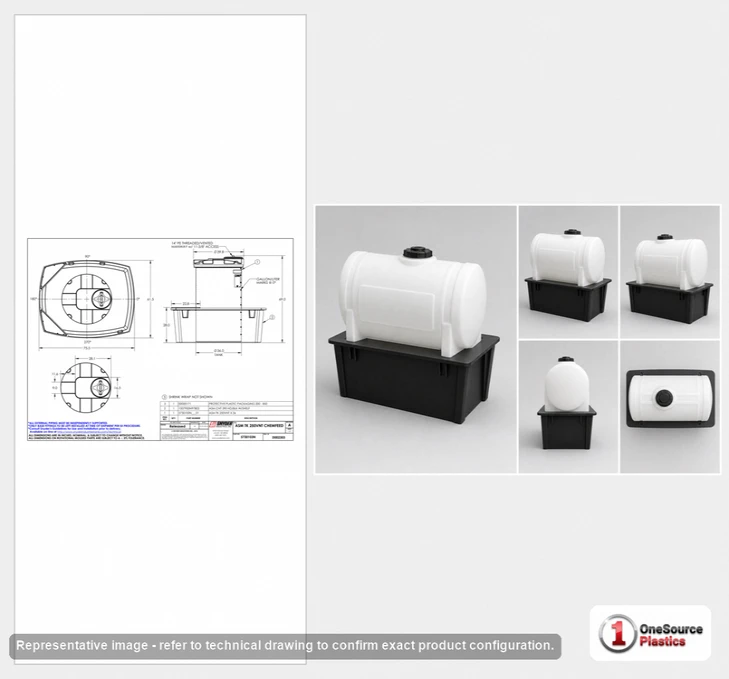
Technical drawing (PDF) for Snyder Industries 5710103CF45.
See this tank
Product video. Watch the Snyder Industries 150 Gallon Plastic Chemical Feed Station Tank video (75 seconds) with dimensions, fittings and shipping notes.
Ready to order?
Add it to your cart at the top of this page, get LTL freight to your ZIP, request a written quote, or call 866-418-1777. The listed price is before freight.