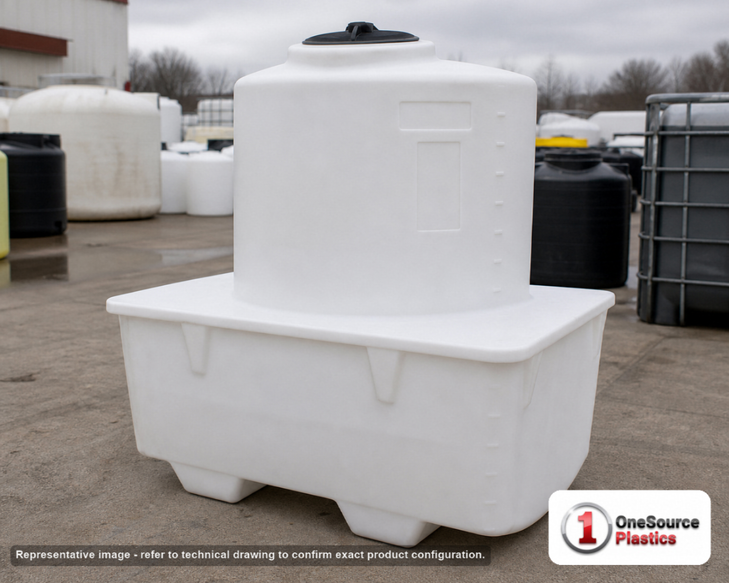
150 gallons standing 78 inches tall on its stand
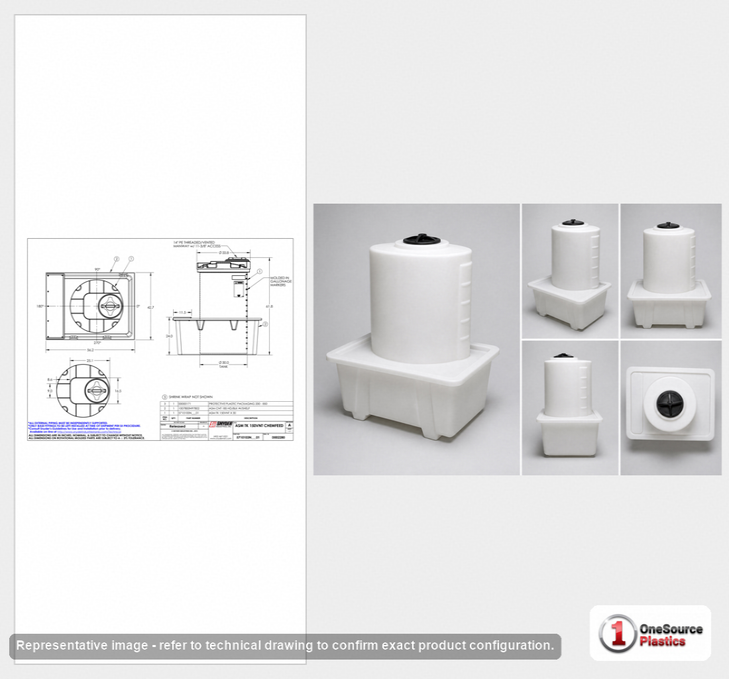
Height is what this part number buys. The Snyder SII-5710104CFWS45 is a 150 gallon chemical feed station supplied with its stand, white high density linear polyethylene, listed at 56 inches long by 43 inches wide by 78 inches tall and 174 pounds. Its floor-standing sibling occupies the same 56 by 43 inch plan at 62 inches and 138 pounds, so the overall height and the weight are the only two figures this sheet publishes about the stand. No stand load, no frame height and no stand material appear anywhere on it, and none is claimed here. What the extra height is for can be said without inventing anything: it lifts the base of the tank so the liquid sits above a metering pump instead of below it, and it leaves the underside of the tank where somebody can see it. The wall is rated at a specific gravity of 1.9, which gives 1,251 pounds for 150 gallons of water at 8.34 pounds per gallon and 2,377 pounds of maximum contents. The lid is 14 inches, the service limit is 120 F / 48 C, and the sheet publishes no warranty term.
Ready to price it? The listed price is before freight; quote freight to your ZIP in a few seconds, then add to cart above or call 866-418-1777.
The tallest shipment in the 150 group, and the door at the far end
This station is molded at Marked Tree, Arkansas and it shipments at 56 by 43 by 78 inches at 174 pounds, which makes it the tallest and heaviest shipment of the four 150 gallon part numbers. That is still one pallet on an ordinary LTL trailer rather than a project shipment, and it is worth being clear about how much that is worth: no crane, no permit, no oversize route, no structural pad, and a plant can have a bulk chemical charge standing over its dosing pump within a normal purchasing cycle. But 78 inches is six and a half feet in a shipment, and the last hundred feet is where that becomes real. Six and a half feet will not pass under a low door header, will not go through a standard personnel door upright, will not fit every freight elevator, and will not clear a low pipe run in a plant room ceiling. Walk the route from the dock to the chemical room before the truck is booked, with a tape, and measure the lowest thing on it. Check the unloading end too: 174 pounds is a forklift job under the base of the stand, or a lift gate and a pallet jack, and neither is a thing to discover at the kerb. Once it is in the room the height starts paying. Put the metering pump below the tank's discharge on its own base so it runs flooded through the whole batch instead of lifting from a tank sitting on the floor; keep the drain path to a carboy or a sump short and falling; and leave enough clear space under the stand that a torch and a pair of eyes can get all the way round the underside, because the first sign of trouble on a chemical station is a stain under the base and not a puddle at the door. The floor under the whole stand has to be flat, continuous and level, and it has to carry the base as one plane: a finished chemical room floor, a coated slab, a poured pad, or the deck of a bund sized for the largest vessel inside it. Never two rails with the middle unsupported and never packed up at one corner to take out a slope. Above that base is 1,251 pounds of water at full and 2,377 pounds at the rating on this sheet, standing higher than a floor tank puts it. Check the charge against the duty in the tank sizing calculator and take the reserve and thermal freeboard from the tank sizing guide before you order. Where containment is still being argued, the Snyder Captor containment comparison sets an integrally contained tank against a built bund properly.
Stand or floor: 78 inches against 62
| Part | Height | Empty weight | Gallons | Stand |
|---|---|---|---|---|
| SII-5710104CFWS45 (this one, linear wall) | 78 in | 174 lb | 150 | With stand |
| SII-5710104CFWS42 (cross-linked wall) | 78 in | 174 lb | 150 | With stand |
| SII-5710103CF45 (linear wall) | 62 in | 138 lb | 150 | On the floor |
| SII-5710103CF42 (cross-linked wall) | 62 in | 138 lb | 150 | On the floor |
| SII-5700103CF42 (smaller charge) | 51 in | 130 lb | 120 | On the floor |
The decision this table exists to settle is the first row against the third, because everything else is a footnote to it. Both hold 150 gallons on the same 56 by 43 inch plan in the same linear polyethylene wall. This one is listed at 78 inches and 174 pounds; SII-5710103CF45 is listed at 62 inches and 138 pounds. What you are buying in the difference is the pump's suction: with the tank standing at 78 inches, a metering pump sits below the discharge and stays flooded, a drain reaches a container without a transfer pump, and the underside of the tank is visible. What you are paying is a taller shipment to get into the building, a fill point above chest height, a higher centre of mass on the same footprint, and more weight to place. Buy this one when the pump is fixed at floor level and must not lift. Buy the floor-standing 62 inch version when a duct, a mezzanine or a door decides the height, or when the tank has to be charged by hand from drums. The second row is this same station in a cross-linked polyethylene wall at the same listed 78 inches and 174 pounds; take that one instead when the chemistry or the handling is hard on a tank, and take this linear-walled one for ordinary treatment duty. SII-5700103CF42 is the smaller charge at 120 gallons, 51 inches and 130 pounds, floor-standing, and it is a different conversation: it saves height and almost no floor. The sheet also lists SII-6370424N95402 as a sibling; that is a dry hopper bin tank rated at 25 cubic feet, 190 gallons, 48 by 48 by 57 inches and 330 pounds, built for dry material through a hopper. Different family, no liquid duty asserted here.
Want us to check the fit? Send the site dimensions to 866-418-1777 or through a written quote request and we will confirm the tank, the pad and the freight.
A 14 inch opening above head height
- The opening: 14 inches, and on this version it sits at the top of a station listed at 78 inches. That is above head height for most people, which changes how the tank is charged. Bring the delivery to a fixed coupling at working level and pipe it up, rather than passing a hose to somebody standing on something.
- If the lid has to be opened routinely: design a step or a small platform with a hand rail into the layout now. A station that is charged by hand twice a week at 78 inches will otherwise be charged from a drum, a pallet or a chair, and that is how people get hurt in chemical rooms.
- Venting: the vent path stays clear at all times. The taller the standing liquid, the more tempting it is to leave the lid shut, and a drawing pump under a closed lid pulls on the wall.
- The discharge: this sheet publishes no outlet fitting, so no size, no valve and no bulkhead assembly is named on this page. Tell us the chemical and the pump when you order and the arrangement is confirmed with the maker in writing before the station ships.
- Laying out the pump: this is the version bought for a flooded suction, so put the pump below the discharge on its own base, keep the run short and falling, and isolate at the tank with a valve, then a flexible connector, then a cleanable strainer.
- Protection: a low level float or probe stops the pump with liquid still above the fitting. A metering pump run dry on a chemical duty is a maintenance call and sometimes a whole day of dosing.
- Limits: the service limit on this sheet is 120 F / 48 C and no warranty term is published.
Fill point, vent, level device and any return line should be drawn as one layout rather than added one at a time, because on a station standing this tall nothing on the top is easy to move afterwards. Put the level reading where the operator stands and choose the technology for the chemistry with the level gauge selection guide, which matters more here than on a floor tank because the top of this one is above eye level. Mark it in words and in the pictograms your inspectors expect, using the tank label and signage guide, and put the marking where a person standing on the floor can read it rather than on the top where the pipework is.
Dosing skids and what the operator can actually reach
This station feeds the duties that never stop: hypochlorite, caustic, acid or polymer at water and wastewater plants; a day tank beside a process line in food, beverage, paper or metal finishing; cooling water treatment; detergent at a wash or a laundry; a dosing point at a mine or a generating station. On a tank standing at 78 inches, every routine task is also a reach question, so decide before the first delivery where the fill coupling is, where the level is read, and where the sample is drawn from. That last one decides whether your lab results mean anything: the chemical sampling protocol article works through how a sample taken at the wrong depth, at the wrong moment, into the wrong container produces a clean-looking wrong number that the plant then corrects against. Same point, same depth, same cadence, logged every time.
Service list by chemical
One line per liquid the maker rates for this resin, with the concentration it is rated to and the fitting and gasket to order. Take your own concentration and temperature to the linked page or the chemical compatibility database before ordering.
- Acetic acid
- Aluminum sulfate
- Calcium chloride
- DEF
- Ethylene glycol
- Ferric chloride
- Ferric sulfate
- Ferrous sulfate
- Hydrochloric acid
- Hydrofluoric acid
- Hydrofluosilicic acid
- Hydrogen peroxide
- Magnesium chloride
- Peracetic acid
- Phosphoric acid
- Polyaluminum chloride
- Potassium carbonate
- Potassium hydroxide
- Propylene glycol
- Sodium bisulfate
- Sodium bisulfite
- Sodium carbonate
- Sodium hypochlorite
- Sodium thiosulfate
- Sulfuric acid
- Urea solution
- Zinc orthophosphate
A hundred and seventy-four pounds, and the unloading plan that goes with it
Molded at Marked Tree, Arkansas. The sheet gives the freight class as LTL, which is a mode and not a numeric class, under NMFC 156600-01, with the shipment at 56 by 43 by 78 inches and 174 pounds. The freight cost estimator prices the lane to your ZIP and the listed price is before freight. Decide the unloading before you book: a dock and a forklift under the base of the stand is the easy version, a kerb needs a lift gate and a pallet jack, and in both cases nothing is ever lifted by the lid or slung around the tank body. Set it in its final position on the level floor or bund deck, plumb nothing until it is standing where it will live, then water-fill it once and hold it while you read the lid seal, the base of the stand and the floor underneath, and drain it dry before the chemical arrives. A week after the first fill, take a torch and walk right round the underside of the tank; the clear space beneath the stand is half of what you paid for, and it only works if somebody looks. A photo of the tank on its pad, full, on day one is worth keeping; it is the baseline every later inspection is compared against.
Freight and documents
Ships from: Marked Tree, AR. LTL freight is quoted to your ZIP with the freight cost estimator or by phone at 866-418-1777. The listed price is before freight.
Technical drawing (PDF) for Snyder Industries 5710104CFWS45.
See this tank
Product video. Watch the Snyder Industries 150 Gallon Plastic Chemical Feed Station Tank video (74 seconds) with dimensions, fittings and shipping notes.
Ready to order?
Add it to your cart at the top of this page, get LTL freight to your ZIP, request a written quote, or call 866-418-1777. The listed price is before freight.