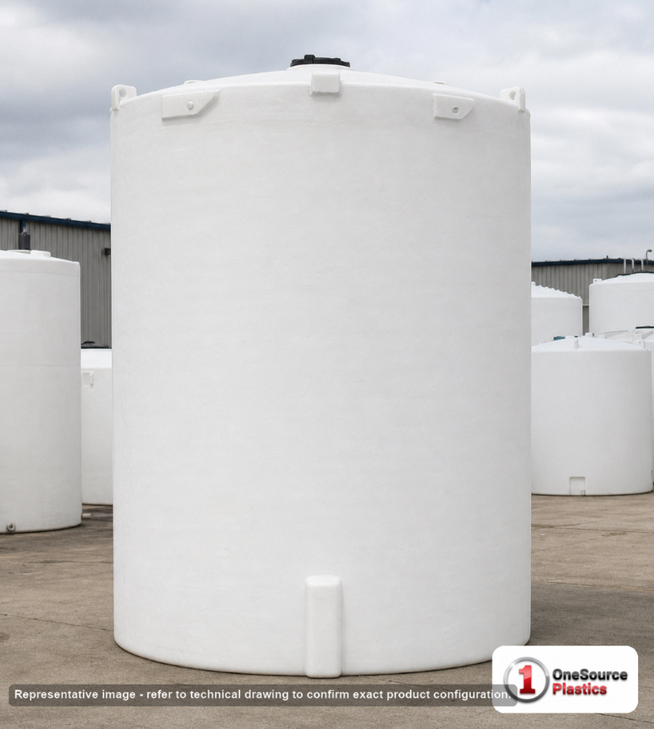
16,500 gallons at 1.9 specific gravity, twenty-one feet tall
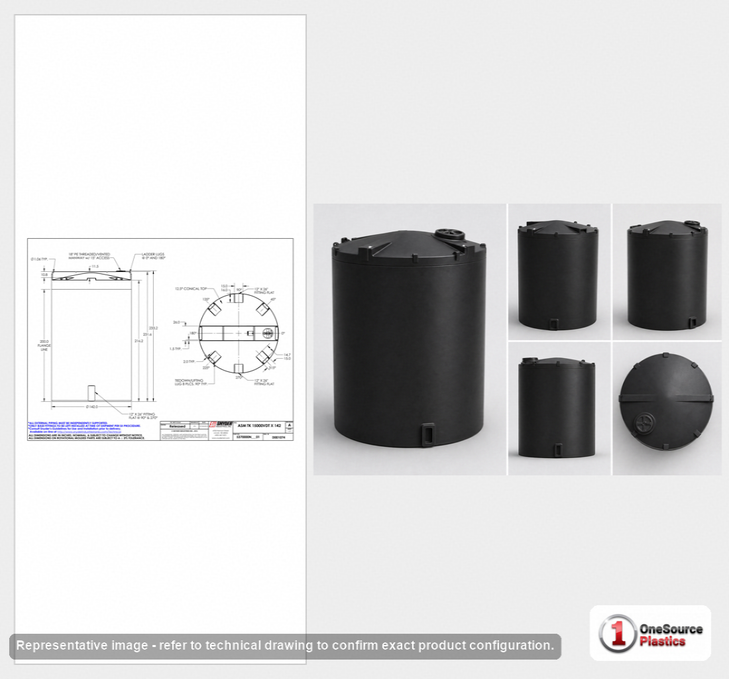
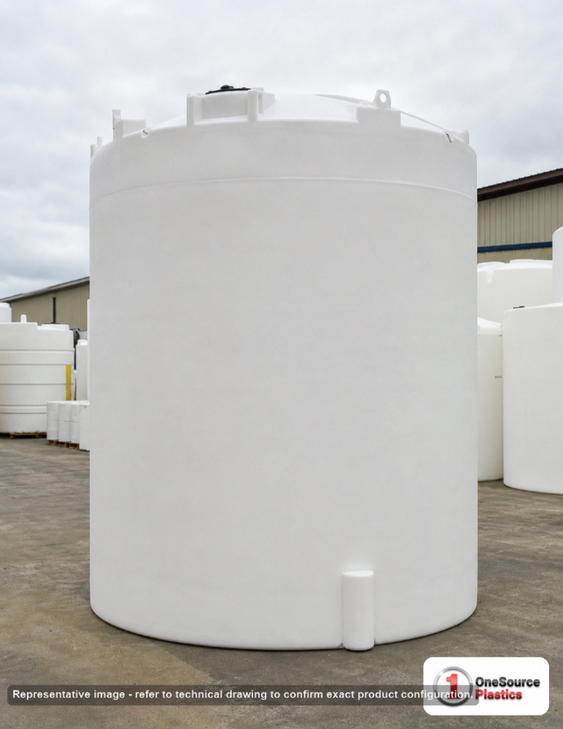
The Snyder 5380000C26 is a white polyethylene vertical liquid storage tank, 142 inches across and 257 inches tall, holding 16,500 gallons at 5,100 pounds. Its wall is rated for a specific gravity of 1.9, or 261,459 pounds of contents against 137,610 for water, the chemical-grade wall for ferric chloride at strength, concentrated acids and the heavy brines at more than three tanker loads, on a twelve foot pad. It carries an 18 inch threaded, vented manway and a 3 year warranty, and it travels as oversize freight.
Is this the right 16500 gallon tank? Call 866-418-1777 with the liquid, the site and the ceiling height, or get freight to your ZIP and add it to your cart above.
The full-density wall at the top of the twelve foot family
A 1.9 specific gravity wall is sized for a liquid nearly twice as dense as water, and 5,100 pounds of resin is what that takes at 16,500 gallons, the tallest tank Snyder puts on a 142 inch base. The wall is sized under ASTM D1998; the HDPE tank wall thickness guide explains that logic and why a wall this tall is inspected from the top, in the headspace. Full, it puts 261,459 pounds on a 142 inch circle at the rating: an engineered slab in full contact under the entire floor, per the concrete pad sizing guide, screeded flat, inside a berm sized to the tank, with the empty tank strapped against wind and the manway reached from a fixed platform on its own footings. The tank sizing calculator works the volume out from feed rate and delivery interval, and the tank sizing guide covers the reserve.
Grades on the 142 x 257 inch tank, and the sizes beside it
| Part | Gallons | Diameter x height | Empty weight |
|---|---|---|---|
| 5380000C26 (this tank, 1.9 SG) | 16,500 | 142 x 257 in | 5,100 lb |
| 5380000N45 (1.9 SG, ASTM certified) | 16,500 | 142 x 257 in | 5,600 lb |
| 5380000N43 (1.5 SG, ASTM certified) | 16,500 | 142 x 257 in | 5,100 lb |
| 5380000C37-BLACK | 16,500 | 142 x 257 in | 5,100 lb |
| 5380000C126 (light wall) | 16,500 | 142 x 257 in | 3,000 lb |
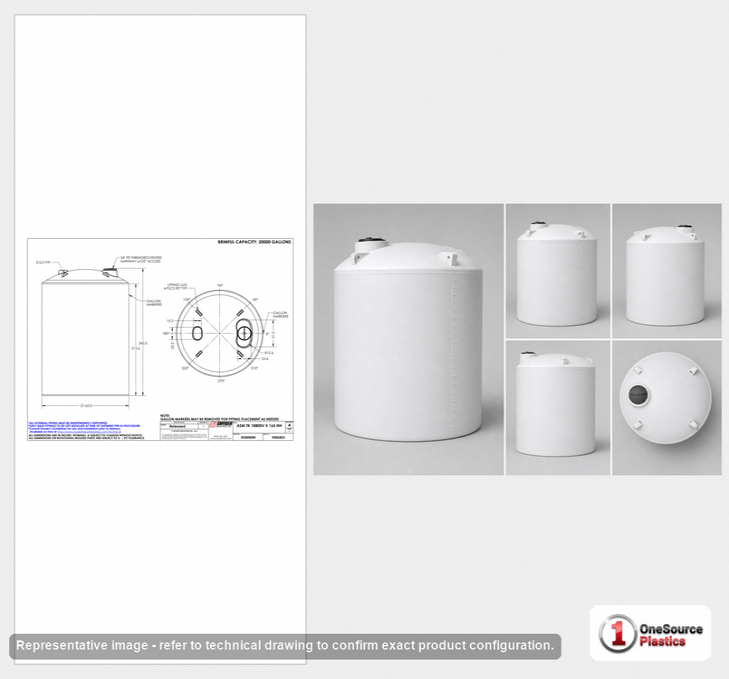
| 3030100C26 (wide) | 15,000 | 165 x 184 in | 4,400 lb |
| 3030000N49 (wide, black) | 18,800 | 165 x 242 in | 5,500 lb |
The N45 is this same 1.9 wall with ASTM certification, 500 pounds heavier, and the N43 is the certified 1.5 wall at this tank's weight; the C37-BLACK is the black water tank in this shell, and the C126 is the light-wall water tank at 3,000 pounds. The 3030100C26 holds 15,000 gallons on a 165 inch base 73 inches shorter, and the 3030000N49 holds 18,800 gallons on that base at 242 inches.
Comparing across brands too? Call 866-418-1777; we carry Norwesco, Snyder, Chem-Tainer, Enduraplas and Bushman and will say which one fits, or price the freight first.
Bulkheads and lid
- Access: 18 inch threaded, vented manway, 257 inches up; vent outside on acid and caustic service, fill through a dip tube, and size the vent for a tanker's unload rate.
- Outlet: name the chemical when ordering so the bulkhead fitting matches it; a flanged transition, an expansion joint, and a valve supported off the slab.
- Service limit: 120 F / 48 C.
Choose the level sender for the chemical and read it at ground level so nobody climbs for a number; keep the manway closed against vapor loss, and shade the tank where the chemical is light-sensitive. A single wall tank of regulated chemical stands inside a berm sized to it. Where it freezes, insulate or drain the outlet valve and the first length of pipe; with this much water in it the body freezes from the top, slowly, without harm.
The tanker unload
A tanker's pump moves liquid faster than a manway vent can pass air, so either the vent is sized to the unload rate or the fill comes in through its own top bulkhead with a separate vent line. A fill pipe to the floor keeps the liquid from free-falling and foaming. If the tank is ever used to dilute a batch, water goes in first and the chemical second; the other order boils. The first delivery into a new tank is watched from start to finish, with the slab edge and the outlet fitting checked as the level climbs, and the log takes the date and strength of every load that follows; the log is the inventory at this scale.
Day-to-day duty
Ferric and other dense coagulants at a large plant with a berm, heavy brine at plant scale, dense process chemicals delivered by tanker, and water where the buyer wants the heaviest wall for a long life outdoors, including a fire reserve of the kind the fire-water reservoir design guide describes, or the storage stage of a reuse system per the industrial water reuse tank topology article. One liquid per tank, labeled.
From the plant to your site
At 142 inches across and 257 inches long on the deck the 5380000C26 is oversize freight (NMFC 156600) on a flatbed at a lane rate, with an escort on most routes; the freight cost estimator quotes the haul to your ZIP; what is listed is the price before freight. A crane sets 5,100 pounds upright on the slab. Water-fill it once to the manway, hold it, and check the outlet fitting before the first chemical delivery. Write the fill date on the manway with a paint marker; it answers the first question anyone asks about a tank.
Freight and documents
Ships from: Lincoln, NE. LTL freight is quoted to your ZIP with the freight cost estimator or by phone at 866-418-1777. The listed price is before freight.
Technical drawing (PDF) for Snyder Industries 5380000C26.
See this tank
Interactive 3D model with live fill. This tank has an interactive 3D model built to its manufacturer dimensions. Rotate it, and set a fill level to see how much liquid it holds at any height. Open the 3D view on the product photo above. Download the 3D model (GLB).
Product video. Watch the Snyder Industries 16500 Gallon HDPE Vertical Liquid Storage Tank video (69 seconds) with dimensions, fittings and shipping notes.
Ready to order?
Add it to your cart at the top of this page, get LTL freight to your ZIP, request a written quote, or call 866-418-1777. The listed price is before freight.