Two hundred and seventy-five gallons, 42 inches across and 63 tall
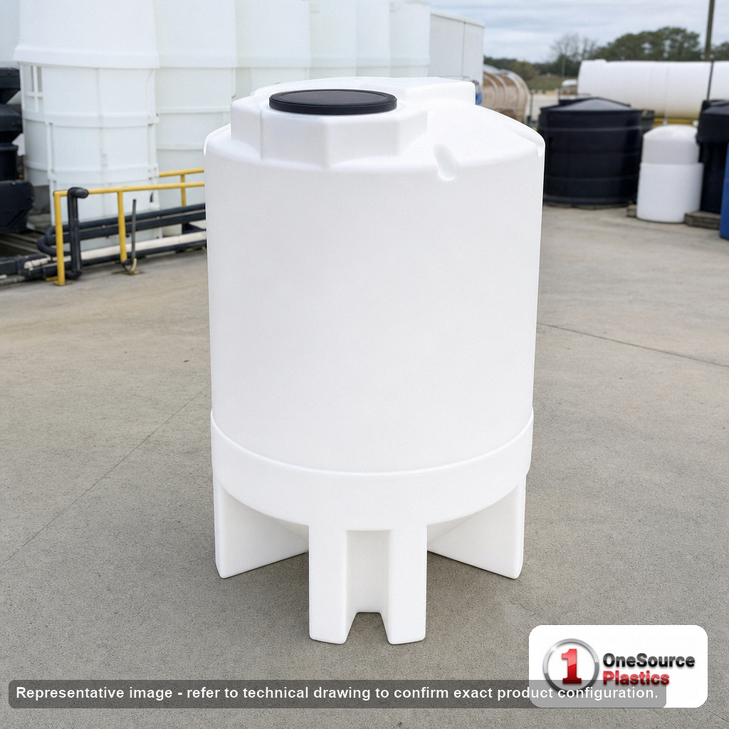
The Snyder SII-5740101N45 is a 275 gallon closed top cone bottom tank in white polyethylene, listed at 42 inches in diameter and 63 inches tall, at 140 pounds empty. Its own name gives the cone angle as 15 degree, and the sheet carries no cone angle field, so the name is the only source and nothing more is claimed about the angle. Fifteen degrees is the shallowest angle in this slice and 63 inches is a little over five feet of height, which together make this the cone that fits where a cone normally does not. The wall is rated at a specific gravity of 1.9, and the sheet gives 2,294 pounds for 275 gallons of water at 8.34 pounds per gallon with 4,358 pounds of max contents. The lid and manway field reads 18 inches. The service limit is 120 F / 48 C. There is no outlet, no stand and no warranty term on this sheet, and none is stated here.
Two ways to buy. Add it to your cart above with freight quoted to your ZIP, or request a written quote for a job that needs paperwork.
Marked Tree, Arkansas, on a standard LTL lane
This one is easy to get to site, and for a cone bottom tank that is a genuine reason to choose it. The sheet lists one plant, Marked Tree, Arkansas, and gives the freight class as LTL, a mode rather than a numeric class, under NMFC 156600-02. LTL means it moves on a normal freight network at a normal booking rather than as an oversize project load, and at 42 inches across, 63 inches tall and 140 pounds it arrives on a pallet that a forklift or a pallet jack handles at the far end. There is no crane, no escort, no route survey and no delivery window to negotiate, which is the difference between a tank that lands next week and a tank that lands next month. Once it is there, the same numbers keep working for you. Forty-two inches of diameter goes through a wide door and down an aisle; 63 inches of height keeps the 18 inch opening within reach from a short platform rather than a fixed ladder; and 140 pounds empty means two people and a pallet truck can place it without booking a machine. What the sheet does not give is the stand, and a cone bottom tank does not stand on its own bottom, so that is a separate item to settle before the order rather than after delivery. The cone bottom tank stand compatibility matrix is where that question gets worked through across makers, and we will confirm what suits this part number when you ask. Whatever holds it up is carrying 140 pounds of tank, 2,294 pounds of water and 4,358 pounds at the rating, on a flat, continuous, level bearing. Check the volume against your batch size and refill interval in the tank sizing calculator before you commit and take the headspace from the tank sizing guide. Where the vessel stands over a floor or a drain that would have to be recovered, the Captor containment comparison puts the containment options against each other plainly.
A closed top 275, a 225 with a stand, and a dry hopper bin
| Part | Capacity | Diameter or plan x height | Empty weight |
|---|---|---|---|
| SII-5740101N45 (this tank, closed top, 15 degree) | 275 gal | 42 x 42 x 63 in | 140 lb |
| SII-1560400N45 (30 degree vertical cone bottom, named with stand) | 225 gal | 48 x 48 x 55 in | 140 lb |
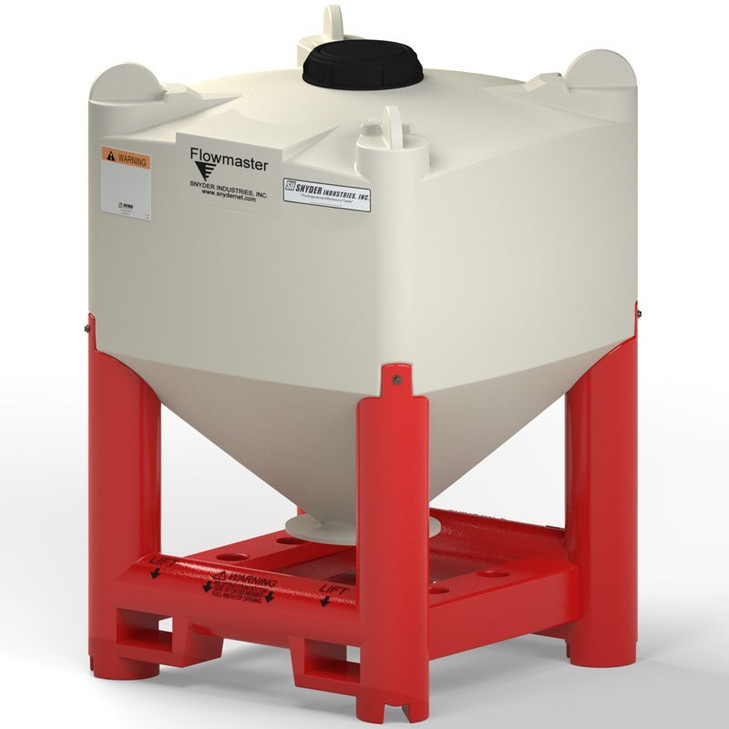
| SII-6370540N95402 (45 degree dry hopper bin, dry material only) | 40 cubic feet | 53 x 48 x 68 in | 341 lb |
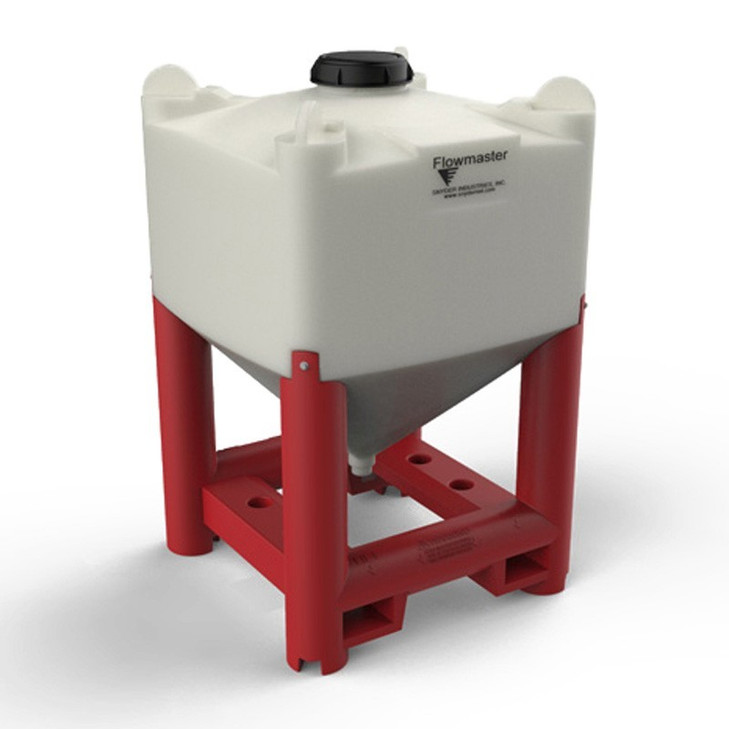
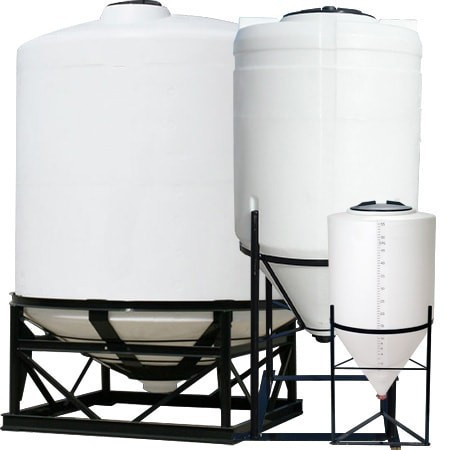
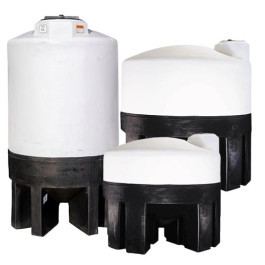
Three products, three different jobs, and the table is worth reading carefully because only two of them hold liquid. SII-1560400N45 is the closest comparison: a 225 gallon cone bottom tank whose own name says it comes with a stand, listed at 48 inches across and 55 inches tall at the same 140 pounds. This tank's sheet publishes no stand at all, so that is the honest difference between the two rows and the one worth asking us about, because a stand bought with the tank is a stand that fits it. On volume and shape the trade is plain: this tank holds more in a narrower, taller body, and that one holds less in a wider, lower one, so a low ceiling points one way and a tight floor points the other. The third row is not a liquid vessel at all. SII-6370540N95402 is a 45 degree cone bottom dry hopper bin, rated in cubic feet on its own name, and a dry bin is for dry material: this page asserts no liquid capacity, no specific gravity and no liquid duty for it, because its own name tells you what it is for. It is listed at 53 by 48 by 68 inches and 341 pounds, which makes it the largest and by far the heaviest of the three. If what you are moving is a powder, a granule or a pellet, that is the row to look at and a different conversation from this one. If it is a liquid, the choice is between the first two rows and it comes down to the stand and the ceiling. The cone bottom buyer's guide on angle selection sets the shallow and the steep cones against each other on the terms that decide it.
Torn between two rows? Call 866-418-1777 with the liquid and the ceiling height, or ask for a quote on both and compare the freight.
An 18 inch lid at the top of a closed cone
- The opening: the lid and manway field reads 18 inches, and it is the only opening this sheet publishes. At 63 inches of tank height plus the stand, that is a short platform rather than a ladder, which is one of the real advantages of this size over a taller cone.
- Closed top: the sheet lists this as a closed top cone bottom tank, so the lid is the whole access route. Eighteen inches takes a fill hose, a lance, a dip tube and a mixer shaft; plan the cleaning method around that opening before the first product goes in.
- Venting: the sheet does not describe the lid as vented and lists no breather. A closed vessel being pumped down needs an air path or the wall takes the load, and a vessel being filled has to put the displaced air somewhere, so the venting arrangement is specified with the order rather than assumed.
- The discharge: no outlet size and no bulkhead is published. The cone ends in a discharge and the sheet does not dimension it, so no figure appears on this page. Tell us the line size, the valve and the product and we will confirm what the part carries before it ships.
- What hangs below: the valve and the first run of line ride on the stand's own steelwork, not on the cone, and the clearance under the discharge for a valve, a hose and whatever receives the batch is designed in at the same time as the stand.
- Limits: 120 F / 48 C, a specific gravity rating of 1.9, 2,294 pounds of water and 4,358 pounds of max contents. No warranty term appears on this sheet.
Where the fill, the vent, a level device and a return all want the same space on a single 18 inch opening, an hour on paper is cheaper than a hole in the wrong place: the top fitting placement guide sequences those decisions properly.
Small batch work where the bottom has to drain
Two hundred and seventy-five gallons over a shallow cone is a working batch size. It goes into day tanks and make-up vessels at small water and wastewater plants, dosing and blending points on process lines, nurseries, greenhouses and hatcheries, breweries, food and beverage producers, metal finishing and plating shops, car washes, and pilot plants where a full-size vessel is more product than the recipe needs. What the cone adds over a flat-bottomed tank of the same volume is that the batch leaves completely and keeps leaving as the level drops, which is what makes a vessel safe to change product in. A 15 degree cone is the shallowest of the common angles, so it is the one to take for a product that pours freely and the one to think twice about for a product that packs, settles hard or carries heavy solids. Where that is your duty, tell us and we will point you at the steeper angle rather than sell you the shorter tank.
Liquids this resin is rated to store
These entries are the manufacturer's ratings for this resin, each with the concentration limit and the fitting and gasket to specify. Your concentration and temperature are confirmed on the chemical page or in the chemical compatibility database before ordering.
- Acetic Acid (60%) - PP/PVC fittings, EPDM gaskets
- Aluminum Sulfate (50%) - PVC fittings, EPDM gaskets
- Calcium Chloride (40%) - PVC fittings, EPDM gaskets
- DEF (32.5%) - 316SS fittings, EPDM gaskets
- Ethylene Glycol (100%) - PVC fittings, EPDM gaskets
- Ferric Chloride (50%) - PVC fittings, EPDM gaskets
- Ferric Sulfate (60%) - PVC fittings, EPDM gaskets
- Ferrous Sulfate (20%) - PVC fittings, EPDM gaskets
- Hydrochloric Acid (37%) - PVC fittings, Viton gaskets
- Hydrofluoric Acid (48%) - PP/PVC fittings, Viton gaskets
- Hydrofluosilicic Acid (26%) - PP/PVC fittings, Viton gaskets
- Hydrogen Peroxide (50%) - PVC fittings, Viton gaskets
- Magnesium Chloride (30%) - PVC fittings, EPDM gaskets
- Peracetic Acid (30%) - 316SS fittings, Aflas gaskets
- Phosphoric Acid (85%) - PVC fittings, Viton gaskets
- Polyaluminum Chloride - PVC fittings, EPDM gaskets
- Potassium Carbonate (50%) - PVC fittings, EPDM gaskets
- Potassium Hydroxide (saturated) - PVC fittings, EPDM gaskets
- Propylene Glycol - PP/316SS fittings, EPDM gaskets
- Sodium Bisulfate - PVC/PP fittings, EPDM gaskets
- Sodium Bisulfite - PVC/PP fittings, EPDM gaskets
- Sodium Carbonate (30%) - PVC fittings, EPDM gaskets
- Sodium Hypochlorite (
- Sodium Thiosulfate (40%) - PVC fittings, EPDM gaskets
- Sulfuric Acid (98%) - CPVC fittings, Viton gaskets
- Urea Solution (50%) - PP/PVC fittings, EPDM gaskets
- Zinc Orthophosphate - PP/316SS fittings, EPDM gaskets
Arkansas, 140 pounds, and a 63 inch shipment
This tank is moulded at Marked Tree, Arkansas, which puts the mid-South, the Gulf and the lower Midwest on a short lane and everywhere else on a measurable one. The sheet gives the freight class as LTL, a mode rather than a numeric class, under NMFC 156600-02, and the shipping weight matches the tank at 140 pounds. Price the lane to your ZIP with the freight cost estimator; the listed price is before freight. At 140 pounds and 63 inches it comes off with a pallet jack or two people under the body, taken by the shell and never by the 18 inch opening. Measure the door and the aisle first, because 63 inches standing on a pallet is taller again on the way in. Set the stand before the tank arrives if you can, level it, anchor it, and put the tank on it the same day rather than leaving a cone bottom vessel resting on its cone against a wall. Fill it with clean water, hold that 2,294 pound load, and read the cone, the lid and the stand feet while it is full. Time the drain-down on that water fill and write the number on the tank; every batch you plan afterwards is built around it. The first fill is the only cheap time to find a problem, so do it in daylight with someone watching the base.
Freight and documents
Ships from: Marked Tree, AR. LTL freight is quoted to your ZIP with the freight cost estimator or by phone at 866-418-1777. The listed price is before freight.
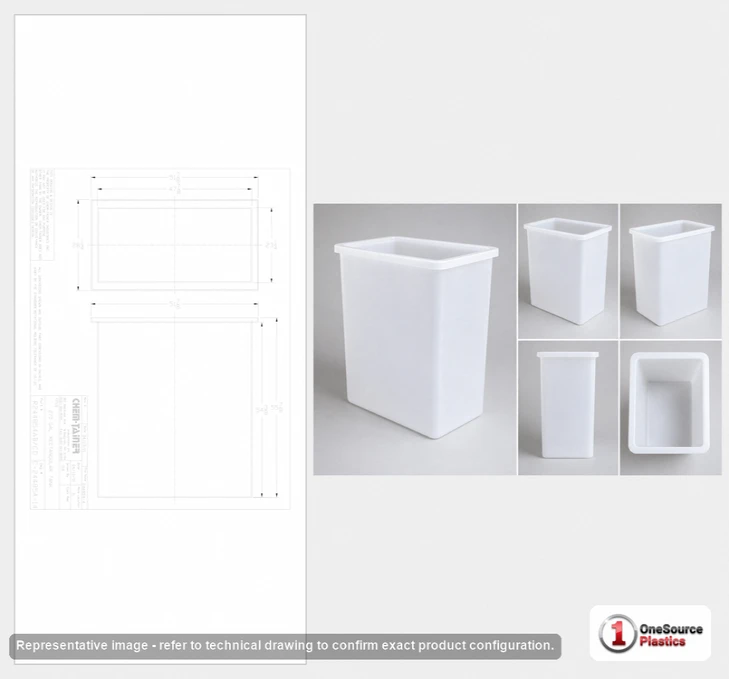
Technical drawing (PDF) for Snyder Industries 5740101N45.
See this tank
Interactive 3D model with live fill. This tank has an interactive 3D model built to its manufacturer dimensions. Rotate it, and set a fill level to see how much liquid it holds at any height. Open the 3D view on the product photo above. Download the 3D model (GLB).
Product video. Watch the Snyder Industries 275 Gallon 15 Degree Plastic Cone Bottom Tank video (67 seconds) with dimensions, fittings and shipping notes.
Looking for a replacement?
This tank has been discontinued by the manufacturer. See the similar tanks listed at the top of this description, request a written quote, or call 866-418-1777.