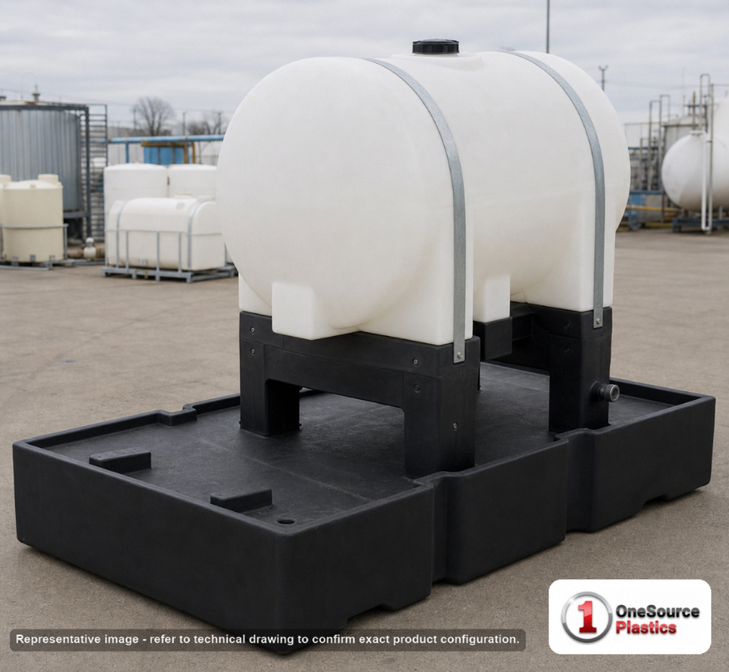
A 250 gallon station standing 86 inches to the lid
Eighty-six inches is the number that defines the Snyder SII-5730104CFWS45. It is a 250 gallon chemical feed station in white high density linear polyethylene supplied on its stand, listed 76 inches long, 62 inches wide and 86 inches tall at 253 pounds, where the same 250 gallon shell without a stand is listed at 69 inches and 209 pounds. That listing difference is the stand and it is the only thing the sheet says about it: no separate stand height, no load rating, no frame material, and this page invents none. The wall is rated at a specific gravity of 1.9, so 250 gallons of water is 2,085 pounds at 8.34 pounds per gallon and max contents is 3,962 pounds. Access is a 14 inch lid, the service limit is 120 F / 48 C, and the sheet publishes no outlet, no inlet, no vent fitting and no warranty term.
Is this the right 250 gallon tank? Call 866-418-1777 with the liquid, the site and the ceiling height, or get freight to your ZIP and add it to your cart above.
The tallest of the 250s, and the stand is the reason
Put the four 250 gallon parts side by side and this one is the tall, standing, linear-wall answer. SII-5730103CF45 and SII-5730103CF42 sit on the floor at 69 inches and 209 pounds; this part and SII-5730104CFWS42 stand at 86 inches and 253 pounds. Inside the standing pair the split is the wall: this is the linear polyethylene one. The reason to spend the height is entirely about what happens under the tank. A metering pump fed from a standing station draws from a flooded suction instead of pulling a lift, the drain reaches a carboy or a sump without a transfer pump, and there is room to see the underside of the vessel and the floor beneath it. Against that, 86 inches has to clear a ceiling, a duct and a door, and the lid is now well above head height, so the fill and the sampling routine have to be designed rather than improvised. If the room cannot take the height, buy a floor-mounted 250 and put the pump in a pit; if it can, this is the station that keeps the pump happy for years. Site it on a flat, level, continuous surface carrying the whole 76 by 62 inch base and anchor the frame before the first fill, because 2,085 pounds of water and 3,962 pounds at the rating sit higher here than on any floor-mounted station in the family. Check the working volume against the dosing rate and the delivery interval in the tank sizing calculator, take the freeboard from the tank sizing guide, and where a basin or a kerb is being specified, read the Snyder Captor containment comparison first.
Stand or no stand, linear wall or cross-linked
| Part | Volume | Length x width x height | Empty weight |
|---|---|---|---|
| SII-5730104CFWS45 (this station, linear wall, with stand) | 250 gal | 76 x 62 x 86 in | 253 lb |
| SII-5730104CFWS42 (cross-linked, with stand) | 250 gal | 76 x 62 x 86 in | 253 lb |
| SII-5730103CF45 (linear wall, no stand) | 250 gal | 76 x 62 x 69 in | 209 lb |
| SII-5730103CF42 (cross-linked, no stand) | 250 gal | 76 x 62 x 69 in | 209 lb |
| SII-5720103CF42 (smaller, no stand) | 200 gal | 76 x 62 x 57 in | 198 lb |
| SII-5740103CF42 (larger, no stand) | 275 gal | 76 x 62 x 59 in | 226 lb |
The top four rows are one tank sold four ways and the table is really a pair of switches. Height: 86 inches and 253 pounds standing, 69 inches and 209 pounds on the floor. Wall: linear polyethylene on this part and on SII-5730103CF45, cross-linked on SII-5730104CFWS42 and SII-5730103CF42. Nothing else in those four listings moves, including the 76 by 62 inch plan, which means the slab and the kerb are the same whichever you choose and the decision lives in the pipework and the ceiling. The last two rows are the neighbours: 200 gallons at 57 inches and 198 pounds, 275 gallons at 59 inches and 226 pounds, both floor-mounted and both on the same plan. If you are buying this part for the stand and then find the room is short of height, the honest alternative is a floor-mounted station plus a pump pit, not a taller tank with the stand left off.
Comparing across brands too? Call 866-418-1777; we carry Norwesco, Snyder, Chem-Tainer, Enduraplas and Bushman and will say which one fits, or price the freight first.
Venting at 86 inches, and the platform question
- Breathing: no vent fitting is named anywhere on this sheet, so the 14 inch lid carries the air. On an 86 inch station that opening is the one thing on the tank nobody can reach casually, and an obstructed lid path plus a running pump is how a wall gets pulled in. Put it on the inspection round with the gauge.
- Working at height: the lid is well above head height on a level floor. Bring the fill line to a coupling at working level, sample through a dedicated point rather than through the lid, and give anybody who has to open the top a proper platform with a rail. Standing on the frame is not a platform.
- What the stand is for: the low point stands clear, so the pump goes underneath on its own base with a short falling run into the suction and keeps a flooded prime through the batch. The sheet lists no outlet or inlet size, so we confirm the fitting on your part before the pipework is made.
- The space underneath: light it, keep it clear, and look at it. The reason to pay for height is that a leak becomes visible before it becomes a spill, and that only works if somebody looks.
- Instrument and label: a level device chosen for the chemistry from the level gauge selection guide, and marking that an inspector will accept from the tank label and signage guide.
- Service limit: 120 F / 48 C. The sheet gives no warranty term.
Every pipe and valve is carried on its own support off the floor rather than on the tank or the frame, with a flexible connector at the first joint. Tell us the chemical and the wetted parts are matched to it instead of being left generic.
Dosing that wants gravity instead of lift
This is the station for a system where the pump runs most of the day and losing prime costs more than the tank: hypochlorite, caustic or acid feed at a water and wastewater plant, polymer ahead of a clarifier, treatment chemical on a cooling loop, a day tank beside a process line in a food, paper or finishing plant, a dosing point in a mine or a power station. All of those are judged on what leaves the pump, which is judged on what is in the tank, which is judged by a sample: the chemical sampling protocol article is the discipline that makes that chain honest.
Which liquids, at what concentration, with which fitting
Each entry pairs a rated liquid with its concentration limit and the fitting and gasket to order alongside the tank. The full rating sits on the linked page and in the chemical compatibility database before ordering.
- Acetic Acid (60%) - PP/PVC fittings, EPDM gaskets
- Aluminum Sulfate (50%) - PVC fittings, EPDM gaskets
- Calcium Chloride (40%) - PVC fittings, EPDM gaskets
- DEF (32.5%) - 316SS fittings, EPDM gaskets
- Ethylene Glycol (100%) - PVC fittings, EPDM gaskets
- Ferric Chloride (50%) - PVC fittings, EPDM gaskets
- Ferric Sulfate (60%) - PVC fittings, EPDM gaskets
- Ferrous Sulfate (20%) - PVC fittings, EPDM gaskets
- Hydrochloric Acid (37%) - PVC fittings, Viton gaskets
- Hydrofluoric Acid (48%) - PP/PVC fittings, Viton gaskets
- Hydrofluosilicic Acid (26%) - PP/PVC fittings, Viton gaskets
- Hydrogen Peroxide (50%) - PVC fittings, Viton gaskets
- Magnesium Chloride (30%) - PVC fittings, EPDM gaskets
- Peracetic Acid (30%) - 316SS fittings, Aflas gaskets
- Phosphoric Acid (85%) - PVC fittings, Viton gaskets
- Polyaluminum Chloride - PVC fittings, EPDM gaskets
- Potassium Carbonate (50%) - PVC fittings, EPDM gaskets
- Potassium Hydroxide (saturated) - PVC fittings, EPDM gaskets
- Propylene Glycol - PP/316SS fittings, EPDM gaskets
- Sodium Bisulfate - PVC/PP fittings, EPDM gaskets
- Sodium Bisulfite - PVC/PP fittings, EPDM gaskets
- Sodium Carbonate (30%) - PVC fittings, EPDM gaskets
- Sodium Hypochlorite (
- Sodium Thiosulfate (40%) - PVC fittings, EPDM gaskets
- Sulfuric Acid (98%) - CPVC fittings, Viton gaskets
- Urea Solution (50%) - PP/PVC fittings, EPDM gaskets
- Zinc Orthophosphate - PP/316SS fittings, EPDM gaskets
Getting 86 inches of station through the door
The plant is Marked Tree, Arkansas, the freight class is given as LTL under NMFC 156600-01, and the station shipments at 76 by 62 by 86 inches. That shipment is the tallest thing in this family, so walk the route before the truck is booked: the dock, the doorway, the aisle, and any duct or light fitting over the last few feet. The freight cost estimator prices the lane to your ZIP and the listed price is before freight. Take the 253 pounds off with a forklift under the base, never with a sling around the body and never by the lid. Set it on the finished floor, anchor the frame, water-fill it once and hold it while you read the base, the lid seal and the floor under the feet, then drain it dry. Photograph the station standing empty on its finished anchors before the pipework goes on; that photograph settles every later argument about how it was installed. Write the fill date on the manway with a paint marker; it answers the first question anyone asks about a tank.
Freight and documents
Ships from: Marked Tree, AR. LTL freight is quoted to your ZIP with the freight cost estimator or by phone at 866-418-1777. The listed price is before freight.
Technical drawing (PDF) for Snyder Industries 5730104CFWS45.
See this tank
Product video. Watch the Snyder Industries 250 Gallon Plastic Chemical Feed Station Tank video (72 seconds) with dimensions, fittings and shipping notes.
Ready to order?
Add it to your cart at the top of this page, get LTL freight to your ZIP, request a written quote, or call 866-418-1777. The listed price is before freight.