200 gallons on a stand, 76 by 62 inches of floor
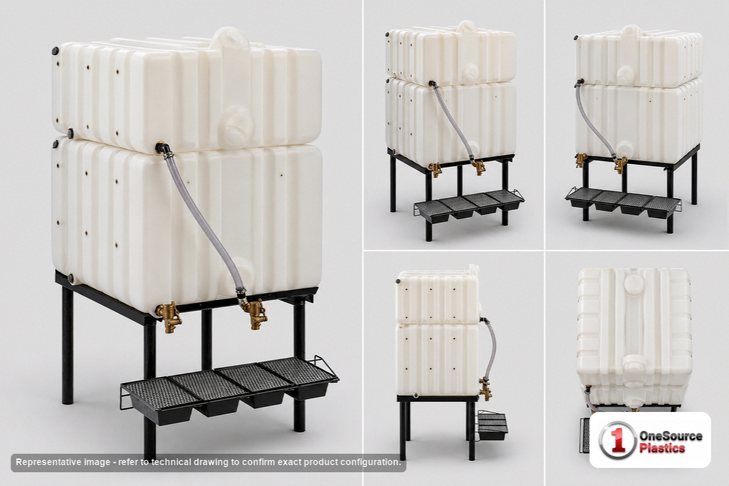
The Snyder SII-5720104CFWS45 is a 200 gallon chemical feed station tank supplied with its stand, in white high density linear polyethylene, listed at 76 inches long by 62 inches wide by 74 inches tall and 242 pounds. Its sheet is the only one in this group that carries a product application field, and that field reads chemical feed station tanks, which is exactly what it is: a day tank charged from a drum, a tote or a delivery hose, standing over a metering pump that feeds a dosing point. The stand is published as a height and a weight and nothing else, so nothing here describes a frame load, a frame height or a frame material. The wall is rated at a specific gravity of 1.9, which gives 1,668 pounds for 200 gallons of water at 8.34 pounds per gallon and 3,169 pounds of maximum contents. The lid is 14 inches, the service limit is 120 F / 48 C, and no warranty term and no outlet fitting are published.
Engineer on the job? Request a written quote with the spec attached, or get freight to your ZIP and add to cart above; 866-418-1777 answers the technical questions.
The widest shipment in this batch, shipping from Arkansas
This station is molded at Marked Tree, Arkansas and the sheet names Arkansas as the shipping state. It shipments at 76 by 62 by 74 inches at 242 pounds, which is the widest and heaviest shipment in its group, and it is still one LTL pallet rather than a project: no crane, no oversize permit, no structural foundation, no capital approval. That is the whole commercial case for a feed station at this size, and it is why a plant that has outgrown a drum programme buys one of these instead of building a bulk installation outside with a pad, a bund, an outdoor pipe run and freeze protection. But 76 inches of shipping width is the number to take seriously before the truck is booked. That is wider than a standard personnel door, wider than many plant room aisles with equipment on both sides, and wide enough that a pallet jack needs a real turning radius. Walk the route from the dock to the room with a tape, measure the narrowest point rather than the widest, and check the lift at the far end: 242 pounds on a wide pallet is a forklift job under the base of the stand, and a kerbside delivery needs a lift gate arranged in advance. Inside the room, that 76 by 62 inch footprint goes down on a level, continuous, finished surface carrying the whole base as one plane: a chemical room floor, a coated slab, a poured pad, or the deck of a bund sized for the largest vessel inside it. Not two rails with the middle unsupported and not packed up at a corner to take a slope out. Above the base stands 1,668 pounds of water at full and 3,169 pounds at the rating on this sheet. What the height buys, at 74 inches, is the same thing every station on a stand buys: the metering pump sits below the discharge and runs flooded, the drain reaches a container, and there is clear space under the tank where a leak can be seen before it is a floor. Size the charge against the dosing rate and the delivery interval in the tank sizing calculator, and take the reserve and thermal freeboard from the tank sizing guide.
200 gallons at 74 inches, at 57 inches, and the 250 beside them
| Part | Gallons | Height | Empty weight | Mounting |
|---|---|---|---|---|
| SII-5720104CFWS45 (this one, linear wall) | 200 | 74 in | 242 lb | With stand |
| SII-5720104CFWS42 (cross-linked wall) | 200 | 74 in | 242 lb | With stand |
| SII-5720103CF45 (linear wall) | 200 | 57 in | 198 lb | On the floor |
| SII-5720103CF42 (cross-linked wall) | 200 | 57 in | 198 lb | On the floor |
| SII-5730103CF42 (larger charge) | 250 | 69 in | 209 lb | On the floor |
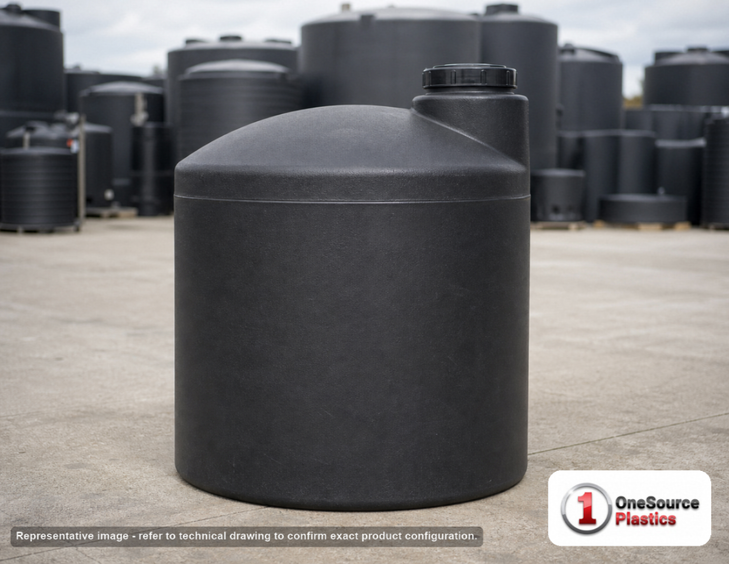
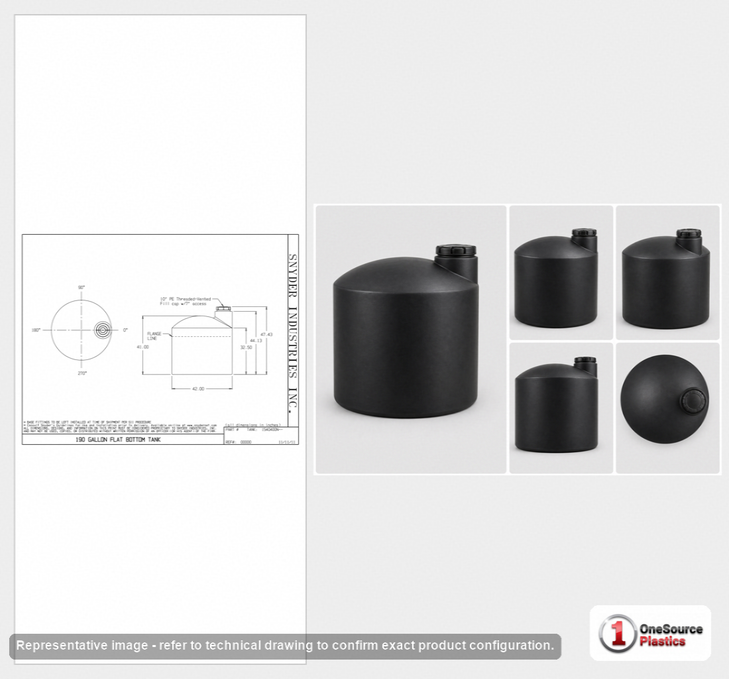
Everything in this table stands on the same 76 by 62 inch plan, so the floor area is settled before you choose and the decision is made on height, wall and charge. This tank is the linear-walled 200 on its stand at 74 inches and 242 pounds. The floor-standing 200s, SII-5720103CF45 and SII-5720103CF42, are listed at 57 inches and 198 pounds, which is a lower fill point, a shorter shipment and less weight to place, and no gravity head under the base at all. That is the trade in full: buy this one when the metering pump is fixed at floor level and must not lift, when the drain has to reach a carboy, or when you want to be able to see the underside of the tank. Buy a floor-standing one when a duct, a mezzanine or a door decides the height, or when the station is charged by hand and a 74 inch tank puts the lid out of reach. SII-5720104CFWS42 is this same station in a cross-linked polyethylene wall at the same listed 74 inches and 242 pounds, and that is the one to specify when the chemistry or the handling is hard on a tank; this part is the linear wall, for ordinary treatment duty. SII-5730103CF42 is the step up in charge, 250 gallons at 69 inches and 209 pounds on the same footprint, floor-standing, and it is worth a hard look if the extra fifty gallons would stretch a delivery interval, because it costs nothing in floor area. The last sibling, SII-6370424N95402, is not a feed station: it is a dry hopper bin tank rated at 25 cubic feet, 190 gallons, 48 by 48 by 57 inches and 330 pounds, built for dry material through a hopper, and no liquid duty is claimed for it here.
Height or floor the limit? The table has both shapes; freight to your ZIP is quoted on each row, or call 866-418-1777 with the site.
A 14 inch lid at 74 inches, and everything else that goes on top
- The opening: 14 inches, at the top of a station listed at 74 inches. That is at or above head height for most people, so the charging route is designed rather than improvised: a fixed delivery coupling at working level, piped up to the tank, is what keeps drums and open containers off the top.
- If the lid is opened routinely: put a step or a platform with a hand rail into the layout from the start, on the long side where there is 76 inches to work with rather than on an end.
- The vent path: clear at all times. A pump drawing against a closed lid pulls on the wall of any polyethylene tank, and there is a lot of standing liquid above the fitting on this one.
- The discharge: this sheet publishes no outlet fitting, so this page names no pipe size, no valve and no bulkhead assembly. Tell us the chemical and the pump you are feeding and we will confirm the discharge arrangement with the maker in writing before the station ships.
- The suction, once settled: pump below the discharge on its own base, short falling run, isolation valve at the tank, flexible connector at the first joint, cleanable strainer before the pump, all pipe weight on its own supports.
- Protection: a low level float or probe stopping the pump with liquid still above the fitting.
- Limits: 120 F / 48 C is the only service limit on this sheet, and no warranty term is published.
A 76 by 62 inch top is a large surface and it will fill up with fittings in the order somebody needed them unless it is planned as one layout. Do it on paper first: the top fitting placement guide sets out the sequence for vent, fill, level, drain and any vapour path so they stop fighting each other for the life of the station. Then choose the level device against the chemistry with the level gauge selection guide, and mark the tank so that a fire inspector and a workplace inspector are each satisfied the first time, using the tank label and signage guide.
Water treatment, wash plants and cooling tower dosing
Two hundred gallons is the charge for a dosing point that runs continuously and is delivered on a schedule: hypochlorite, caustic, acid, polymer or coagulant at a water or wastewater plant; a day tank beside a process line in food, beverage, paper or metal finishing; cooling tower and chiller treatment on a large building or a plant site; bulk detergent at a truck wash, a bus depot or a commercial laundry; a dosing point at a mine or a generating station. The bigger the charge, the longer any single delivery sits in the tank, and the more the sampling routine matters, because a stratified or settled charge reads fine from the wrong sample point and doses wrong for weeks. The chemical sampling protocol article is the piece to read before the routine is written: same point, same depth, same cadence, same container, logged every time.
Resin compatibility, line by line
Below are the liquids this resin is rated for, the concentration each rating holds to, and the fitting and gasket to specify. Check the exact concentration and temperature you run against the chemical page or the chemical compatibility database before ordering.
- acetic acid (60%, PP/PVC fittings, EPDM gasket)
- aluminum sulfate (50%, PVC/EPDM)
- calcium chloride (40%, PVC/EPDM)
- DEF (32.5%, 316SS/EPDM)
- ethylene glycol (100%, PVC/EPDM)
- ferric chloride (50%, PVC/EPDM)
- ferric sulfate (60%, PVC/EPDM)
- ferrous sulfate (20%, PVC/EPDM)
- hydrochloric acid (37%, PVC/Viton)
- hydrofluoric acid (48%, PP/PVC/Viton)
- hydrofluosilicic acid (26%, PP/PVC/Viton)
- hydrogen peroxide (50%, PVC/Viton)
- magnesium chloride (30%, PVC/EPDM)
- peracetic acid (30%, 316SS/Aflas)
- phosphoric acid (85%, PVC/Viton)
- polyaluminum chloride (PVC/EPDM)
- potassium carbonate (50%, PVC/EPDM)
- potassium hydroxide (saturated, PVC/EPDM)
- propylene glycol (PP/316SS/EPDM)
- sodium bisulfate (PVC/PP/EPDM)
- sodium bisulfite (PVC/PP/EPDM)
- sodium carbonate (30%, PVC/EPDM)
- sodium hypochlorite (under 16.5%, PVC/Viton)
- sodium thiosulfate (40%, PVC/EPDM)
- sulfuric acid (98%, CPVC/Viton)
- urea solution (50%, PP/PVC/EPDM)
- zinc orthophosphate (PP/316SS/EPDM), and ozonated water (up to 10 PPM, PVC/EPDM). Cross-check any of these against the concentration- and temperature-specific
Two hundred and forty-two pounds, and the forklift waiting at the far end
Molded at Marked Tree, Arkansas, and the sheet names Arkansas as the shipping state. The freight class is given as LTL, which is a mode and not a numeric class, under NMFC 156600-02, with the shipment at 76 by 62 by 74 inches and 242 pounds. The freight cost estimator prices the lane to your ZIP and the listed price is before freight. Arrange the lift before the truck is booked: a dock and a forklift under the base of the stand is the straightforward version, and a kerbside delivery needs a lift gate and a pallet jack plus a measured path wide enough for 76 inches. Never lift by the lid and never sling the tank body. Set it in its final position on the level floor or bund deck, plumb nothing until it stands where it will live, then water-fill it once, hold it while you read the lid seal, the base of the stand and the floor underneath, and drain it dry before the first chemical delivery. On the day it goes into service, write the chemical, the charge level and the commissioning date on the tank where somebody standing on the floor can read all three. The vent screen is the cheapest part on the tank and the one that saves it; look at it every time the manway opens.
Freight and documents
Ships from: Marked Tree, AR. LTL freight is quoted to your ZIP with the freight cost estimator or by phone at 866-418-1777. The listed price is before freight.
Technical drawing (PDF) for Snyder Industries 5720104CFWS45.
See this tank
Product video. Watch the Snyder Industries 200 Gallon HDLPE Chemical Feed Station Tank with Stand in White video (68 seconds) with dimensions, fittings and shipping notes.
Ready to order?
Add it to your cart at the top of this page, get LTL freight to your ZIP, request a written quote, or call 866-418-1777. The listed price is before freight.