275 gallons at 59 inches, under an 18 inch lid
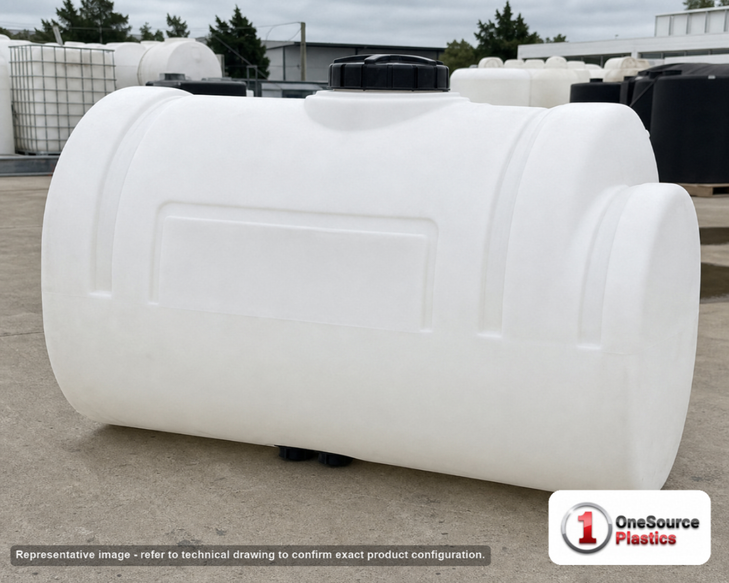
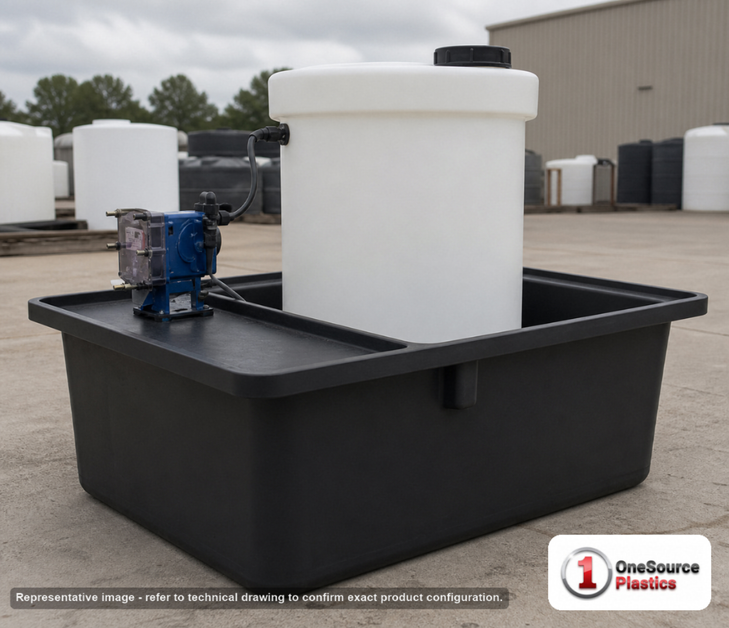
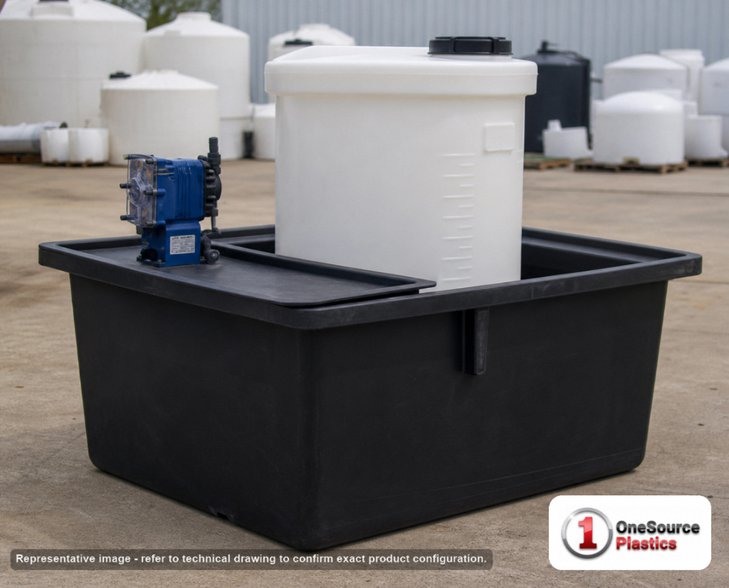
More supply and less height is an unusual combination, and the Snyder SII-5740103CF45 is where this family offers it. It is a 275 gallon chemical feed station in white high density linear polyethylene, listed 76 inches long, 62 inches wide and 59 inches tall at 226 pounds empty, on the same 76 by 62 inch plan the 250 gallon stations use and shorter than those 250s at 69 inches. The sheet gives both listings and does not explain the difference, so we print what it says. The wall is rated at a specific gravity of 1.9, giving 2,294 pounds for 275 gallons of water at 8.34 pounds per gallon and 4,358 pounds of max contents. Access is an 18 inch lid, the largest opening in this part of the family. The service limit is 120 F / 48 C, and the sheet publishes no outlet, no inlet, no vent fitting and no warranty term.
Need it before the next delivery? Call 866-418-1777 for the ship date, or get freight to your ZIP and add it to your cart above now.
More supply than the 250 and less height
The family comparison is the reason to buy this part and it is worth being precise about. SII-5730103CF42 holds 250 gallons at 76 by 62 by 69 inches and 209 pounds. This station holds 275 gallons at 76 by 62 by 59 inches and 226 pounds. Same plan, more liquid, a lower tank and a heavier one. If your constraint is a ceiling, a mezzanine or a low duct, that combination is rare enough to be worth knowing about, because the usual assumption that the bigger tank is the taller tank does not hold here. The sheet states both and explains neither, so treat it as a listed fact rather than a design principle. The second comparison is the wall: SII-5740103CF42 is listed at the same 76 by 62 by 59 inches and the same 226 pounds in cross-linked polyethylene, where this part is high density linear polyethylene. Take this one when the chemistry does not call for a cross-linked wall. The third is the stand, and here the 275 gallon group differs from the rest of the family: SII-5740104CFWS42 is the standing part, listed at 72 by 62 by 76 inches and 150 pounds, which is a different plan and a lighter listing than this floor-mounted station. Again, that is what the sheet gives. Whichever you take, the site work is the same: a flat, level, continuous bearing surface under the whole base, carrying 2,294 pounds of water at full and 4,358 pounds at the rating. Run your dosing rate and delivery interval through the tank sizing calculator before you commit to 275 gallons, take the freeboard from the tank sizing guide, and settle any containment argument with the Snyder Captor containment comparison.
275 gallons, and what sits either side of it
| Part | Volume | Length x width x height | Empty weight |
|---|---|---|---|
| SII-5740103CF45 (this station, linear wall, no stand) | 275 gal | 76 x 62 x 59 in | 226 lb |
| SII-5740103CF42 (cross-linked wall, no stand) | 275 gal | 76 x 62 x 59 in | 226 lb |
| SII-5740104CFWS42 (cross-linked, with stand) | 275 gal | 72 x 62 x 76 in | 150 lb |
| SII-5730103CF42 (smaller, cross-linked, no stand) | 250 gal | 76 x 62 x 69 in | 209 lb |
| SII-5750103CF30 (larger, listed for sulfuric acid with containment basin) | 330 gal | 76 x 62 x 68 in | 238 lb |
Two of these rows are the same shell and two are not. This station and SII-5740103CF42 are listed identically at 76 by 62 by 59 inches and 226 pounds and are separated by wall material alone. The standing part, SII-5740104CFWS42, is listed on a 72 by 62 inch plan at 76 inches and 150 pounds; that is four inches shorter in length and a lighter listing than the floor-mounted pair, which runs against the pattern the smaller stands in this family follow, and the sheet offers no reason for it. We print the listings as given and will confirm the part before it ships rather than smoothing over the difference. Below, SII-5730103CF42 gives 250 gallons at 69 inches and 209 pounds. Above, SII-5750103CF30 is a 330 gallon station the maker names for sulfuric acid with a containment basin, 76 by 62 by 68 inches and 238 pounds; we describe it exactly as it is named and assert nothing about concentration, temperature or fitness for any particular liquid. If your load is acid, that conversation starts with the chemical name and the concentration you actually run, not with a tank.
Need a different size? Every tank in the table is in stock programs; ask for a quote on the one that fits, or call 866-418-1777.
An 18 inch opening changes the fill and the cleaning
- Headspace and breathing: no vent fitting is published on this sheet. The 18 inch lid is the only opening it gives, so it is the fill point and the breather at once, and 275 gallons moving in or out moves that air through it. Never close the top and run a pump underneath.
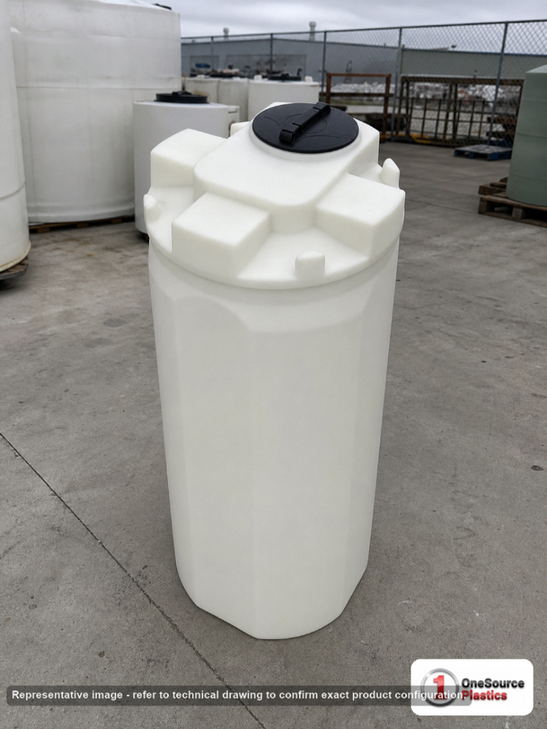
- What the bigger opening buys: 18 inches takes an arm and a brush where a smaller lid takes a hand, which makes wash-out, inspection and a level device far easier to live with. At 59 inches the opening is at a comfortable working height too, which is the other quiet advantage of the low body.
- Discharge: no outlet or inlet size is published, so we confirm the fittings on your part before the pipework is fabricated rather than printing a size the sheet does not carry. Pump below the low point on its own base, short falling suction, cleanable strainer ahead of it.
- Control: isolation valve at the tank, flexible connector at the first joint, low level cut-out that stops the pump with liquid still above the fitting.
- Knowing and naming: the level gauge selection guide for choosing a level device that suits the chemistry, and the tank label and signage guide for marking that stands up to an inspection.
- Service limit: 120 F / 48 C, the only limit on this sheet, and there is no warranty term.
Support the pipework on its own steel, not on the tank, and break the first joint with a flexible connector. Name the chemical when you order so the wetted parts are chosen for it.
Stretching the interval between deliveries
Two hundred and seventy-five gallons is usually bought to buy time: one delivery instead of two, a long weekend covered, a shutdown bridged without a tanker. It goes into hypochlorite and caustic feed at treatment works, coagulant and polymer ahead of a clarifier, cooling water treatment, food and beverage cleaning chemical, wash-bay detergent and small chemical rooms at mines and generating stations. The longer the liquid sits in a day tank, the more the sample matters, because a settled or stratified supply reads fine at the top and doses differently at the bottom: the chemical sampling protocol article is the routine that catches it.
Service list by chemical
One line per liquid the maker rates for this resin, with the concentration it is rated to and the fitting and gasket to order. Take your own concentration and temperature to the linked page or the chemical compatibility database before ordering.
- sodium hypochlorite (
- sulfuric acid (98%, CPVC fittings, Viton)
- hydrochloric acid (37%, PVC, Viton)
- phosphoric acid (85%, PVC, Viton)
- ferric chloride (50%, PVC, EPDM)
- aluminum sulfate (50%, PVC, EPDM)
- potassium hydroxide (saturated, PVC, EPDM)
- hydrogen peroxide (50%, PVC, Viton)
- peracetic acid (30%, 316SS, Aflas)
- hydrofluoric acid (48%, PP/PVC, Viton)
- DEF (32.5%, 316SS, EPDM)
- urea solution (50%, PP/PVC, EPDM)
- ethylene glycol (100%, PVC, EPDM)
- calcium chloride (40%, PVC, EPDM)
- ferric sulfate (60%)
- sodium carbonate (30%)
- polyaluminum chloride
- zinc orthophosphate and ozonated water (up to 10 PPM, PVC fittings, EPDM gaskets), among others. Fitting and gasket material matters as much as the tank wall:
- propylene glycol and zinc orthophosphate (PP/316SS). Choosing an EPDM gasket on a sodium hypochlorite line is the kind of detail-level mistake that fails be
226 pounds on the same 76 by 62 inch plan
Marked Tree, Arkansas is the plant and the freight class is given as LTL under NMFC 156600-02. The station shipments at 76 by 62 by 59 inches, a pallet that fits through more doors than the standing parts in this family do, which is worth remembering if the chemical room is down a corridor. Price the lane to your ZIP with the freight cost estimator; the listed price is before freight. Take the 226 pounds off under the base with a forklift or a pallet truck, never by the lid. Set it on the finished pad, water-fill it on the level, hold it while you read the base, the lid seal and the slab beneath, and drain it dry before the chemical arrives. Mark the tank with the chemical name and the date of that first fill in paint, not in marker; the label that survives is the one that matters. Keep the first delivery's paperwork with the tank; strength and date on day one is the baseline for every batch after.
Freight and documents
Ships from: Marked Tree, AR. LTL freight is quoted to your ZIP with the freight cost estimator or by phone at 866-418-1777. The listed price is before freight.
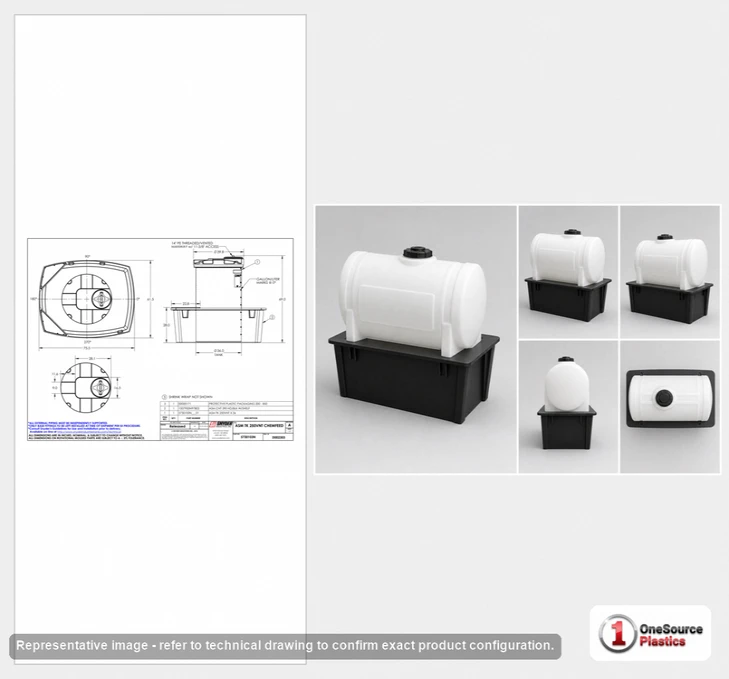
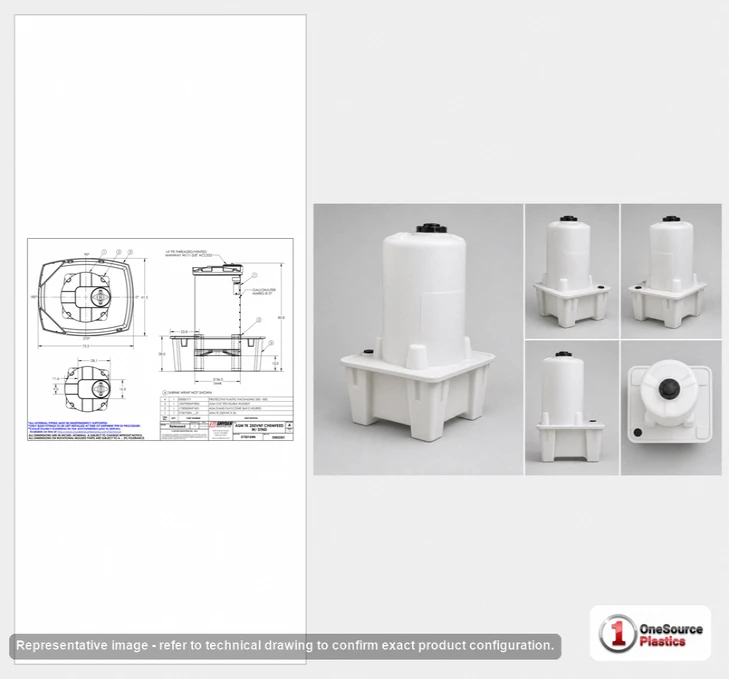
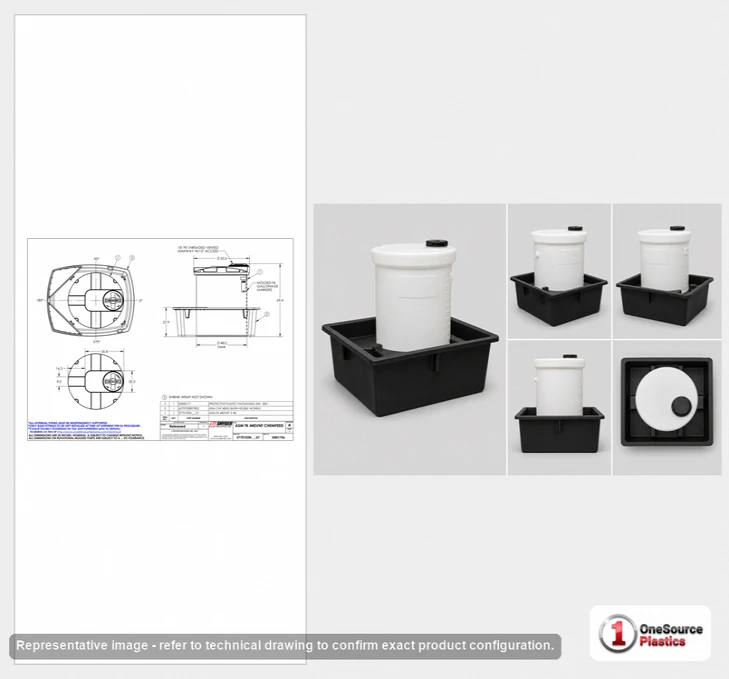
Technical drawing (PDF) for Snyder Industries 5740103CF45.
See this tank
Product video. Watch the Snyder Industries 275 Gallon Plastic Chemical Feed Station Tank video (72 seconds) with dimensions, fittings and shipping notes.
Ready to order?
Add it to your cart at the top of this page, get LTL freight to your ZIP, request a written quote, or call 866-418-1777. The listed price is before freight.