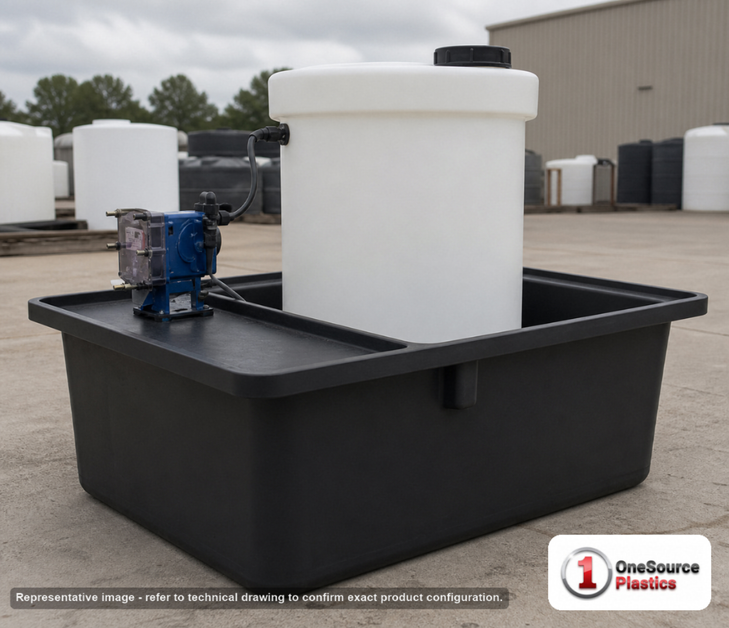
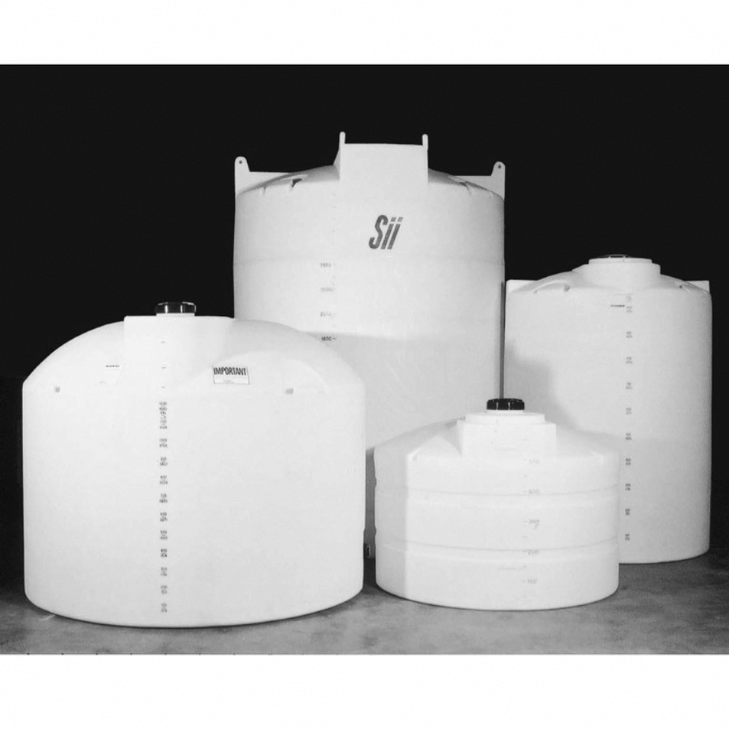
330 gallons for sulfuric acid, basin included, 68 inches tall
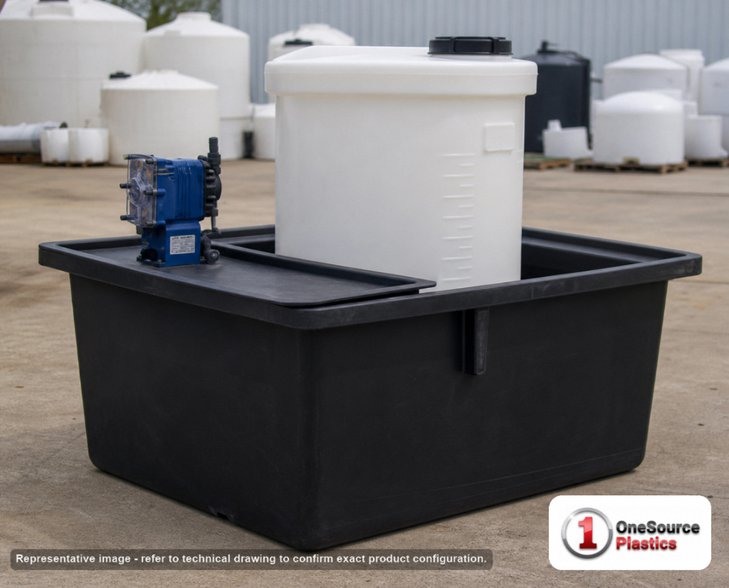
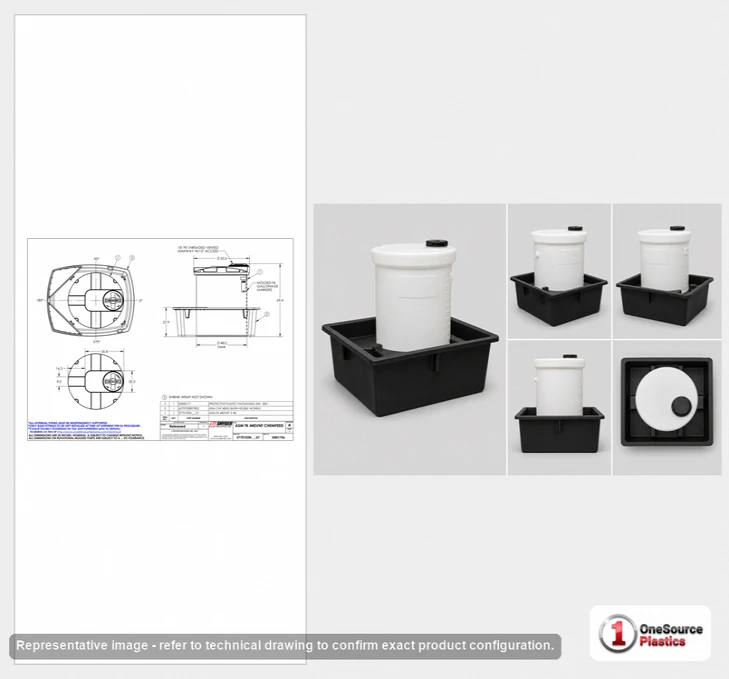
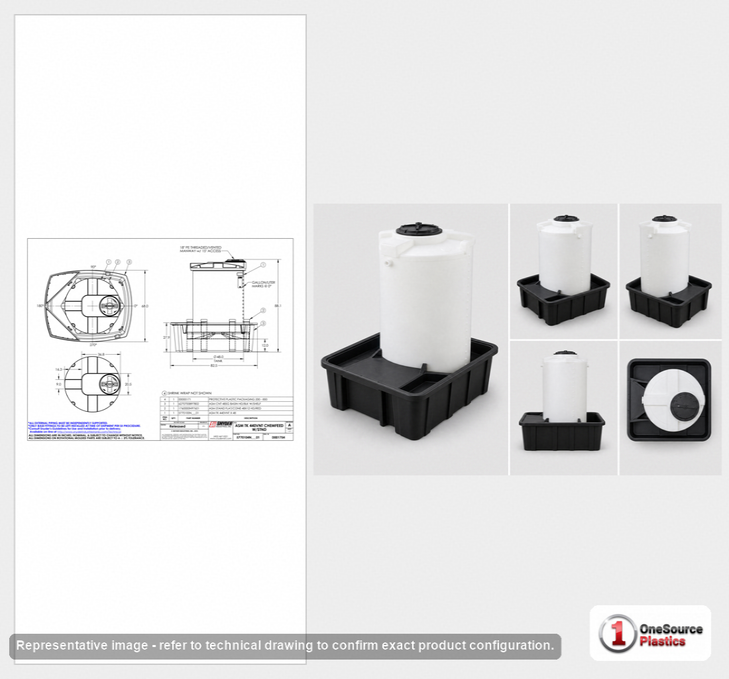
Snyder names this one for the duty. The SII-5750103CF30 is a 330 gallon chemical feed station tank in white high density linear polyethylene, and the maker's own name for it is a chemical feed station tank for sulfuric acid with containment basin. The sheet lists it 76 inches long, 62 inches wide and 68 inches tall, at 238 pounds empty, which makes it the lowest of the four 330 gallon builds in its family. The wall is rated at a specific gravity of 1.9: 2752 pounds for 330 gallons of water at 8.34 pounds per gallon, and 5229 pounds at the max contents rating. The manway is listed at 18 inches; the sheet publishes no outlet and no inlet, so no pipe size or valve is named here. The service limit is 120 F / 48 C, and nothing beyond that limit and the maker's own naming is asserted about the acid duty. No warranty term appears on this sheet. The freight class field reads LTL under NMFC 156600-02.
Ready for the pad? Quote freight to your ZIP, add the 330 gallon tank to your cart above, and 866-418-1777 will confirm the truck and the unload.
The acid feed room that has to hold a spill where it happens
The duty that buys this part is metered acid feed in a room where a spill has to stay inside the machine's own footprint. A municipal water plant trimming pH on a finished-water line. A wastewater operation neutralizing before discharge. A cooling tower system on acid feed to hold scale down. A metal finishing or plating shop with a bath that gets made up from bulk rather than from carboys. A pulp, paper or food plant with a small acid service beside a process line. In every one of those the feed rate is modest and constant, the delivery is measured in months rather than days, and the reason the operator is looking at a station rather than at a plain tank is that the tank, the basin and the space around the fittings are meant to be one item on one pad instead of three separate problems. Snyder names this build with a containment basin and names it for sulfuric acid, and that is exactly as far as this page will go: we do not state a concentration, a temperature above the published limit, or a compatibility conclusion the sheet does not carry. What the page can tell you is what the geometry means on a floor. Seventy-six by 62 inches is one rectangle to level, one area to curb, and one plan to fit into an aisle. At 68 inches tall it is the lowest of its family, which matters in a chemical room with a low ceiling, a roll-up door, a mezzanine, or a fill point that has to be reached from floor level rather than from a platform. Above the floor sits 2752 pounds of water at full and 5229 pounds at the rating, so the surface under it has to be flat, level and continuous across the whole footprint, with no shim under a corner and no span across a trench. Work the volume against your real feed rate and delivery interval in the tank sizing calculator before you commit to 330 gallons, and take the reserve and thermal freeboard from the tank sizing guide. Where the containment question is a regulatory one rather than a housekeeping one, the Snyder Captor containment and SPCC comparison is where that argument is made with the standards named properly.
The lowest of the 330 group, and the four listed beside it
| Part | Volume | Length x width x height | Empty weight |
|---|---|---|---|
| SII-5750103CF30 (this one, acid build, no frame) | 330 gal | 76 x 62 x 68 in | 238 lb |
| SII-5750103CF42 (cross-linked wall, no frame) | 330 gal | 76 x 62 x 69 in | 238 lb |
| SII-5750103CF45 (linear wall, no frame) | 330 gal | 76 x 62 x 69 in | 238 lb |
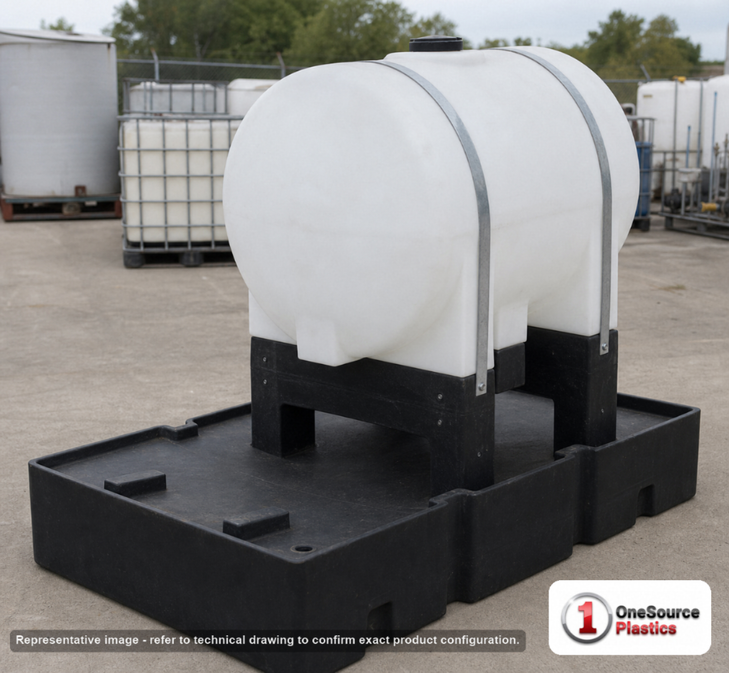
| SII-5750104CFWS30 (same acid build, with stand) | 330 gal | 76 x 62 x 86 in | 318 lb |
| SII-5740103CF42 (smaller, lower) | 275 gal | 76 x 62 x 59 in | 226 lb |
| SII-6372104N95402 (dry hopper bin, listed beside it) | 360 gal | 48 x 45 x 84 in | 346 lb |
Four parts on this sheet hold 330 gallons on the same 76 by 62 inch plan and they divide on two questions: frame or no frame, and which wall. This one is the acid-named build without a frame, and it is the one to specify when the pump already sits below floor level or on a curb, when the ceiling will not take a taller station, or when the fill coupling has to be reachable without a step. SII-5750104CFWS30 is the same acid build on a stand, listed at 86 inches tall and 318 pounds against this tank's 68 inches and 238 pounds; the difference between the two is the frame, and the sheet publishes no stand height, load or material of its own, so we print the two overall figures and nothing more. The CF42 and CF45 builds are the same plan at 69 inches, one in a cross-linked wall and one in a linear wall, and neither carries the acid naming or the basin in its name. There is an inch to explain and we will not pretend to explain it: this part is listed 68 inches tall where those two are listed 69, all three at 238 pounds. The sheet gives all three figures and we publish what it says. Below the group, SII-5740103CF42 holds 275 gallons on the identical 76 by 62 inch footprint at 59 inches tall and 226 pounds, which is the part to take when the plan is fixed and the ceiling is the constraint. The last row is a different product family and it is listed here only because the sheet lists it: SII-6372104N95402 is named as a 48 cubic feet 60 degree dry hopper bin tank, on a 48 by 45 inch plan at 84 inches tall and 346 pounds, and the sheet also carries 360 gallons against it. It is a dry material bin discharged through a hopper, not a liquid feed station, and this page asserts no liquid duty for it.
Still deciding between these? Freight to your ZIP often settles it; the wider tanks ship differently. Or call 866-418-1777 and we will walk the table with you.
Suction, drain, and the basin under both
- The pump and drain path: no outlet and no inlet appears on this sheet, so no pipe size, valve or fitting is named here; the draw arrangement is specified with the order and matched to the chemical you name. What the geometry decides is the layout: on a station that sits at 68 inches with no frame under it, the pump belongs as low as the room allows and the suction run should fall toward it in a short, straight line with the first bend clear of the tank.
- Prime and low level protection: a metering pump on a chemical duty must not run dry, and a station with only 68 inches of standing height loses its column quickly at the end of a delivery cycle. Put a low level float or probe in that stops the pump with liquid still above the draw point, and a strainer ahead of the pump that can be cleaned without breaking into the chemical line.
- Draining and the basin: the maker names this build with a containment basin, and the basin is a floor to be kept clear and dry rather than a place to store anything. Keep the drain path from the basin visible and testable, and keep a means of getting liquid out of it that does not require a person to lean over the tank.
- Access and filling: an 18 inch manway is the only fitting the sheet publishes. At 68 inches tall that is within reach from floor level for most operators, which is a real operational argument for the no-frame build: the fill coupling, the level device and the vent can all be serviced without a platform.
- Level and marking: read the level where the operator stands, and mark what is in the tank in words on the tank. The level gauge selection guide compares the technologies for chemical service, and the tank label and signage guide covers the marking that survives an inspection.
- Service limit: 120 F / 48 C, the only limit this sheet publishes, and the sheet publishes no warranty term.
Everything downstream of the tank rides on its own support, never on the tank wall, with a flexible connector at the first joint so that a pump start or a thermal move is not taken by the shell. Name the chemical when you order so the fittings, gaskets and bolting are matched to it rather than left generic, and keep the whole draw assembly inside the plan the basin covers so a weeping joint lands where it is meant to land.
Acid dosing, and knowing what is in the tank
The jobs are pH trim on finished water, neutralization ahead of a discharge point, cooling water treatment, bath make-up in a metal finishing shop, and small acid service beside a process line in a paper or food plant. Every one of them depends on knowing what the tank actually holds, and a badly drawn sample gives a wrong answer that looks right, which is precisely the subject of the chemical sampling protocol article. Sample from the same point, at the same depth, on the same cadence, and write it down.
Resin compatibility, line by line
Below are the liquids this resin is rated for, the concentration each rating holds to, and the fitting and gasket to specify. Check the exact concentration and temperature you run against the chemical page or the chemical compatibility database before ordering.
- Sulfuric Acid at 98% concentration, CPVC fittings, Viton gaskets
- Hydrochloric Acid at 37%, PVC fittings, Viton gaskets
- Hydrofluoric Acid at 48%, PP/PVC fittings, Viton gaskets
- Hydrofluosilicic Acid at 26%, PP/PVC fittings, Viton gaskets
- Phosphoric Acid at 85%, PVC fittings, Viton gaskets
- Hydrogen Peroxide at 50%, PVC fittings, Viton gaskets
- Sodium Hypochlorite at under 16.5%, PVC fittings, Viton gaskets
- Peracetic Acid at 30%, 316SS fittings, Aflas gaskets
- Acetic Acid at 60%, PP/PVC fittings, EPDM gaskets
- Ferric Chloride at 50%, PVC fittings, EPDM gaskets
- Ferric Sulfate at 60%, PVC fittings, EPDM gaskets
- Ferrous Sulfate at 20%, PVC fittings, EPDM gaskets
- Aluminum Sulfate at 50%, PVC fittings, EPDM gaskets
- Polyaluminum Chloride PVC fittings, EPDM gaskets
- Calcium Chloride at 40%, PVC fittings, EPDM gaskets
- Magnesium Chloride at 30%, PVC fittings, EPDM gaskets
- Sodium Carbonate at 30%, PVC fittings, EPDM gaskets
- Sodium Thiosulfate at 40%, PVC fittings, EPDM gaskets
- Sodium Bisulfate PVC/PP fittings, EPDM gaskets
- Sodium Bisulfite PVC/PP fittings, EPDM gaskets
- Potassium Carbonate at 50%, PVC fittings, EPDM gaskets
- Potassium Hydroxide at saturated concentration, PVC fittings, EPDM gaskets
- Zinc Orthophosphate PP/316SS fittings, EPDM gaskets
- Propylene Glycol PP/316SS fittings, EPDM gaskets
- Ethylene Glycol at 100%, PVC fittings, EPDM gaskets
- Urea Solution at 50%, PP/PVC fittings, EPDM gaskets
- DEF at 32.5%, 316SS fittings, EPDM gaskets
Marked Tree to the plant floor at 238 pounds
Marked Tree, Arkansas is the only plant this sheet lists, which puts the short lane through the Mid-South and the lower Mississippi valley. The freight class field reads LTL under NMFC 156600-02, a mode rather than a numeric class, and the station shipments on its 76 by 62 inch plan at 68 inches tall, which is a wide pallet rather than a tall one. Price the lane to your ZIP with the freight cost estimator; the listed price is before freight. At 238 pounds this comes off the truck with a forklift or a pallet jack, never by the manway and never with a sling around the shell, and the low profile is the one thing in its favor on the way in: check the door and aisle width against 76 by 62 inches rather than worrying about the height. Set it on the finished, level floor, connect nothing until the footprint is fully bearing, then water-fill it once and hold it long enough to read the basin floor, the manway seal and every joint you have made. Drain and dry it before the first delivery of chemical arrives, and log that date where the operators will see it. Write the outlet fitting size and material on the site plan; the replacement is ordered by those two words.
Freight and documents
Ships from: Marked Tree, AR. LTL freight is quoted to your ZIP with the freight cost estimator or by phone at 866-418-1777. The listed price is before freight.
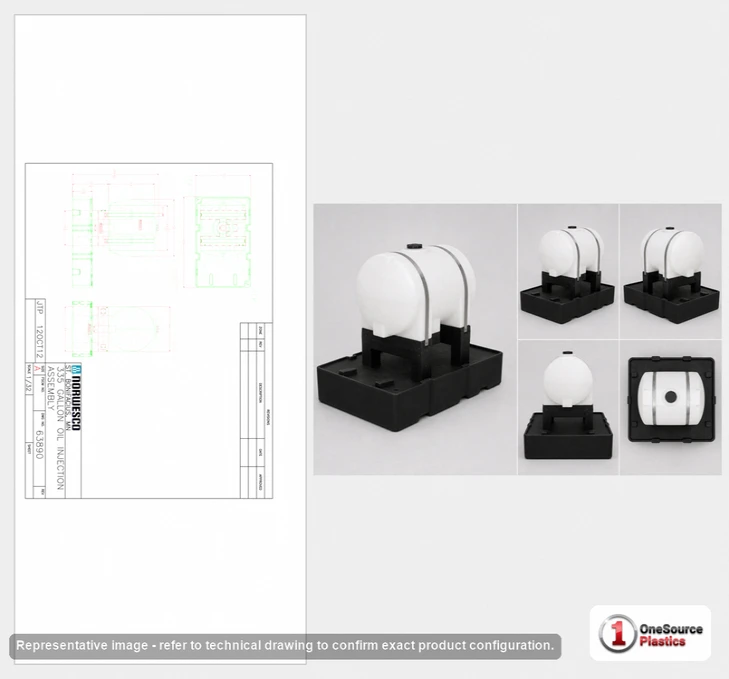
Technical drawing (PDF) for Snyder Industries 5750103CF30.
See this tank
Product video. Watch the Snyder Industries 330 Gallon HDLPE Chemical Feed Station Tank for Sulfuric Acid with Containment Basin video (76 seconds) with dimensions, fittings and shipping notes.
Ready to order?
Add it to your cart at the top of this page, get LTL freight to your ZIP, request a written quote, or call 866-418-1777. The listed price is before freight.