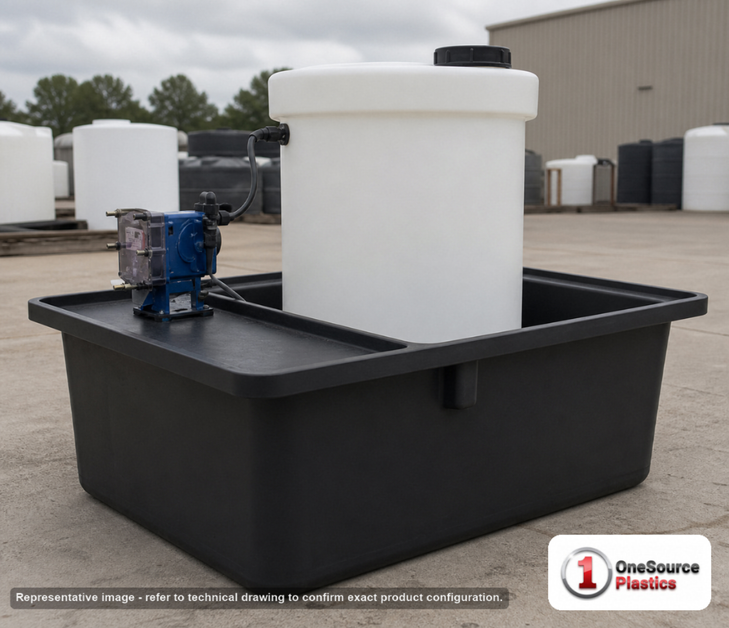
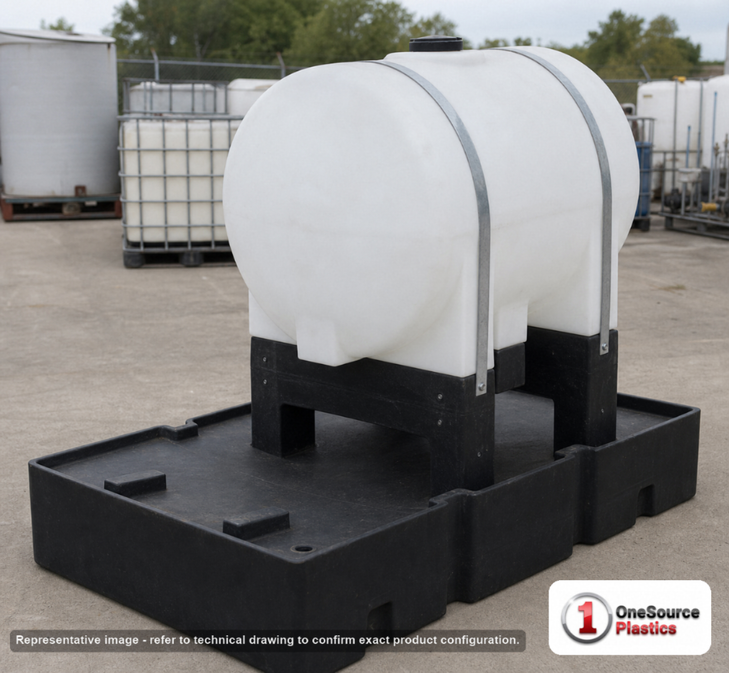
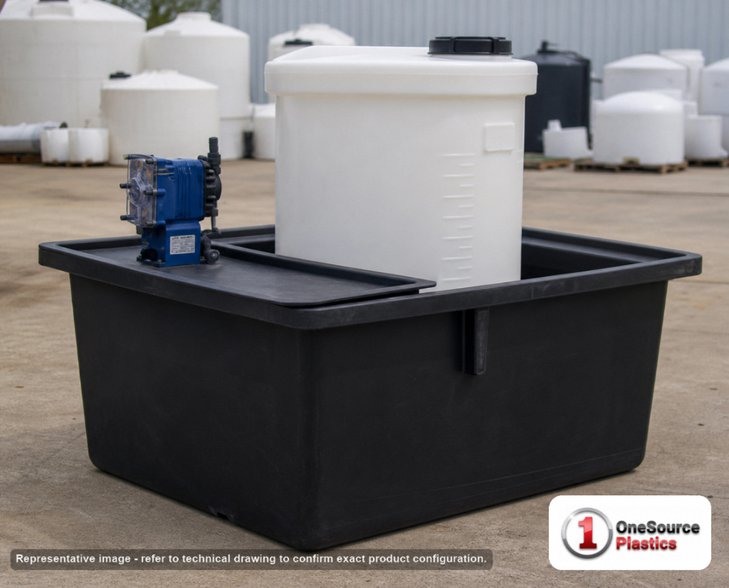
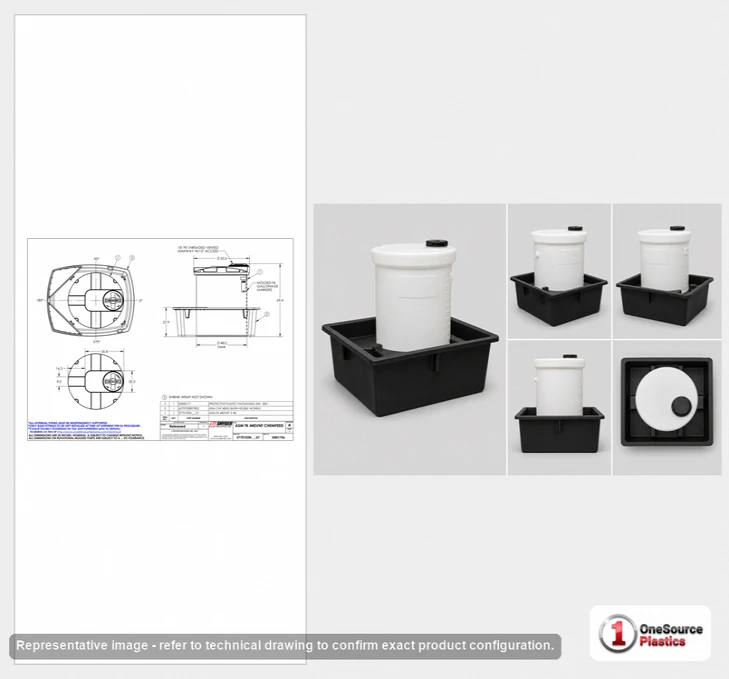
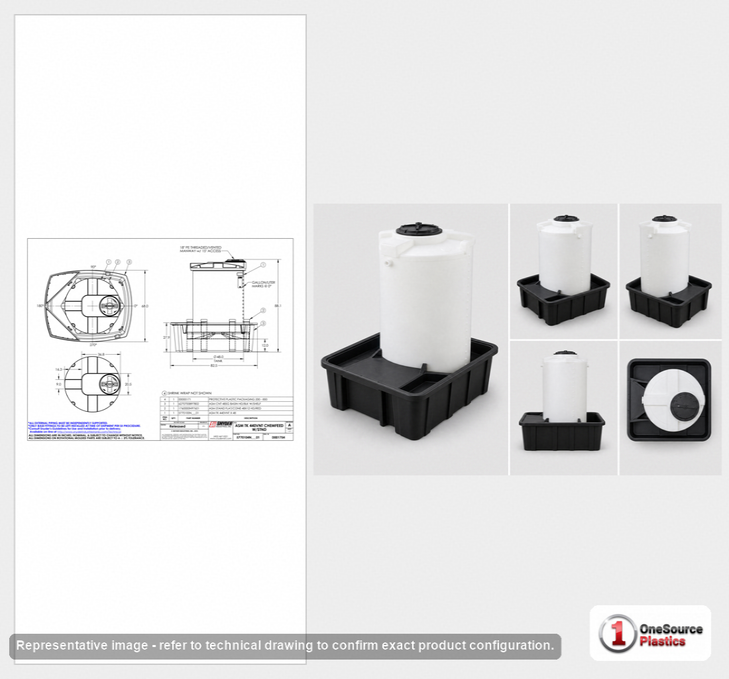
The same 330 acid station, raised to 86 inches on its frame
Height is what you are buying here. The Snyder SII-5750104CFWS30 is the 330 gallon chemical feed station that the maker names for sulfuric acid with a containment basin and stand, in white high density linear polyethylene, and the sheet lists it 76 inches long, 62 inches wide and 86 inches tall at 318 pounds. Set that against the same station without the frame, listed at 68 inches and 238 pounds: the frame is the whole difference between the two part numbers, and the sheet publishes no stand height, stand load or stand material of its own, so nothing about the frame is asserted beyond the two overall figures. The wall is rated at a specific gravity of 1.9, giving 2752 pounds for 330 gallons of water at 8.34 pounds per gallon and 5229 pounds at the max contents rating. The manway is listed at 18 inches and the sheet's product application field reads chemical feed station tanks. No outlet, no inlet and no warranty term appear on this sheet. Service limit 120 F / 48 C.
Need it before the next delivery? Call 866-418-1777 for the ship date, or get freight to your ZIP and add it to your cart above now.
Dosing where the metering pump must never pull a lift
Somebody specifies this part when the pump is the fragile thing in the system. A water plant where a diaphragm metering pump runs every hour of every day and a lost prime is a compliance event, not an inconvenience. A wastewater operation where the dose has to be steady through a shift change. A cooling tower or boiler treatment loop where a small, constant feed rate has to be repeatable. A plating or finishing shop where a bath is fed continuously rather than batched. A paper or food plant with a chemical room and a pump skid in it. What all of those have in common is that they would rather raise the tank than fight the pump, and 86 inches of overall height is what raising it looks like on a drawing. Standing the 330 gallon vessel on its frame puts the low point of the tank above the pump, so the suction is flooded by the column above it rather than lifted, the last of a delivery still leaves under gravity, a drain can reach a carboy or a drum without a transfer pump, and there is space under the tank to see a wet spot before somebody finds it with a boot. That is the argument in full, and it costs you two things worth knowing in advance: 318 pounds instead of 238, and 86 inches of height to get through a door, under a beam and into an aisle. Measure both before ordering. The floor question is unchanged from the no-frame build: 2752 pounds of water at full, 5229 pounds at the rating, all of it carried on the frame's bearing points rather than spread across the tank's own base, so the surface has to be flat, level, continuous and unbroken under the whole 76 by 62 inch plan. Size the volume against the feed rate and the delivery interval in the tank sizing calculator, and take the reserve and freeboard from the tank sizing guide. Nothing on this page states an acid concentration or a service temperature above the published limit; the maker names the build for sulfuric acid and that naming is where our claim stops. Where the chemistry is the question rather than the geometry, start with the pillar for the product you are feeding: sulfuric acid, hydrochloric acid, sodium hypochlorite or phosphoric acid, and the wider chemical compatibility database for anything else the room feeds.
Eighty-six inches with the frame, sixty-eight without
| Part | Volume | Length x width x height | Empty weight |
|---|---|---|---|
| SII-5750104CFWS30 (this one, acid build, with stand) | 330 gal | 76 x 62 x 86 in | 318 lb |
| SII-5750103CF30 (same acid build, no frame) | 330 gal | 76 x 62 x 68 in | 238 lb |
| SII-5750103CF42 (cross-linked wall, no frame) | 330 gal | 76 x 62 x 69 in | 238 lb |
| SII-5750103CF45 (linear wall, no frame) | 330 gal | 76 x 62 x 69 in | 238 lb |
| SII-5740103CF42 (smaller, lowest of the group) | 275 gal | 76 x 62 x 59 in | 226 lb |
| SII-6372104N95402 (dry hopper bin, different family) | 360 gal | 48 x 45 x 84 in | 346 lb |
The comparison that decides this order is the first two rows, and it is a single question: does the pump need to sit under the tank? If yes, this is the part, at 86 inches and 318 pounds. If no, SII-5750103CF30 is the same acid-named build at 68 inches and 238 pounds, and it is easier to move, easier to fill from floor level and easier to fit under a low ceiling. Everything else in the table is a different decision. The CF42 and CF45 parts are the same 76 by 62 inch plan at 69 inches tall with no frame, one in a cross-linked wall and one in a linear wall, and neither carries the acid naming or the basin in its name; if your chemical argues for a different wall, that is the row to read. SII-5740103CF42 holds 275 gallons on the identical plan at 59 inches and 226 pounds, the lowest thing in the group and the choice when the constraint is overhead rather than floor. SII-6372104N95402 is not a feed station at all: the sheet names it as a 48 cubic feet 60 degree dry hopper bin tank on a 48 by 45 inch plan at 84 inches and 346 pounds, while also carrying 360 gallons against it. We print both figures because both are on the sheet, and we claim no liquid service, no dosing duty and no rating for a dry bin. One honest note on the group: the acid build is listed 68 inches tall where the CF42 and CF45 builds are listed 69, all three at 238 pounds. The sheet gives all of it and we print what it says.
Need a different size? Every tank in the table is in stock programs; ask for a quote on the one that fits, or call 866-418-1777.
Flooded suction off the low point, and a drain that reaches a drum
- The pump path, which is the reason for the frame: no outlet or inlet size is published on this sheet, so none is named here, and the draw arrangement is specified with the order against the chemical you name. What the frame gives you is placement freedom: the pump goes on its own base directly under the tank's low point, the suction run is short and falling, and the column above keeps that suction flooded through the whole delivery cycle instead of only at the start.
- Draining to a container: with the vessel standing at 86 inches, a drain can discharge into a carboy, a drum or a sump under gravity, which is the difference between a five minute job and a portable pump. Fit an isolation valve close to the tank and a second one at the point of use so the line can be broken without emptying the station.
- Prime protection and filtration: a low level float or probe that stops the pump with liquid still above the draw point, and a strainer ahead of the pump that can be serviced without cutting into the chemical line. A metering pump run dry on a chemical duty is a maintenance call, and sometimes a day.
- Access and filling at height: the sheet publishes an 18 inch manway, and at 86 inches overall that opening is above comfortable reach. Bring the fill line to a coupling at working level, open the manway from a platform or steps with a handrail rather than from a drum, and keep the vent path clear at all times so a delivery cannot pressurize the vessel or a pump collapse it.
- Layout before drilling: the order in which the fill, the vent, the level device and any return line are placed on top of a station decides how the rest of its life goes, and the top fitting placement guide sets out that sequence. Read the level where the operator stands using the level gauge selection guide, and mark the station to the standard the tank label and signage guide lays out.
- Service limit: 120 F / 48 C, and the sheet publishes no warranty term.
Carry every line, valve and filter on its own support off the floor or the wall, never on the tank or the frame, and break the first joint with a flexible connector. Anchor the frame before the first fill and check it again a week later; a station that was plumb on delivery day settles a little once 2752 pounds has stood in it.
Hypochlorite, acid, and the sampling that keeps them honest
Raised feed stations do the continuous duties: acid and hypochlorite dosing at water and wastewater plants, cooling tower and boiler treatment, bath feed in metal finishing, and a day tank on a dosing skid beside a process line. All of them stand or fall on knowing what is actually in the vessel, and a sample drawn from the wrong place at the wrong depth produces a wrong result that reads as a right one, which is the whole subject of the chemical sampling protocol article.
Three hundred and eighteen pounds, and the doorway it has to clear
The sheet lists one plant, Marked Tree, Arkansas, and gives the freight class as LTL under NMFC 156600-02, which is a mode rather than a numeric class. It crates on the 76 by 62 inch plan at 86 inches tall, so the height is the constraint and not the weight: confirm the door opening, the aisle and any beam or pipe run between the dock and the chemical room before the truck is booked, because seven feet of station on its frame does not duck. Price the lane with the freight cost estimator; the listed price is before freight. Take the 318 pounds off with a forklift under the frame, never by the manway and never with a sling around the shell, set it on the finished level floor, anchor the frame, and only then plumb it. Water-fill it once and hold it while you read the basin floor, the manway seal, the frame footings and every joint, then drain and dry it. Keep the crate until the anchoring is finished, because the one mistake this build cannot absorb is a tall station standing on an unfinished floor. Keep the first delivery's paperwork with the tank; strength and date on day one is the baseline for every batch after.
Freight and documents
Ships from: Marked Tree, AR. LTL freight is quoted to your ZIP with the freight cost estimator or by phone at 866-418-1777. The listed price is before freight.
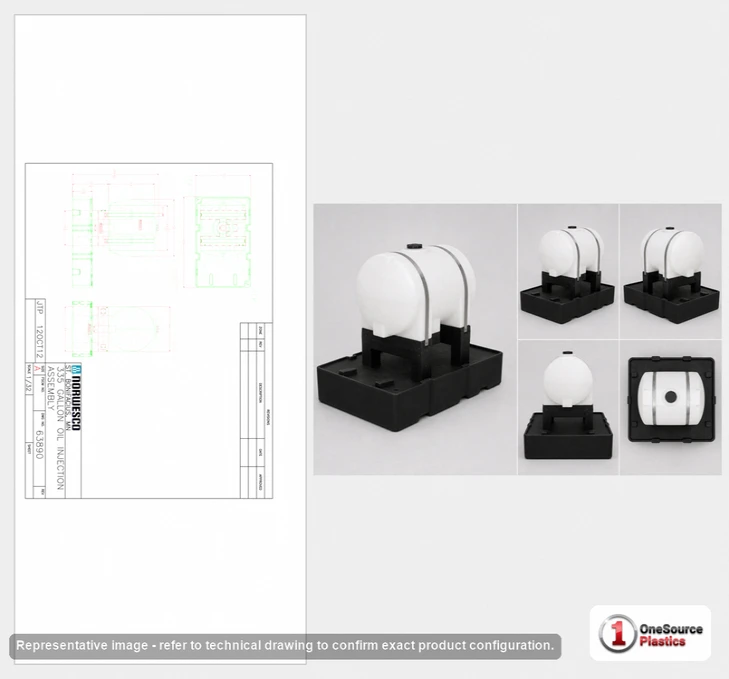
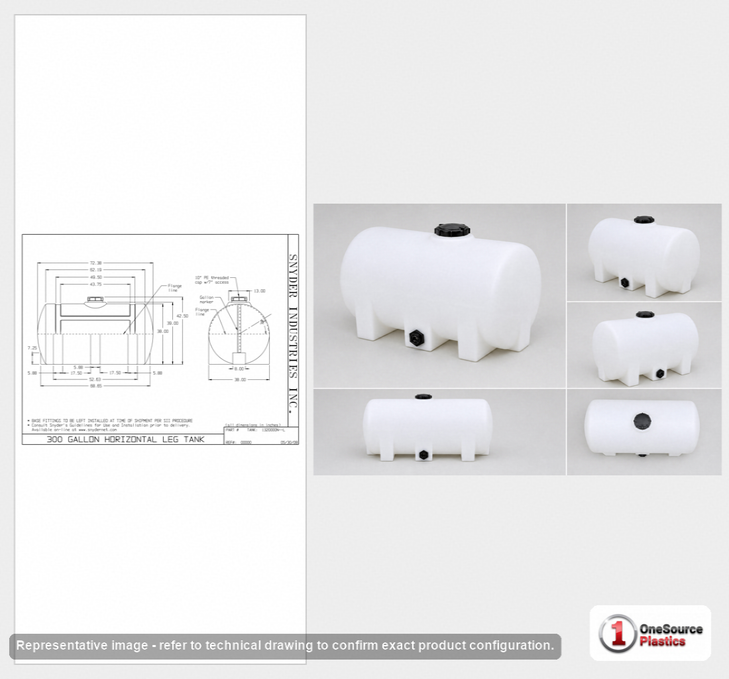
Technical drawing (PDF) for Snyder Industries 5750104CFWS30.
Ready to order?
Add it to your cart at the top of this page, get LTL freight to your ZIP, request a written quote, or call 866-418-1777. The listed price is before freight.