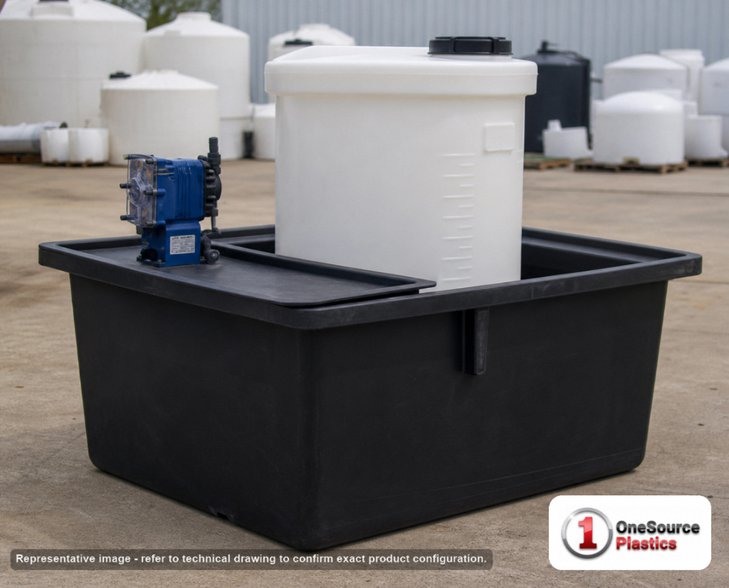
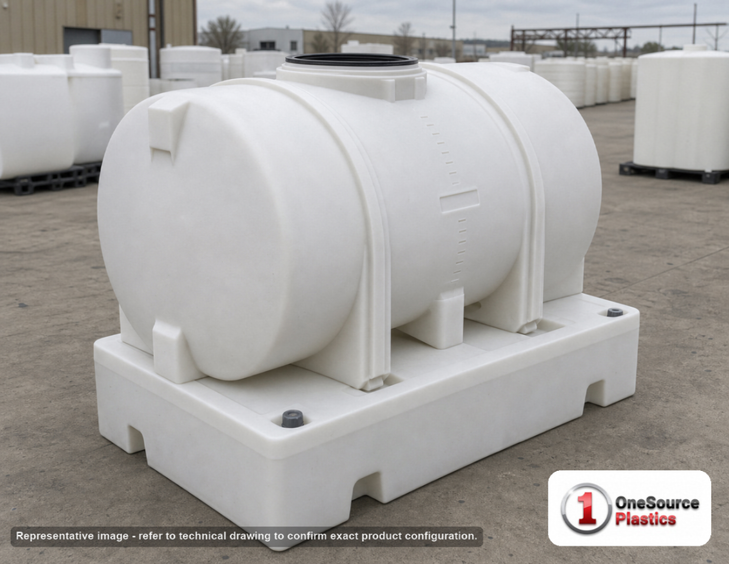
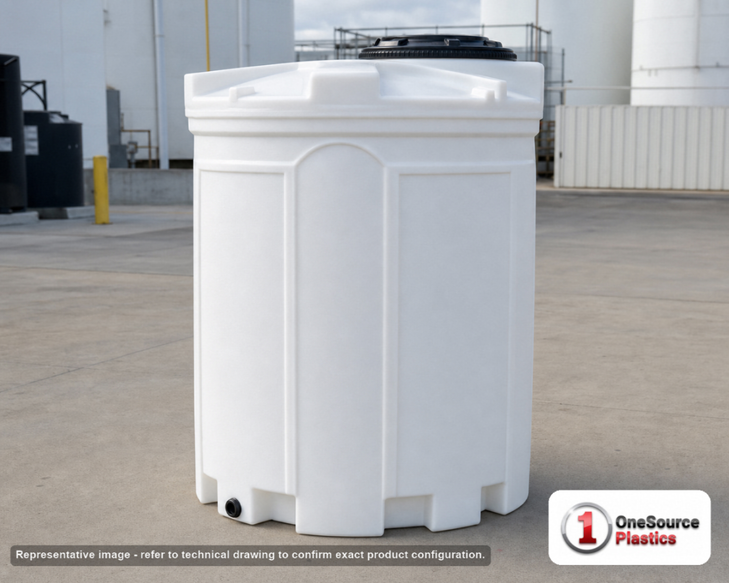
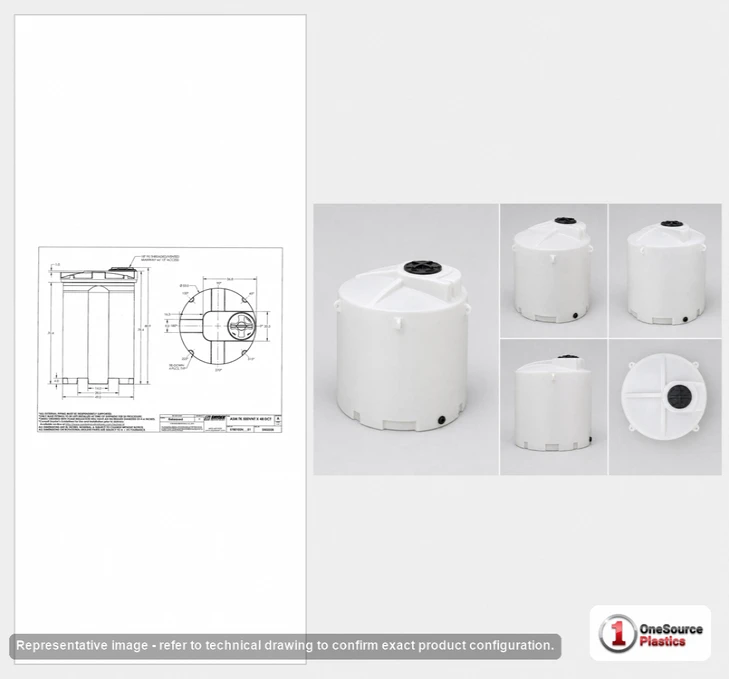
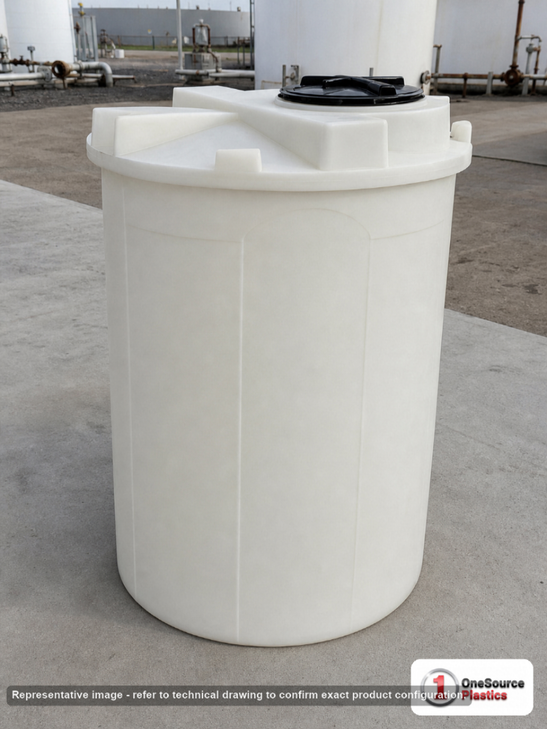
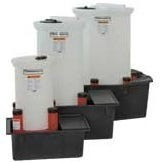
The 440 on its stand: 88 inches tall and 400 pounds as listed
Eighty-eight inches, seven feet four inches, is what Snyder's SII-5770104CFWS45 stands at. It is a 440 gallon chemical feed station tank in white high density linear polyethylene, supplied on its stand, 83 inches long and 68 inches wide in plan, listed at 400 pounds as it ships. The wall is rated at a specific gravity of 1.9, so the sheet gives 3,670 pounds for 440 gallons of water at 8.34 pounds per gallon and 6,972 pounds of max contents. Access is an 18 inch lid and the service limit is 120 F / 48 C. The plant is Marked Tree, Arkansas. This sheet publishes no outlet size, no inlet size, no warranty term and no rating for the stand, so this page asserts none of them.
Ordering for a plant or a bid? Request a written quote with freight to your ZIP for the file; a single 440 gallon tank goes straight to the cart above.
Standing the tank up: the floor, the anchors and the space underneath
Put the tank up in the air and three things change on the floor. The first is what fits beneath it: a metering pump on its own base below the draw-off, a drum or carboy under the drain when a batch has to come out, a sump or a trench that can be reached without a transfer pump. The second is what you can see: the underside of a vessel carried on a frame is visible on a walk-past, so a weep is a maintenance job rather than a puddle discovered by somebody's boot. The third is what the floor has to do. The plan is still 83 by 68 inches, but the load no longer spreads across it; it arrives through the frame's own feet, and 3,670 pounds of water at full, 6,972 pounds at the sheet's rating, is a genuine point load on an old slab or a mezzanine deck. This sheet publishes no anchor pattern, no foot detail and no load rating for the stand, so none is printed here; where the room is seismic, where forklifts work the same aisle, or where the deck is not ground-bearing concrete, get that detail confirmed for this part number before the order. Height is the trade. Seven feet four inches has to clear the door, the header and any overhead services on the route in, and the lid at that height needs a platform or a step with a rail rather than somebody on a drum. It also raises the fill point, so the delivery hose and the coupling have to be planned at working level instead of at the rim. Confirm the volume before the height: 440 gallons against your dosing rate and delivery interval in the tank sizing calculator, with the reserve and the freeboard from the tank sizing guide.
Two part numbers at 88 inches, one at 69
| Part | Volume | Length x width x height | Empty weight |
|---|---|---|---|
| SII-5770104CFWS45 (this one, with stand) | 440 gal | 83 x 68 x 88 in | 400 lb |
| SII-5770104CFWS42 (with stand, the other part number) | 440 gal | 83 x 68 x 88 in | 400 lb |
| SII-5770103CF45 (no stand, lower and lighter) | 440 gal | 83 x 68 x 69 in | 350 lb |
| SII-6372405N95402 (dry hopper bin, steeper cone) | 58 cu ft | 48 x 48 x 91 in | 352 lb |
| SII-6370629N95402 (dry hopper bin, shallower cone) | 60 cu ft | 48 x 45 x 86 in | 352 lb |
The comparison that decides this order is the first three rows, and it is a clean one because the plan never changes: 83 by 68 inches whichever part you buy. SII-5770103CF45 is the same station listed at 69 inches and 350 pounds with no stand; this one is listed at 88 inches and 400 pounds with the stand, and that is the entire published difference between them. Buy the height when the pump needs a flooded suction below the draw-off, when a container has to go underneath, or when the drain has to reach something without help. Buy the low one when the ceiling, the header or the existing fill point rules the height out. Against SII-5770104CFWS42 the sheet gives the same 83 by 68 by 88 inches and the same 400 pounds, so there is no dimensional difference to report and no explanation offered for the two part numbers; each carries its own sheet's rating, and the sensible rule is to match the number already on your plant's drawing or spares list. The last two rows are a different family that happens to land at a similar volume: dry hopper bin tanks rated in cubic feet, 58 cubic feet on the steeper 60 degree cone and 60 cubic feet on the shallower 45 degree one, for dry material through a hopper. No liquid duty and no gallon rating is claimed for either of them here.
Need the taller or the wider one? Every row links to its page with freight to your ZIP on each; 866-418-1777 will check the ceiling and the pad.
Draw off below, fill above: an 18 inch lid at 88 inches
- The draw-off and the valve: no outlet size and no inlet size are published on this sheet, so none is printed. Name the chemical and the flow when you order and we confirm the fitting, the gasket and the valve against Snyder's drawing for this part number before it ships. Whatever the size, the valve is carried on its own support and the first joint is a flexible connector, never a rigid line clamped between the frame and a wall.
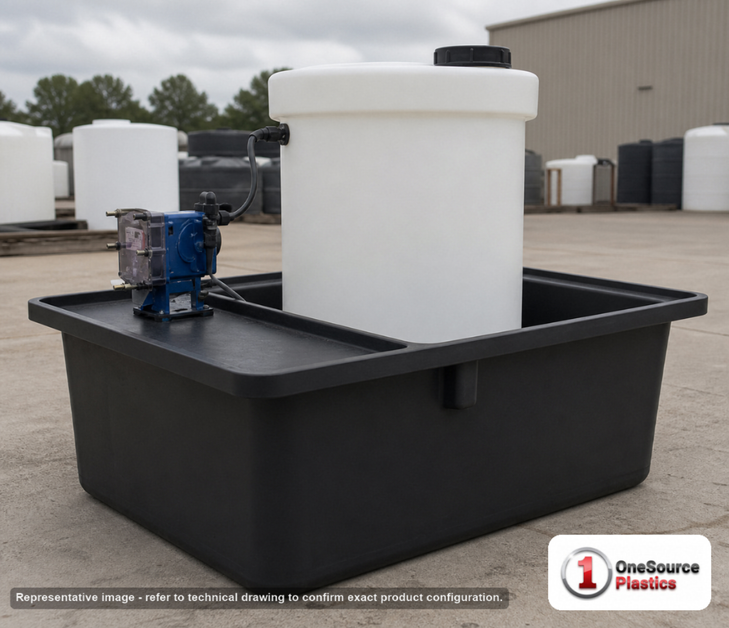
- The pump under the outlet: the reason this part number exists. Set the metering or transfer pump below the draw-off on its own base with a short falling run into the suction, so the standing column keeps it flooded through the whole batch and it does not lose prime between calls. Add a low level float or probe that stops the pump with liquid still over the fitting.
- The drain path: with the vessel raised, a batch can be dumped to a drum, a carboy or a sump without a transfer pump, which is the difference between a wrong delivery being a nuisance and being a day's work. Leave the room under the tank clear so that path stays usable.
- Filling at height: an 18 inch lid at 88 inches is above head height, so bring the fill line to a coupling at working level and open the lid from a platform with a rail, not from the top of a drum. Keep the vent path clear whenever a pump is drawing.
- Level and identity: put the level on a display the operator reads from the floor, using the level gauge selection guide to pick the technology, and mark the vessel and its lines to the standard set out in the tank label and signage guide.
A raised vessel changes the spill question as well as the pump question, because anything that leaves a fitting at height travels further than anything that leaks at floor level. Decide where a failure drains to before the first delivery rather than after one, and where that answer has to satisfy somebody official, the Snyder Captor containment comparison is the honest treatment of what a bund does and where an engineered double wall takes over. The wall rating here is a specific gravity of 1.9 and the limit is 120 F / 48 C, both as this sheet gives them.
Feeding a line at a fixed rate, all shift
This is the station a plant buys when dosing is continuous and the pump is not allowed to stop: chlorine, caustic, acid, coagulant or polymer feed at a water or wastewater works; a chemical day tank on a process line in food, paper, dairy or metal finishing; cooling tower treatment at a large site; bulk detergent or acid at a commercial wash; a dosing point at a mine, a plant or a generating station. Four hundred and forty gallons at a working dosing rate is a delivery every week or two rather than drums every few days, and the stand is what keeps the pump honest between those deliveries. Check the volume against your own consumption in the tank sizing calculator before deciding that a bigger vessel is the answer; a station that is refilled twice a month and always full is worth more than one that is refilled quarterly and half empty.
Chemical service ratings
The resin is rated for the liquids below at the concentrations shown; the fitting and gasket called out are the ones to order with the tank. Verify the exact service on the linked page or in the chemical compatibility database before ordering.
- Sulfuric Acid (98%) - CPVC fittings, Viton gaskets
- Hydrochloric Acid (37%) - PVC fittings, Viton gaskets
- Phosphoric Acid (85%) - PVC fittings, Viton gaskets
- Acetic Acid (60%) - PP/PVC fittings, EPDM gaskets
- Hydrofluoric Acid (48%) - PP/PVC fittings, Viton gaskets
- Hydrofluosilicic Acid (26%) - PP/PVC fittings, Viton gaskets
- Ferric Chloride (50%) - PVC fittings, EPDM gaskets
- Ferric Sulfate (60%) - PVC fittings, EPDM gaskets
- Ferrous Sulfate (20%) - PVC fittings, EPDM gaskets
- Aluminum Sulfate (50%) - PVC fittings, EPDM gaskets
- Polyaluminum Chloride - PVC fittings, EPDM gaskets
- Sodium Hypochlorite (
- Hydrogen Peroxide (50%) - PVC fittings, Viton gaskets
- Peracetic Acid (30%) - 316SS fittings, Aflas gaskets
- Potassium Hydroxide (saturated) - PVC fittings, EPDM gaskets
- Potassium Carbonate (50%) - PVC fittings, EPDM gaskets
- Sodium Carbonate (30%) - PVC fittings, EPDM gaskets
- Sodium Bisulfite - PVC/PP fittings, EPDM gaskets
- Sodium Bisulfate - PVC/PP fittings, EPDM gaskets
- Sodium Thiosulfate (40%) - PVC fittings, EPDM gaskets
- Calcium Chloride (40%) - PVC fittings, EPDM gaskets
- Magnesium Chloride (30%) - PVC fittings, EPDM gaskets
- Zinc Orthophosphate - PP/316SS fittings, EPDM gaskets
- DEF (Diesel Exhaust Fluid) (32.5%) - 316SS fittings, EPDM gaskets
- Urea Solution (50%) - PP/PVC fittings, EPDM gaskets
- Ethylene Glycol (100%) - PVC fittings, EPDM gaskets
- Propylene Glycol - PP/316SS fittings, EPDM gaskets
Oversize out of Marked Tree at 400 pounds
Molded at Marked Tree, Arkansas. The sheet gives the freight class as OVS under NMFC 156600-03, which is an oversize move rather than an ordinary LTL one, and the shipped package is 83 by 68 by 88 inches. That is the number to check first: seven feet four inches tall and nearly six feet wide does not go through a standard doorway standing up and does not fit under a low dock canopy, so measure the route to the room and confirm who is unloading before the truck is booked. The freight cost estimator prices the lane to your ZIP, and the listed price is before freight. Take the 400 pounds off with a forklift under the frame, never by the lid, never with a sling around the vessel, and stand it in its final position on level floor before anything is connected. Water-fill it once, hold it, and read the floor under every foot of the frame, the lid seal and each joint you have made, then drain it dry before the chemical arrives. A week after the first real delivery, go back and check the frame's feet and the joints again; the load has been on them now, and that is when a bolt that was tight turns out not to be. A strap that is checked once a season is a strap that holds; put it on the same calendar as the gutters.
Freight and documents
Ships from: Marked Tree, AR. LTL freight is quoted to your ZIP with the freight cost estimator or by phone at 866-418-1777. The listed price is before freight.
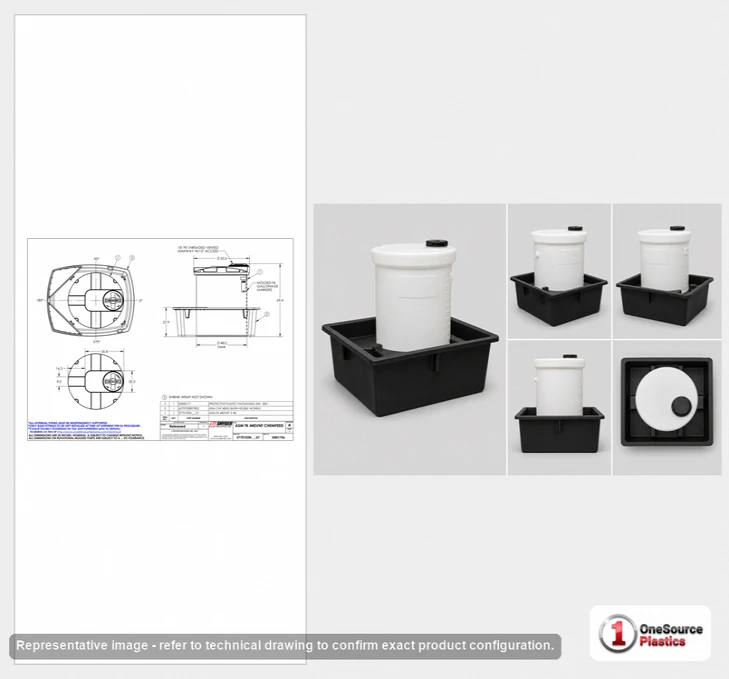
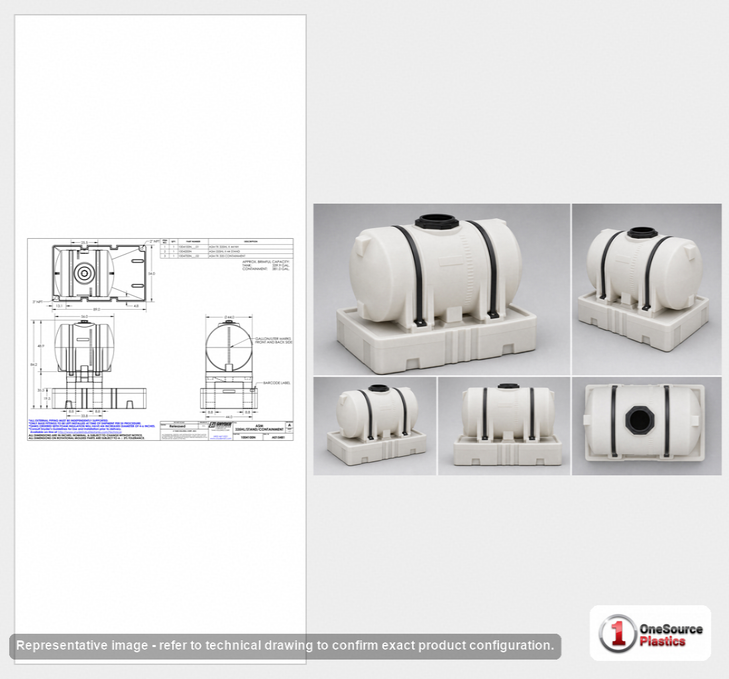
Technical drawing (PDF) for Snyder Industries 5770104CFWS45.
See this tank
Product video. Watch the Snyder Industries 440 Gallon Plastic Chemical Feed Station Tank video (69 seconds) with dimensions, fittings and shipping notes.
Ready to order?
Add it to your cart at the top of this page, get LTL freight to your ZIP, request a written quote, or call 866-418-1777. The listed price is before freight.