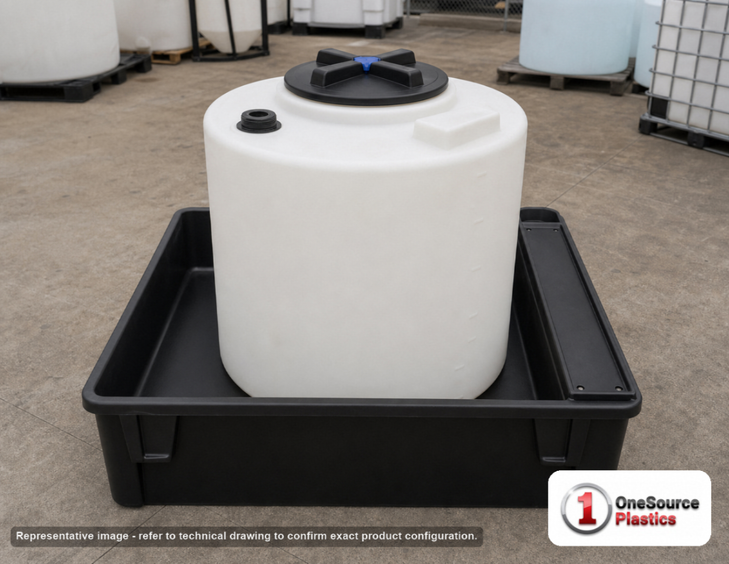
A 35 gallon chemical feed station tank that replaces the drum under the pump
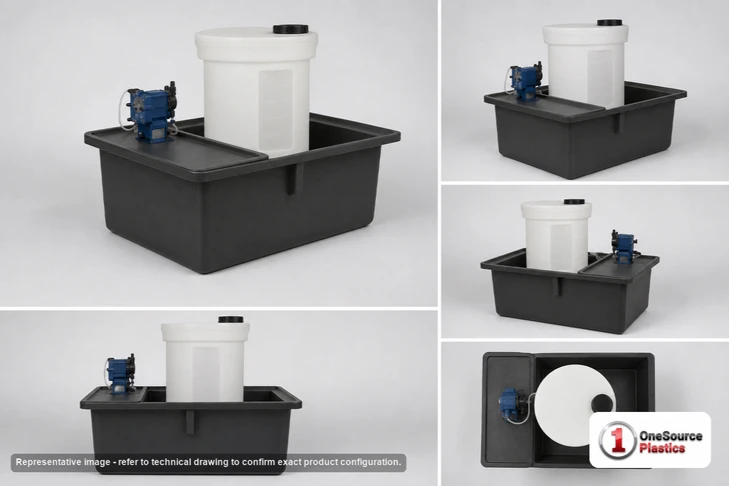
Snyder part 1000123CF45 is a 35 gallon chemical feed station tank in white high density linear polyethylene, 47 inches long, 36 inches wide and 36 inches tall, weighing 72 lb empty, with a 6 inch lid. It is built to sit on a floor and feed a small metering pump for weeks at a time; the footprint is wider than the liquid needs, which is what separates a station from a drum on a pallet. The wall is rated to 1.9 specific gravity and 120 F; 35 gallons of water weighs 292 lb (35 x 8.34). Snyder does not list an outlet size on this part number and names no containment basin on it, so tell us the pump connection and we will confirm how the tank ships.
Want it on the pad this month? Check freight to your ZIP, add it to your cart above, and 866-418-1777 will confirm the ship date.
The small dosing job that replaces a drum
Somewhere in most plants there is a chemical that arrives in drums and is fed by a small pump, and somebody handles those drums twice a week. A cooling tower on inhibitor or biocide. A boiler house feeding an oxygen scavenger. A small water system on hypochlorite. A pool on sanitizer. A laundry on a single detergent line. A greenhouse metering a pH adjuster. The volumes are small, which is why 35 gallons lasts for weeks, and the cost being removed is the handling: a drum lifted, a drum tipped, a suction line moved from an empty drum to a full one at the worst possible moment. A station stops all of that; the pump feeds from one fixed vessel at one fixed point and the delivery arrives on a schedule. At 36 inches tall the lid, the fill point and a level device are at working height without a platform. The floor takes 292 lb of water at full, a light load for any sound slab, but it still has to bear across the whole 47 by 36 inch plan with no rocking corner. Check that 35 gallons really is the right interval for your feed rate in the tank sizing calculator, because a station that runs out on a Sunday is worse than the drums it replaced, and take the freeboard from the tank sizing guide. Where containment is a written requirement, the Snyder Captor containment and SPCC comparison is where it belongs.
What goes in it
Linear polyethylene handles water and the everyday treatment chemicals. Check yours in the chemical compatibility guide; small station buyers look up sodium hypochlorite, sodium bisulfite, phosphoric acid and propylene glycol. Keep the liquid at or below 120 F and under 1.9 specific gravity. The level gauge selection guide for chemical service covers reading a small tank without opening it, our guide to sampling a chemical day tank explains where to draw from, and the labelling and signage guide covers the placards.
Openings and what to confirm
- Lid. 6 inches on top: room for a fill hose, a suction line and a level sensor. Cleaning is by rinse rather than by hand through a lid this size.
- Outlet. Not listed for this part number. Give us the pump suction size and we confirm before it ships.
- Drawing. Snyder's drawing for 1000123CF45 is linked under Technical Drawing on this page.
The 35 gallon family and the operator tanks beside it
Lifted for a flooded pump suction, the same tank is the 35 gallon chemical feed station tank with stand, part 1000124CFWS45. In cross-linked polyethylene, Snyder makes the 35 gallon XLPE feed station with containment basin and the 35 gallon XLPE feed station with stand. For a pest control rig rather than a plant room, see the 30 gallon pest control operator tank and the 50 gallon pest control operator tank with lid.
Shipping and receiving
LTL from Snyder's Marked Tree, Arkansas plant, 47 by 36 by 36 inches and 72 lb on a pallet. The listed price is before freight; the freight cost estimator gives the cost to your ZIP. Check 1000123CF45 against the bill of lading, look over the lid and base, and fill with water before the chemical goes in.
Questions before you order? Call 866-418-1777.
Freight and documents
Ships from: Marked Tree, AR. LTL freight is quoted to your ZIP with the freight cost estimator or by phone at 866-418-1777. The listed price is before freight.
Technical drawing (PDF) for Snyder Industries 1000123CF45.
See this tank
Product video. Watch the Snyder Industries 35 Gallon Plastic Chemical Feed Station Tank video (71 seconds) with dimensions, fittings and shipping notes.
Ready to order?
Add it to your cart at the top of this page, get LTL freight to your ZIP, or call 866-418-1777. The listed price is before freight.