525 gallons in the shortest body of the group, 68 inches long
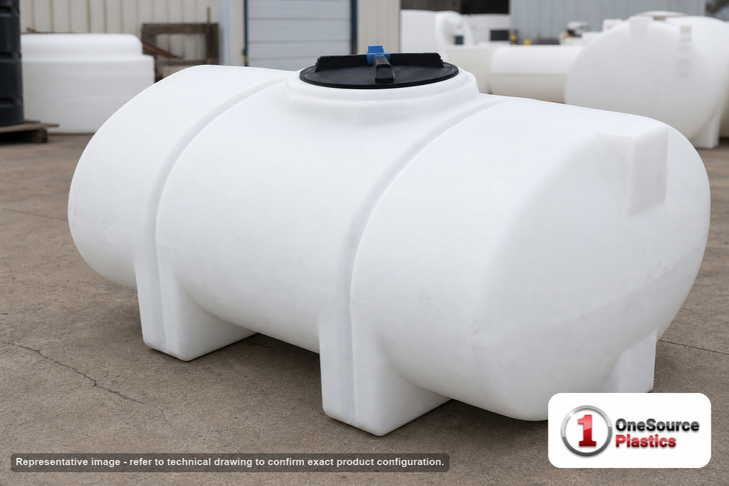
Sixty-eight inches is what the Snyder SII-1400000W94303 is for. It is a 525 gallon horizontal leg tank in white polyethylene, 68 inches long, 48 inches wide and 53 inches tall, 128 pounds empty and 128 pounds to ship, molded at Lincoln, Nebraska or Philippi, West Virginia, and it is the shortest body among the tanks in its own size group. Its feet are moulded into the underside, so it stands on a deck or a floor with no cradle and no stand. The sheet rates the wall at a specific gravity of 1.5, which is where the 6,568 pound figure for maximum contents comes from, against 4,378 pounds for 525 gallons of water at 8.34 pounds per gallon. It carries a 10 inch lid and a service limit of 120 F / 48 C, and freight is class LTL. This sheet publishes no warranty term, so none is stated here; ask us for Snyder's current terms in writing.
Ready for the pad? Quote freight to your ZIP, add the 525 gallon tank to your cart above, and 866-418-1777 will confirm the truck and the unload.
Lincoln, Nebraska and Philippi, West Virginia: the eastern lane to a 525
The plant list on this sheet is the argument for this part number as much as the rectangle is. Lincoln, Nebraska and Philippi, West Virginia cover the plains and the eastern half of the country between them, and on a 128 pound tank at class LTL the lane is the biggest number in the cost at your gate: freight on a light, bulky item is priced on distance and dimensions long before it is priced on weight. A buyer in Ohio, Pennsylvania, Kentucky, the Carolinas, Iowa or the Dakotas has a short haul to one of those two plants. Give us the ZIP and let the estimator choose the origin rather than guessing. The other half of the argument is that this is the shortest body in its group, 68 inches, under six feet, which is what puts a 525 gallon tank onto a deck that will not take a longer one: a short pickup bed with a toolbox already in it, a compact utility trailer, a skid that has to leave room for a pump and a hose reel behind the tank, a spot on a shop floor between two doorways. It buys that by being nearly the widest and by sitting at 48 inches across, so it wants width in exchange for length. Under it, the surface is the whole installation. Legs are flat bearing feet, not stilts, so they bear through the whole foot onto whatever they rest on and a bed rib, a raised lip, a cracked board or a hollow in a slab becomes the bearing point for 4,378 pounds of water, or up to 6,568 pounds of contents at the rating. Plywood or a mat on a ribbed deck, full contact, level. Then plan the restraint for surge, because a short body does not mean a small load: 525 gallons moves fore and aft hard under braking at part-full, and it lands in the anchors and the deck rather than in the wall. Bolt or strap it down through the legs in both directions. The classification question when a leg or applicator tank travels is worked through in the applicator and leg tank classification guide. Confirm the volume against your real draw in the tank sizing calculator, and take the reserve and the freeboard a warming liquid needs from the tank sizing guide.
Three ways to hold 525 gallons, and a 500 beside them
| Part | Gallons | Length x width x height | Empty weight |
|---|---|---|---|
| SII-1400000W94303 (this tank, shortest body, 10 inch lid) | 525 | 68 x 48 x 53 in | 128 lb |
| SII-1400000N45 (same volume, longer, same height) | 525 | 75 x 48 x 53 in | 124 lb |
| SII-32398 (same volume, tallest and heaviest) | 525 | 71 x 49 x 56 in | 194 lb |
| SII-1400100C26 (smaller) | 500 | 72 x 49 x 55 in | 160 lb |
| SII-1400300N45 (larger, longest and narrowest) | 535 | 78 x 47 x 52 in | 124 lb |
Three of these five part numbers hold exactly 525 gallons in three different rectangles, which means the capacity column is the least useful thing in the table. Take this one for length and for nothing else: 68 inches is the only body in the group under six feet, and on a short bed or a crowded skid that is the difference between the tank fitting and the tank being sent back. Against the SII-1400000N45, which holds the same volume at the same 53 inch height in a body 75 inches long, you are trading seven inches of deck for four pounds on the sheet, and the sheet gives both figures without comment. Against the SII-32398 at 71 by 49 by 56 inches and 194 pounds, you are giving up a much larger lid and gaining a shorter, lower, considerably lighter tank. The 500 gallon SII-1400100C26 at 72 by 49 by 55 inches is the step down in volume and up in weight, and the 535 gallon SII-1400300N45 at 78 by 47 by 52 inches is the longest, narrowest and lowest of the set, which is the buy when the deck is long and something has to clear the top. The honest summary is that this family is one tank in five rectangles: decide what the deck and the clearance will take, and let the gallons be whatever falls out.
Still deciding between these? Freight to your ZIP often settles it; the wider tanks ship differently. Or call 866-418-1777 and we will walk the table with you.
A 10 inch lid, and what a small opening costs you in service
- The lid is the fill opening, and the sheet gives it as 10 inches, the smallest in this size group. There is no inlet field on this sheet, so no fill fitting is asserted: the tank fills through the lid, with the hose taken down inside the body rather than splashing across the surface.
- What a small opening buys and what it costs, stated plainly. It buys durability in transit, because a 10 inch lid is a smaller thing to catch on a branch, a door frame or a loading arm, and a smaller seal to keep tight on a tank that spends its life on a moving deck. It costs you cleaning: a hand and a light go in, shoulders do not, so this is the tank to pick for one liquid held for years rather than for a vessel that changes product between seasons. If you know you will be washing it out and switching products, the larger-lidded tanks in this family are the honest answer.
- Keep the vent path clear at all times. With a small opening there is less margin for a partly blocked vent, and a tank drawn on hard through a blocked vent will pull its own wall inwards regardless of how thick that wall is.
- The outlet, printed as given: the sheet lists the outlet as 2 and prints no unit for it, so the figure is printed here and nothing more is claimed. It is not a pipe size. Tell us what you are connecting and we will confirm the port and the thread against Snyder's current documentation first.
- The valve and the first joint: a shut-off on its own support off the deck, never hanging off the tank wall, then a flexible connector before any hard pipe so deck flex, brake loads and thermal movement stay out of the fitting.
- Service limit: 120 F / 48 C, as the sheet gives it, for the liquid and for a loaded tank standing in the sun.
Name the liquid at order and the fitting, the gasket and the valve material get matched to it against Snyder's current documentation rather than guessed. If the product is a blended fertilizer solution, the failure that costs money is the blend rather than the vessel: a wide, shallow horizontal body has plenty of surface and very little height to drive mixing, and a separated blend will run a spreader off spec before anybody notices, which the fertilizer blend stratification guide works through along with the field checks that catch it. If site rules require secondary containment, a single-wall leg tank does not provide it, and the Captor double wall containment walkthrough sets out what a contained installation has to do to count.
Skid-mounted transfer, stock water and wash-down supply
A short 525 goes where a longer tank cannot, so the duties are the crowded ones. A skid-mounted transfer package where the tank, the pump, the reel and a generator all share one deck. A short pickup bed that still has to carry tools. A compact utility trailer behind a tractor or a side-by-side. Water hauled to stock tanks, a remote pump house or a planting crew. Starter fertilizer or fluid feed carried alongside a planter. Wash-down and equipment rinse water on a service truck. Dust control on a small job. A standing gravity supply against a shop wall, filled from a hose and drawn into pails, where a shorter body keeps a walkway open. The common factor is that the deck is the scarce thing, not the volume, and that the tank is bought to fit a space somebody already measured. Two honest limits. There is no containment on this tank of any kind, so it is not the buy where the rules require a liquid to be contained. And the 120 F / 48 C service limit on the sheet applies to a loaded tank in the sun as much as to what goes in it, so shade it, fill it cool, or work it down before the afternoon. The other limit is the one in the fittings section and worth repeating once: with a 10 inch opening this is a single-product tank in practice, so choose the product before you choose the tank.
Which liquids, at what concentration, with which fitting
Each entry pairs a rated liquid with its concentration limit and the fitting and gasket to order alongside the tank. The full rating sits on the linked page and in the chemical compatibility database before ordering.
- Acetic Acid 60% - PP/PVC fittings, EPDM gaskets
- Aluminum Sulfate 50% - PVC fittings, EPDM gaskets
- Calcium Chloride 40% - PVC fittings, EPDM gaskets
- DEF 32.5% - 316 stainless fittings, EPDM gaskets
- Ferrous Sulfate 20% - PVC fittings, EPDM gaskets
- Magnesium Chloride 30% - PVC fittings, EPDM gaskets
- Sodium Carbonate 30% - PVC fittings, EPDM gaskets
- Urea Solution 50% - PP/PVC fittings, EPDM gaskets
128 pounds empty, the lightest figure on this sheet, at class LTL
Two plants, Lincoln, Nebraska and Philippi, West Virginia, and the sheet gives the freight class as LTL at 68 inches by 48 inches by 53 inches and 128 pounds, which is the lightest figure on this sheet and the lightest body in its size group. The freight cost estimator prices the lane to your ZIP, and the listed price is before freight. It is still a pallet shipment rather than a parcel at nearly six feet long, so tell us at order whether the delivery address has a dock, a forklift or neither; a pallet at a field gate with none of those is a curbside drop and two people carrying, which at 128 pounds is genuinely a two-person job and not a solo one. Do not drag it on its legs across a deck, because the legs are bearing surfaces and they scuff. Look at the legs, the outlet and the lid seal before the driver leaves, then mount it and water-test it before the first working load: fill on the deck it will live on, drive it gently, and check the tie-downs, the legs and the outlet afterwards. Put the lid gasket on the shelf as a spare the week the tank arrives; on a small opening opened often it is the part that wears out first and the part nobody has when it goes. Write the outlet fitting size and material on the site plan; the replacement is ordered by those two words.
Freight and documents
Ships from: Lincoln, NE; Philippi, WV. LTL freight is quoted to your ZIP with the freight cost estimator or by phone at 866-418-1777. The listed price is before freight.
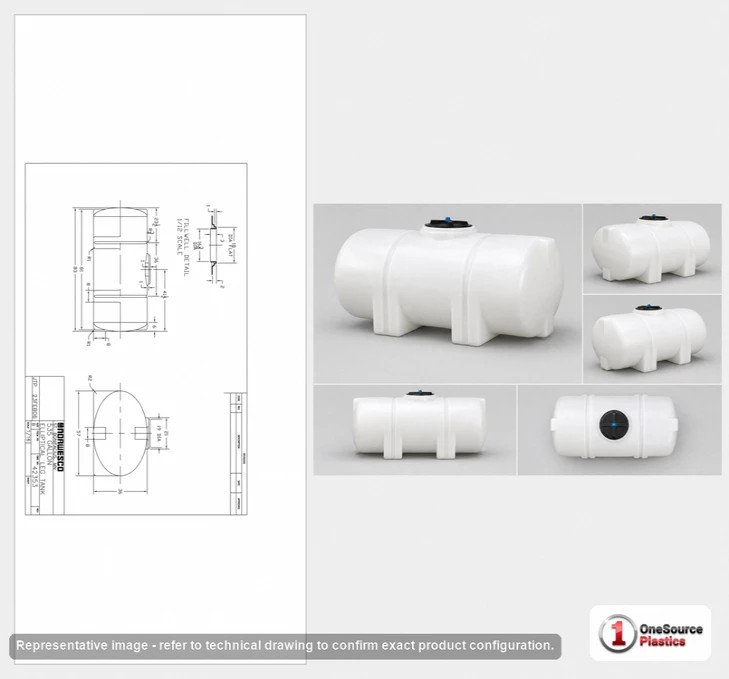
Technical drawing (PDF) for Snyder Industries 1400000W94303.
See this tank
Interactive 3D model with live fill. This tank has an interactive 3D model built to its manufacturer dimensions. Rotate it, and set a fill level to see how much liquid it holds at any height. Open the 3D view on the product photo above. Download the 3D model (GLB).
Product video. Watch the Snyder Industries 525 Gallon Plastic Horizontal Leg Tank in White video (72 seconds) with dimensions, fittings and shipping notes.
Ready to order?
Add it to your cart at the top of this page, get LTL freight to your ZIP, request a written quote, or call 866-418-1777. The listed price is before freight.