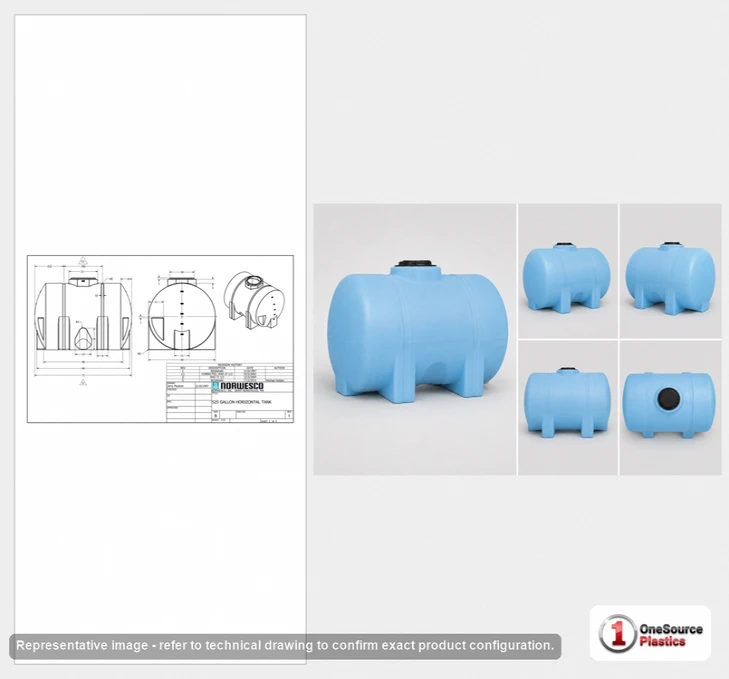
500 gallons, 72 inches long, out of Chowchilla, California
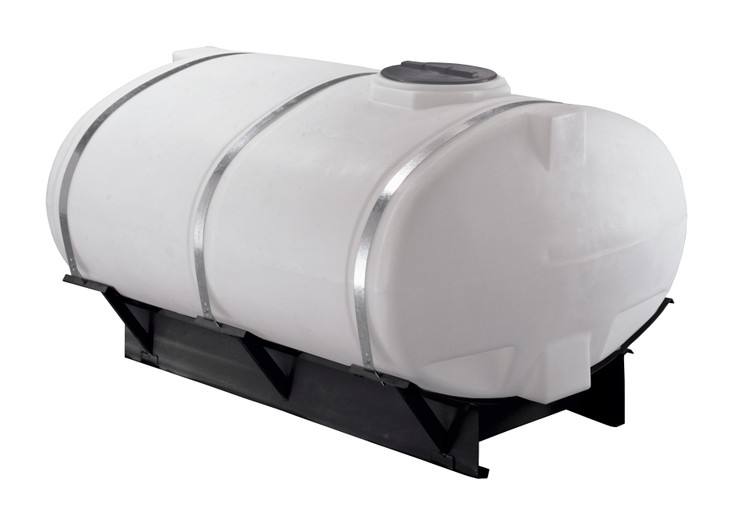
The Snyder SII-1400100C26 is a 500 gallon horizontal leg tank in white high density linear polyethylene, 72 inches long, 49 inches wide and 55 inches tall, 160 pounds empty and 160 pounds to ship, molded at Chowchilla, California. Its feet are moulded into the body, so it stands on a deck, a skid or a floor with no cradle and no stand. The sheet rates the wall at a specific gravity of 1.9, the highest rating in its own size group, which is where the 7,923 pound figure for maximum contents comes from, against 4,170 pounds for 500 gallons of water at 8.34 pounds per gallon. It carries an 18 inch lid, a service limit of 120 F / 48 C, and freight class LTL. The sheet publishes no warranty term for this tank, so this page asserts none; ask us and we will get Snyder's current terms in writing.
One tank or a train of them? A single 500 gallon tank goes straight to the cart above; for several, request a written quote with freight to your ZIP.
One California plant, and what that does to a western freight lane
This sheet lists one plant and it is in the San Joaquin Valley. Chowchilla, California is the only origin published for this part number, which makes it the tank to buy on the west coast and the one to ask us about twice anywhere east of the Rockies, because on a light item the lane is a larger share of the cost at your gate than anything else on the invoice. For a California, Nevada, Arizona or Oregon buyer that is close to the best case: a short lane, class LTL as the sheet gives it, 160 pounds on a single pallet-scale shipment, and a body 72 inches long by 49 inches wide that fits a standard flatbed or box truck without becoming a permitted load. For a buyer in the east, the honest thing to do is give us the ZIP and let the estimator decide, because there are tanks in this same size group molded in Nebraska, West Virginia, Arkansas and Alabama and the right answer may be one of those instead. Once it lands, where it sits is short and flat. A pickup bed, forward against the bulkhead so the weight is over the axle rather than behind it, with the payload rating checked before the tank is bought. A utility trailer or a flat-deck skid, bolted down through the legs. A shop or barn floor as a standing gravity supply. In all of those the surface is what carries the load, because legs are bearing feet rather than stilts: they bear through the whole flat foot onto whatever they rest on, so a bed rib, a toolbox lip, a warped board or a hollow in a slab becomes the bearing point for 4,170 pounds of water, or up to 7,923 pounds of contents at the rating. Plywood or a mat on a ribbed deck, full contact, and level. Then plan for the surge, because 500 gallons in a body six feet long slams fore and aft under braking and it is worst at part-full: restrain it in both directions through the legs, not with two straps over the body. How a leg or applicator tank is classified on the road is set out in the applicator and leg tank classification guide, with the portable utility case in the loaf-style portable utility tank guide. Size the volume against the real job in the tank sizing calculator, and take the working reserve and the freeboard from the tank sizing guide.
The 500, the 335 and the 525 on this sheet
| Part | Gallons | Length x width x height | Empty weight |
|---|---|---|---|
| SII-1400100C26 (this tank, the heavier of the two 500s) | 500 | 72 x 49 x 55 in | 160 lb |
| SII-1400100N45 (same shell, second part number) | 500 | 72 x 49 x 55 in | 160 lb |
| SII-1004100N45 (smaller, shorter and narrower) | 335 | 56 x 44 x 49 in | 116 lb |
| SII-1400000N45 (larger, longer and lower) | 525 | 75 x 48 x 53 in | 124 lb |
Three rectangles and a duplicate part number, and the choice between them is about the deck rather than the gallons. The 335 gallon SII-1004100N45 is the one that fits where this tank will not: 56 inches long, 44 inches wide and 49 inches tall at 116 pounds, which is a compact pickup bed with a toolbox already in it, or a small utility vehicle deck. The 525 gallon SII-1400000N45 goes the other way for twenty-five more gallons, stretching to 75 inches of length while dropping to 53 inches of height and 124 pounds, so it is the buy when the deck is long and something has to pass over the top of the tank: a cover, a rack, a mirror line, a doorway. This tank sits between them at 72 by 49 by 55 inches and is the tallest and heaviest of the three at 160 pounds. What it has over the 525 is the rating printed on its own sheet, a specific gravity of 1.9 with 7,923 pounds of maximum contents, which is the figure to bring to the conversation if the liquid is dense; and what it gives up is height and weight. The second row is the same shell under a second part number at the identical 72 by 49 by 55 inches and the identical 160 pounds, and since the sheet prints no difference between them, neither do we. Ask us which is on the shorter lead time. Whatever the volume, tell us the liquid first and we will confirm compatibility against Snyder's documentation before you order rather than after.
Other makers in the running? 866-418-1777 will compare them honestly; Norwesco, Snyder, Chem-Tainer, Enduraplas and Bushman are all here, or price freight on this one.
An 18 inch fill opening, and the outlet as the sheet prints it
- The lid is the fill opening on this tank, and the sheet gives it as 18 inches. There is no inlet field on this sheet, so no fill fitting is asserted: the tank fills through that lid, with the hose taken down inside the body rather than splashing on the surface. Keep the lid closed in transit and keep the vent path clear, because a tank drawn on hard through a blocked vent will pull its own wall in.
- Eighteen inches is a generous opening for 500 gallons, and it is the reason this tank cleans out properly: a hand, a light and a brush all go in, so a product that settles or dries does not end the tank's working life. On a body 72 inches long that access matters more than on a small one.
- The outlet, printed as the sheet gives it: the sheet lists the outlet as 2 and prints no unit for it. So this page prints the figure and stops. It is not a pipe size and we will not present it as one. Tell us what you intend to connect and we will confirm the port, the thread and the fitting against Snyder's current documentation before anybody buys pipe or a valve.
- Where the outlet sits: at the low end of the body above the legs, so a level deck drains the tank to the fitting and a deck tilted toward the outlet drains it further. Park nose-up with the outlet at the back, or shim the far end of a skid.
- The valve and the first joint: a shut-off supported off the deck rather than off the tank wall, then a flexible connector before any hard pipe. A rigid line bolted from a tank fitting to a pump bracket puts every brake load and every bit of deck flex into the fitting, and on a mobile tank that is the failure that actually happens.
- Service limit: 120 F / 48 C, as the sheet gives it, covering the liquid and the tank standing loaded in the sun.
Give us the liquid at order and the fitting, the gasket and the valve material get matched to it rather than guessed. Our chemical compatibility reference is the place to start, and four of the questions we are asked most about tanks this size have their own pages, worth reading before you order rather than after: sodium hypochlorite, sulfuric acid, diesel exhaust fluid and hydrochloric acid. Where the liquid is a blended fertilizer solution, the risk is the blend rather than the tank: a wide, shallow horizontal body lets layers form and a separated blend runs a spreader off spec before anybody looks, which the fertilizer blend stratification guide covers with the checks that catch it. Where the site requires containment, a single-wall leg tank is not that product, and the Captor double wall containment walkthrough explains what a contained installation has to do.
Spray fill, water hauling and chemical transfer on a farm fleet
Five hundred gallons on legs is the size where a tank stops being a jug and starts being a vehicle's reason for existing. The duties: a nurse supply on a trailer or a flat-deck truck that keeps a sprayer working through a field without a trip back to the yard; a spot-spraying or right-of-way rig with a pump, a reel and a wand; water hauled to livestock, a remote building or a planting crew; starter fertilizer and fluid feed carried to a planter or a side-dress bar; wash-down, dust control and equipment rinse water on a construction, utility or landscape truck; de-icing brine on a contractor or small municipal rig; a standing gravity supply of a shop fluid on a barn floor, drawn into pails. In all of them the tank is on something that moves, or on a floor and filled by something that moves, which is why the mounting discipline on this page matters more than the wall does. Two honest limits. This is a single-wall tank with no containment of any kind, so it is not the product for a liquid your site rules say must be double contained. And the 120 F / 48 C service limit on the sheet is a real number in July on a dark deck, so a tank that sits loaded in the sun all day should be shaded, filled cool, or drawn down before the afternoon. What ends tanks this size early is almost never the liquid: it is a bad mount, straps over the body instead of anchors through the legs, rigid pipe bolted to the outlet, or a half-full load driven fast.
Class LTL at 160 pounds, with the mount bought before the tank
This tank is molded at Chowchilla, California and the sheet gives the freight class as LTL, at 72 inches by 49 inches by 55 inches and 160 pounds. The freight cost estimator prices the lane to your ZIP, and the listed price is before freight. At six feet long it is a pallet shipment rather than a parcel, so tell us at order whether the delivery address has a dock, a forklift or neither, because a 72 inch pallet at a field entrance or a residential address is a curbside drop and two people carrying. One hundred and sixty pounds is a comfortable two-person lift off a deck and a one-person injury, so plan who is taking it off before the truck is due, and do not drag it on its legs: they are bearing surfaces, not skids. Inspect the legs, the outlet and the lid seal before the driver leaves. Then water-test it on the mount it will live on, drive it slowly if it is mobile, and look at the tie-downs, the legs and the outlet afterwards, because a tank that shifts with water in it will shift with anything. Order the straps, the anchor points and the plywood in the same conversation as the tank, because the damage always happens on the one trip that was taken loose. Put the tank's part number on the maintenance log the day it lands; five years on, nobody remembers which shell it is.
Freight and documents
Ships from: Chowchilla, CA. LTL freight is quoted to your ZIP with the freight cost estimator or by phone at 866-418-1777. The listed price is before freight.
Technical drawing (PDF) for Snyder Industries 1400100C26.
See this tank
Interactive 3D model with live fill. This tank has an interactive 3D model built to its manufacturer dimensions. Rotate it, and set a fill level to see how much liquid it holds at any height. Open the 3D view on the product photo above. Download the 3D model (GLB).
Product video. Watch the Snyder Industries 500 Gallon Plastic Horizontal Leg Tank in White video (76 seconds) with dimensions, fittings and shipping notes.
Ready to order?
Add it to your cart at the top of this page, get LTL freight to your ZIP, request a written quote, or call 866-418-1777. The listed price is before freight.