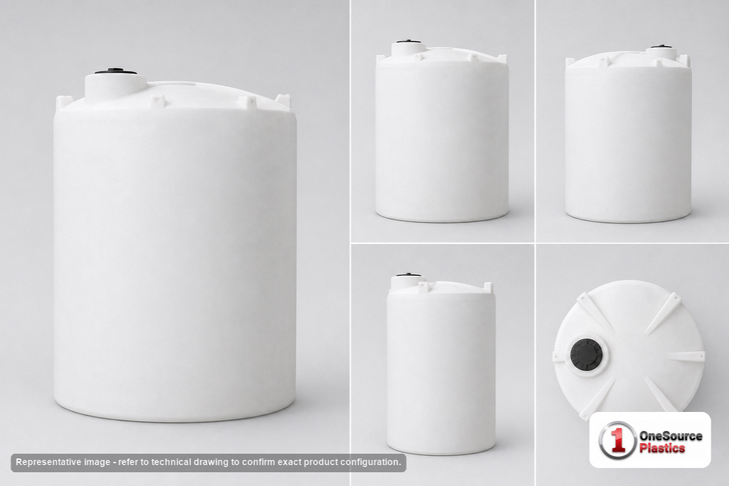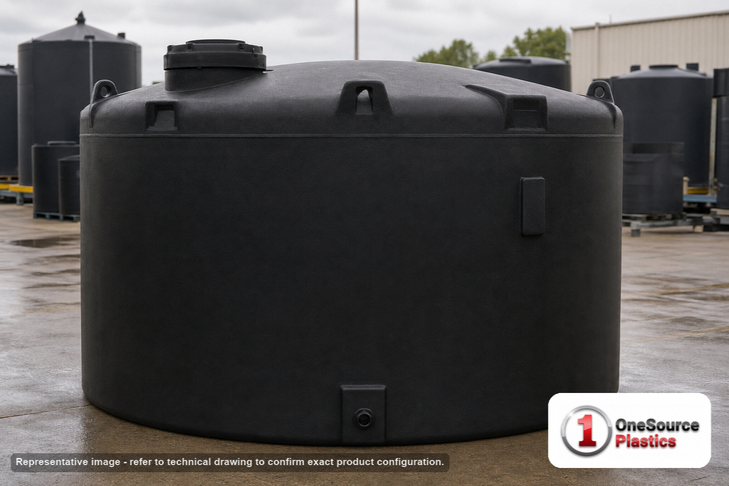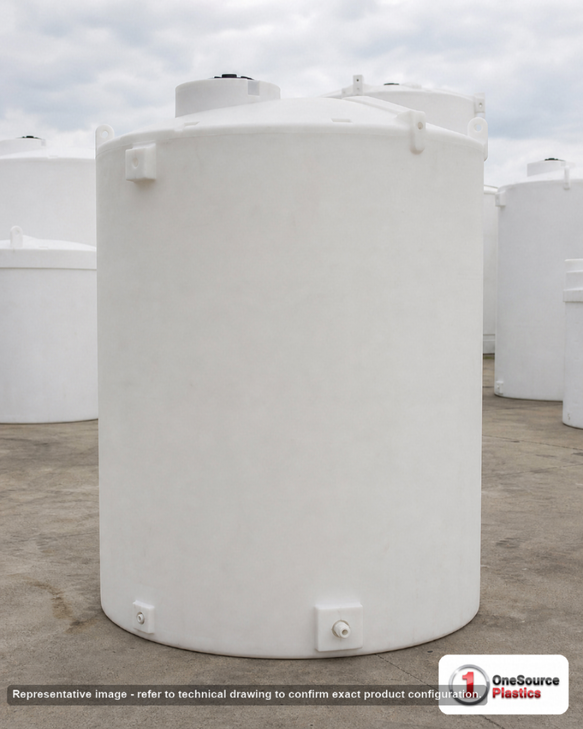
6,600 gallons thirteen feet two inches tall, rated 1.9, molded in Chowchilla
The Snyder 5300400N42 is the heavy-duty wall in the 5300400 shell: 6,600 gallons on a 120 inch circle standing 158 inches tall, 2,100 pounds empty, natural white crosslinked linear polyethylene out of Chowchilla, California. The sheet rates the wall for a specific gravity of 1.9, which it reads as 104,584 pounds of maximum contents against 55,044 pounds for plain water at 8.34 pounds per gallon. An 18 inch threaded, vented manway on top, 8 lifting lugs, ladder lugs and 2 flange lines as listed, the outlet field given as one manway and lid, a service limit of 140 F / 60 C, a 3 year warranty, and class 300 freight.
Buying for a site, a fleet or a district? Request a written quote with freight to your ZIP, or add it to your cart above and call 866-418-1777 with any question on the fit.
The duty: a Central Valley plant buying dense liquid by the truckload
The West Coast buyer for this molding is specific. A municipal water or wastewater plant in the valley with a dense chemical and a chemical building around thirteen or fourteen feet at the eave. A food processor with a caustic or a brine that arrives by tanker through the season. A grower or a packer with a heavy nutrient solution and an outdoor pad that bakes from spring to October. What they have in common is a liquid heavier than water, a delivery that comes in one large drop, and a footprint of 120 inches they can find but cannot grow. The delivery decides the top of the tank. At 158 inches the manway is real overhead work, so a fixed platform with a rail and a gate and a permanent fill connection at the manway are part of the install rather than a later improvement; a tanker discharging into a 6,600 gallon vessel moves a lot of liquid quickly, and nobody should be up there holding a hose while it does. The pad decides the bottom. A rotationally molded floor bears on its own floor and on nothing else, so the 120 inch circle takes 55,044 pounds with plain water in it and 104,584 pounds if the liquid works the 1.9 rating this sheet gives, and a slab poured by rule of thumb will not stay flat under that. Engineer it to the concrete pad sizing framework, level, cured, in full contact, inside a berm sized to the tank wherever the liquid is regulated, and on valley ground pay attention to what the slab is sitting on as much as to the slab. Then the wind, which gets thirteen feet of empty shell weighing 2,100 pounds: bands to structure or anchors cast in while the slab is poured, on the day it lands, with a tension check after the first storm and again at the end of the first summer. Take 6,600 gallons to the tank sizing calculator against the dosing rate and the delivery interval, and read the reserve and the warm-weather freeboard out of the tank sizing guide.
The 5300400 shell and the 6,500 and 6,900 either side of it
| Part | Gallons | Diameter x height | Empty weight |
|---|---|---|---|
| 5300400N42 (this tank, rated 1.9) | 6,600 | 120 x 158 in | 2,100 lb |
| 5300400N48 (same shell, heavy) | 6,600 | 120 x 158 in | 2,100 lb |
| 5300400N40 (same shell, lighter wall) | 6,600 | 120 x 158 in | 1,900 lb |
| 5300400N46 (same shell, lighter wall) | 6,600 | 120 x 158 in | 1,900 lb |
| 7140000N33 (shorter, rated 1.35) | 6,500 | 120 x 153 in | 1,450 lb |
| 7140000C26 (shorter, more volume) | 6,900 | 120 x 153 in | 1,300 lb |
Four moldings come out of this 120 by 158 inch shell at the same volume, and the wall rating is the whole difference. Take this one when the liquid is genuinely dense and the height already works, because the 1.9 figure and the 2,100 pounds of polyethylene behind it are the heaviest specification the shell offers. The 5300400N40 and 5300400N46 are the 1,900 pound pair, each rated as its own sheet says, and they are the right answer on chemistry that sits near water weight. The 5300400N48 is the other heavily built molding, listed on its own page. The two neighbours on a 120 inch base are both shorter at 153 inches, which is the row to read if the purlins are the problem: the 7140000N33 holds 6,500 gallons on a lighter 1.35 rated wall, and the 7140000C26 actually holds more volume at 6,900 gallons in a shorter shell, which is the kind of thing that only shows up when you put the family in one table. Whether crosslinking earns its cost for your chemistry is the subject of the crosslinked against high density polyethylene comparison.
Comparing against another maker? Send the competing spec to 866-418-1777 or a quote request and we will show the differences honestly.
The sheet gives no bottom fitting, so the pump arrangement is a conversation
- The pump, first and at length, because this sheet gives you nothing to assume. The outlet field reads one manway and lid, and there is no bottom fitting of any size or material listed anywhere on it. That means the draw-off arrangement gets agreed against the liquid, the flow you need and the pump you already own, and only then does anything get drilled. Tell us all three at order.
- Whatever the arrangement turns out to be, the pump belongs below it. Thirteen feet two inches of liquid is a generous suction head and the way to keep it is a pump that sits under the connection, gravity primed, flooded to the last few inches, rather than one mounted level with the base and fighting for prime every time the level drops.
- Low-level protection: a float or probe that stops the pump before it draws air, wired so it cannot be restarted into an empty tank. On a dense liquid a dry run costs a seal, and on a tank that is filled by tanker the empty condition arrives fast and without warning.
- Access: an 18 inch threaded, vented manway at the top of a 158 inch shell, which is a fixed platform with a rail and a gate, and a permanent fill connection landed at the manway rather than a hose held overhead.
- Fill and vent: a dip tube to the floor so the incoming stream does not free-fall thirteen feet and foam the headspace, and a vent piped outdoors on anything that fumes, sized to the delivery pump and not to the nearest spare port.
- Handling and hardware as listed: 8 lifting lugs, ladder lugs, 2 flange lines. Service limit 140 F / 60 C, warranty 3 year, rating specific gravity 1.9 as the sheet gives it.
The honest version of a sheet with no bottom connection on it is the one printed above: we publish the field and we do not invent a bulkhead, a thread or a gasket to fill the space. When the connection is specified, the first valve rides on its own support off the pad with a flexible element between it and hard pipe, because thirteen feet of standing liquid at the 1.9 rating is real static pressure and the shell is not a pipe anchor. The band of wall above the liquid line is the surface that ages first, which liquid-side inspection misses entirely, as the headspace wall thickness article explains, so put a light on it every time the cover comes off.
Dense chemistry on a valley pad
A brine or a concentrate at a valley water plant, a caustic at a food processor, a heavy nutrient solution at a grower who stores through the season, a dosing skid that wants the head a thirteen foot column gives it for nothing. The duty is always the same shape: a liquid above water weight, arriving in bulk, held on a footprint that cannot grow. Plain water at 8.34 pounds per gallon is far inside this rating, but a private fire reserve is its own specification in a water-rated vessel, and the fire-water reservoir design guide is where that case belongs rather than here.
Chowchilla to the pad at class 300
One plant molds this part, Chowchilla, California, and the sheet gives class 300 at 2,100 pounds shipping weight. A single origin means the lane length decides the freight: a West Coast dock is short and anyone east of the mountains should price it rather than assume it, so put the ZIP into the freight cost estimator and read the number, with the listed price before freight. A shipment 120 inches across and 158 inches long rides on the deck space it fills rather than on the scale. Stand it up on the lugs with straps under the body, never a sling through the manway, onto a pad that has cured, and get the bands on before the crane is released. Then water to the manway, held long enough to walk the base and the pad edge twice, drained and dried before the working liquid arrives, on the method the hydrostatic test methodology article sets out. Photograph the base from below before the pipe goes on; a slow weep is far easier to compare against a photograph than against a memory. Save the pallet; a tank that ever has to move again is easier to move on it.
Freight and documents
Ships from: Chowchilla, CA. LTL freight is quoted to your ZIP with the freight cost estimator or by phone at 866-418-1777. The listed price is before freight.
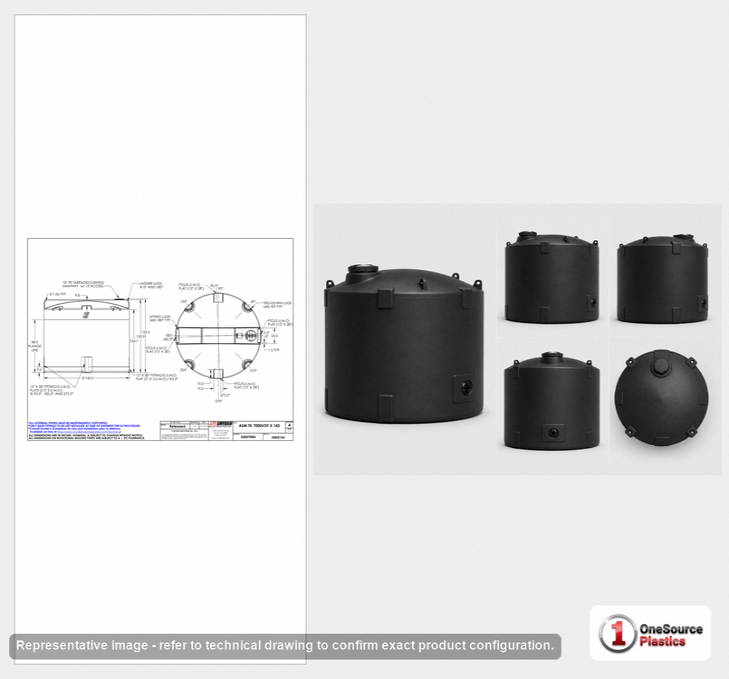
Technical drawing (PDF) for Snyder Industries 5300400N42.
See this tank
Interactive 3D model with live fill. This tank has an interactive 3D model built to its manufacturer dimensions. Rotate it, and set a fill level to see how much liquid it holds at any height. Open the 3D view on the product photo above. Download the 3D model (GLB).
Ready to order?
Add it to your cart at the top of this page, get LTL freight to your ZIP, request a written quote, or call 866-418-1777. The listed price is before freight.