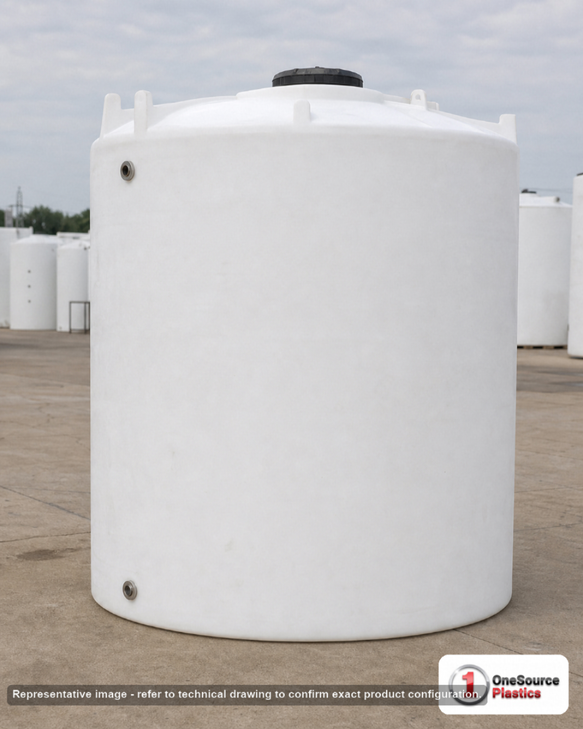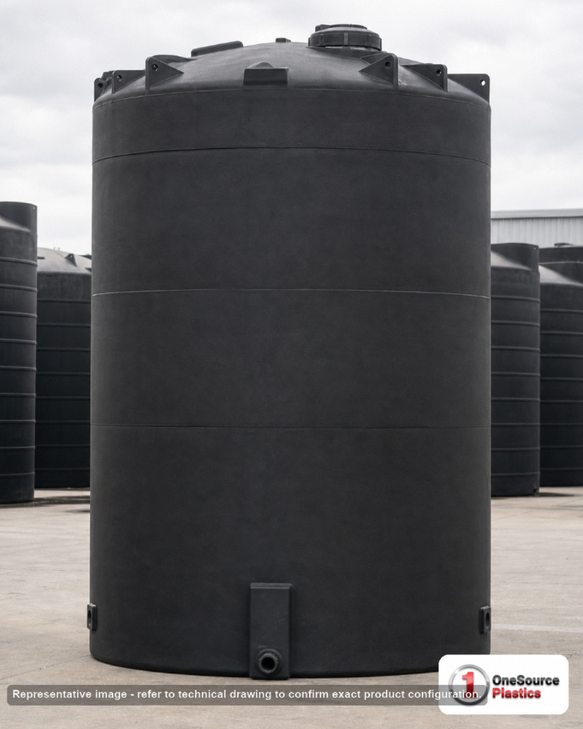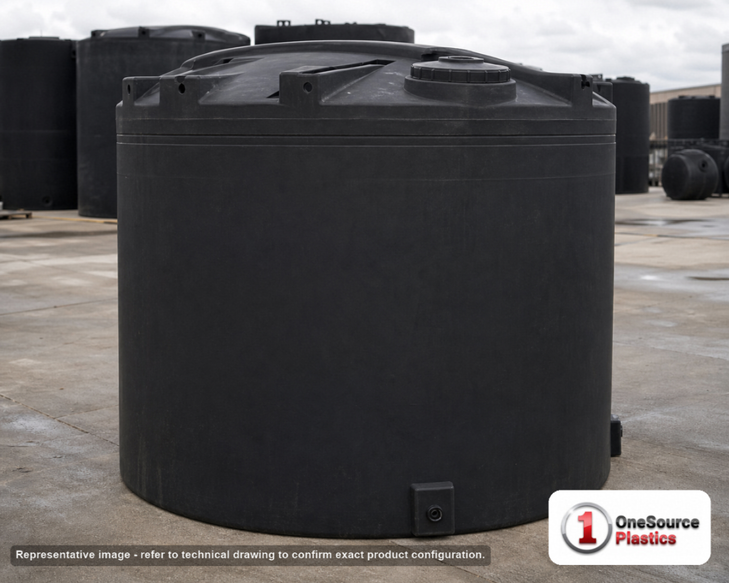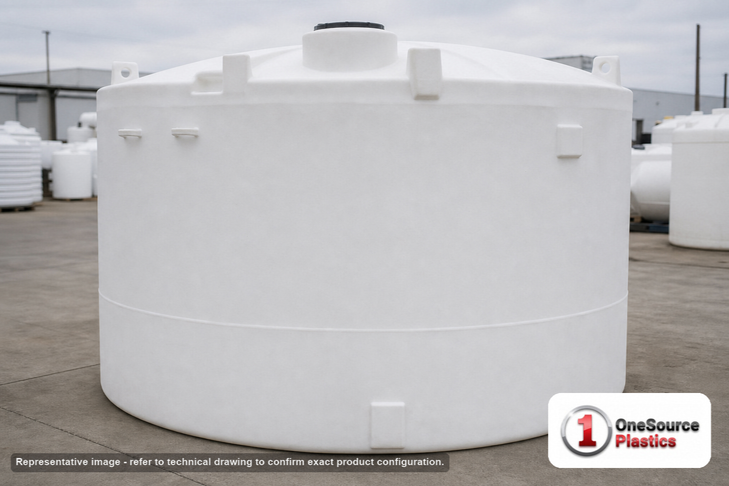
7,000 gallons of dense liquid ten feet two inches off the ground
Low, wide and heavily rated. The Snyder 5300700N42 holds 7,000 gallons on a 142 inch circle standing 122 inches tall, weighs 1,900 pounds empty, and is molded in natural white crosslinked linear polyethylene. The sheet rates the wall for a specific gravity of 1.9, which it reads as 110,922 pounds of maximum contents against 58,380 pounds for plain water at 8.34 pounds per gallon. An 18 inch threaded, vented manway on top, ladder lugs and one flange line as listed, the outlet field given as 28, a service limit of 140 F / 60 C, a 3 year warranty, and class 300 freight out of Lincoln, Nebraska.
Two ways to buy. Add it to your cart above with freight quoted to your ZIP, or request a written quote for a job that needs paperwork.
The duty: dense chemistry at a plant with a low chemical building
This is the tank for the plant that has the floor and not the height, storing something that weighs more than water. A wastewater plant with a dense polymer or a metal salt solution in a building whose purlins sit near ten feet. A food or beverage plant with a caustic or a brine in a room that also has to take a forklift. A co-op with a heavy liquid fertilizer under a shed roof, in a yard wide enough to lose a twelve foot circle in. The delivery on a squat tank is the easy part and that is half the reason to buy one: the manway is 122 inches up, ten feet two inches, so the connection is reached from a short platform or a stair rather than from a tower, and the driver's hose run is short enough that a permanent fill line is cheap to build. What the shape costs you is slab. Because a rotationally molded floor bears on its own floor and nothing else, the whole load goes down through a 142 inch circle: 58,380 pounds with plain water in it, or 110,922 pounds if the liquid works the 1.9 rating the sheet gives, and a wide tank on a pad with one low corner puts that load on the corner. Engineer the slab to the concrete pad sizing framework rather than pouring it by rule of thumb, level, cured and in full contact, inside a berm sized to the tank wherever the liquid is regulated. The wind is the least of this tank's problems, since the center of gravity sits about shoulder height when it is full, but an empty shell of 1,900 pounds still moves in a gust, so band it while it is empty and forget about it once it is working. Check 7,000 gallons against the draw between deliveries in the tank sizing calculator, and take the reserve and the warm-weather freeboard from the tank sizing guide.
The low 5300700 shell against the tall slim 7,500
| Part | Gallons | Diameter x height | Empty weight |
|---|---|---|---|
| 5300700N42 (this tank, rated 1.9, class 300) | 7,000 | 142 x 122 in | 1,900 lb |
| 5300700N48 (same shell, heavy) | 7,000 | 142 x 122 in | 1,900 lb |
| 5300700N40 (same shell, lighter wall) | 7,000 | 142 x 122 in | 1,400 lb |
| 5300700N46 (same shell, lighter wall) | 7,000 | 142 x 122 in | 1,400 lb |
| 7140000C26 (taller, narrower) | 6,900 | 120 x 153 in | 1,300 lb |
| 7440000N40 (tall and slim) | 7,500 | 102 x 234 in | 2,450 lb |
Four moldings share this 142 by 122 inch shell and only the wall rating and the empty weight separate them. The case for this one is density at a fixed ceiling: the 1.9 figure on its sheet with 1,900 pounds of polyethylene behind it, in a shape that fits under a roof the tall tanks cannot use. The 5300700N40 and 5300700N46 are the lighter pair at 1,400 pounds empty, each rated as its own sheet says, and on a solution at or near water weight they are the cheaper honest buy. The 5300700N48 is the other heavily built molding in the shell, listed on its own page. Step outside the shell and the trade is height for floor: the 7140000C26 takes 6,900 gallons up to 153 inches on a 120 inch base, and the 7440000N40 puts 7,500 gallons into a 102 inch footprint at 234 inches, nineteen and a half feet, for a plant with the opposite problem to yours. Whether crosslinking is the right resin call for the chemistry is the subject of the crosslinked against high density polyethylene comparison.
Torn between two rows? Call 866-418-1777 with the liquid and the ceiling height, or ask for a quote on both and compare the freight.
Suction on a squat tank: the pump goes below the tank, not beside it
- Pump placement is the first decision and the one people get wrong on a low tank, because there is only ten feet two inches of liquid above the base at best and far less at the end of a shift. Put the transfer pump below the level of the base connection, in a pit or on a low plinth, so it is gravity primed through the whole working range. A pump sitting on the same slab as the tank is running on almost no head by the time the tank is a third full, and that is where cavitation starts.
- Suction line: as short and as straight as the layout allows, one size up rather than down, and falling continuously to the pump with no high spot to trap air. On a dense liquid the friction loss in a long suction run is what eats the little head this shape gives you.
- Low-level protection: a float or probe that cuts the pump before it draws air, and a set point chosen with the pump curve in hand rather than at the bottom of the tank. This matters more on a shallow vessel than on a tall one, because the last inches here are a larger share of the volume.
- Outlet, printed as the sheet publishes it: the sheet lists the outlet as 28. That is the field, it is not a pipe size, and no bottom fitting diameter, material or thread appears anywhere on the sheet. Name the liquid and the draw-off arrangement you want at order and we confirm what this molding accepts, in what material and with what gasket, before a hole is cut in it.
- Access: an 18 inch threaded, vented manway at the top of a 122 inch shell, reachable from a short platform, with a permanent fill connection landed there and a dip tube to the floor so the stream does not foam the headspace.
- Hardware as listed: ladder lugs and one flange line. Vent piped outdoors on anything that fumes and sized to the delivery pump. Service limit 140 F / 60 C, warranty 3 year, rating specific gravity 1.9 as the sheet gives it.
Because the manway is within reach on this shape, this is the tank people open too often; keep it threaded shut between deliveries so vapor stays in and rain stays out, and inspect the band of wall above the liquid line with a light rather than by feel, for the reason the headspace wall thickness article sets out. Whatever goes on the base connection is carried on its own support off the pad with a flexible element between it and hard pipe, and where winters bite, the trace heat goes on that piping and the first valve, never on the body.
Heavy liquids under a low roof
A brine, a concentrate, a metal salt solution, a heavy liquid fertilizer: chemistry that runs well above water weight, in a building or under a canopy that will not take a tall vessel. Plant engineers who have measured the purlins and found nothing over about ten feet stop shopping when they find this shape. Plain water at 8.34 pounds per gallon is far inside the rating on this sheet, and 7,000 gallons is a serious reserve, but a private fire reserve is a separate specification in a water-rated vessel and the fire-water reservoir design guide explains what that specification actually asks for. A vessel this size is a bulk stage, not a day tank; if the dosing loop wants something small downstream, buy the small one and let this hold the trailer.
Lincoln, Nebraska, class 300, and a load wider than a trailer
The sheet gives class 300 and 1,900 pounds shipping weight out of Lincoln, Nebraska. At 142 inches across, this is a load the carrier handles outside the trailer rather than inside it, so the lane and the equipment both matter and neither is guessable from the scale ticket: run your ZIP through the freight cost estimator and read the real number, with the listed price before freight. A crane or a forklift with long forks sets 1,900 pounds on the pad with straps under the body, never a sling through the manway, and a wide tank wants two spotters rather than one because the operator cannot see the far edge of the base. Fill it with water to the manway once, hold it, walk the pad edge and the base twice, then drain and dry before the working liquid goes in, on the method the hydrostatic test methodology article lays out. Save the pallet it arrived on, because a tank this wide that ever has to move again moves far more easily on it than off it. The first fill is the only cheap time to find a problem, so do it in daylight with someone watching the base.
Freight and documents
Ships from: Lincoln, NE. LTL freight is quoted to your ZIP with the freight cost estimator or by phone at 866-418-1777. The listed price is before freight.
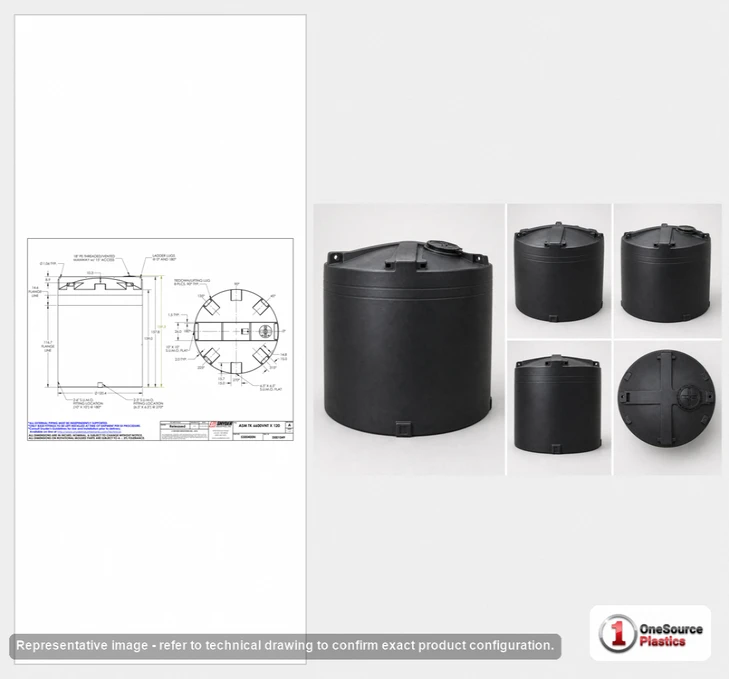
Technical drawing (PDF) for Snyder Industries 5300700N42.
See this tank
Interactive 3D model with live fill. This tank has an interactive 3D model built to its manufacturer dimensions. Rotate it, and set a fill level to see how much liquid it holds at any height. Open the 3D view on the product photo above. Download the 3D model (GLB).
Ready to order?
Add it to your cart at the top of this page, get LTL freight to your ZIP, request a written quote, or call 866-418-1777. The listed price is before freight.