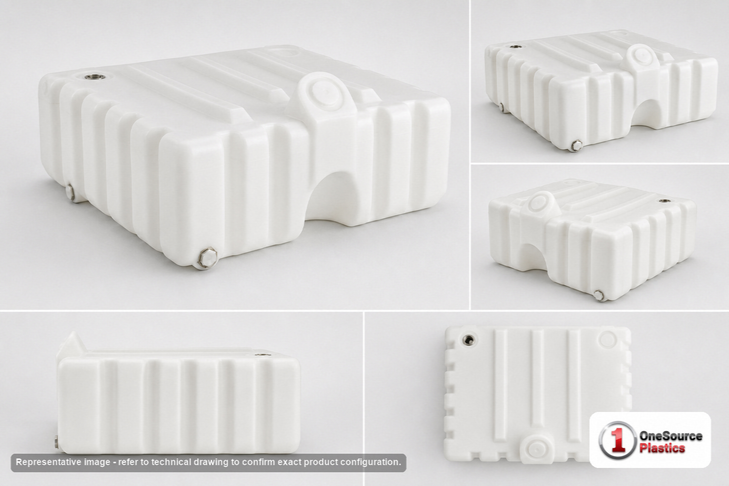
The cross-linked 90, same footprint, harder wall
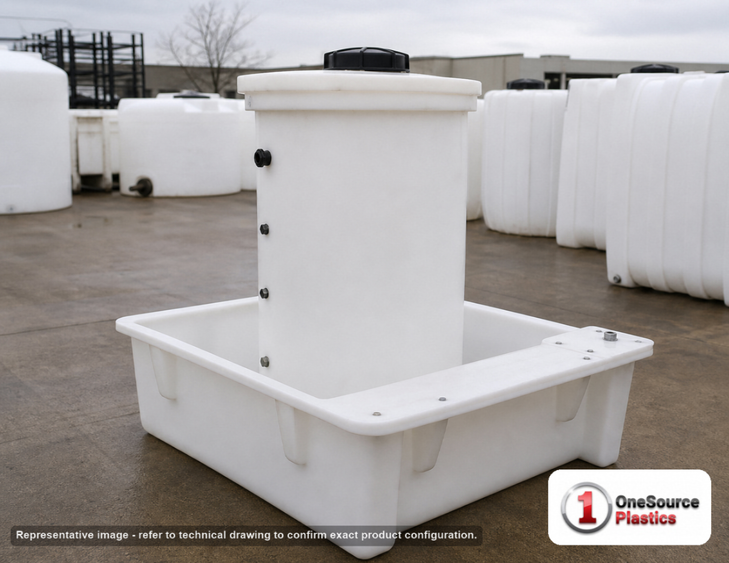
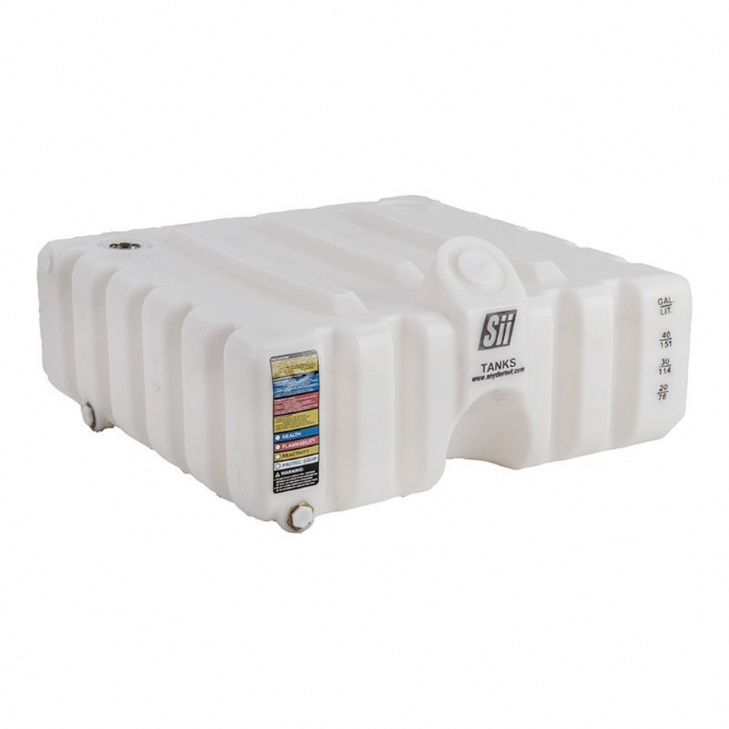
Cross-linked polyethylene is what separates the Snyder SII-5690103CF42 from the other 90 gallon feed station on the same sheet. Everything else is shared: 56 inches long, 43 inches wide, 41 inches tall, 99 pounds empty, white, a 14 inch lid, and a wall rated at a specific gravity of 1.9, which gives 751 pounds for 90 gallons of water at 8.34 pounds per gallon and 1,426 pounds of max contents. The service limit is 120 F / 48 C. The sheet publishes no outlet, no inlet and no warranty term, so this page states none of them. It is molded at Marked Tree, Arkansas and moves as LTL freight under NMFC 156600-02.
Is this the right 90 gallon tank? Call 866-418-1777 with the liquid, the site and the ceiling height, or get freight to your ZIP and add it to your cart above.
Standing a cross-linked feed station inside a bunded room
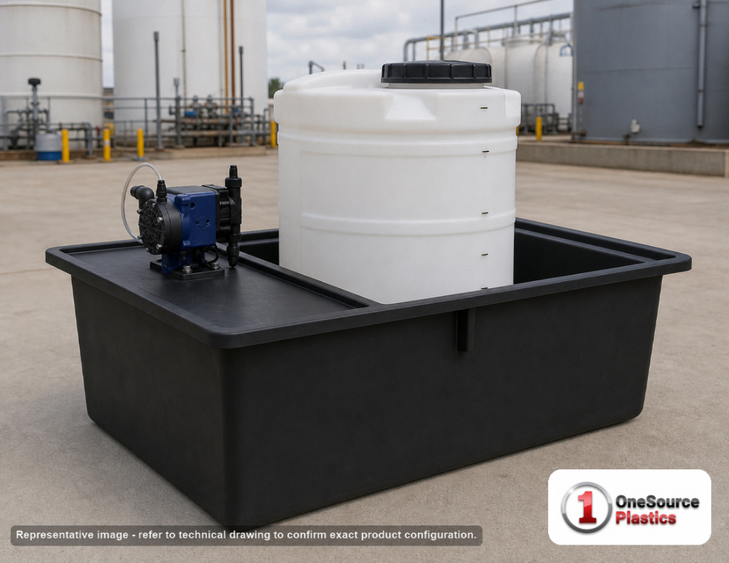
This tank is bought to stand still in a chemical building for years, so the floor it stands on is the first decision and the bund around it is the second. The base is a 56 by 43 inch rectangle and the tank is 41 inches tall, a little under three and a half feet, which is deliberately low: the lid is reachable from the floor, the top of the tank sits below a standard pipe rack, and the whole vessel fits in an aisle rather than a bay. Set it on finished concrete, a poured pad or a steel curb that supports the entire base area. No packers under one corner, no timber bearers with an unsupported span in the middle, no leaving it on the shipping pallet as a permanent plinth. Once it is full there is 751 pounds of water sitting on that rectangle, and 1,426 pounds at the rating the sheet gives, and a base that is bearing on three points instead of its whole plan will tell you about it eventually. If the room has a bund or a curb, check the clear internal dimensions before delivery, not after: a 56 inch tank in a bund sized for drums is a problem that only shows up when the shipment is already on the dock. Where a site is still choosing between putting tanks inside a lined bund and buying vessels with their own second wall, the Snyder Captor containment and SPCC comparison is the honest treatment of what each approach buys and what it costs in floor area. Size the working volume before you buy the shell: run your dose rate, your batch size and your delivery interval through the tank sizing calculator, and take the thermal freeboard from the tank sizing guide, because a feed station filled to the brim on a cold morning is a feed station that weeps out of the lid by afternoon.
Same shell, two walls: how the 90 gallon stations divide
| Part | Gallons | Length x width x height | Empty weight |
|---|---|---|---|
| SII-5690103CF42 (this one, cross-linked wall) | 90 | 56 x 43 x 41 in | 99 lb |
| SII-5690103CF45 (same shell, high density linear wall) | 90 | 56 x 43 x 41 in | 99 lb |
| SII-5690104CFWS42 (cross-linked, raised on a stand) | 90 | 56 x 43 x 57 in | 123 lb |
| SII-5690104CFWS45 (raised on a stand, second part number) | 90 | 56 x 43 x 57 in | 123 lb |
| SII-5680023CF42 (smaller volume, taller body) | 60 | 47 x 36 x 58 in | 108 lb |
| SII-5700103CF42 (larger volume, same plan) | 120 | 56 x 43 x 51 in | 130 lb |
Four of these six are 90 gallon stations and they divide twice: by wall and by whether there is a stand under them. This one is the cross-linked wall with no stand. Buy it when the chemical or the handling argues for a cross-linked wall and the pump can sit beside the tank rather than under it. SII-5690103CF45 is the same 56 by 43 by 41 inch shell at the same 99 pounds in a high density linear wall, and that material line is the only difference the sheet prints between the two, so it is the only one stated here; match whatever your plant drawing or spares list already calls out. The two 57 inch listings are this plan raised on a frame at 123 pounds, which is what you want when the metering pump must be fed from above rather than beside. Outside the 90s, the 60 gallon SII-5680023CF42 is the odd one: less volume, a narrower 47 by 36 inch plan, but 58 inches tall and 108 pounds, so it is the choice when floor space is the scarce thing and headroom is not. The 120 gallon SII-5700103CF42 keeps the 56 by 43 inch plan of this tank and grows upward to 51 inches at 130 pounds, adding a third again as much working volume without taking another square inch of floor, which is usually the cheapest capacity in the family when the ceiling allows it.
Comparing across brands too? Call 866-418-1777; we carry Norwesco, Snyder, Chem-Tainer, Enduraplas and Bushman and will say which one fits, or price the freight first.
The valve you will add, because the sheet lists none
- Outlet and valve: the sheet gives no outlet and no inlet on this part, so no size, no thread, no bulkhead and no valve is claimed on this page. Name the chemical, the draw and the pump position when you order and we will confirm the fitting arrangement for your part number in writing before it leaves the plant.
- Isolation, whatever is fitted: put a full-flow shutoff at the tank and a second valve downstream so a strainer or a hose can be changed without emptying 90 gallons into a bund. Support both valves off the floor or the wall, never off the tank wall.
- Access: a 14 inch lid is the opening the sheet publishes, at a working height of 41 inches. It takes a fill hose, a level probe and a hand with a brush, and it is the only route in for a wash-out, so plan cleaning around it.
- Breathing: keep an air path open at all times. A sealed lid over a pump that is drawing will pull the wall in, and a cross-linked wall resists that no better than any other polyethylene.
- Level and limits: measure the level with a device chosen for the chemistry rather than for the price, and the level gauge selection guide for chemical service lays out where each technology struggles. The sheet's only service limit is 120 F / 48 C, and it carries no warranty term.
A cross-linked wall changes what the tank tolerates, not what the pipework owes it. Flexible connector at the first joint, no rigid run clamped between the tank and a wall, nothing hanging off the lid collar. And mark the station: the chemical in words on the side that faces the door, the fill point identified at the coupling, and the signage set out the way the tank label and signage guide describes, so that the marking satisfies the fire officer and the workplace inspector with one set of labels instead of two arguments.
Caustic, acid and coagulant duty in a small chemical building
The cross-linked wall tends to be specified where the duty is harder than water: caustic and acid feed at a water or wastewater plant, coagulant and polymer dosing, pickling and plating chemistry in a metal finishing shop, a day tank beside a food or paper process, cooling tower treatment, and bulk cleaning chemistry at a wash or a laundry. In every one of those the station replaces a rotation of drums and a stand, and the win is that the delivery becomes one hose connection a fortnight instead of a manual handling exercise twice a week. Keep the vessel dedicated to one chemical for its life if you can. Swapping a feed station between chemistries is possible but it is a full wash-out, a dry-out and a relabel, and the 14 inch lid is the only way in and out for all of it.
What this tank is listed to hold
Each line is a liquid the resin is rated for, at the concentration shown, with the fitting and gasket to order. Follow the link for the full rating, or search the chemical compatibility database before ordering.
- hydrofluosilicic acid (26%) moves the gasket to Viton (PP/PVC fittings)
- DEF (32.5%) calls for 316SS fittings with EPDM; and
- propylene glycol calls for PP/316SS fittings with EPDM.Chemicals commonly stored in an XLPE feed tank of this class include
- acetic acid (60%, PP/PVC, EPDM)
- aluminum sulfate (50%, PVC, EPDM)
- calcium chloride (40%, PVC, EPDM)
- ethylene glycol (100%, PVC, EPDM)
- ferric chloride (50%, PVC, EPDM)
- ferric sulfate (60%, PVC, EPDM)
- ferrous sulfate (20%, PVC, EPDM)
- magnesium chloride (30%, PVC, EPDM)
- polyaluminum chloride (PVC, EPDM)
- potassium carbonate (50%, PVC, EPDM)
- potassium hydroxide (saturated, PVC, EPDM)
- sodium carbonate (30%, PVC, EPDM)
- sodium thiosulfate (40%, PVC, EPDM)
- urea solution (50%, PP/PVC, EPDM), and ozonated water (up to 10 PPM, PVC, EPDM).Reconcile wall, fitting, and gasket as one system, not three independent
One Arkansas lane, ninety-nine pounds, and the first fill
Marked Tree, Arkansas is the only plant on this sheet, so there is one lane to price and no plant choice to make. The freight class is given as LTL under NMFC 156600-02, and the shipment is the tank's own 56 by 43 by 41 inches on a pallet. The freight cost estimator prices it to your ZIP and the listed price is before freight. Ninety-nine pounds is a two-person lift or a forklift under the pallet; take it off by the base, not by the lid. Measure the dock, the door and the aisle before the truck is booked, because the tank is wider than a drum in both directions and a chemical room doorway is usually where the trip goes wrong. Set it on its finished floor or curb, fill it with clean water, and let it stand full while you read the base contact, the lid seal and the floor beneath it; then drain it, dry it and label it before the first chemical delivery. Put the part number and the commissioning date on the maintenance log the day it lands, because in five years nobody will remember which of the two 90 gallon shells is standing in that corner. Write the fill date on the manway with a paint marker; it answers the first question anyone asks about a tank.
Freight and documents
Ships from: Marked Tree, AR. LTL freight is quoted to your ZIP with the freight cost estimator or by phone at 866-418-1777. The listed price is before freight.
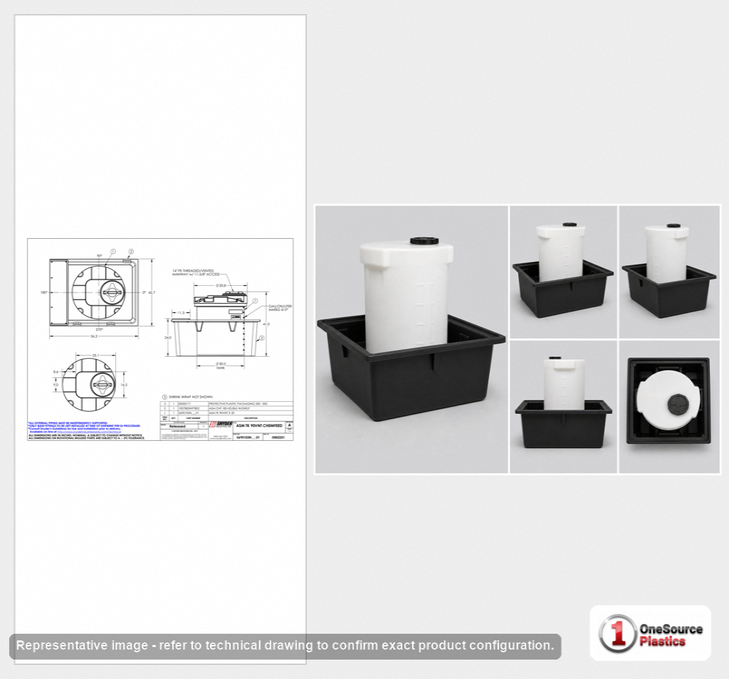
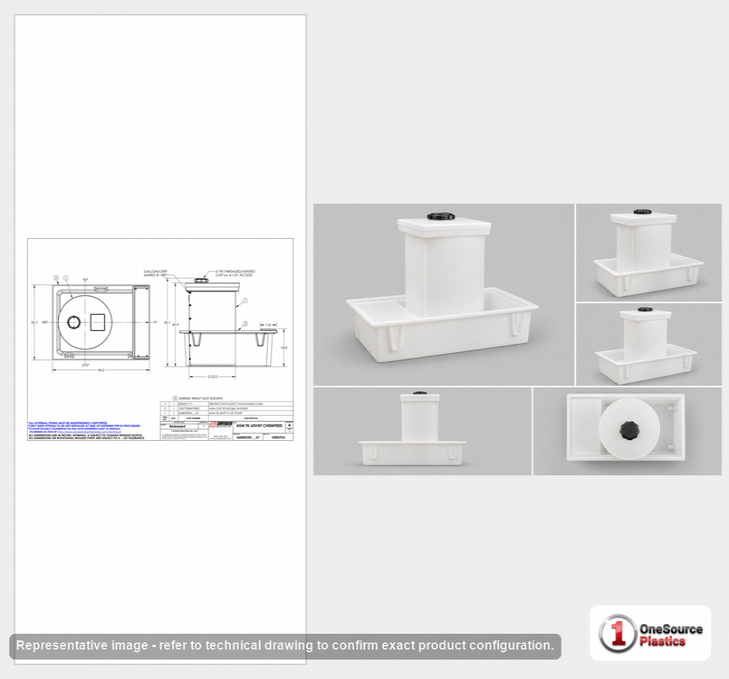
Technical drawing (PDF) for Snyder Industries 5690103CF-42.
See this tank
Product video. Watch the Snyder Industries 90 Gallon XLPE Chemical Feed Station Tank video (60 seconds) with dimensions, fittings and shipping notes.
Ready to order?
Add it to your cart at the top of this page, get LTL freight to your ZIP, request a written quote, or call 866-418-1777. The listed price is before freight.