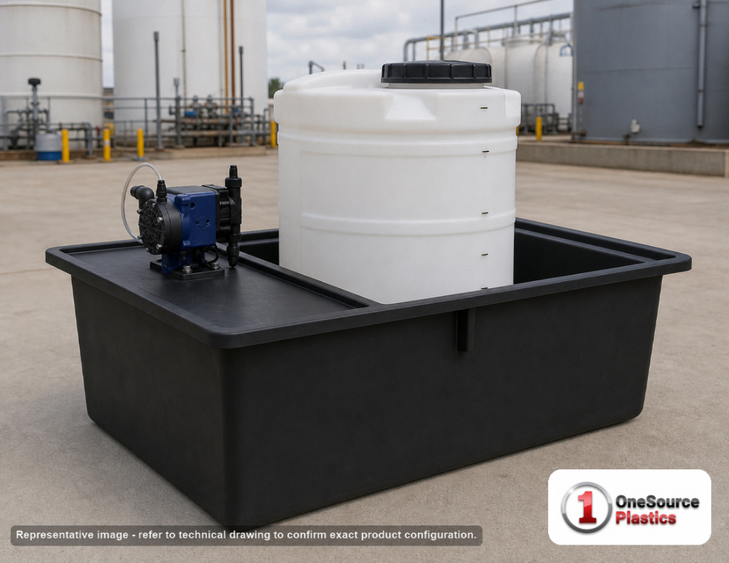
Ninety gallons on a 56 by 43 inch floor rectangle
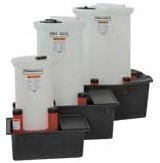
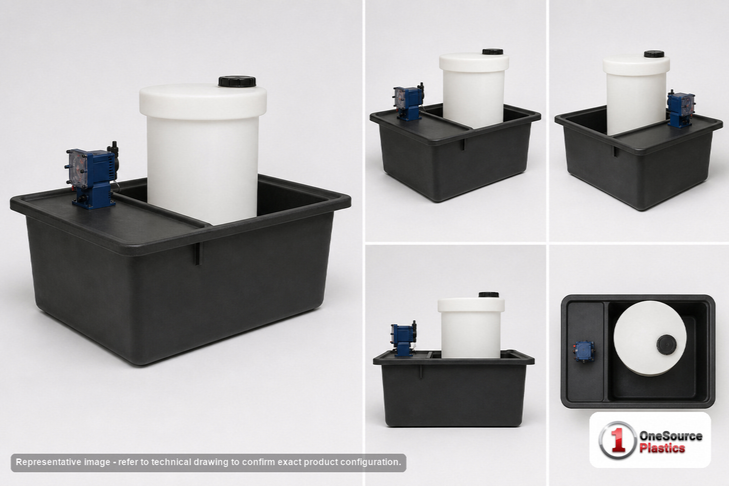
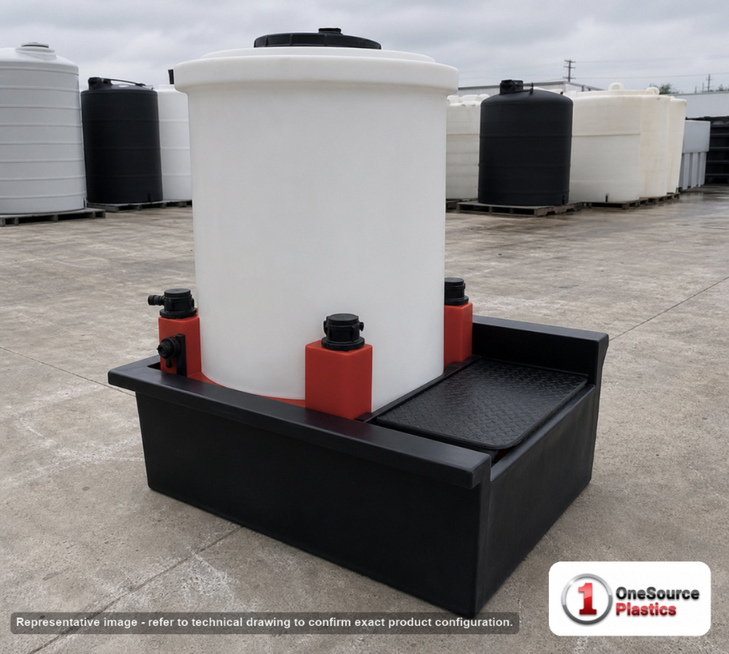
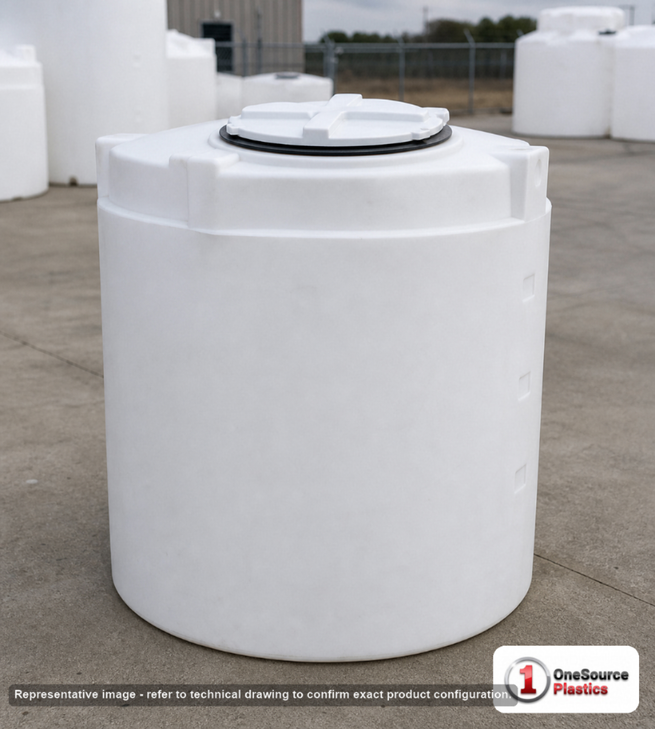
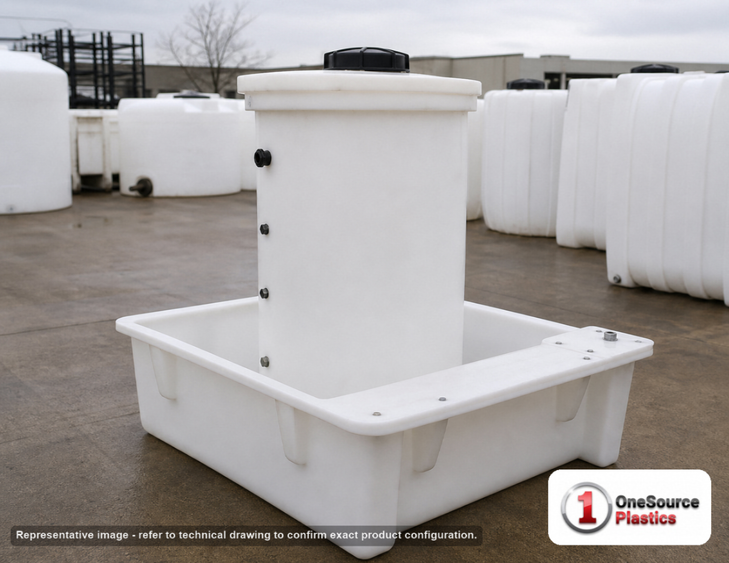
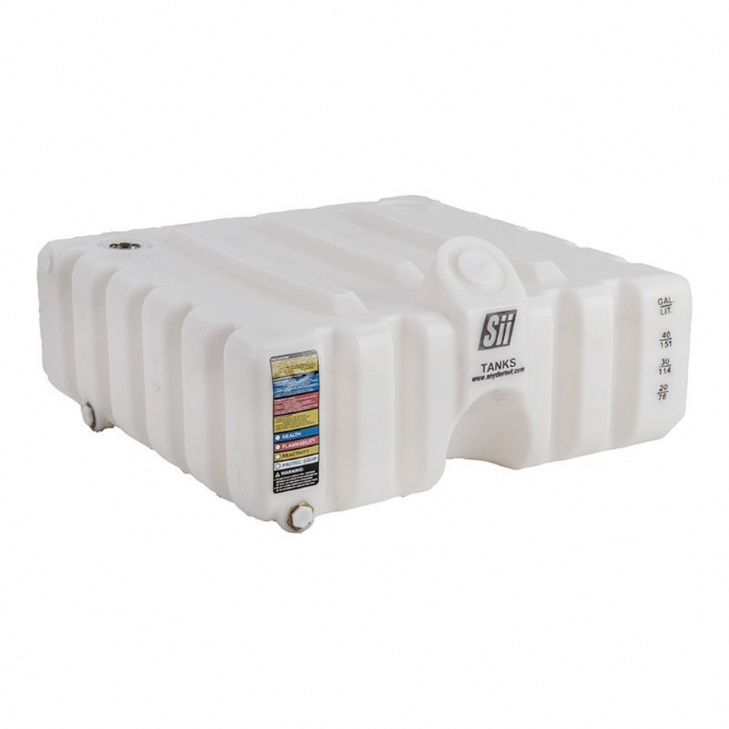
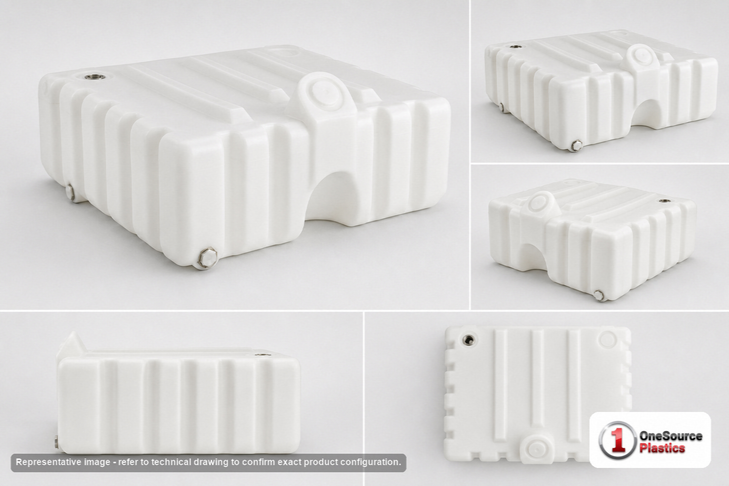
The Snyder SII-5690103CF45 is a 90 gallon chemical feed station tank in white high density linear polyethylene. It is 56 inches long, 43 inches wide and 41 inches tall, and it weighs 99 pounds empty. The sheet rates the wall at a specific gravity of 1.9, which puts 751 pounds of water in it at 8.34 pounds per gallon and 1,426 pounds of max contents at that rating. The only opening the sheet gives is a 14 inch lid. It lists no outlet fitting, no inlet and no warranty term, and the single service limit it publishes is 120 F / 48 C. It is molded at Marked Tree, Arkansas. Everything on this page comes off that sheet; where the sheet is silent, this page says so rather than filling the gap.
Ready to price it? The listed price is before freight; quote freight to your ZIP in a few seconds, then add to cart above or call 866-418-1777.
Where a 41 inch feed station sits, and what it needs under it
Start with the floor, because that is what this product is shaped for. A feed station is a tank that lives beside the process it feeds rather than out in a tank yard, and this one occupies a rectangle 56 inches by 43 inches and stands 41 inches tall, which is three feet five inches. That height is the whole argument. It clears under a mezzanine, under a pipe rack and under the low soffit in a chlorine room where a taller vessel would not go in upright, and the lid lands at working height so an operator fills it standing on the floor instead of on a drum or a step. The footprint is the other half: 56 by 43 inches is one rectangle to bund, one patch of floor to keep clear, and it fits down an aisle in a plant room rather than needing a bay. What the shape asks in return is flat, continuous, level bearing under the whole base. Put it on a finished concrete floor, a poured pad or a steel curb that carries the full plan area; never on two rails with the middle unsupported, never on packing under one corner to level it, and never on gravel. The load is not trivial for a small vessel: 751 pounds when it is full of water and 1,426 pounds at the specific gravity of 1.9 the sheet rates it to, all of it standing on 56 by 43 inches of floor. If the room is bunded, measure the bund before the tank arrives, because a station this size is usually one of several in a line and the bund has to hold whatever the site has decided it should hold. Where the containment argument is still open and somebody is weighing an integral second wall against a lined bund, the Snyder Captor containment and SPCC comparison sets the two approaches side by side. Before the order, put your dosing rate and delivery interval through the tank sizing calculator to confirm 90 gallons is the right working volume, and take the freeboard a warming liquid needs from the tank sizing guide. A day tank that is sized to the delivery rather than to the dose is the one that gets topped up by hand.
Two 90s at the same height, a 60 and a 120
| Part | Gallons | Length x width x height | Empty weight |
|---|---|---|---|
| SII-5690103CF45 (this one, high density linear wall) | 90 | 56 x 43 x 41 in | 99 lb |
| SII-5690103CF42 (same shell, cross-linked wall) | 90 | 56 x 43 x 41 in | 99 lb |
| SII-5690104CFWS42 (same plan, on a stand) | 90 | 56 x 43 x 57 in | 123 lb |
| SII-5690104CFWS45 (on a stand, second part number) | 90 | 56 x 43 x 57 in | 123 lb |
| SII-5680023CF42 (smaller, narrower, taller) | 60 | 47 x 36 x 58 in | 108 lb |
| SII-5700103CF42 (larger, same plan, taller) | 120 | 56 x 43 x 51 in | 130 lb |
The reason to buy this one rather than any other row is height with no stand under it. At 41 inches it is the lowest station on the sheet, and the two 57 inch listings are the same 56 by 43 inch plan raised onto a frame at 123 pounds. Take one of those when a pump has to sit under the outlet; take this one when the ceiling, the mezzanine or the shelf above the tank decides the matter and the pump can live beside the station rather than beneath it. Against SII-5690103CF42 there is exactly one difference on the sheet and it is the wall: that part is listed as cross-linked polyethylene and this one as high density linear polyethylene, at the same 90 gallons, the same 56 by 43 by 41 inches, the same 99 pounds and the same 14 inch lid. Where a plant already runs one of them, order the matching part number so a lid, a gasket or a bund liner fits without a second trip. The 60 gallon SII-5680023CF42 goes the other way entirely: a smaller working volume in a narrower 47 by 36 inch plan but 58 inches tall, which is a taller vessel in less floor, and it is listed at 108 pounds, heavier than this 90 gallon tank. The 120 gallon SII-5700103CF42 keeps this exact 56 by 43 inch plan and buys its extra volume in height at 51 inches and 130 pounds, which is the one to specify when the floor is fixed and the ceiling is not.
Want us to check the fit? Send the site dimensions to 866-418-1777 or through a written quote request and we will confirm the tank, the pad and the freight.
No outlet on the sheet, one 14 inch lid, and what that means for plumbing
- The outlet and the valve: this sheet publishes no outlet fitting and no inlet, so this page names no size, no style and no valve. Tell us the chemical, the draw rate and where the pump will stand when you order, and we will confirm the fittings on your part in writing before it ships rather than guessing at them here.
- The one opening given: a 14 inch lid, on top of a tank that stands 41 inches tall. That is a reachable opening from the floor for filling, for dropping a level probe and for getting a hand and a brush inside on a wash-out, which is more than a small threaded bung would give you.
- Vent path: whatever is fitted, keep the tank able to breathe. A closed vessel with a pump drawing out of it and no air coming in is how a polyethylene wall gets pulled inward, and it happens on a 90 gallon day tank exactly as it does on a bulk tank.
- Level: the level goes on a gauge read where the operator actually stands, not on a sight tube nobody looks at. The level gauge selection guide for chemical service compares the technologies honestly, including which of them care about foam, vapour and a dark liquid.
- Service limit: 120 F / 48 C, which is the only limit this sheet publishes. There is no warranty term on it either, so ask us for Snyder's current terms in writing rather than taking a number off a web page.
Two habits keep a small feed station alive. First, carry every line, valve and strainer on its own support off the floor or the wall, never on the tank, and break the first joint with a flexible connector so a pump start does not load the polyethylene. Second, label the station in words before the first delivery. A room with three identical white tanks in a row and no markings is how the wrong tanker hose ends up in the wrong lid, and the tank label and signage guide works through the marking that survives a fire inspection and a workplace one at the same time.
Day tanks, dosing points and the sampling that keeps them honest
Ninety gallons is a day tank volume. It goes into water and wastewater plants as a hypochlorite, caustic or polymer feed point; into food, paper and metal finishing plants as the small vessel beside a process line; into cooling water treatment; into car washes and laundries holding bulk detergent; and into a plating or a lab building where the drum it replaces was being wrestled onto a stand every week. What all of those share is that the contents are checked, not assumed, and a sample drawn from the wrong place at the wrong time gives a wrong answer that looks exactly like a right one. The chemical sampling protocol for bulk polyethylene storage covers where to draw from, how deep, how often for each chemistry class, and which container to put it in. Draw from the same point at the same depth on the same cadence, and write it down.
Listed chemical service for this shell
The maker's list for this resin: each liquid, the concentration it is rated to, and the fitting and gasket that go on the order. Verify your own service on the linked page or in the chemical compatibility database before ordering.
- Acetic Acid 60% (PP/PVC fittings, EPDM gaskets)
- Aluminum Sulfate 50% (PVC, EPDM)
- Calcium Chloride 40% (PVC, EPDM)
- DEF 32.5% (316SS, EPDM)
- Ethylene Glycol 100% (PVC, EPDM)
- Ferric Chloride 50% (PVC, EPDM)
- Ferric Sulfate 60% (PVC, EPDM)
- Ferrous Sulfate 20% (PVC, EPDM)
- Hydrochloric Acid 37% (PVC, Viton)
- Hydrofluoric Acid 48% (PP/PVC, Viton)
- Hydrofluosilicic Acid 26% (PP/PVC, Viton)
- Hydrogen Peroxide 50% (PVC, Viton)
- Magnesium Chloride 30% (PVC, EPDM)
- Peracetic Acid 30% (316SS, Aflas)
- Phosphoric Acid 85% (PVC, Viton)
- Polyaluminum Chloride (PVC, EPDM)
- Potassium Carbonate 50% (PVC, EPDM)
- Potassium Hydroxide saturated (PVC, EPDM)
- Propylene Glycol (PP/316SS, EPDM)
- Sodium Bisulfate (PVC/PP, EPDM)
- Sodium Bisulfite (PVC/PP, EPDM)
- Sodium Carbonate 30% (PVC, EPDM)
- Sodium Hypochlorite below 16.5% (PVC, Viton)
- Sodium Thiosulfate 40% (PVC, EPDM)
- Sulfuric Acid 98% (CPVC, Viton)
- Urea Solution 50% (PP/PVC, EPDM), and
- Zinc Orthophosphate (PP/316SS, EPDM). Match every wetted fitting and gasket to the chemistry, because the wrong gasket elastomer, not the tank wall, is the mos
Marked Tree to the chemical room at 99 pounds
This station is molded at Marked Tree, Arkansas, which is the short lane into the Mid-South and the lower Mississippi valley and a reasonable one across most of the eastern half of the country. The sheet gives the freight class as LTL under NMFC 156600-02, and it shipments at 56 by 43 by 41 inches, so it moves on a pallet rather than as a parcel. Price the lane to your ZIP with the freight cost estimator; the listed price is before freight. At 99 pounds empty it comes off the truck with two people or a forklift under the pallet, and it should never be dragged by the lid collar. Before it goes to its final position, walk the route: a 56 inch shipment on a pallet has to clear the dock, the door and the aisle, and a chemical room door is usually the tightest point on the trip. Set it on the finished floor or pad, fill it once with clean water, and leave it standing full long enough to read the base, the lid seal and the floor around it before you drain it dry and let the chemical in. The tank that gets water-tested on a Friday is the tank nobody argues about on a Monday. A photo of the tank on its pad, full, on day one is worth keeping; it is the baseline every later inspection is compared against.
Freight and documents
Ships from: Marked Tree, AR. LTL freight is quoted to your ZIP with the freight cost estimator or by phone at 866-418-1777. The listed price is before freight.
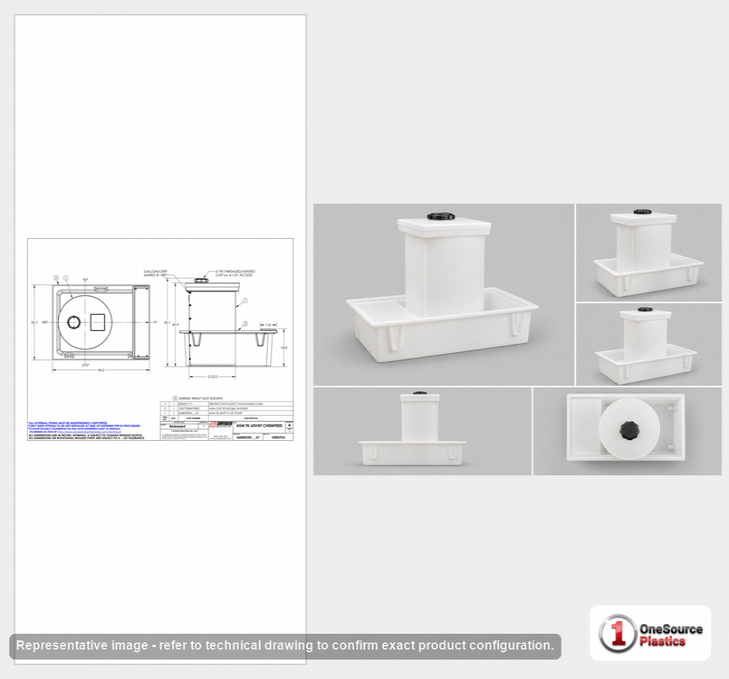
Technical drawing (PDF) for Snyder Industries 5690103CF45.
See this tank
Product video. Watch the Snyder Industries 90 Gallon Plastic Chemical Feed Station Tank video (72 seconds) with dimensions, fittings and shipping notes.
Ready to order?
Add it to your cart at the top of this page, get LTL freight to your ZIP, request a written quote, or call 866-418-1777. The listed price is before freight.