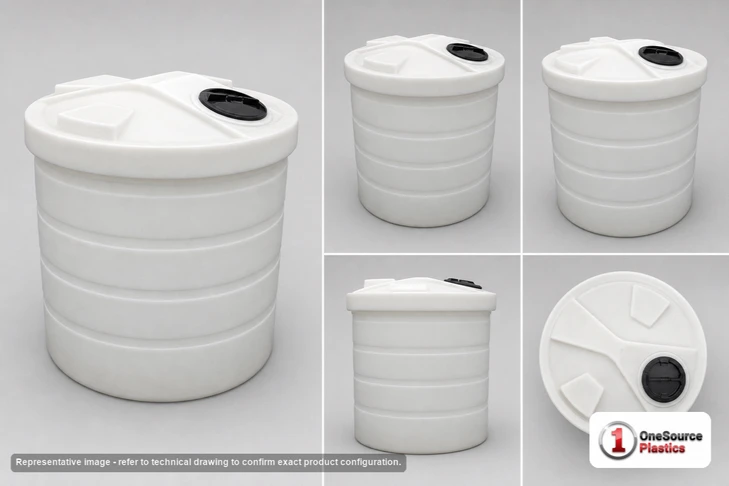
Eighty gallons inside a 24 inch square, contained
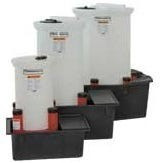
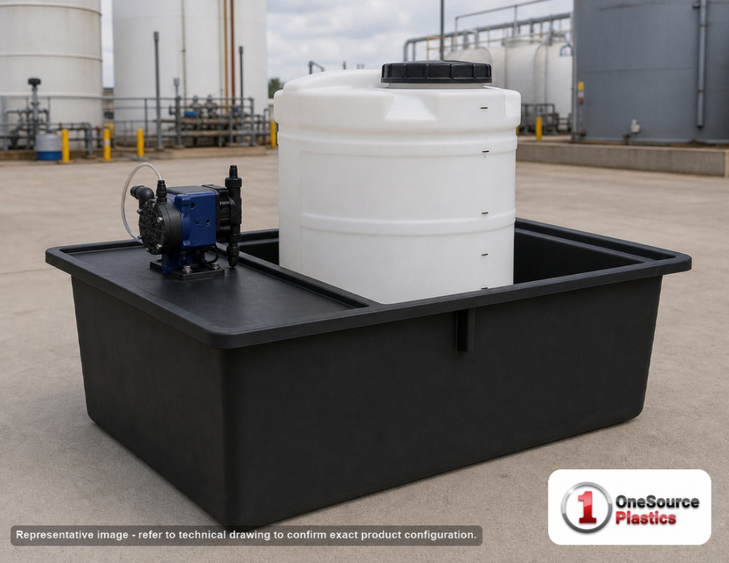
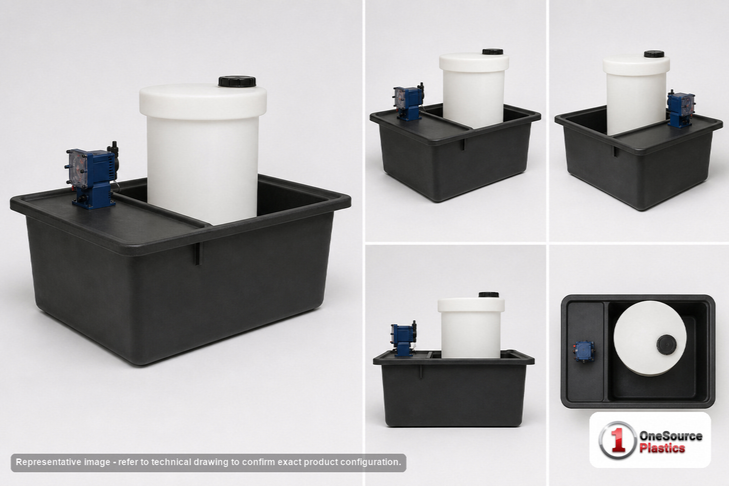
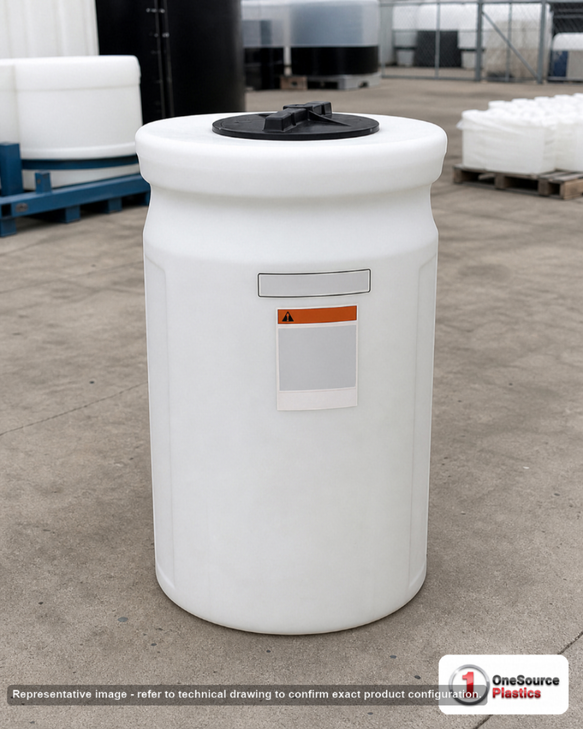
The Snyder SII-5991002N42 is an 80 gallon square dual containment tank: a primary tank standing inside an outer containment shell, moulded in white cross-linked polyethylene, 24 inches long, 24 inches wide and 43 inches tall, at 100 pounds empty. Two feet square is the whole argument for it. The sheet rates the wall at a specific gravity of 1.9 and prints that rating as 1.9 with a maximum of 15.87 pounds per gallon, which gives 667 pounds for 80 gallons of water at 8.34 pounds per gallon and 1,268 pounds of max contents. The one opening the sheet publishes is an 8 inch threaded vented lid. The service limit is 120 F / 48 C and the warranty is listed as a 3 Year Warranty, which makes this the only sheet in its batch with a term on it. No outlet, no inlet and no containment volume appear anywhere on this sheet, so this page states none of them.
Need it before the next delivery? Call 866-418-1777 for the ship date, or get freight to your ZIP and add it to your cart above now.
Two feet square on the floor, and what goes under it
Floor space is why this shape exists. A 24 by 24 inch base is smaller than the footprint most plants give a drum pallet, which means the tank goes where the drum was standing and not where the yard has room: the end of a bench, the corner of a chemical room, the gap beside a dosing skid, the bay behind a wash line. Because the containment is the tank's own outer shell, that 24 inch square is also the whole of the bunded area. There is no separate basin to lay out, no second pallet to buy, no sump to detail into a floor drawing, and nothing to trip over on the way past. The floor under it still has to be right. Set the tank on a flat, continuous, level surface that carries the full 24 by 24 inch base, not on two rails with the middle hanging, not on a pallet with a broken board, not shimmed at one corner to fake level. Empty it is 100 pounds and two people move it. Full of water the sheet gives 667 pounds, and at the rating it gives 1,268 pounds, and all of that is standing on four square feet of floor, so the load per square foot is higher here than under a wide tank of the same volume. That is the trade you accept for the footprint, and it is worth a look at the slab before the order rather than after. Where the floor is a poured pad rather than a structural slab, the concrete pad sizing guide for above-ground polyethylene tanks sets out how the pad is sized and where the boundary lies. Run 80 gallons against your real draw and refill interval in the tank sizing calculator before you settle on it, because a contained tank that is refilled twice a week costs more in deliveries than it saves in floor, and take the freeboard a warming liquid wants from the tank sizing guide. The sheet publishes no forklift pockets, no lift lugs and no anchor points on this tank, so nothing here tells you to lift it by anything but a pallet under the base.
The 60, the 80 and the 120 in the containment family
| Part | Gallons | Length x width x height | Empty weight |
|---|---|---|---|
| SII-5991002N42 (this tank, cross-linked) | 80 | 24 x 24 x 43 in | 100 lb |
| 5991002N48 (same shell, lightest listing) | 80 | 24 x 24 x 43 in | 80 lb |
| 5991002N51 (same shell, middle listing) | 80 | 24 x 24 x 43 in | 90 lb |
| SII-5991002N45 (same shell, same weight) | 80 | 24 x 24 x 43 in | 100 lb |
| 5680002N42 (smaller volume, wider base) | 60 | 26 x 26 x 41 in | 55 lb |
| 5700102N42 (larger volume, larger base) | 120 | 34 x 34 x 51 in | 100 lb |
Read the table before you read the part numbers, because the shape story is not what the numbering suggests. Four of these six are the same 24 by 24 by 43 inch shell holding the same 80 gallons, listed at 80, 90, 100 and 100 pounds. The sheet gives those weights and explains nothing about them, so we print what it says: this tank is one of the two heaviest listings in that group, moulded in cross-linked polyethylene, and where a plant already runs one of the four the honest advice is to buy the part number that matches so a lid, a gasket or a spare shell drops straight in. The genuine outliers are the last two rows. The 60 gallon 5680002N42 holds twenty fewer gallons than this tank and takes more floor to do it, 26 inches square against 24, while standing two inches shorter at 41 inches and weighing 55 pounds: buy it only when the ceiling or the reach over the lid is the binding constraint, because it does not save you floor. The 120 gallon 5700102N42 is the one to step up to when 80 gallons means an extra delivery, and it is the number that makes this family worth comparing properly. It is listed at the same 100 pounds as this tank while holding half again as much, on a 34 inch square base and 51 inches tall. Ten inches more in each direction of plan and eight inches more height is a real change in a chemical room aisle, and it is what fifty per cent more contained volume costs you in space. This tank is the one to buy when 24 inches square is the number you cannot exceed.
Need a different size? Every tank in the table is in stock programs; ask for a quote on the one that fits, or call 866-418-1777.
No outlet on the sheet, an 8 inch vented lid on top
- Outlet and discharge: the sheet publishes no outlet and no inlet for this tank, so we assert neither a size nor a position. Tell us how the liquid is meant to leave and we will confirm what the part carries before it ships, rather than print a fitting the sheet does not give.
- Drawing off in practice: with no published outlet, the working assumption on a contained day tank of this size is a pump or a wand through the top opening, which is why the lid size matters more here than it would on a tank with a valve. Support the suction hose off the tank, not on the lid rim, and keep the pump below the liquid line where the layout allows it.
- Access and filling: an 8 inch threaded vented lid, sitting at 43 inches, which is bench height rather than ladder height. Eight inches is a hose fill and a wand, not a bucket fill and not a hand and forearm for cleaning, so plan the wash-out routine around the opening the sheet gives.
- The vent: the lid is listed as vented, and that vent path is the part that keeps a polyethylene wall out of trouble when a pump is drawing. Keep it clear, keep it unpainted, and look at it every time the lid comes off.
- The containment shell: the outer shell is what makes this a dual containment tank, and the sheet publishes no containment volume, no basin capacity and no percentage. We will not print one. Keep the annular space dry and empty, and treat anything standing in it as the inspection finding it is.
- Service limit and term: 120 F / 48 C, and a 3 Year Warranty, which is what this sheet publishes and the extent of it.
Name the chemical when you order. On a tank with no published fitting, the liquid is the only thing that tells us what the lid seal and any fitting we add have to be made of, and a generic answer is how a gasket gets chosen twice. Where the tank is holding a regulated product and somebody has asked what a second wall is actually worth, the Captor double wall SPCC walkthrough argues it properly instead of assuming it.
Corners, day tanks and the drum that leaked
Eighty contained gallons in two feet square is bought for small, permanent, awkward duties: a day tank of treatment chemical beside a dosing pump, a caustic or acid supply in a plating or finishing shop, a waste collection point under a machine, a bulk detergent station at a wash or a laundry, a corrosion inhibitor supply in a boiler room, and the very common case of replacing a row of drums that keeps weeping onto a floor nobody wants to wash again. The reason to contain at this size is that the spill is small, the room is not, and the clean-up is the expensive part. Before you fill it, know what the second wall buys in usable volume and what it costs in freeboard, because a contained tank is not simply the same tank with a skirt: the Captor double wall freeboard sizing guide works through thermal expansion, density and the volume you can actually use.
Marked Tree to a doorway at 100 pounds
This tank is moulded at Marked Tree, Arkansas, and the sheet lists Arkansas as the state it ships from. The freight class is given as LTL under NMFC 156600, and it shipments at 24 by 24 by 43 inches, which is the rare tank that goes through an ordinary doorway on a pallet jack without anyone measuring first. Price the lane to your ZIP with the freight cost estimator; the listed price is before freight. One hundred pounds comes off the truck on a pallet or between two people, never by the lid and never dragged across a floor on the containment shell. Set it on its finished, level position before you plumb or fill anything, fill it once with clean water, and hold that fill long enough to read the lid seal and to look into the annular space for anything that should not be there. Drain it dry before the working liquid arrives. Write the chemical and the fill date on the outer shell in paint marker the day it lands, because the thing nobody can identify at a glance is the thing that gets the wrong delivery. Keep the first delivery's paperwork with the tank; strength and date on day one is the baseline for every batch after.
Freight and documents
Ships from: Marked Tree, AR. LTL freight is quoted to your ZIP with the freight cost estimator or by phone at 866-418-1777. The listed price is before freight.
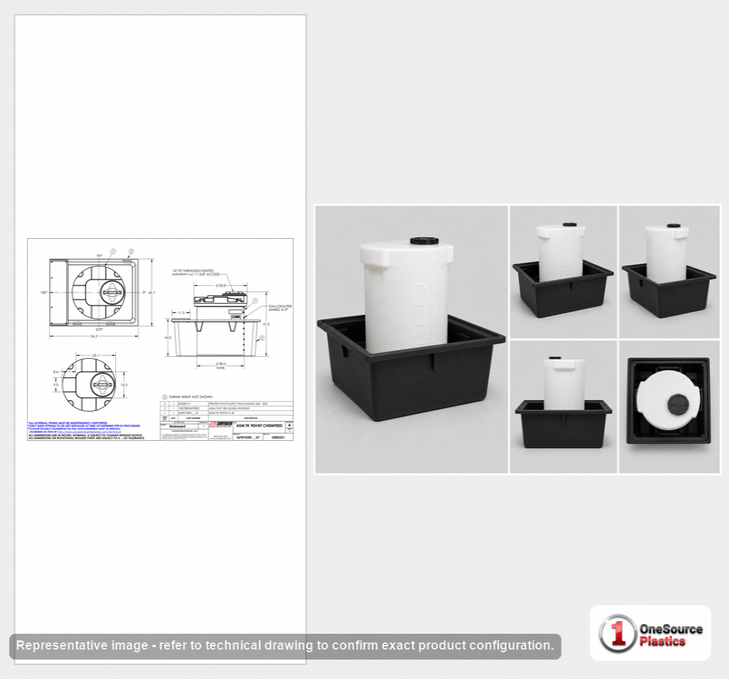
Technical drawing (PDF) for Snyder Industries 5991002N42.
See this tank
Interactive 3D model with live fill. This tank has an interactive 3D model built to its manufacturer dimensions. Rotate it, and set a fill level to see how much liquid it holds at any height. Open the 3D view on the product photo above. Download the 3D model (GLB).
Product video. Watch the Snyder Industries 80 Gallon XLPE Square Dual Containment Tank video (68 seconds) with dimensions, fittings and shipping notes.
Ready to order?
Add it to your cart at the top of this page, get LTL freight to your ZIP, request a written quote, or call 866-418-1777. The listed price is before freight.