1500 gallons on the same 72 inch base, 93 inches tall
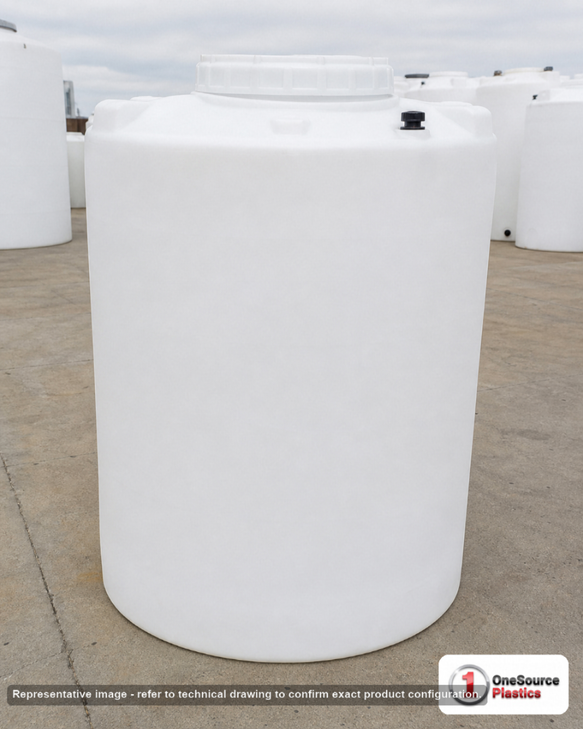
The Snyder SII-1008700C26 takes the 72 inch base this family is built on and stands it up: 1500 gallons in a natural white polyethylene shell 72 inches across and 93 inches tall, 260 pounds empty, molded at Chowchilla, California. The sheet rates the wall at a specific gravity of 1.9 and turns that into 23,769 pounds of contents, against the 12,510 pounds the tank weighs full of water at 8.34 pounds per gallon. It comes fitted with a 2 inch polypropylene female NPT bulkhead outlet at the base and an 18 inch threaded vented manway on top. The sheet publishes a maximum operating temperature of 120 F / 48 C and a 3 Year Warranty. Freight is class 300.
Price it in one step. Freight to your ZIP shows in seconds; add the 1500 gallon tank to your cart above, or call 866-418-1777 if the site has a question in it.
One plant, one lane, and the 72 inch base that grew upward
Every tank in this group leaves the same plant on the same rate: Chowchilla, California, class 300, and a shipment that is 72 inches square. What changes from tank to tank on that lane is only the height, and this is the tall one at 93 inches, seven feet nine inches. That matters to the delivery in a specific way. A six foot square shipment is the same width whether the shell on it is short or 93 inches tall, so the lane cost moves with the height and the class rather than with the footprint, and the practical constraint is whether your approach has clear air above it and whether the yard can take 260 pounds off a deck. For a Western buyer the plant is a short lane; for anyone east of the plains it is a long one, and that geography is worth more attention than any figure on the specification. On the ground it is the same 72 inch circle the smaller tanks in this family stand on, which makes this the volume upgrade that does not cost floor: 1500 gallons on six feet of concrete, with 23,769 pounds of allowed contents at the sheet's specific gravity rating of 1.9 landing on it through a floor that bears on the whole surface it touches and nothing else. That means the pad matters more here than on the shorter tanks, not less, because the same footprint carries nearly twice the load: level, cured, continuous, poured wider than six feet, overflow away from the edge, to the framework in the concrete pad sizing guide. Seven feet nine inches of empty shell at 260 pounds catches wind, so band it before the first fill and check it after the first storm. Prove the volume against the duty in the tank sizing calculator, and set the reserve and the freeboard from the tank sizing guide.
1500 gallons: 72 by 93, 86 by 72, and the 1550 at 124 inches
| Part | Gallons | Base x height | Empty weight |
|---|---|---|---|
| SII-1008700C26 (this tank, natural white, narrow base) | 1500 | 72 x 93 in | 260 lb |
| 1770000C34 (black, wide and low) | 1500 | 86 x 72 in | 260 lb |
| 1770000N42 (wide and low, heavy duty) | 1500 | 86 x 72 in | 260 lb |
| 1770000N48 (black, wide and low, heavy duty) | 1500 | 86 x 72 in | 260 lb |
| 1830400N40 (smaller, same base) | 1300 | 72 x 87 in | 290 lb |
| 1840000C26 (larger, slim, tallest) | 1550 | 64 x 124 in | 335 lb |
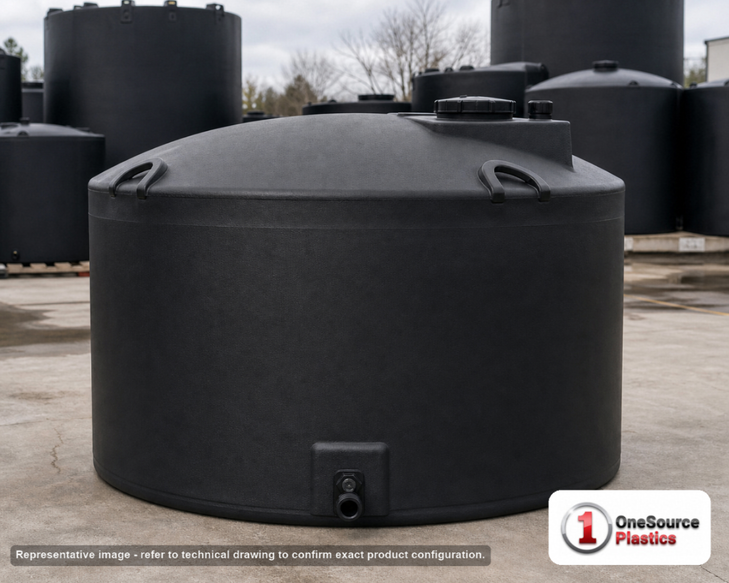
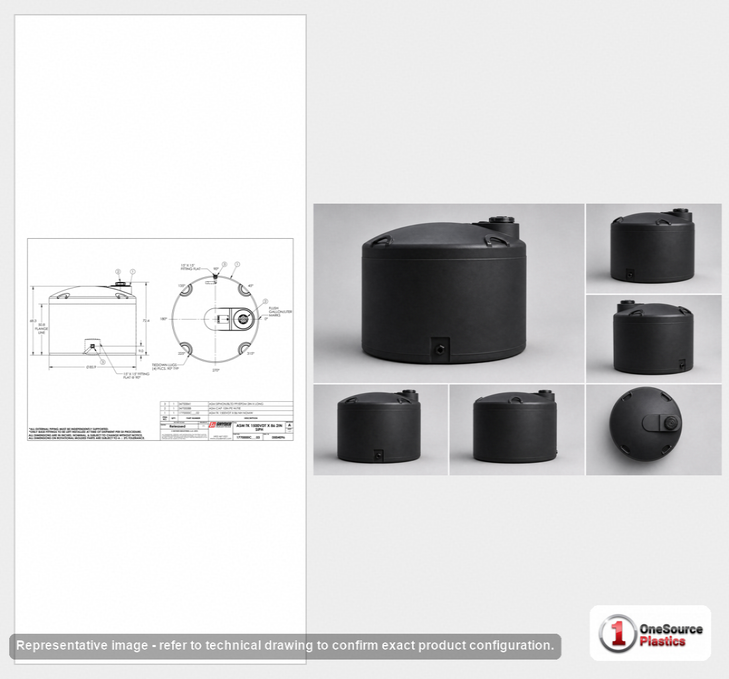
Four part numbers hold 1500 gallons on this sheet and the sheet lists every one of them at 260 pounds, including the three that do it in a completely different shape, 86 inches across and 72 inches tall. That is the figure as given and this page prints it without explanation. The choice, then, is entirely silhouette. The 86 by 72 inch trio sit low and wide, seven feet two inches of base for six feet of height, which is the buy where a roof line or a sight line rules and there is floor to spare. This one does the same volume on the 72 inch circle the rest of this family uses, standing seven feet nine inches, which is the buy when the pad is already six feet and cannot grow, when the tank has to fit a row of tanks on the same footprint, and when the extra foot and nine inches of standing liquid over the 2 inch outlet is worth having at the pump. Either side of the capacity, the 1300 gallon 1830400N40 is on this tank's base at 87 inches and listed heavier at 290 pounds for two hundred fewer gallons, and the 1550 gallon 1840000C26 is the slim one, 64 inches across and 124 inches tall at 335 pounds, ten feet four inches of tank for the tightest footprint in the group.
Settled on the 1500 gallon tank? Freight to your ZIP and add to cart above; a written quote is one click away for the paperwork.
Ninety three inches to the manway, and the vent that matters more than the lid
- The top is 93 inches up, seven feet nine inches, so the 18 inch threaded vented manway needs a platform or a short fixed ladder with something to hold, not a step and a stretch. Decide that access before the tank is standing, because a lid nobody can reach safely is a lid nobody opens and a tank nobody inspects.
- The vent is the part that earns the attention on this shell. A 1500 gallon column on a 72 inch base is tall and narrow, so the level falls quickly at the end of a draw and the air has to come in at the same rate the liquid leaves. Keep the vent clear, and if the duty includes rapid filling and rapid drawing, size the vent to those rates rather than to the fitting that came on the tank; the arithmetic for thermal inbreathing, liquid movement outbreathing and the combined case is worked through with worked examples in the atmospheric vent capacity guide, and a 1500 gallon vertical is exactly the size it starts from.
- Outlet: a 2 inch polypropylene female NPT bulkhead fitting at the base, as the sheet lists it. Seven feet nine inches of standing liquid above it is the most head of any tank on this 72 inch base, which is good for a pump and hard on a fitting; make the thread up once, correctly, and put a union or flange downstream for every later change.
- Pump layout: set the pump below the outlet on its own base with a short, straight, falling suction run and it stays flooded nearly to the bottom of the draw. Add a cleanable strainer and a low level float or run-dry cut-out that stops the pump with liquid still over the fitting.
- Published limits: a maximum operating temperature of 120 F / 48 C and a 3 Year Warranty appear on this sheet, and the specific gravity rating of 1.9 allows up to 23,769 pounds of contents. None of those three is a statement of chemical compatibility, which gets settled by naming the liquid before the order.
The rest is the discipline a tall shell on a small base always needs. Flexible first joint off the bulkhead; the first valve on its own support off the pad, never hanging on the wall; a kerb or bollard between the fitting and pad traffic; freeze protection on the valve and exposed pipe rather than on the body. Watch the strap tension through the first year, because polyethylene grows in the sun and a strap tightened in spring is loose by late summer.
Farm chemical mix, stored water and vent sizing
1500 gallons on a six foot base is the practical working size for a lot of farm and light industrial duty: a chemical or liquid fertilizer mix tank feeding a sprayer, a nurse tank at a yard that fills faster than the well can supply, stored water for irrigation, wash-down or trough supply, rinse and equipment wash water in a shop, a dosing or day tank beside a small treatment skid, and construction water for dust control on a long job. Two figures gate all of it: the published 120 F / 48 C maximum operating temperature and the specific gravity rating of 1.9, which the sheet turns into 23,769 pounds of allowed contents. Fast filling and fast drawing on a tank this shape is the case where vent sizing stops being theoretical, which is why the calculations matter on a working mix tank more than on a static reservoir. Where the tank is a stage in a system that collects and re-uses water in quality bands rather than a standalone vessel, the industrial water reuse tank topology article shows the sequencing, and water held against a fire is a designed reserve rather than a full tank, which the fire-water reservoir design guide spells out.
Chowchilla at class 300, 260 pounds, and the first fill
The SII-1008700C26 ships from Chowchilla, California at class 300 as the sheet lists it, shipped 72 inches by 72 inches by 93 inches. At 260 pounds it is the heaviest of the 72 inch base tanks in this family and still an ordinary LTL load, so the questions are the same ones the smaller tanks ask with one addition: seven feet nine inches standing on a deck wants clear air on the approach, so look up at the gate, the tree line and the service drop before delivery day. The freight cost estimator prices the lane to your ZIP, and the listed price is before freight. Take it off with slings under the body and a machine that can stand it upright on the finished pad, never a hook through the manway. Then do the one thing that protects the rest of the installation: fill it with clean water, hold it, and read the base, the pad edge, the 2 inch bulkhead and the strap tension while the full 12,510 pounds is sitting on the pad. A tall tank on a small base tells you about the pad on its first fill or it tells you in a year, and the first version is much cheaper. Note the pad height and the outlet height on the site plan while the tape is out; the next pipe run will need both.
Freight and documents
Ships from: Chowchilla, CA. LTL freight is quoted to your ZIP with the freight cost estimator or by phone at 866-418-1777. The listed price is before freight.
Ready to order?
Add it to your cart at the top of this page, get LTL freight to your ZIP, request a written quote, or call 866-418-1777. The listed price is before freight.