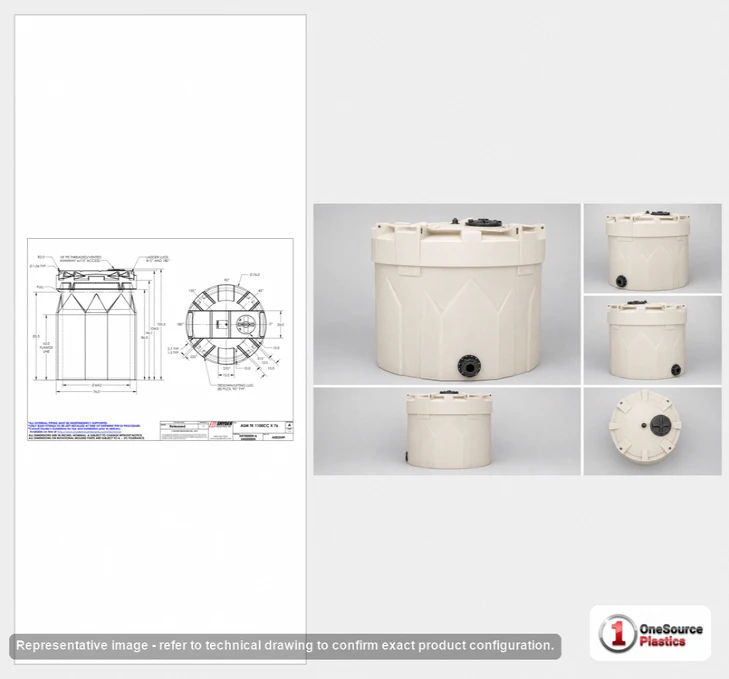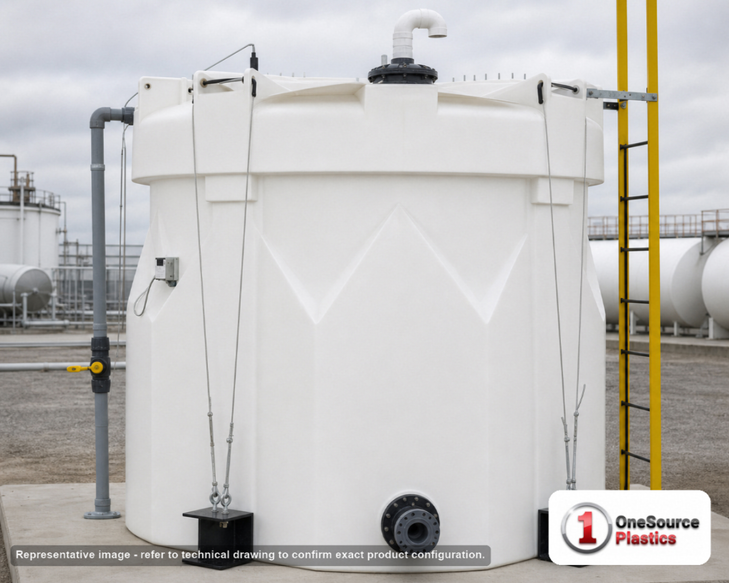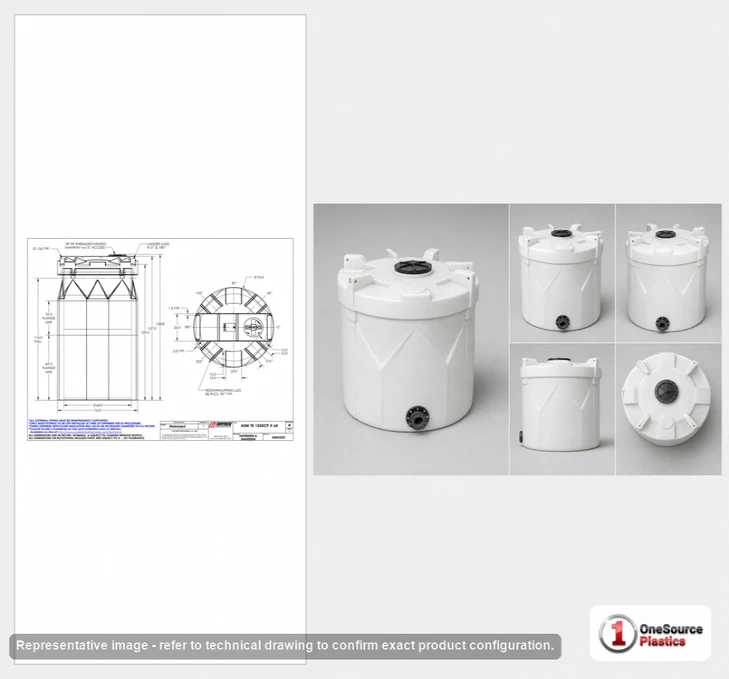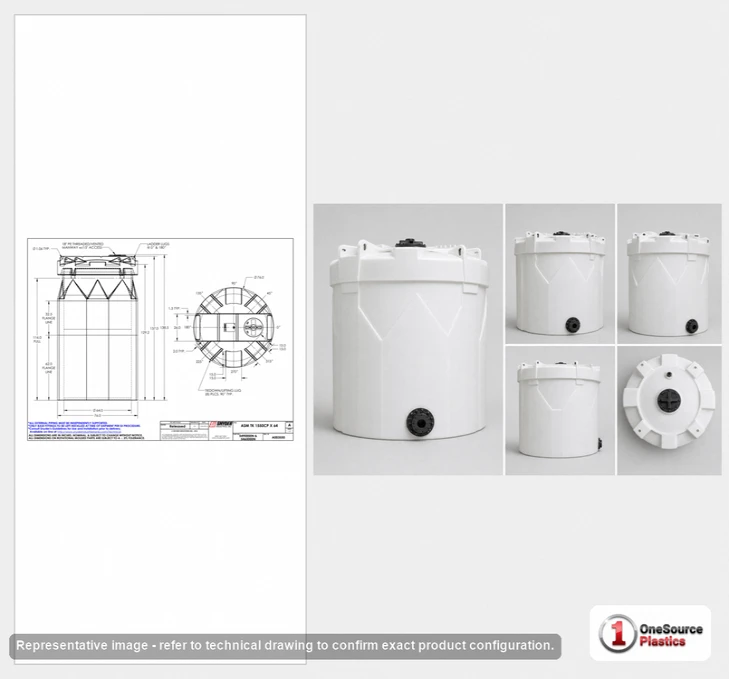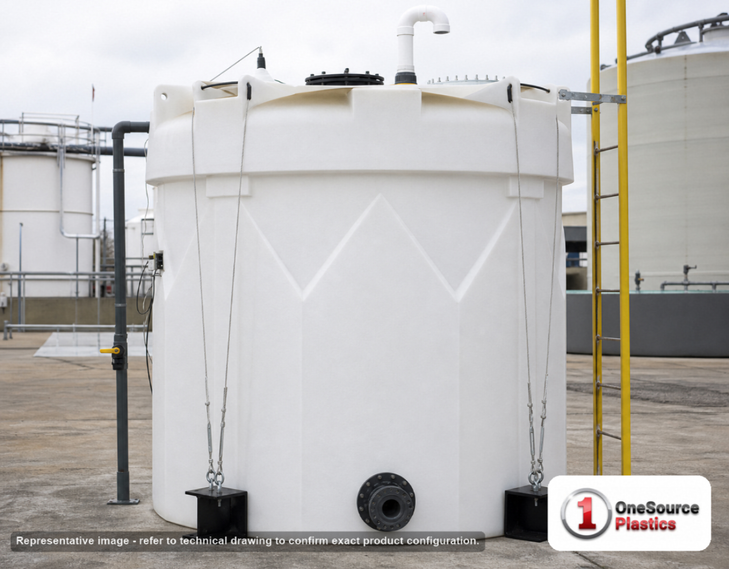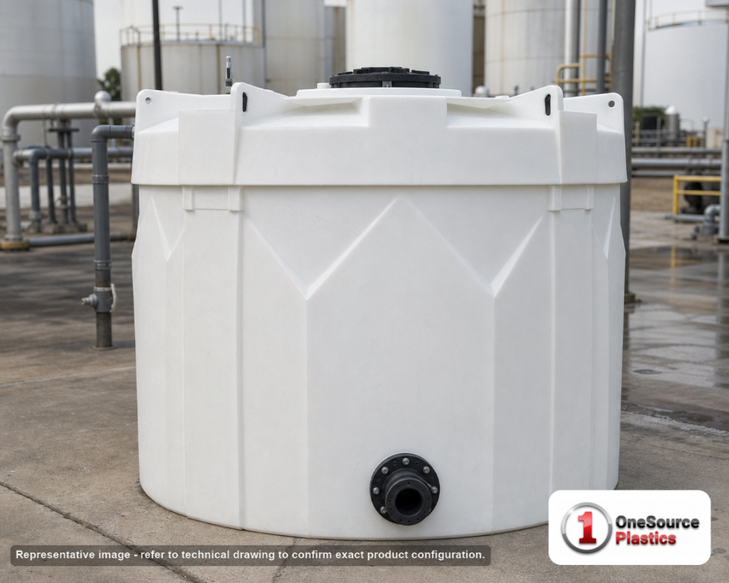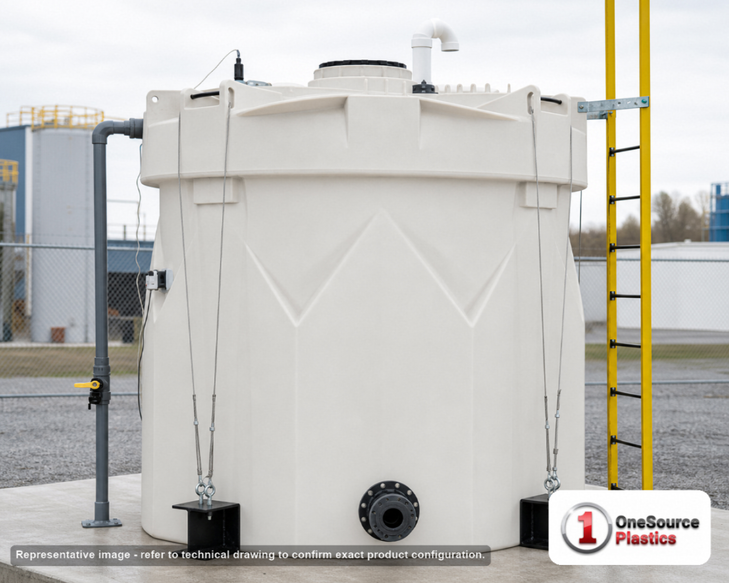
2500 gallons of cross-linked polyethylene in a 102 inch double wall shell
The Snyder SII-5580000N42 is a 2500 gallon double wall tank in white cross-linked polyethylene: an inner tank inside an outer containment shell, 102 inches by 102 inches on the base and 122 inches tall, listed at 1,420 pounds empty and the same 1,420 pounds to ship, molded at Lincoln, Nebraska. The sheet rates it at a specific gravity of 1.9, which is where the 39,615 pound maximum contents figure comes from against 20,850 pounds for 2500 gallons of water at 8.34 pounds per gallon. Access is an 18 inch threaded vented manway. The service limit is 120 F / 48 C and the sheet gives a 3 year warranty. Freight is class OVS on NMFC 156600. The sheet publishes one set of outside dimensions and nothing for the inner tank, so no containment volume or annulus figure is claimed on this page.
Want a second opinion on the size? Call 866-418-1777 with the daily draw and the delivery interval, or price freight to your ZIP and add it to your cart above.
The cross-linked white one, and the three tanks it shares a shell with
Start with the family, because on this sheet the shell is settled before you choose anything. Four part numbers hold 2500 gallons in the same 102 by 102 by 122 inch outside envelope, and the only things that separate them are the resin, the colour and the weight on the line. This one is the cross-linked polyethylene tank in white, listed at 1,420 pounds empty. The three tanks beside it in that shell are listed at 1,100 pounds each: 5580000N30, which Snyder names for sulfuric acid service; 5580000N48, a cross-linked tank in black; and 5580000N51, a black tank the sheet does not call cross-linked. The sheet gives those weights and offers no explanation for the difference, and neither do we. What it means at the pad is simple and worth saying out loud: the footprint, the height, the manway, the service limit and the warranty are identical across the four, so the decision is resin and colour, and the decision is made with the liquid in front of you rather than from a catalogue. White is the choice where somebody has to read a level through the wall, which on a contained tank is the only way to see the inner tank at all. Black is the choice where light on the contents is the problem. Cross-linked is a different material from the high density linear polyethylene on most of the sheets around it, and it is the reason this part number exists as a separate line. Under the tank, the base carries 20,850 pounds of water on a shell eight and a half feet across, and a rotationally molded floor bears on the whole surface it touches and nothing else, so the slab is flat, level, continuous and poured wider than the tank rather than to its edge. The framework for getting that right is in the concrete pad sizing guide, and on a double wall tank it matters more than on a single wall one, because the outer shell is the thing standing on the slab and it is the thing you cannot inspect from underneath. Run 2500 gallons against your real draw and refill interval in the tank sizing calculator before you commit, and take the working reserve and the freeboard a warming liquid needs from the tank sizing guide.
One 102 inch shell, four part numbers, two weights
| Part | Gallons | Length x width x height | Empty weight |
|---|---|---|---|
| SII-5580000N42 (this tank, white, cross-linked) | 2500 | 102 x 102 x 122 in | 1420 lb |
| 5580000N30 (same shell, named for sulfuric acid) | 2500 | 102 x 102 x 122 in | 1100 lb |
| 5580000N48 (same shell, cross-linked, black) | 2500 | 102 x 102 x 122 in | 1100 lb |
| 5580000N51 (same shell, black) | 2500 | 102 x 102 x 122 in | 1100 lb |
| 5570000N48 (shorter shell, smaller) | 2000 | 102 x 102 x 103 in | 900 lb |
| 5590000N30 (taller shell, larger) | 3000 | 102 x 102 x 142 in | 1900 lb |
Read the table as two decisions rather than six options. The first is capacity, and it is a height decision, because all six tanks stand on the same 102 inch base. The 2000 gallon 5570000N48 does it in 103 inches of height at 900 pounds, this tank does 2500 in 122 inches at 1,420 pounds, and the 3000 gallon 5590000N30 does it in 142 inches at 1,900 pounds. So a bay with a fixed ceiling, a canopy, a doorway or a fill point at a fixed height picks the capacity for you, and the footprint does not change while it does. The second decision is the one inside the 2500 gallon group, and it is resin and colour only. Nothing in the sheet separates those four tanks by size, by service limit, by manway or by warranty. That is unusual enough to be worth stating plainly, because a buyer looking at four part numbers at one capacity normally assumes a wall difference is buried in there somewhere, and on this sheet no wall figure is published for any of them. Tell us the liquid, its temperature at the inlet and the temperature it sits at, and we will match the part number to it against Snyder's current documentation rather than by elimination. Two questions settle most of these calls: whether anyone needs to read the level by eye through the shell, and whether the liquid is one your site rules require to be held in a contained tank at all. What a contained installation actually has to do, and where the tank stops and the site plan starts, is worked through in the Captor double wall compliance walkthrough.
Not sure which one? Tell us the liquid, the site and the ceiling height at 866-418-1777, or request a written quote with freight to your ZIP.
The 18 inch threaded vented manway, and what the headspace has to breathe
- The vent comes first on a tank this size. The sheet gives one top opening, an 18 inch threaded vented manway, and that vent is the only breathing path it publishes. A 2500 gallon tank being filled has to push 2500 gallons of air out, and the same tank being drawn down has to pull it back in; block the vent and the wall takes the difference, inward on a pump draw and outward on a fast fill. Keep it clear, keep it inspected, and never cap it to keep rain out.
- Headspace is the other half of the same subject. Vapour collects at the top of the shell, above the liquid line, and that is where a chemical tank is worked hardest and looked at least. Leave the freeboard the liquid needs as it warms rather than filling to the manway, and take the sizing logic for it from the freeboard sizing guide, which is the difference between 2500 gallons of capacity and 2500 gallons you can actually use.
- Access: 18 inches is a hand, a light, a hose and a level probe, and it is the opening every inspection of the inner tank goes through. Keep the threads and the gasket clean, keep a spare gasket on the shelf, and do not let the manway become the place where a fitting gets improvised.
- Outlet and inlet: the sheet publishes neither for this tank, so this page claims neither. That is not a gap to guess at, it is a conversation at order: tell us where the liquid comes in, where it goes out, and what pumps it, and we will confirm the fittings and their positions against Snyder's current documentation before anything is drilled or bought.
- Service limit: 120 F / 48 C as the sheet gives it, with a 3 year warranty. The limit applies to the liquid and to a shell standing in the sun, and a white tank in full afternoon sun is warmer inside than the air around it.
The rest of the fitting discipline on a double wall tank is about respecting the two walls as two separate things. The inner tank holds the liquid. The outer shell is there for what the inner tank does not hold, and nothing should be hung, braced, drilled or bolted through it that the manufacturer has not specified. Support every pipe, valve and gauge off its own stand rather than off the shell, and break the first joint at the tank with a flexible connector so thermal movement and pump vibration never reach the wall. Leave access all the way round; a contained tank you cannot walk around is a contained tank nobody inspects. Level instrumentation belongs through the manway rather than through a new hole. And where the liquid is one you would rather see than measure, the white shell is the reason to buy this part number rather than one of the black ones in the table above.
Where a contained 2500 earns its keep
Twenty-five hundred gallons is the size where a contained tank stops being a compliance line item and starts being the cheapest part of the installation. The work it does: bulk chemical storage at a water or wastewater plant where a release into the yard is unthinkable; a day tank or bulk feed for a metering skid on a process line; a mining, plating or pulp and paper site holding a working supply of an aggressive liquid outside; an agricultural or industrial site keeping a liquid where a concrete berm would otherwise have to be poured, inspected and maintained; a bulk reservoir for a rural or remote property, where the same tank that holds process water can be the standing reserve a private fire pump draws from, and the sizing discipline for that duty is set out in the fire-water reservoir design guide. Two limits, stated honestly. The sheet publishes no containment volume, no annulus dimension and no inner tank dimension, so this page does not tell you what fraction of the inner tank the outer shell will hold; ask us and we will get that figure from Snyder in writing rather than estimate it for you. And 120 F / 48 C is the service limit on this sheet, which rules the tank out for anything that arrives hot. Beyond those, what ends a tank this size early is almost never the liquid: it is a pad that settled under one edge, a rigid pipe run bolted to the shell, a vent somebody capped, or a fill line left running while nobody watched the level.
Out of Lincoln, Nebraska as an oversize load at 1,420 pounds
This tank is molded at Lincoln, Nebraska and the sheet gives its freight class as OVS on NMFC 156600, shipping at 122 inches long by 102 inches wide by 102 inches high at 1,420 pounds. Ten feet two inches of tank on an eight and a half foot base is an oversize load, which changes the delivery rather than just the price: the truck needs a clear approach, a turning radius and a place to set the tank down near the pad, and it needs to know that before it leaves. The freight cost estimator prices the lane to your ZIP, and the listed price is before freight. Tell us at order whether there is a forklift with the reach for a shell this tall, a telehandler, or a crane, because 1,420 pounds is not the problem and 122 inches of height with a high centre of gravity is. Have the pad cured and the site clear before the truck is booked; a tank standing on its side in a yard for three weeks waiting for concrete is how shells get damaged. Walk the whole outer shell, the manway and the base ring with the driver before the paperwork is signed. Then water-test it in place: fill the inner tank with clean water, hold it, and walk the tank and the containment space before any product goes in. Keep the serial number on the shell recorded with your delivery paperwork, because that is where a warranty claim starts and it is also the number nobody can find in a hurry. Chalk the full-water line on the outside after the first fill; it is the level every later reading gets checked against.
Freight and documents
Ships from: Lincoln, NE. LTL freight is quoted to your ZIP with the freight cost estimator or by phone at 866-418-1777. The listed price is before freight.
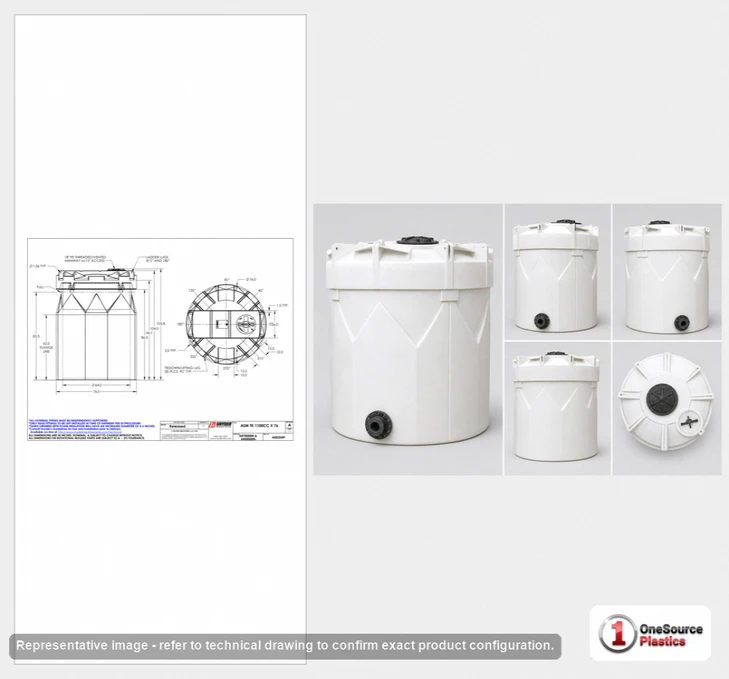
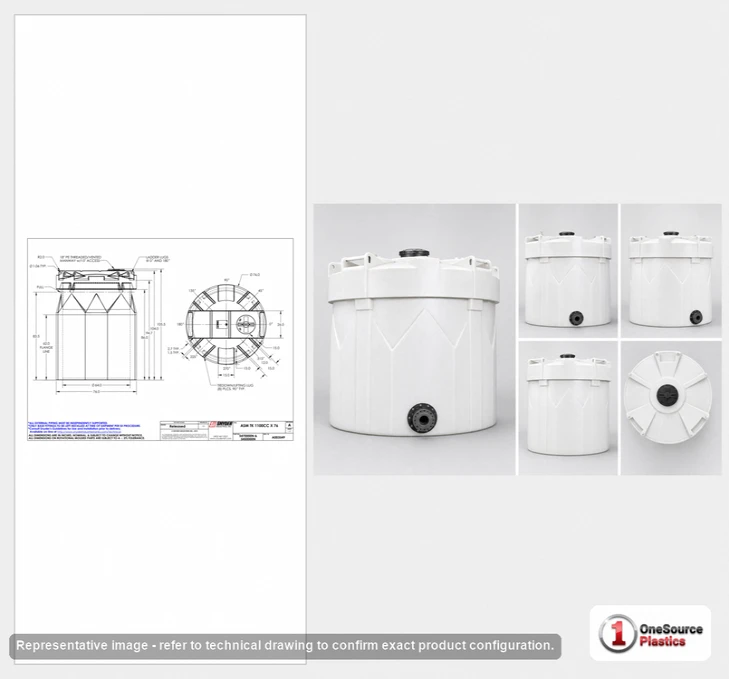
Technical drawing (PDF) for Snyder Industries 5580000N42.
See this tank
Interactive 3D model with live fill. This tank has an interactive 3D model built to its manufacturer dimensions. Rotate it, and set a fill level to see how much liquid it holds at any height. Open the 3D view on the product photo above. Download the 3D model (GLB).
Product video. Watch the Snyder Industries 2500 Gallon XLPE Double Wall Tank in White 1.9 SG video (69 seconds) with dimensions, fittings and shipping notes.
Ready to order?
Add it to your cart at the top of this page, get LTL freight to your ZIP, request a written quote, or call 866-418-1777. The listed price is before freight.