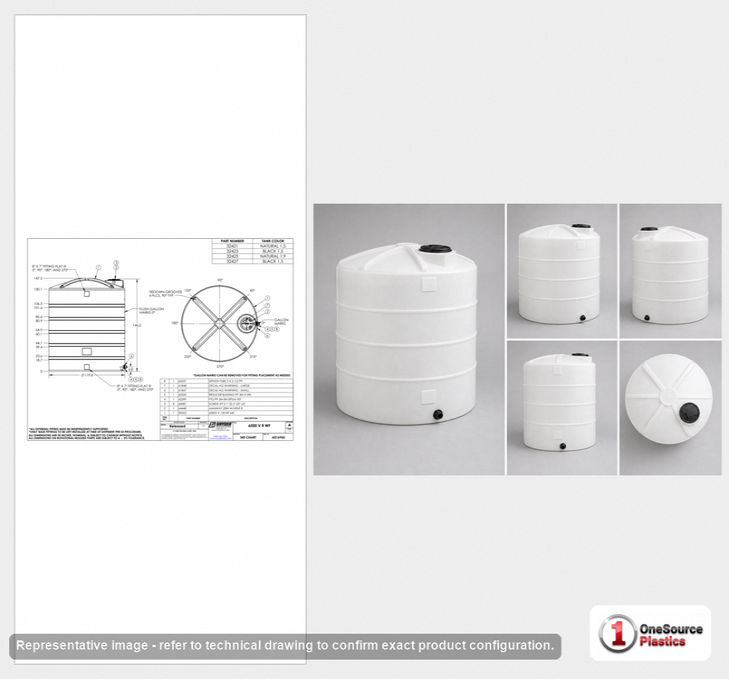
5,500 gallons of double wall chemical storage at 1.9 specific gravity
The Snyder 5660000N45 is a white high density linear polyethylene vertical double wall chemical storage tank, 120 inches across and 172 inches tall over the outer wall, holding 5,500 gallons in the inner tank at 3,800 pounds. Its inner wall is rated for a specific gravity of 1.9, or 87,153 pounds of contents against 45,870 for water, the chemical-grade wall for ferric chloride at strength, concentrated acids and the heavy brines, and the outer tank is the containment: a spill from the inner wall stays inside the outer one, so the tank stands on a slab without a berm. On top, an 18 inch threaded, vented manway; behind it, a 3 year warranty; on the road, oversize freight.
Have the liquid and the ZIP? That is all 866-418-1777 needs to confirm the fit; or price freight to your ZIP and add it to your cart above.
A tanker of dense chemical with the berm built in
A single wall tank of a regulated liquid has to stand inside a berm sized to it, and at 5,500 gallons that berm is a room with a floor drain, a sump and a permit; the double wall tank carries its containment on the truck, and the Captor double wall SPCC compliance walkthrough shows how an inspector reads that under 40 CFR 112. A 1.9 wall is sized for a liquid nearly twice as dense as water, and 3,800 pounds is what two walls of it take at this size, 600 pounds more than the lighter grades in the same mold. The rated chemistry for the resin is listed below; check the liquid at its concentration in the chemical compatibility database, because weight rating and chemical resistance are separate properties. The usable volume of a double wall tank is less than the nominal once thermal expansion and the interstice are accounted for; the freeboard sizing guide works out the real number, and for a dense chemical the expansion is large. The tank sizing calculator matches the volume to feed rate and delivery interval, and the tank sizing guide covers the reserve.
Grades on the 5,500 gallon double wall, and the sizes beside it
| Part | Gallons | Diameter x height | Empty weight |
|---|---|---|---|
| 5660000N45 (this tank, 1.9 SG) | 5,500 | 120 x 172 in | 3,800 lb |
| 5660000N42 (XLPE, heavy wall) | 5,500 | 120 x 172 in | 3,800 lb |
| 5660000N40 (XLPE) | 5,500 | 120 x 172 in | 3,200 lb |
| 5660000N46 | 5,500 | 120 x 172 in | 3,200 lb |
| 5630000N40 (tall, XLPE) | 5,000 | 102 x 216 in | 3,600 lb |
| 5670000N45 (1.9 SG) | 6,500 | 120 x 199 in | 5,300 lb |
| 5670000N30 (sulfuric grade) | 6,500 | 120 x 199 in | 5,300 lb |
The N42 is the heavy cross-linked double wall at this tank's weight for the densest oxidizers, and the N40 and N46 the lighter cross-linked and linear grades. The 5630000N40 stands 5,000 gallons of cross-linked double wall on a 102 inch base at 216 inches for a small pad, and the 5670000 tanks hold 6,500 gallons on this base 27 inches taller, the N45 this same 1.9 wall and the N30 the sulfuric acid resin.
Found the 5500 gallon tank in the table? Freight to your ZIP is one click; add it to your cart above, or call 866-418-1777 to check the grade.
Openings, alarms and the interstice
- Access: 18 inch threaded, vented manway, 172 inches up; on acid or caustic the vent goes outdoors, the fill goes down a dip tube, and the vent is sized to the tanker pump.
- Outlet: specify the bulkhead fitting for the chemical when ordering; on a double wall the outlet passes through both walls with a sealed transition, so it is set at the factory.
- Interstice: the space between the walls takes a leak sensor; fit one, wire it to an alarm, and test it with water at commissioning.
- Service limit: 120 F / 48 C.
Choose the level sender for the chemical with the level gauge selection guide, read at ground level. A double wall tank protects against a wall failure, not an overfill: a high-level alarm, an automatic cutoff on the fill line and a double block and bleed on the loadout are the layers the tank spillover redundancy guide lays out, and they are cheaper than the chemical they save. Full, the tank loads a 120 inch circle to 87,153 pounds at the rating: an engineered slab in full contact under the whole outer wall, a wind strap on the empty tank, and access to the manway from a fixed platform with a rail. Keep the manway closed against vapor loss, and shade the tank where the chemical is light-sensitive.
Unloading without a spill
The driver's pump can deliver faster than the manway vent can breathe, so the vent is sized for the unload rate or the fill goes through a dedicated top bulkhead with its own vent line. A fill pipe to the floor keeps caustic or coagulant from free-falling and foaming. A dense liquid heats when water is added to it, so a batch tank is filled with water before the chemical, never after. The first delivery into a new tank is watched from start to finish, with the interstice sensor and the outlet transition checked as the level climbs, and each delivery after it is logged with its date and strength.
In service
Ferric and other dense coagulants at a plant that cannot build a berm, acid feed for pH control under a spill plan, heavy brine at plant scale, and any dense regulated chemical where the containment has to be on the drawing rather than in the floor. One chemical per tank, labeled for both inspectors at once.
Rated chemistries for this tank
The manufacturer lists these liquids for this resin at the concentrations noted, with the fitting and gasket material to specify. Check the concentration and temperature you actually run on the linked page or in the chemical compatibility database before ordering.
- acetic acid (60%, PP/PVC fittings, EPDM gaskets)
- aluminum sulfate (50%, PVC, EPDM)
- calcium chloride (40%, PVC, EPDM)
- DEF (32.5%, 316SS, EPDM)
- ethylene glycol (100%, PVC, EPDM)
- ferric chloride (50%, PVC, EPDM)
- ferric sulfate (60%, PVC, EPDM)
- ferrous sulfate (20%, PVC, EPDM)
- hydrochloric acid (37%, PVC, Viton)
- hydrofluoric acid (48%, PP/PVC, Viton)
- hydrofluosilicic acid (26%, PP/PVC, Viton)
- hydrogen peroxide (50%, PVC, Viton)
- magnesium chloride (30%, PVC, EPDM)
- peracetic acid (30%, 316SS, Aflas)
- phosphoric acid (85%, PVC, Viton)
- polyaluminum chloride (PVC, EPDM)
- potassium carbonate (50%, PVC, EPDM)
- potassium hydroxide (saturated, PVC, EPDM)
- propylene glycol (PP/316SS, EPDM)
- sodium bisulfate (PVC/PP, EPDM)
- sodium bisulfite (PVC/PP, EPDM)
- sodium carbonate (30%, PVC, EPDM)
- sodium hypochlorite (under 16.5%, PVC, Viton)
- sodium thiosulfate (40%, PVC, EPDM)
- sulfuric acid (98%, CPVC, Viton)
- urea solution (50%, PP/PVC, EPDM)
- zinc orthophosphate (PP/316SS, EPDM), and ozonated water (up to 10 PPM, PVC, EPDM). Notice the gasket calls vary by chemical: sodium hypochlorite, hydrogen per
Freight and unloading
At 120 inches across and 172 inches long on the deck the 5660000N45 is oversize freight (NMFC 156600) on a flatbed at a lane rate; the freight cost estimator gives the flatbed number for your ZIP, and the listed price is before freight. A crane sets 3,800 pounds upright on the slab; this is not a forklift job. Water-fill the inner tank once to the manway, hold it, test the interstice sensor, then drain and dry before the chemical connection is made. Check the strap tension a week after the first fill; a tank settles a little, and the strap that was tight is loose.
Freight and documents
Ships from: Lincoln, NE. LTL freight is quoted to your ZIP with the freight cost estimator or by phone at 866-418-1777. The listed price is before freight.
Technical drawing (PDF) for Snyder Industries 5660000N45.
See this tank
Interactive 3D model with live fill. This tank has an interactive 3D model built to its manufacturer dimensions. Rotate it, and set a fill level to see how much liquid it holds at any height. Open the 3D view on the product photo above. Download the 3D model (GLB).
Product video. Watch the Snyder Industries 5500 Gallon Plastic Vertical Double Wall Liquid Chemical Storage Tank in White (1.9 SG) video (74 seconds) with dimensions, fittings and shipping notes.
Ready to order?
Add it to your cart at the top of this page, get LTL freight to your ZIP, request a written quote, or call 866-418-1777. The listed price is before freight.