A hundred and twenty gallons in a 46 inch rectangle
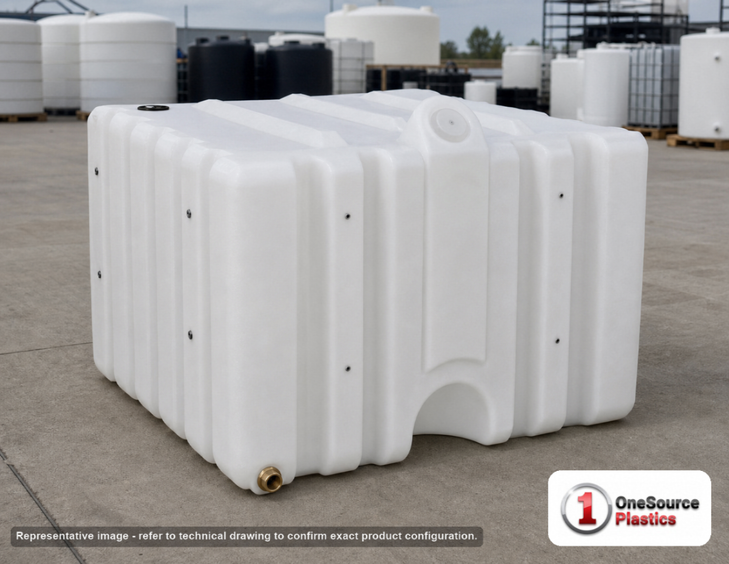
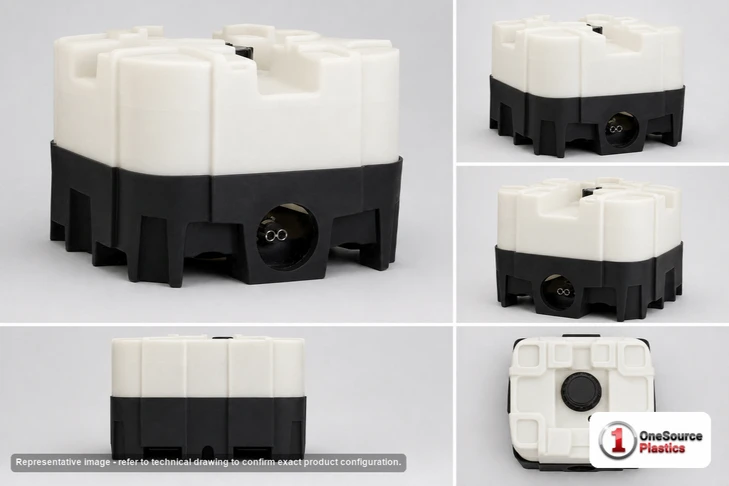
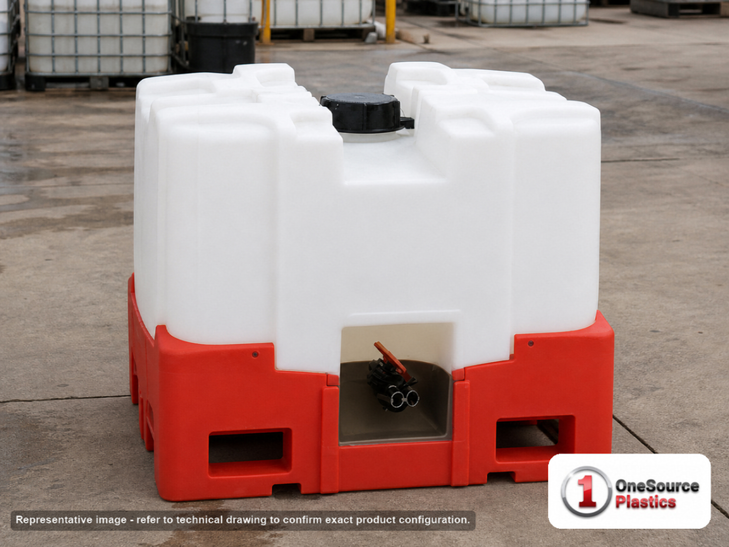
The Snyder SII-6660015B97205 is a 120 gallon stackable IBC tote tank in white polyethylene, listed 46 inches long, 45 inches wide and 34 inches tall, at 187 pounds empty and 187 pounds shipping. It is a non-caged tote: the vessel itself is the product, and the sheet describes no cage, no pallet, no fork pocket and no stacking load. The word stackable is in the product's own name and nothing on the sheet qualifies it, so that is where this page leaves it. The wall is rated at a specific gravity of 1.9, and the sheet gives 1,001 pounds for 120 gallons of water at 8.34 pounds per gallon with 1,902 pounds of max contents. The connections are a 2 inch outlet and a 2 inch inlet, with a 6 inch lid on top. There is no maximum operating temperature and no warranty term on this sheet, so neither is stated here. Freight is given as LTL under NMFC 156600-04, out of Lincoln, Nebraska.
Ordering for a plant or a bid? Request a written quote with freight to your ZIP for the file; a single 120 gallon tank goes straight to the cart above.
Where a non-caged tote sits, and what carries it
Start with the floor, because on a non-caged tote the floor is the product's other half. This vessel is 46 inches long and 45 inches wide, which is a square-ish footprint close to a standard warehouse pallet plan, and it stands only 34 inches tall. Low is the whole point of this one. At 34 inches the lid is at hip height on most people, the fill is done standing on the floor rather than off a step, and the vessel goes under a shelf, a mezzanine edge, a pipe run or a roller conveyor that a taller tote would not clear. It also means the centre of gravity stays down when it is full, which matters because the sheet publishes 1,001 pounds of water and 1,902 pounds at the rating and every pound of that is carried by whatever the tote is standing on. Set it on a flat, continuous, level surface that supports the whole 46 by 45 inch base, not on two bearers with the middle spanning air and not on a broken pallet. If it is going on a pallet for handling, the pallet is a load-bearing part of the installation from that moment on, and it gets inspected like one. The sheet gives no fork pocket and no cage, so nothing here tells you to put forks under the vessel itself; handle it the way your own rigging arrangement and the pallet under it allow. Where the tote stands over a drain, inside a building, or anywhere a release becomes somebody's paperwork, the containment question is a separate purchase from the tank, and the Captor containment comparison puts a built-in containment product against the alternatives on the points that decide it, while the RCRA 40 CFR 264.193 secondary containment article sets out the leak detection options and the inspection cadence in detail. Before you settle on the volume at all, put your real consumption and delivery interval through the tank sizing calculator and take the headspace a warming or gassing product needs from the tank sizing guide. A tote filled to the lid has nowhere to put expansion and nothing left for the operator to read.
Two ways to buy 120 gallons, and the 220 above them
| Part | Gallons | Length x width x height | Empty weight |
|---|---|---|---|
| SII-6660015B97205 (this tote) | 120 | 46 x 45 x 34 in | 187 lb |
| SII-6570000B96002 (same volume, smaller plan, lighter) | 120 | 42.5 x 42.5 x 32.25 in | 105 lb |
| SII-6630023B97204 (the step up) | 220 | 45 x 46 x 48 in | 243.1 lb |
The first two rows hold the same 120 gallons and they are not the same purchase. SII-6570000B96002 puts that volume on a 42.5 inch square plan, stands 32.25 inches tall, and is listed at 105 pounds where this one is 187. That is a smaller footprint, a slightly lower profile and a much lighter empty vessel. The sheet gives no reason for the weight difference and this page will not invent one, but the practical reading is straightforward: where the tote is moved often, lifted, or set on a mezzanine or a rack where every pound is counted, the lighter listing is the one to look at, and where it is set down once and lived with, this heavier listing is the one that gets specified. Run the tape over your bunded area before you choose, because 46 by 45 inches and 42.5 by 42.5 inches land differently inside a small bund. The third row is the real decision for most buyers. SII-6630023B97204 holds 220 gallons on a 45 by 46 inch plan, which is essentially the same floor space as this tote, but it stands 48 inches tall instead of 34 and is listed at 243.1 pounds. Read that carefully: it is a longer step in volume than in floor. If the constraint at your site is the square footage in a chemical store, the 220 buys a lot more product for the same tile, and the price of it is fourteen inches of height and a lid that is now at chest level. If the constraint is height, a roller conveyor, a shelf or the reach of the person filling it, this 34 inch vessel is the one that fits. Very few sites are short of both, and knowing which one you are short of settles the choice in a minute.
Need the taller or the wider one? Every row links to its page with freight to your ZIP on each; 866-418-1777 will check the ceiling and the pad.
The 2 inch outlet, the 2 inch inlet and a 6 inch lid
- Outlet: 2 inches, as listed, and it is the fitting the whole installation is planned around. Support the valve, the reducer and the first run of line on their own bracket so nothing downstream is hanging on the tote wall, and put a flexible connector at the first joint so a pump start never reaches the vessel.
- Valve and dispensing: the sheet lists no valve, no cap and no dip tube, so none is claimed here. Tell us how the product is drawn off and we will confirm what the part carries before it ships rather than print a fitting the maker does not list.
- Inlet: 2 inches, as listed. A dedicated fill connection at a known height is what keeps a hose out of the top opening and keeps the lid closed on a working vessel; label it and cap it.
- Lid: 6 inches, on the top of a 34 inch vessel, which is reachable from the floor. Six inches takes a hose end, a lance and a dip tube; it does not take an arm, so decide how this tote gets rinsed before you decide what goes in it.
- Venting: the sheet does not describe the lid as vented and lists no breather. A closed vessel being pumped out pulls against itself and a vessel being filled has to put the displaced air somewhere, so the venting arrangement belongs to your installation and to the order, not to an assumption.
- Limits: no maximum operating temperature and no warranty term appear on this sheet. The specific gravity rating of 1.9 is the only rating on it, against 1,001 pounds of water and 1,902 pounds of max contents.
Name the product when you order. On a vessel with two published connections and one lid, the chemistry decides the gasket, the valve material and the cap, and a generic answer is how a seal gets bought twice.
Turnover, not storage: what a small tote is bought for
A 120 gallon tote is a turnover vessel. It goes into chemical stores at water and wastewater plants, dosing points beside a process line, metal finishing and plating shops, food and beverage plants running a sanitiser or a cleaning chemical, laboratories and pilot lines, car washes, print and coating shops, and any operation that has outgrown drums but would be storing rather than using product in a bulk tank. That is the decision worth making properly, because it is arithmetic rather than preference: how much you consume, how often it arrives, what each handling costs, and what the hazard class does to the storage rules. The drum versus tote versus bulk tank break-even analysis works the numbers through properly, and the shorter container versus tank guide is the quick version of the same argument. A tote sized so that it empties is a tote that never holds product long enough to change on you.
What this tank is listed to hold
Each line is a liquid the resin is rated for, at the concentration shown, with the fitting and gasket to order. Follow the link for the full rating, or search the chemical compatibility database before ordering.
- acetic acid (60%)
- aluminum sulfate (50%)
- calcium chloride (40%)
- magnesium chloride (30%)
- ferric chloride (50%)
- ferric sulfate (60%)
- ferrous sulfate (20%)
- potassium carbonate (50%)
- potassium hydroxide (saturated)
- sodium carbonate (30%)
- sodium thiosulfate (40%)
- sodium bisulfate
- sodium bisulfite
- ethylene glycol (100%) and
- polyaluminum chloride.A few in this group call for 316SS-grade fittings alongside EPDM:
- propylene glycol (PP/316SS) and
- zinc orthophosphate (PP/316SS).
- hydrochloric acid (37%, PVC/Viton)
- hydrofluoric acid (48%, PP/PVC/Viton)
- hydrofluosilicic acid (26%, PP/PVC/Viton)
- hydrogen peroxide (50%, PVC/Viton)
- phosphoric acid (85%, PVC/Viton)
- sodium hypochlorite (under 16.5%, PVC/Viton) and
- sulfuric acid (98%, CPVC/Viton).
- Peracetic acid (30%) calls for 316SS fittings with Aflas gaskets.For fluid-handling duty the chart specifies 316SS fittings with EPDM for
- DEF (32.5%) supports
- urea solution (50%) on PP/PVC with EPDM, and handles ozonated water up to 10 PPM on PVC with EPDM.Verify every selection at your service concentration and temp
Lincoln, Nebraska, 187 pounds and an LTL lane
This tote is moulded at Lincoln, Nebraska, which puts the plains and the Midwest on a short lane and everything else on a longer one. The sheet gives the freight class as LTL, a mode rather than a numeric class, under NMFC 156600-04, and the shipping weight matches the empty weight at 187 pounds. Price the lane to your ZIP with the freight cost estimator; the listed price is before freight. At 187 pounds this comes off the truck with a machine or with several sets of hands under the body, never by the lid and never by the 2 inch fittings. Measure the door and the aisle on the route to its final position first: 46 inches of length on a pallet turns a corner differently than it looks on paper. Set it where it will live, level it, and then fill it with clean water and hold that 1,001 pound load long enough to read the lid, the outlet joint and the surface under the base. Drain it and let it dry before the working product arrives. Write the contents and the fill date on the shell in paint marker on day one, because a tote nobody can identify from across the store is the one that gets topped up with the wrong drum. A strap that is checked once a season is a strap that holds; put it on the same calendar as the gutters.
Freight and documents
Ships from: Lincoln, NE. LTL freight is quoted to your ZIP with the freight cost estimator or by phone at 866-418-1777. The listed price is before freight.
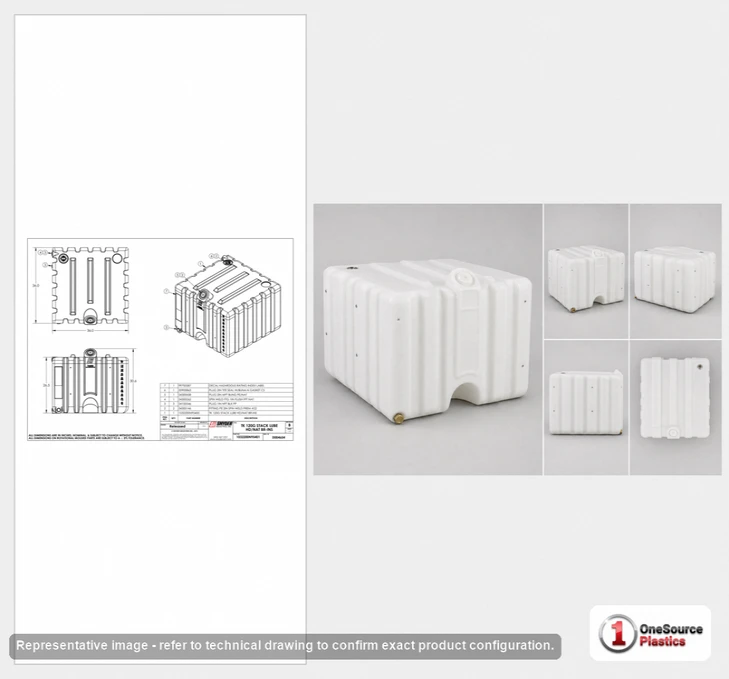
Technical drawing (PDF) for Snyder Industries 6660015B97205.
See this tank
Product video. Watch the Snyder Industries 120 Gallon HDPE Stackable IBC Tote Tank video (75 seconds) with dimensions, fittings and shipping notes.
Ready to order?
Add it to your cart at the top of this page, get LTL freight to your ZIP, request a written quote, or call 866-418-1777. The listed price is before freight.