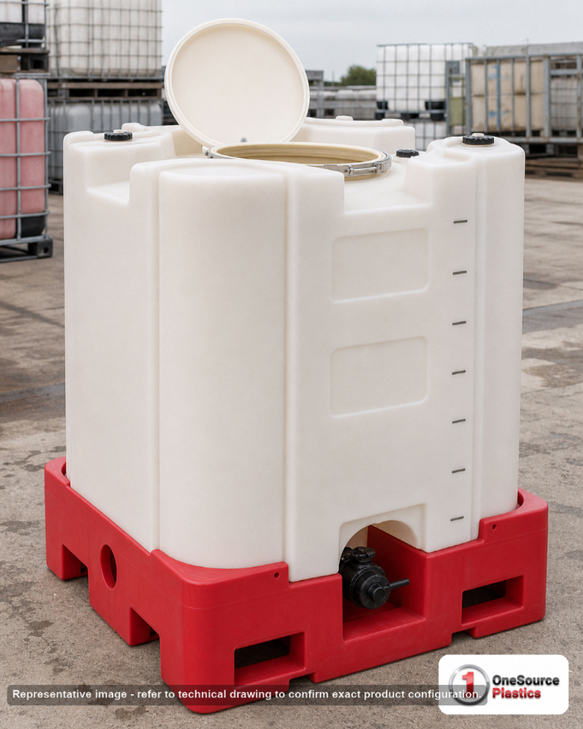
A 275 gallon Payloader system IBC tote with Viton gaskets
The Snyder Industries 275 gallon plastic stackable IBC tote tank, Payloader system with Viton gaskets, part number 6620030B97205, is a white polyethylene tote 46 inches long, 46 inches wide and 54 inches tall, weighing 244 lb empty. It carries a 2 inch outlet, a 2 inch inlet and a 6 inch lid on top. Snyder rates the wall for liquids up to 1.9 specific gravity and a service limit of 120 F (48 C); 275 gallons of water weighs 2,294 lb, and a liquid at the full rating weighs 4,358 lb. Payloader and Viton are Snyder's names for the system and the gasket material, and the point of buying into a named system is that every tote, fitting and gasket in the yard is the same part and reorders as a matched part instead of being specified from scratch. The name says stackable and no stacking load is stated for this part, so get the stacking condition confirmed for this exact part number before any tote goes on top of another.
Talk to a person first? 866-418-1777 reaches a tank specialist, not a call center; or get freight to your ZIP and add it to your cart above.
A system tote for an operation that moves totes daily
Where a tote is plumbed once and left, almost any tote will do; where it is picked up, carried, set down, emptied and swapped as part of the working day, an operation standardises on one system. That is the buyer here: a chemical distributor running a fleet of returnable containers, a service company that delivers product in a tote and collects the empty, an agricultural operation moving product between sites, a plant with several use points and one delivery bay, a blender that fills totes on one line and ships them from another. Physically it is one of the squarest totes Snyder makes: 46 inches on both sides, 54 inches tall and 244 lb empty, which is light for a 275 gallon polyethylene tote. Set it on a flat, continuous, level surface carrying the whole 46 inch square: rack beams sized for the plan, a solid deck, or a slab. Not two pallets, not blocks under the corners. Empty it is a pallet jack job; full of water it is 2,294 lb and at the rating 4,358 lb, and that is the number the rack beam has to answer to. Handle it from underneath on something that spreads the base.
What goes in it
Water, most fertilizers and the common process chemistries polyethylene handles, up to 1.9 times the weight of water and up to 120 F. The gasket material matters as much as the shell for aggressive chemistries, so check the liquid in our chemical compatibility guide and ask us about the gasket before the first fill; sodium hypochlorite, sulfuric acid, hydrochloric acid, hydrogen peroxide and DEF are the entries tote buyers open most. Decide the tier with our container versus tank guide and the drum, tote and bulk tank break even analysis, size it with the tank sizing calculator and the tank sizing guide, and for hazardous waste read our note on RCRA secondary containment.
Openings and fittings
- Outlet. 2 inch. Snyder's listing for this part does not say whether a valve is fitted or the outlet is a bare boss, so tell us what you are connecting and we will confirm what Snyder supplies before you order.
- Inlet. 2 inch, for a closed fill. Confirm the fitting type with us the same way.
- Lid. A 6 inch lid on top: a hose fill and a hand, not an arm. If somebody has to get inside to clean, ask us for a tote with a manway.
- Drawing. Snyder's drawing is linked under Technical Drawing on this page and shows the fitting positions.
Sizes nearby
Other ways Snyder packages 275 gallons: the 275 gallon stackable IBC tote 6620030B97203 and the 275 gallon Cagebuster stackable IBC tote in white. One size up: the 330 gallon stackable IBC tote in red. In steel: the 245 gallon 304 stainless steel Supertainer with side drain. For containment under any of them, see the Snyder Captor containment comparison.
Shipping and receiving
The tote ships LTL under NMFC 156600-03 from Snyder's plant in Lincoln NE, 46 by 46 by 54 inches at 244 lb. Add it to your cart at the top of this page, get LTL freight to your ZIP, or call 866-418-1777. The listed price is before freight; the freight cost estimator gives the lane cost to your ZIP. At the dock, check the part number against 6620030B97205 on the bill of lading, look over every face and every gasket for transit damage, and fill it with water the first time before it carries product.
Freight and documents
Ships from: Lincoln, NE. LTL freight is quoted to your ZIP with the freight cost estimator or by phone at 866-418-1777. The listed price is before freight.
Technical drawing (PDF) for Snyder Industries 6620030B97205.
See this tank
Product video. Watch the Snyder Industries 275 Gallon Plastic Stackable IBC Tote Tank Payloader System with Viton Gaskets video (67 seconds) with dimensions, fittings and shipping notes.
Ready to order?
Add it to your cart at the top of this page, get LTL freight to your ZIP, or call 866-418-1777. The listed price is before freight.