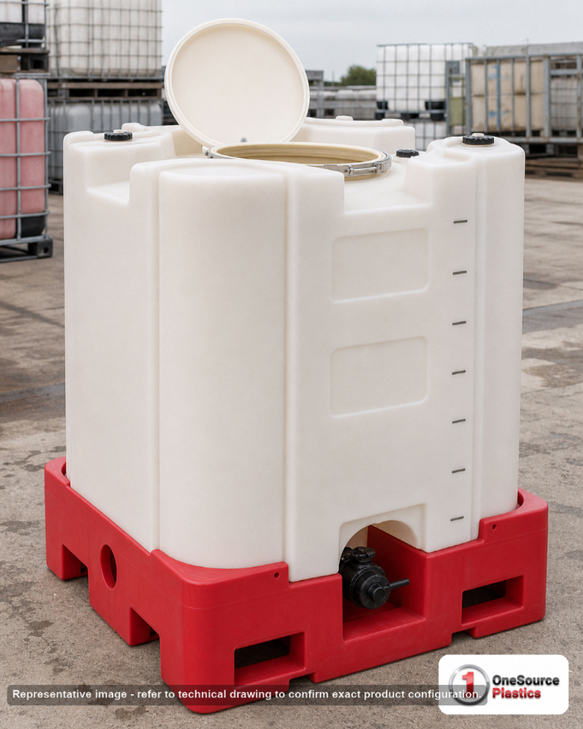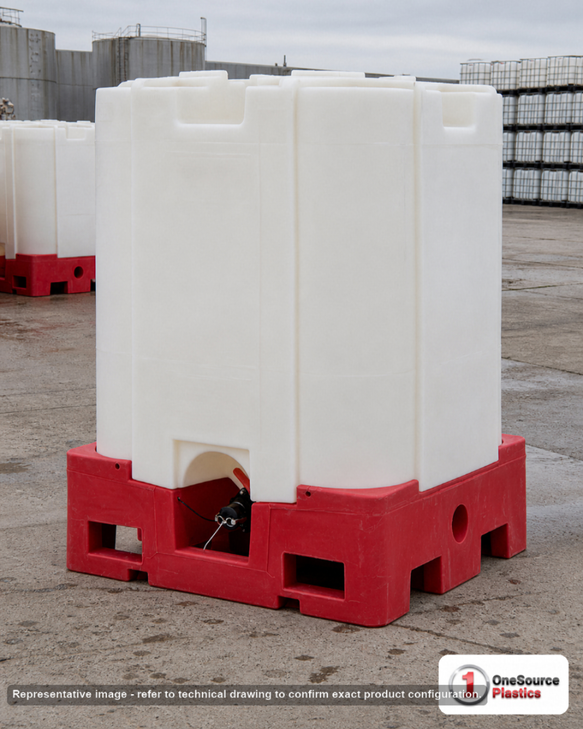
The 330 gallon stackable tote with the tightest footprint
Part number 6610056B97205 is Snyder's 330 gallon stackable IBC tote tank in high density polyethylene, sold as the red version. It is 45 inches long, 45 inches wide and 64 inches tall, and weighs 268 lb empty: the narrowest plan and the tallest body of the 330 gallon totes we carry. It comes with a 2 inch inlet, a 2 inch outlet and a 6 inch lid. Snyder rates it for liquids up to 1.9 specific gravity, which covers water, most fertilizers and many common chemicals; 330 gallons of water weighs 2,752 lb. The name carries red and the colour field we hold says white, so tell us which you need and we will confirm it before the tote ships.
Ready to order? Add it to your cart at the top of this page, get LTL freight to your ZIP, or call 866-418-1777. The listed price is before freight.
Why buy the taller 330
What 64 inches of height buys you is a 45 inch square plan. If your rack bays, your bunded area or the aisle between two lines is laid out to 45 inches, this tote fits and the wider ones do not, and gaining height under a roof is almost always cheaper than gaining floor. Set it on a flat, continuous, level surface carrying the whole square: a rack beam pair sized for the plan, a solid deck or a slab, never two pallets pushed together or a packer under one corner. Check the beams before anything goes up, because full of water it is over 2,750 lb, a real number for a rack that was laid out for drums. Height also changes how the tote is handled: the centre of mass sits higher than on a squat tote, so move it slowly on a pallet jack, keep it low while it travels, and do not walk it across a floor joint with a full load. The name says stackable; ask us for the stacking condition for this exact part number before a tote goes on top of a tote, because it is not a figure we publish here. Our container versus tank guide and the drum versus tote versus bulk tank break-even analysis set out when a tote is the right vessel at all. Check the volume with the tank sizing calculator and the tank sizing guide.
What goes in it
Water, liquid fertilizer and the common treatment chemicals polyethylene handles are the normal loads, up to 1.9 times the weight of water. Check the liquid in our chemical compatibility guide first; the entries for sodium hypochlorite, sulfuric acid, urea solution and DEF are the ones tote buyers ask about most. Red is the colour many sites use to mark a tote for one product line so it is never filled with another. If the tote holds a regulated waste, read our note on RCRA secondary containment for hazardous waste tank systems.
Openings and fittings
- Inlet. 2 inch. Confirm the thread form with us before you buy the fill fitting.
- Outlet. 2 inch. Your valve or hose adapter goes here; support the first length of hose so the fitting carries liquid, not hardware.
- Lid. A 6 inch lid on top.
- Drawing. Snyder's drawing for this tote is linked under Technical Drawing on this page and shows the opening positions.
Sizes nearby
The same tote in black, on a wider and lower body: the 330 gallon stackable IBC tote tank in black. One size down: the 275 gallon stackable IBC tote tank. The same volume in the Cagebuster build: the 330 gallon Cagebuster IBC tote in white and the 330 gallon Cagebuster IBC tote in white with Viton. For aviation fuel, the 550 gallon Jet A LiquiTote is the one to look at, not this tote.
Shipping and receiving
The tote ships LTL from Snyder's Lincoln, Nebraska plant, 45 by 45 by 64 inches on the pallet at 268 lb, one upright pallet position over five feet tall. The listed price is before freight; the freight cost estimator gives the lane cost to your ZIP. At the tailgate, check the part number 6610056B97205 and the colour against the bill of lading, look at the base and the lid for transit damage, and fill it with water the first time before it carries anything else.
Questions before you order? Call 866-418-1777.
Freight and documents
Ships from: Lincoln, NE. LTL freight is quoted to your ZIP with the freight cost estimator or by phone at 866-418-1777. The listed price is before freight.
Technical drawing (PDF) for Snyder Industries 6610056B97205.
See this tank
Product video. Watch the Snyder Industries 330 Gallon HDPE Stackable IBC Tote Tank with Red Base video (67 seconds) with dimensions, fittings and shipping notes.
Ready to order?
Add it to your cart at the top of this page, get LTL freight to your ZIP, or call 866-418-1777. The listed price is before freight.