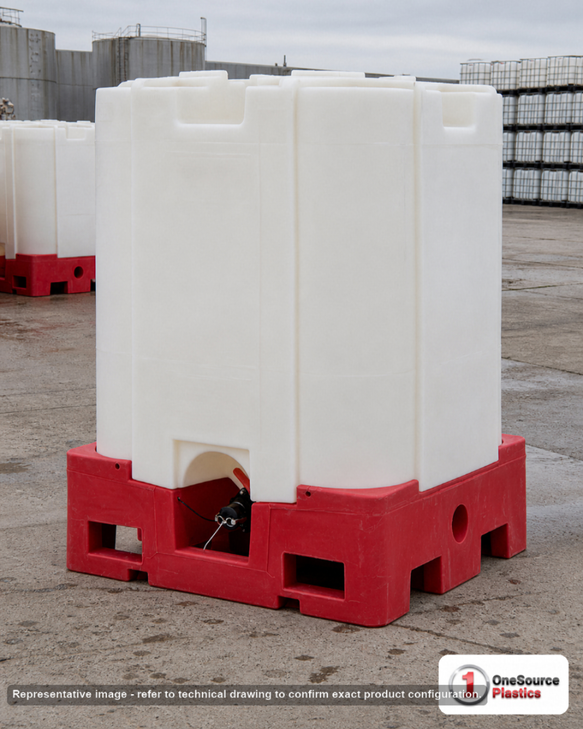
275 gallons on a 45 inch square, no cage around it
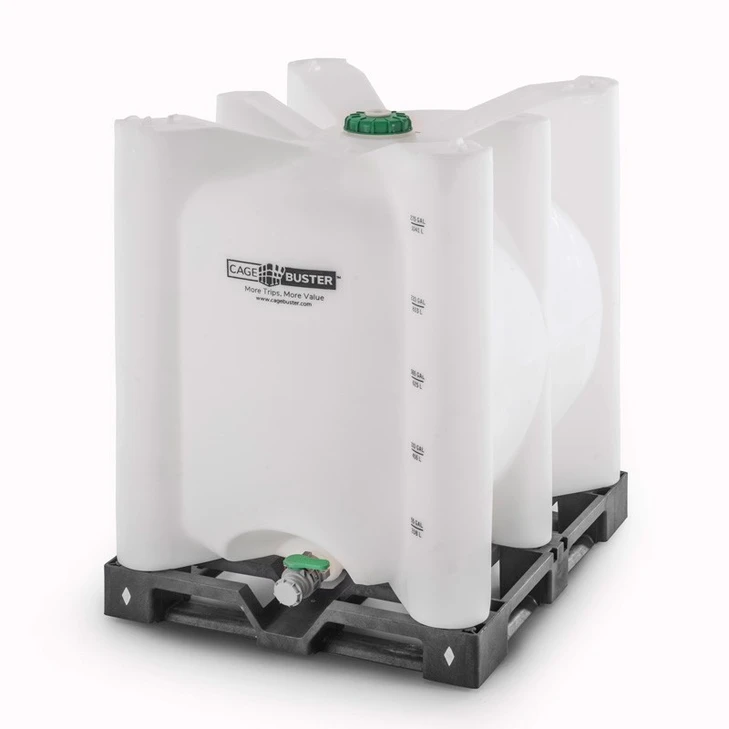
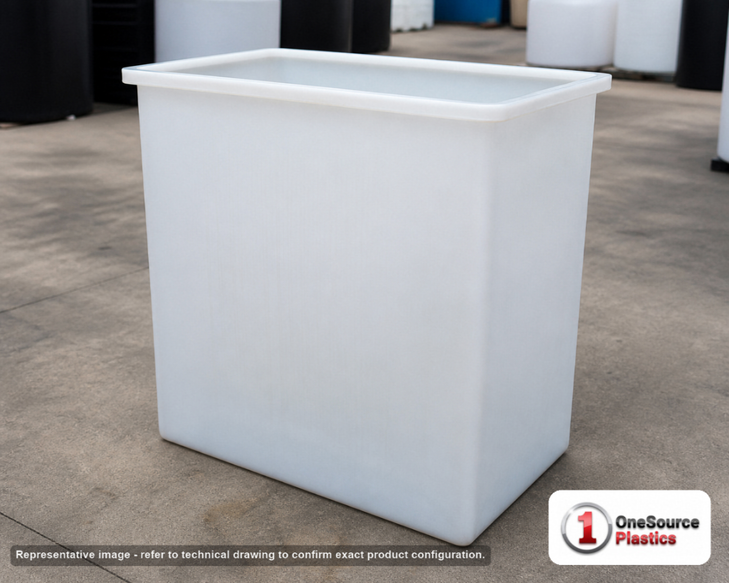
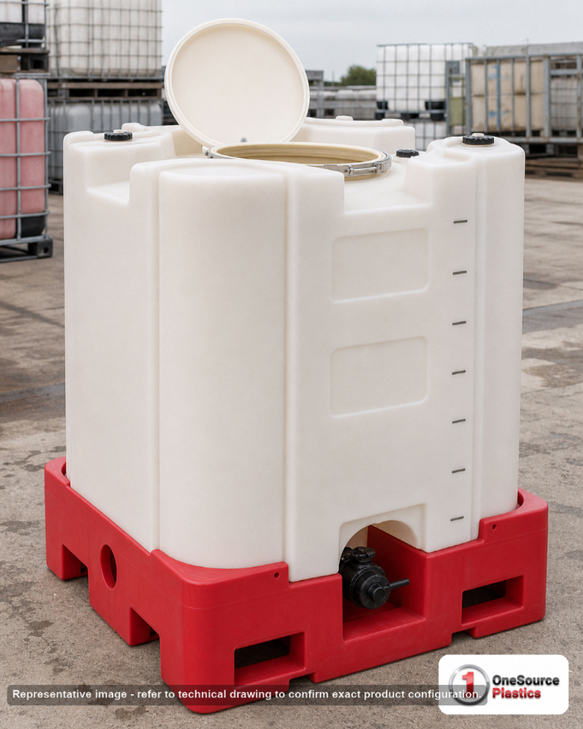
The Snyder SII-6620030B97203 is a 275 gallon non-caged stackable IBC tote tank in white polyethylene, listed 45 inches long, 45 inches wide and 56 inches tall. Its empty weight is given twice on the sheet, 269 pounds on the served spec and 269.5 pounds on the master listing, with a ship weight of 270 pounds; we print all three rather than choose one. The wall carries a specific gravity rating of 1.9. Against that rating the sheet gives 2,294 pounds for 275 gallons of water at 8.34 pounds per gallon and 4,358 pounds of max contents. The outlet is 2 inches, the inlet field reads 2 as a bare number, and the opening on top is a 6 inch lid. The service limit is 120 F / 48 C. No stacking load, no cage, no pallet, no fork pocket and no warranty term appear on this sheet, so none of them is claimed here.
Ready to price it? The listed price is before freight; quote freight to your ZIP in a few seconds, then add to cart above or call 866-418-1777.
The plant that buys 275 gallons and pours it out in batches
The duty comes first, because the shape follows it. A 275 gallon tote is bought by an operation that takes delivery of one product in bulk and then issues it a bucket, a drum or a dosing pot at a time: a machine shop drawing coolant, a finishing line pulling pre-treat chemistry, a food or beverage plant issuing sanitiser, a water utility feeding a small dosing skid, a distributor breaking bulk down into jugs. In every one of those the tote is not the process, it is the pantry, and the job looks the same each day: park it, plumb it once, draw off it many times, swap it when it runs dry. That is why the non-caged version matters. With no cage around the body there is nothing between a hose, a hand or a wash-down and the tank wall, and nothing to trap the product that runs down the outside of a fitting. It also means the body itself is the structure, so this tote is set down on a flat, continuous, level bearing surface that carries the whole 45 by 45 inch base. Not two pallets pushed together, not a pallet with a cracked board, not blocked up at one corner to fake level. At 269 pounds empty it is a pallet jack or a fork job rather than a two-person lift, and the loaded case is what really decides the floor: 2,294 pounds of water, and 4,358 pounds at the rating the sheet gives, all bearing on a plan a little over fourteen square feet. If it is going on a rack, check that number against the rack beam rating before anything goes up. The name says stackable and the sheet publishes no stacking load at all, so this page gives you none: if totes are going on top of totes at your site, get the stacking condition confirmed in writing for this exact part number first. Before you settle on the volume, run your real draw and refill interval through the tank sizing calculator, take the freeboard a warming liquid wants from the tank sizing guide, and read the container versus tank guide, which is the honest comparison of when a tote beats a drum and when it loses to a fixed tank.
Four containers in the 245 to 330 gallon band
| Part | Volume | Length x width x height | Empty weight |
|---|---|---|---|
| SII-6620030B97203 (this tote, 6 inch lid) | 275 gal | 45 x 45 x 56 in | 269 lb |
| SII-6620030B97205 (Payloader system, Viton gaskets) | 275 gal | 46 x 46 x 54 in | 244.2 lb |
| SII-6998601B97204 (Cagebuster, lightest here) | 275 gal | 48 x 40 x 52 in | 203 lb |
| SII-6984000B51318 (304 stainless steel, side drain) | 245 gal | 42 x 48 x 35.25 in | 384 lb |
| SII-6610056B97205 (larger, in red) | 330 gal | 45 x 45 x 64 in | 268 lb |
Three of these hold 275 gallons and they are three different purchases. This one is the squarest and the tallest of the three at 45 inches on a side and 56 inches up, which is the shape to buy when the floor position is fixed and square and the ceiling is not the problem. SII-6620030B97205 is an inch wider each way and two inches shorter at 54 inches, and it is the one named as a Payloader system with Viton gaskets; if that named system is what your site already runs, match it rather than this one. SII-6998601B97204 is the Cagebuster, and it is the odd shape of the group: 48 inches one way, 40 the other, 52 tall, at 203 pounds, which is sixty-odd pounds lighter than this tote and the only rectangular plan here. Buy it when the aisle is narrow in one direction only. The 245 gallon SII-6984000B51318 is not a polyethylene tote at all. It is a 304 stainless steel supertainer with a side drain, 42 by 48 inches and 35.25 inches tall at 384 pounds, listed here because it lands in the same volume band and solves what steel solves; this page makes no polyethylene, resin or specific gravity statement about it. The step up is SII-6610056B97205 at 330 gallons in red, on the identical 45 inch square base and eight inches taller at 64 inches. That is the cleanest upgrade on the table: fifty-five more gallons per delivery for no extra floor at all, bought purely with height. If your ceiling has eight inches in it, that is the one to price.
Want us to check the fit? Send the site dimensions to 866-418-1777 or through a written quote request and we will confirm the tank, the pad and the freight.
Drawing it down: the 2 inch outlet and the 6 inch lid
- The discharge path: the sheet gives a 2 inch outlet at the base of a 56 inch body. Gravity into a drum works hard at the start of a tote and runs out of head at the end, so if the last third has to come out at a usable rate, plan for a pump below the outlet or a stand under the tote. Decide that on paper once, in metal, rather than on blocks later.
- The pump and its suction: keep the pump below the liquid line where the layout allows it, and take the suction through a short, straight, falling run. Every elbow between the outlet and the pump is paid for at the bottom of every tote, and a self-priming pump that has to lift from a nearly empty tote is the arrangement operators end up fighting.
- Isolation: put a full-flow shutoff hard against the outlet fitting, then a flexible connector, then the hose or the pipe. Nothing rigid is threaded straight into a tote and left there, and nothing downstream is carried on the fitting boss.
- The inlet: the sheet lists the inlet as 2. That is the field as published, not a pipe size, so tell us how you intend to fill and we will confirm what the part actually carries before it ships.
- Access: a 6 inch lid on top at 56 inches, which is chest height on most people. Six inches takes a hose, a wand and a dip tube; it does not take an arm, so the wash-out plan is decided by the lance you own rather than by reaching inside.
- Limits: 120 F / 48 C is the service limit, and the specific gravity rating of 1.9 is the only other rating on this sheet. There is no warranty term published.
Name the liquid when you order, because the outlet fitting, the gasket and the bolting are matched to the product and a generic answer is how a gasket gets chosen twice. Where the product is regulated, the tote is only half the arrangement: the RCRA secondary containment guide covers the containment, the leak detection options and the inspection cadence that go under and around it, and the Captor containment comparison sets a contained polyethylene vessel against the steel route on the terms that decide it.
Where a non-caged tote earns its keep
Take the cage off a tote and two things change: you can see the whole wall, and you can wash the whole wall. That is why this version goes into places where the outside of the container is inspected or cleaned as a matter of routine, and where a cage would only collect what drips. It is also the version that suits a permanent, plumbed position rather than a container that travels: set it once, run the line off the 2 inch outlet, and refill it in place. Whether 275 gallons is even the right tier is a separate question and the more expensive one to get wrong, because it turns on annual volume, turnover frequency, hazard class and how much floor the whole arrangement takes once access and containment are counted. That is exactly the calculation in the drum versus tote versus bulk tank break-even analysis, and it is worth an hour before a site standardises on a container size.
Listed chemical service for this shell
The maker's list for this resin: each liquid, the concentration it is rated to, and the fitting and gasket that go on the order. Verify your own service on the linked page or in the chemical compatibility database before ordering.
- Acetic acid (60%) - PP/PVC fitting, EPDM gasket
- Aluminum sulfate (50%) - PVC fitting, EPDM gasket
- Calcium chloride (40%) - PVC fitting, EPDM gasket
- DEF (32.5%) - 316SS fitting, EPDM gasket
- Ethylene glycol (100%) - PVC fitting, EPDM gasket
- Ferric chloride (50%) - PVC fitting, EPDM gasket
- Ferric sulfate (60%) - PVC fitting, EPDM gasket
- Ferrous sulfate (20%) - PVC fitting, EPDM gasket
- Hydrochloric acid (37%) - PVC fitting, Viton gasket
- Hydrofluoric acid (48%) - PP/PVC fitting, Viton gasket
- Hydrofluosilicic acid (26%) - PP/PVC fitting, Viton gasket
- Hydrogen peroxide (50%) - PVC fitting, Viton gasket
- Magnesium chloride (30%) - PVC fitting, EPDM gasket
- Peracetic acid (30%) - 316SS fitting, Aflas gasket
- Phosphoric acid (85%) - PVC fitting, Viton gasket
- Polyaluminum chloride - PVC fitting, EPDM gasket
- Potassium carbonate (50%) - PVC fitting, EPDM gasket
- Potassium hydroxide (saturated) - PVC fitting, EPDM gasket
- Propylene glycol - PP/316SS fitting, EPDM gasket
- Sodium bisulfate - PVC/PP fitting, EPDM gasket
- Sodium bisulfite - PVC/PP fitting, EPDM gasket
- Sodium carbonate (30%) - PVC fitting, EPDM gasket
- Sodium hypochlorite (<16.5%) - PVC fitting, Viton gasket
- Sodium thiosulfate (40%) - PVC fitting, EPDM gasket
- Sulfuric acid (98%) - CPVC fitting, Viton gasket
- Urea solution (50%) - PP/PVC fitting, EPDM gasket
- Zinc orthophosphate - PP/316SS fitting, EPDM gasket
Lincoln, Nebraska, shipped 45 by 45 by 56
This tote is moulded at Lincoln, Nebraska, which is a fair lane to most of the country and a short one into the plains and the upper Midwest. The sheet gives the freight class as LTL under NMFC 156600-03 and lists the shipping size as 45 inches long by 45 inches wide by 56 inches high at a ship weight of 270 pounds, so it travels as a compact square pallet and blocks well on a trailer. Price the lane to your ZIP with the freight cost estimator; the listed price is before freight. It comes off the truck on forks or a pallet jack under the base, never by the lid and never by the outlet boss. Put it in its final position before anything is plumbed, then fill it with clean water on the level and hold that 2,294 pound load long enough to read the outlet joint, the inlet and the lid seal. Drain it through the outlet rather than the lid, so you learn at the water stage whether your valve and hose arrangement actually empties it. The first thing to fail on a tote is the joint somebody hard-piped straight into the outlet; break that joint flexible on day one and you will not meet it again. A photo of the tank on its pad, full, on day one is worth keeping; it is the baseline every later inspection is compared against.
Freight and documents
Ships from: Lincoln, NE. LTL freight is quoted to your ZIP with the freight cost estimator or by phone at 866-418-1777. The listed price is before freight.
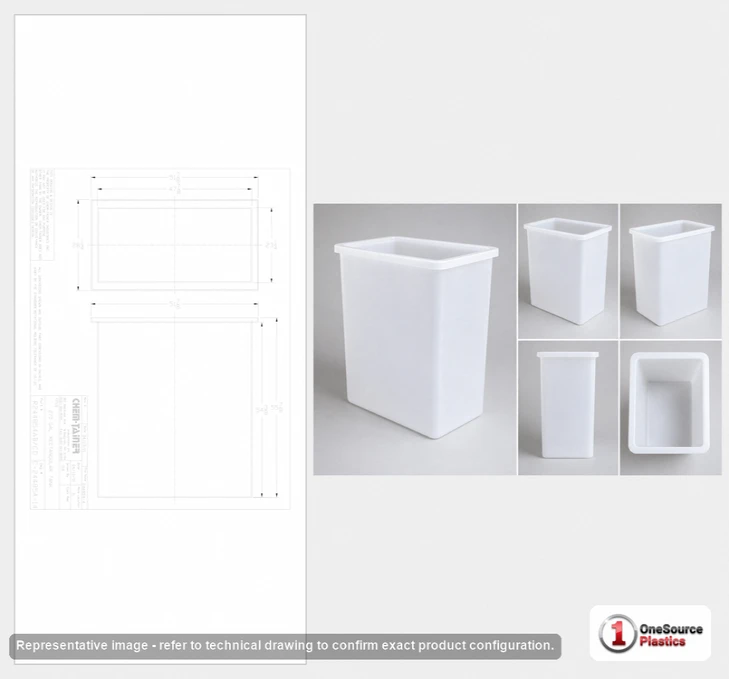
Technical drawing (PDF) for Snyder Industries 6620030B97203.
See this tank
Product video. Watch the Snyder Industries 275 Gallon HDPE Stackable IBC Tote Tank video (62 seconds) with dimensions, fittings and shipping notes.
Ready to order?
Add it to your cart at the top of this page, get LTL freight to your ZIP, request a written quote, or call 866-418-1777. The listed price is before freight.