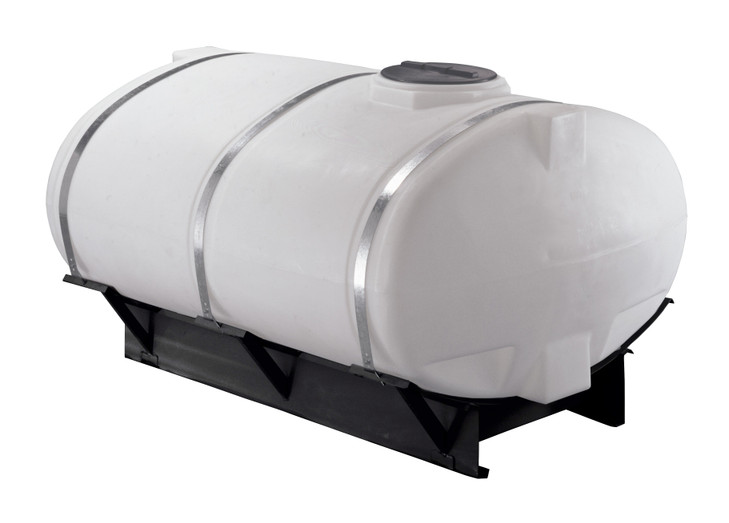
The same 750 gallon hooped tank, listed under a second part number
The Snyder SII-1300000N45 is a 750 gallon horizontal leg tank with securing hoops in white polyethylene, 117 inches long, 46 inches wide and 48 inches tall, listed at 210 pounds empty and 210 pounds to ship, molded at Lincoln, Nebraska. Its feet are moulded into the body, so it stands flat on a floor, a skid or a deck with no cradle and no stand. The sheet rates the wall at a specific gravity of 1.9, which is where the 11,884 pound maximum contents figure comes from, against 6,255 pounds for 750 gallons of water at 8.34 pounds per gallon. Fittings are a 2 inch outlet and an 18 inch lid, and the service limit is 120 F / 48 C. Freight is class OVS. No warranty term is published on this sheet, so none is stated here; ask us and we will get Snyder's current terms in writing.
Want it on the pad this month? Check freight to your ZIP, add it to your cart above, and 866-418-1777 will confirm the ship date.
Standing it still: a 46 inch wide tank on a shop floor or a skid
Most tanks this shape are bought to travel. This page is written for the other half of the market, because a long, low, narrow body is also the best stationary tank in the family, and 46 inches of width is why. Forty-six inches goes through a standard barn or shop doorway, down a walkway between posts, along one wall of a bay, and into a space that a squarer tank of the same volume will not enter at all. Forty-eight inches of height keeps the lid reachable from a low step and puts the outlet above a pail without a stand. And 117 inches of length is the one dimension a building usually has to spare. Set up like that, the tank becomes a supply point rather than a load: filled by a bulk delivery or a hose through the 18 inch lid, drawn by gravity into containers or by pump into a smaller rig, and never lifted again. What that arrangement needs is a floor worth standing it on. A rotationally molded body bears on the whole surface its feet are resting on and nothing else, so a slab with a hollow in it, a timber floor with a soft board, or a skid frame that only touches two of the feet puts 6,255 pounds of water, or up to 11,884 pounds of contents at the rating, onto a point instead of across the base. Level it, shim it into full contact, and leave room to walk all the way around it, because the side nobody can see is the side that weeps. Where it does travel, the securing hoops named on the sheet give the strapping a defined path across the crown rather than leaving a band to find its own line and chafe, and the tank still wants restraint fore, aft and across, through the feet and the hoops. The road-use question, what an agricultural exemption covers and what it does not, is worked through in the applicator and leg tank classification guide, with the portable utility case in the loaf-style portable utility tank guide. Before you settle on the volume, run 750 gallons against your draw and your refill interval in the tank sizing calculator, and take the working reserve and the freeboard a warming liquid needs from the tank sizing guide.
Identical figures, two part numbers, and how to order the right one
| Part | Gallons | Length x width x height | Empty weight |
|---|---|---|---|
| SII-1300000N45 (this tank, with securing hoops) | 750 | 117 x 46 x 48 in | 210 lb |
| SII-1300000C26 (the same published figures) | 750 | 117 x 46 x 48 in | 210 lb |
| SII-1360000C26 (smaller, shorter, wider, taller) | 730 | 80 x 54 x 57.5 in | 240 lb |
| SII-1440000C26 (larger, longer) | 1025 | 139 x 48 x 50 in | 290 lb |
Be told this straight: the SII-1300000C26 on the row below carries the same 750 gallons, the same 117 by 46 by 48 inch body and the same 210 pounds as this part number, and the sheet publishes no difference between the two. We are not going to invent one. What we will do is confirm at order which number is being supplied and what it is supplied with, because that is the only honest answer to a question the manufacturer's own paper does not settle. Where the sheet does separate products, it separates them clearly. The 730 gallon SII-1360000C26 puts twenty fewer gallons in a body 80 inches long, 54 inches wide and 57.5 inches tall at 240 pounds, which is a different tank in every practical sense: thirty-seven inches shorter, eight inches wider, nearly ten inches taller and heavier on the sheet, and the right buy where the floor is short and broad. The 1025 gallon SII-1440000C26 holds this tank's proportions and stretches to 139 inches long, 48 inches wide and 50 inches tall at 290 pounds, which is the move to make when you are refilling a 750 more often than once a day, because one larger tank means one mount, one outlet and one hose instead of two of everything. Measure the space you actually have and let the row follow from it.
Which wall for your chemical? Call 866-418-1777 with the name and the concentration, or send a quote request and we will pick the row.
What the securing hoops and the 18 inch lid ask of the plumbing
- Outlet: a 2 inch outlet, as the sheet lists it, at the low end above the feet. Standing still, this is the fitting the whole installation hangs off: it will gravity-feed containers, it will feed a transfer pump at a working rate, and it will fill a smaller tank on a vehicle faster than a hose into a lid ever will. It is a transfer port, not a dump valve.
- Valve and first joint: on a stationary tank the temptation is to run hard pipe straight from the fitting to a wall bracket, and that is the one arrangement to avoid. A polyethylene body moves with temperature and with the weight of its own contents, so the first joint gets a flexible connector, the first valve rides on its own support off the floor, and nothing rigid is bolted between the wall and the tank.
- Draw-off and the last gallons: 117 inches of floor under 48 inches of body means a level installation leaves a residue in the far end. If the product is one you want out completely, shim the tank so it falls toward the outlet by a small amount, and do it while the tank is empty.
- The hoops: the sheet names securing hoops, which give a band a defined path across the crown. Keep the straps square to them, and where the tank is stationary use them to hold it against being knocked rather than leaving 210 pounds of empty tank free to slide when a forklift passes.
- No inlet on this sheet, so none is claimed. Filling is through the 18 inch lid, hose or fill line down inside the body rather than splashing on the surface.
- Access: an 18 inch lid, the largest in this family. It is what makes the tank cleanable by a person rather than by hope, which matters most on a stationary tank that holds one product for years. Keep the vent path clear at all times; a tank drawn on hard through a blocked vent will pull its own wall in.
- Service limit: 120 F / 48 C. The sheet publishes no warranty term for this part number.
Tell us the liquid before you order and we will match the outlet fitting, the gasket and the valve material against Snyder's current documentation. If the product is a blended fertilizer solution, a long horizontal body standing still is the easiest place in the world for layers to form, because nothing is moving the liquid and there is almost no height to drive convection; the fertilizer blend stratification guide sets out both the mechanism and the field checks that catch it. If the site requires the liquid to be held inside a second barrier, this single-wall tank does not do that, and the Captor double wall containment walkthrough explains what a contained installation has to satisfy.
Stationary transfer, mix station supply and seasonal water storage
Standing still, this tank earns its keep in places where the floor is long and narrow. A mix station supply in a farm shop, filled by a bulk delivery and drawn into a sprayer or a spreader through the season. A shop or plant holding a single fluid against a slow supply, drawn by pump into pails and smaller rigs. Water storage in a barn for stock, wash-down or a planting crew, where the 18 inch lid takes a fill hose and a person's arm. Brine or de-icing liquid held over winter and loaded onto a truck through the 2 inch outlet. Wash and rinse water at an equipment yard. A holding tank between a slow source and a fast demand, which is the classic reason to buy volume you never draw all at once. Mounted, it does the haulage work the shape was drawn for, on a flat deck with the hoops giving the straps their line. Two honest limits either way. It is a single-wall tank, so containment has to come from the installation if the liquid needs it. And the sheet's 120 F / 48 C limit applies to the liquid and to the tank in the sun, which on a yard slab in July is worth respecting rather than assuming. Beyond those, a stationary tank fails at the floor, not at the wall.
Chemical ratings on record for this resin
What the manufacturer lists for this resin, liquid by liquid, with the concentration ceiling and the fitting and gasket material. Your concentration and temperature get checked on the linked page or in the chemical compatibility database before ordering.
- aluminum sulfate (50%)
- calcium chloride (40%)
- DEF at 32.5% (the urea concentration used in diesel exhaust fluid)
- ethylene glycol (100%, PVC fittings and EPDM gaskets)
- propylene glycol (PP or 316 stainless fittings, EPDM gaskets)
- ferric chloride (50%)
- ferric sulfate (60%)
- ferrous sulfate (20%)
- hydrochloric acid (37%)
- hydrofluoric acid (48%)
- hydrofluosilicic acid (26%)
- hydrogen peroxide (50%)
- magnesium chloride (30%)
- peracetic acid (30%)
- phosphoric acid (85%)
- polyaluminum chloride
- potassium carbonate (50%)
- potassium hydroxide (saturated)
- sodium bisulfate
- sodium bisulfite
- sodium carbonate (30%)
- sodium hypochlorite (below 16.5% as a hard ceiling)
- sodium thiosulfate (40%)
- sulfuric acid (98%)
- urea solution (50%)
- zinc orthophosphate and ozonated water up to 10 PPM. See the full
Lincoln, Nebraska, an oversize load, and the pallet it arrives on
This tank is molded at Lincoln, Nebraska and the sheet gives its freight class as OVS, at 117 by 46 by 48 inches and 210 pounds. The weight is modest and the shape is not: a shipment nine feet nine inches long is what the carrier is pricing, so the route, the stop and the unloading equipment matter more than the pounds. The freight cost estimator prices the lane to your ZIP, and the listed price is before freight. Say at order whether the address has a dock, a forklift or a telehandler, and if it has none of the three, plan for a curbside drop and four people. Never take it off by dragging it on its feet. Where it is going inside a building, measure the doorway and the turn before delivery day rather than after, because 46 inches of width is the figure that gets it in and the one that stops it. Then fill it with clean water where it will stand, leave it overnight, and read the floor, the feet, the outlet and the lid seal in the morning. Keep the pallet it arrives on: an empty 750 travels around a yard on one, and a tank that has to move twice is easier to move on a deck than on its feet. Walk the base after the first hard rain; a pad that shifts shows it at the edge first.
Freight and documents
Ships from: Lincoln, NE. LTL freight is quoted to your ZIP with the freight cost estimator or by phone at 866-418-1777. The listed price is before freight.
Technical drawing (PDF) for Snyder Industries 1300000N45.
See this tank
Interactive 3D model with live fill. This tank has an interactive 3D model built to its manufacturer dimensions. Rotate it, and set a fill level to see how much liquid it holds at any height. Open the 3D view on the product photo above. Download the 3D model (GLB).
Product video. Watch the Snyder Industries 750 Gallon Plastic Horizontal Leg Tank with Securing Hoops video (67 seconds) with dimensions, fittings and shipping notes.
Ready to order?
Add it to your cart at the top of this page, get LTL freight to your ZIP, request a written quote, or call 866-418-1777. The listed price is before freight.