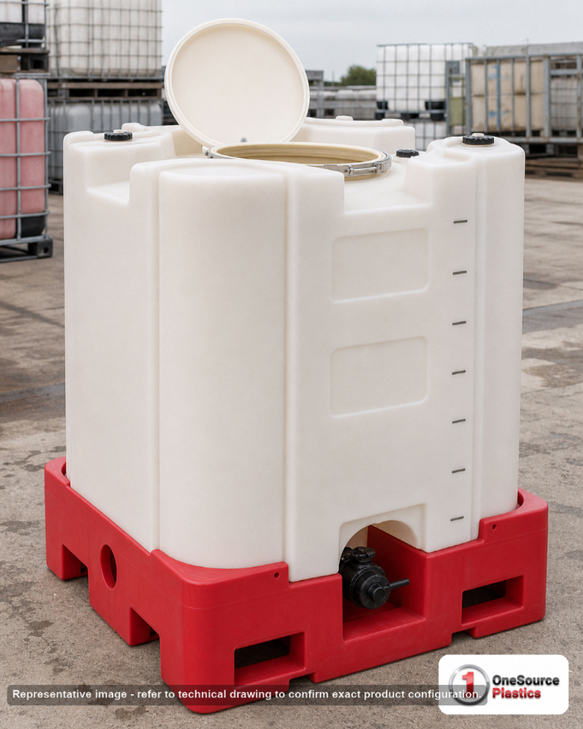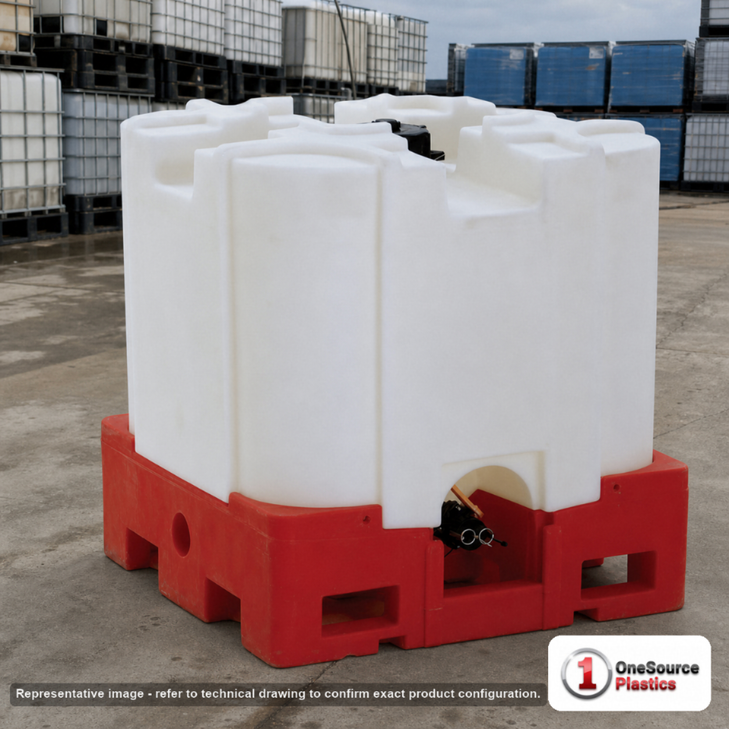
A 275 gallon stackable IBC tote on a 45 inch square
The Snyder Industries 275 gallon stackable IBC tote tank, part number 6620030B97202, is a white polyethylene tote 45 inches long, 45 inches wide and 56 inches tall, weighing 269 lb empty. It arrives plumbed: a 2 inch ball valve as the outlet, a 2 inch bung as the inlet and a 6 inch threaded vented lid on top. Snyder rates the wall for liquids up to 1.9 specific gravity and a service limit of 120 F (48 C); 275 gallons of water weighs 2,294 lb, and a liquid at the full rating weighs 4,358 lb. The 45 inch square is the tightest footprint among Snyder's 275 gallon totes, and the 56 inch height keeps useful head under the valve without demanding the ceiling Snyder's taller 275 gallon totes need. The name says stackable and no stacking load is stated for this part, so get the stacking condition confirmed for this exact part number before any tote goes on top of another.
Want it on your site? Get LTL freight to your ZIP and add it to your cart above, or call 866-418-1777 and we will confirm the fit.
Why the 45 inch square
On a rack bay, a bunded area or a floor position laid out to a fixed plan, an inch of clearance on each side is the clearance you actually get to use: the fork goes in, the tote comes out, and nothing catches the beam on the way. That matters more than it sounds on a site where totes are swapped weekly rather than left in place. The height is the compromise it buys: at 56 inches this tote sits below Snyder's tallest 275 gallon bodies and above the lowest one, so the valve still has gravity head into a drum or a pail without needing a tall ceiling. White is not cosmetic: a white shell reads a level through the wall in good light in a way a coloured one never will, and a site that keeps white for one chemistry and colour for another has solved an identification problem that no label solves permanently. Set it on a flat, continuous, level surface carrying the whole 45 inch square: rack beams sized for the plan, a solid deck or a slab, never two pallets pushed together and never blocks under the corners. At 2,294 lb of water and 4,358 lb at the rating, the beam rating is a number to look up rather than assume. At 269 lb empty it is a fork or pallet jack job.
What goes in it
Water, most fertilizers and the common process chemistries polyethylene handles, up to 1.9 times the weight of water and up to 120 F. Check the liquid in our chemical compatibility guide before the first fill; sodium hypochlorite, sulfuric acid, hydrochloric acid, hydrogen peroxide and DEF are the entries tote buyers open most. Decide the tier with our container versus tank guide and the drum, tote and bulk tank break even analysis, size it with the tank sizing calculator and the tank sizing guide, and for hazardous waste read our note on RCRA secondary containment.
Openings and fittings
- Outlet. A 2 inch ball valve, factory fitted. Your camlock, hose adapter or pipe connects to it; support the first length of hose so the valve carries liquid, not hardware.
- Inlet. A 2 inch bung for a closed fill from a hose or a pump.
- Lid. A 6 inch threaded vented lid: a hose fill and a hand, not an arm. If somebody has to get inside to clean, ask us for the manway version.
- Drawing. Snyder's drawing is linked under Technical Drawing on this page and shows the valve and bung positions.
Sizes nearby
The same 275 gallons in Snyder's other shells: the shorter 275 gallon tote 6620030B97204, and the taller 275 gallon tote 6040001B97204 and 275 gallon tote 6040011B97216. In steel: the 245 gallon carbon steel Supertainer and the 300 gallon 304 stainless steel Supertainer. For containment under any of them, see the Snyder Captor containment comparison.
Shipping and receiving
The tote ships LTL under NMFC 156600-03 from Snyder's plant in Lincoln NE, 45 by 45 by 56 inches at 270 lb on the pallet. Add it to your cart at the top of this page, get LTL freight to your ZIP, or call 866-418-1777. The listed price is before freight; the freight cost estimator gives the lane cost to your ZIP. At the dock, check the part number against 6620030B97202 on the bill of lading, work the valve once by hand, look over every face for transit damage, and fill it with water the first time before it carries product.
Freight and documents
Ships from: Lincoln, NE. LTL freight is quoted to your ZIP with the freight cost estimator or by phone at 866-418-1777. The listed price is before freight.
Technical drawing (PDF) for Snyder Industries 6620030B97202.
See this tank
Product video. Watch the Snyder Industries 275 Gallon HDPE Stackable IBC Tote Tank video (71 seconds) with dimensions, fittings and shipping notes.
Ready to order?
Add it to your cart at the top of this page, get LTL freight to your ZIP, or call 866-418-1777. The listed price is before freight.