A 275 gallon tote that arrives with the valve already on it
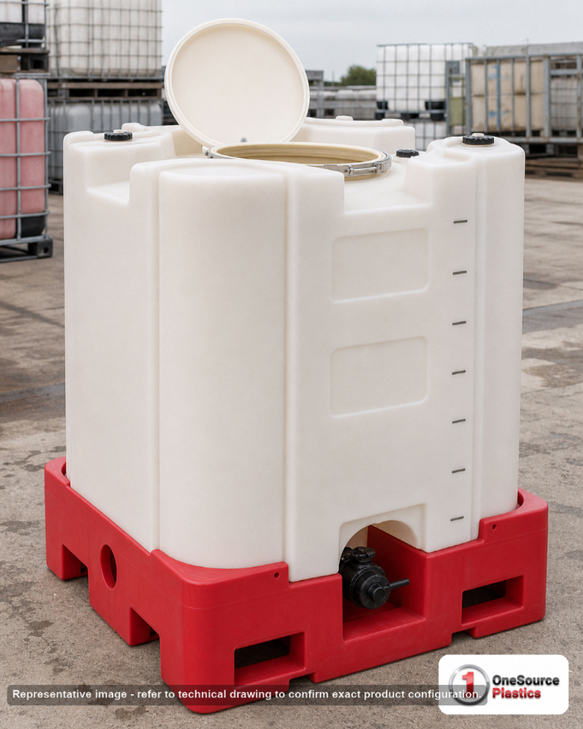
Two hundred and forty-three pounds empty is what separates this tote from most of its family. The Snyder SII-6620030B97204 is a 275 gallon stackable IBC tote tank in white polyethylene, listed 46 inches long, 45 inches wide and 54 inches tall, with a ship weight matching its empty weight at 243 pounds. Unlike the bare-field listings beside it, this sheet names its fittings in full: a 2 inch ball valve as the outlet, a 2 inch PP female NPT bulkhead fitting as the inlet, and a 6 inch threaded vented lid on top. The wall is rated at a specific gravity of 1.9, and the sheet gives 2,294 pounds for 275 gallons of water at 8.34 pounds per gallon with 4,358 pounds of max contents. The service limit is 120 F / 48 C. There is no cage, no pallet, no fork pocket, no stacking load and no warranty term on this sheet, and none is claimed.
Is this the right 275 gallon tank? Call 866-418-1777 with the liquid, the site and the ceiling height, or get freight to your ZIP and add it to your cart above.
Bought by the shop that meters product out of a valve
The duty here is measured issue rather than bulk transfer. This is the tote for the operation that fills a pail, a dosing pot, a sprayer or a small day tank several times a shift and wants a shutoff it can work with rather than a bare threaded boss it has to adapt: a car wash issuing speciality chemistry, a plating or finishing shop drawing acid or caustic into a line tank, a food plant decanting an additive, a grounds or agricultural operation filling a tank on a truck, a municipal site feeding a dosing pump. What those jobs have in common is that somebody stands at the tote with a container, and what they want at hand is a valve at a working height on a body that is only 54 inches tall. That is the shortest of the 275 gallon totes in this group and it is the reason to buy this one: a 54 inch body puts the lid inside comfortable reach and puts the ball valve where an operator can see and turn it without kneeling. Set it on a flat, continuous, level bearing surface that carries the whole 46 by 45 inch plan: a solid deck, a slab, or rack beams sized for it. Not two pallets, not a soft board under one corner. At 243 pounds empty two people cannot walk it, so plan on forks or a pallet jack, and check the loaded case against whatever it stands on: 2,294 pounds full of water and 4,358 pounds at the rating. The word stackable is in the name and this sheet publishes no stacking load, no cage, no integral pallet and no fork pocket, so handle it from underneath on something that spreads the base and do not put anything on top of it without a written condition for this part number. Check the tier before you check the shape: run the volume and the turnover through the tank sizing calculator, take the headspace from the tank sizing guide, and read the container versus tank guide if a drum row is what this is replacing.
Two polyethylene 275s, a steel pair, and what separates them
| Part | Volume | Length x width x height | Empty weight |
|---|---|---|---|
| SII-6620030B97204 (this tote, lightest and shortest) | 275 gal | 46 x 45 x 54 in | 243 lb |
| SII-6620030B97202 (same family, taller) | 275 gal | 45 x 45 x 56 in | 269.5 lb |
| SII-6040001B97204 (tallest, heaviest polyethylene) | 275 gal | 46 x 46 x 62 in | 354.2 lb |
| SII-6040011B97216 (same shell, lighter listing) | 275 gal | 46 x 46 x 62 in | 319 lb |
| 6984000B32217 (carbon steel supertainer) | 245 gal | 42 x 48 x 35.25 in | 389 lb |
| 6984000B51303 (304 stainless steel supertainer) | 300 gal | 42 x 48 x 41.25 in | 424 lb |
Four of these hold 275 gallons in polyethylene and the whole difference is height and weight. This tote is the shortest and the lightest of the four at 54 inches and 243 pounds. SII-6620030B97202 is two inches taller at 56 inches and 269.5 pounds. SII-6040001B97204 and SII-6040011B97216 are the same 46 inch square shell at 62 inches tall, listed at 354.2 and 319 pounds; the sheet gives those two weights and explains nothing about the difference, so neither will we. What that table says plainly is that eight inches of height costs you between seventy-six and a hundred and eleven pounds of empty weight for the identical 275 gallons, and where headroom under a mezzanine, a pipe run or a roller door is the binding constraint, the short light one is the buy and that is this one. Where your site already runs one of the taller listings, match it so the rack layout, the handling and the spares stay the same. The last two rows are steel vessels, not polyethylene, and they sit here because they land in the same volume band: 6984000B32217 is a 245 gallon carbon steel supertainer and 6984000B51303 is a 300 gallon 304 stainless supertainer, both on a 42 by 48 inch plan, both low at 35.25 and 41.25 inches, and both heavy at 389 and 424 pounds. This page makes no polyethylene, resin or specific gravity statement about either of them. Note that both are spelled on the sheet without the prefix the polyethylene parts carry, and we spell them the way the sheet does.
Comparing across brands too? Call 866-418-1777; we carry Norwesco, Snyder, Chem-Tainer, Enduraplas and Bushman and will say which one fits, or price the freight first.
The ball valve at the base and the bulkhead fitting above it
- The discharge: a 2 inch ball valve at the base, which is the whole reason to buy this listing rather than one with a bare outlet field. A ball valve opens fully in a quarter turn, so an operator filling a pail can shut it with one hand, and it is the fitting most likely to be worked a dozen times a day.
- Feeding a pump off it: on a 54 inch body the outlet sits low, so a pump set below the valve primes easily and keeps priming as the tote empties. Take the suction through a short, straight, falling run; every elbow between the valve and the pump shows up at the bottom of the tote, not the top.
- Supporting the line: nothing downstream of the valve hangs on the tote. A meter, a coupling, a reel or a filling gun goes on its own bracket off a rack or a wall, with a flexible connector between the valve and the rigid line.
- The inlet: a 2 inch PP female NPT bulkhead fitting, which is a closed fill connection. Filling through it instead of through the lid keeps the top shut, keeps the operator off the tote and keeps whatever is in the air out of the product.
- Access: a 6 inch threaded vented lid. Keep the vent path clear whenever a pump is drawing off the valve, because that vent is what keeps a polyethylene wall out of trouble under suction. Look at it every time the lid comes off.
- Limits: 120 F / 48 C and a specific gravity rating of 1.9. That is the extent of what this sheet publishes; there is no warranty term on it.
Tell us what the liquid is when you order and the valve seat, the gasket and the bulkhead material are matched to it instead of left generic. Where the product has to be contained as well as stored, the RCRA secondary containment guide is where the basin, the leak detection and the inspection cadence get decided, and the Captor containment comparison argues the contained polyethylene route against the steel one properly.
Closed transfer, batch issue, and the drum row it replaces
Most of these totes go in where four or five drums used to stand, and the arithmetic that justifies the swap is not the price of the container. It is how many times a year somebody moves a drum, how much product is left in the bottom of each one, what the hazard class does to the storage rules, and how much floor the whole arrangement takes once you count access and containment. A single 275 gallon tote with a named inlet and a valve turns a handful of separate lifts into one delivery and one connection, which is where the labour saving actually lives. It also changes the failure mode: a drum row leaks in five places and a tote leaks at one fitting you can reach. The drum versus tote versus bulk tank break-even analysis runs that calculation properly, including the case where the honest answer is that you should have gone to a fixed tank instead.
What this tank is listed to hold
Each line is a liquid the resin is rated for, at the concentration shown, with the fitting and gasket to order. Follow the link for the full rating, or search the chemical compatibility database before ordering.
- aluminum sulfate (50%, PVC, EPDM)
- calcium chloride (40%, PVC, EPDM)
- DEF (32.5%, 316SS fittings, EPDM)
- ethylene glycol (100%, PVC, EPDM)
- ferric chloride (50%, PVC, EPDM)
- ferric sulfate (60%, PVC, EPDM)
- ferrous sulfate (20%, PVC, EPDM)
- hydrochloric acid (37%, PVC, Viton)
- hydrofluoric acid (48%, PP/PVC, Viton)
- hydrofluosilicic acid (26%, PP/PVC, Viton)
- hydrogen peroxide (50%, PVC, Viton)
- magnesium chloride (30%, PVC, EPDM)
- peracetic acid (30%, 316SS, Aflas)
- phosphoric acid (85%, PVC, Viton)
- polyaluminum chloride (PVC, EPDM)
- potassium carbonate (50%, PVC, EPDM)
- potassium hydroxide (saturated, PVC, EPDM)
- propylene glycol (PP/316SS, EPDM)
- sodium bisulfate (PVC/PP, EPDM)
- sodium bisulfite (PVC/PP, EPDM)
- sodium carbonate (30%, PVC, EPDM)
- sodium hypochlorite (
- sodium thiosulfate (40%, PVC, EPDM)
- sulfuric acid (98%, CPVC, Viton)
- urea solution (50%, PP/PVC, EPDM), zinc orthophosphate (PP/316SS, EPDM), and ozonated water (up to 10 PPM, PVC, EPDM). Cross-reference your application i
Two hundred and forty-three pounds out of Nebraska
The sheet lists Nebraska as the state this tote ships from and Lincoln, Nebraska as the plant. Freight class is given as LTL under NMFC 156600-03, with a shipping size of 46 inches long by 45 inches wide by 54 inches high and a ship weight of 243 pounds, which is the lightest shipment among the polyethylene 275s listed beside it and the cheapest of them to move. Price the lane to your ZIP with the freight cost estimator, and note that the listed price is before freight. Unload from under the base with forks or a pallet jack, never by the lid, the valve or the bulkhead fitting; a tote taken by its valve arrives with a leak nobody can account for. Set it in its finished position before you plumb it, fill it with clean water on the level, and hold the full 2,294 pound load long enough to read the valve joint, the bulkhead and the lid seal in daylight. Drain it through the valve and time it, because the rate you get on water is the best case and everything thicker will be slower. Label the tote with the product name and the in-service date before the first delivery lands, because the container nobody can identify from across the aisle is the one that gets topped up from the wrong drum. Write the fill date on the manway with a paint marker; it answers the first question anyone asks about a tank.
Freight and documents
Ships from: Lincoln, NE. LTL freight is quoted to your ZIP with the freight cost estimator or by phone at 866-418-1777. The listed price is before freight.
Technical drawing (PDF) for Snyder Industries 6620030B97204.
See this tank
Product video. Watch the Snyder Industries 275 Gallon HDPE Stackable IBC Tote Tank video (72 seconds) with dimensions, fittings and shipping notes.
Ready to order?
Add it to your cart at the top of this page, get LTL freight to your ZIP, request a written quote, or call 866-418-1777. The listed price is before freight.