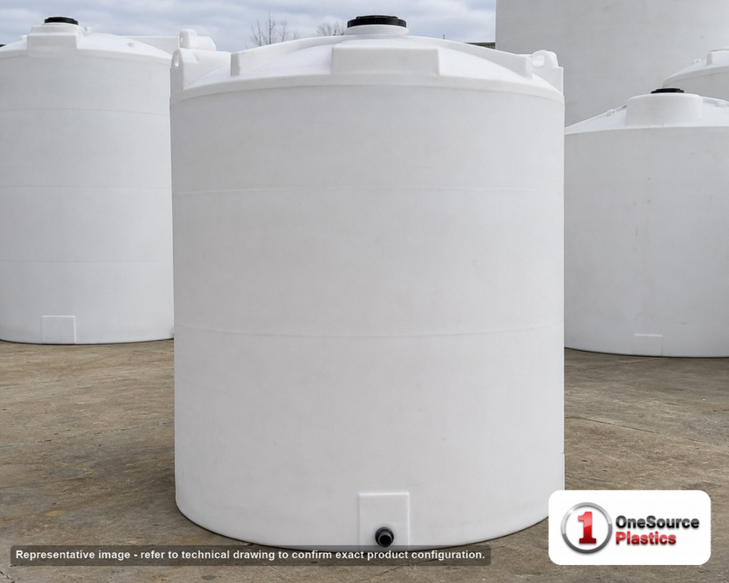
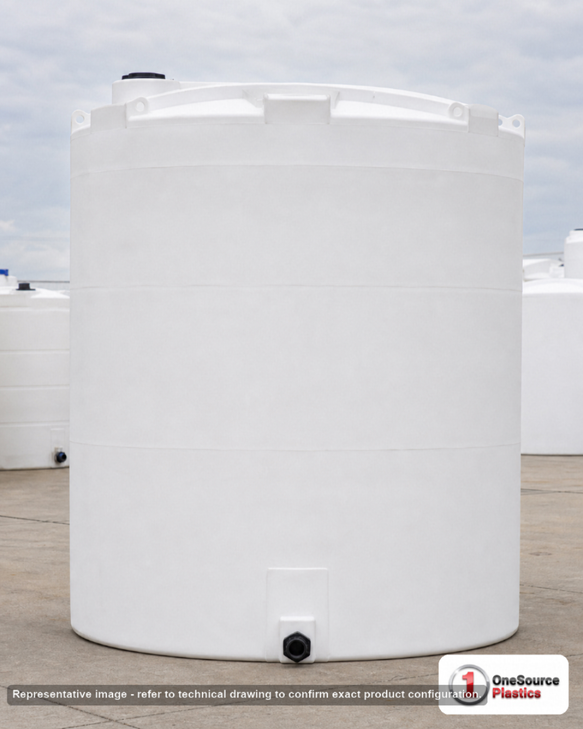
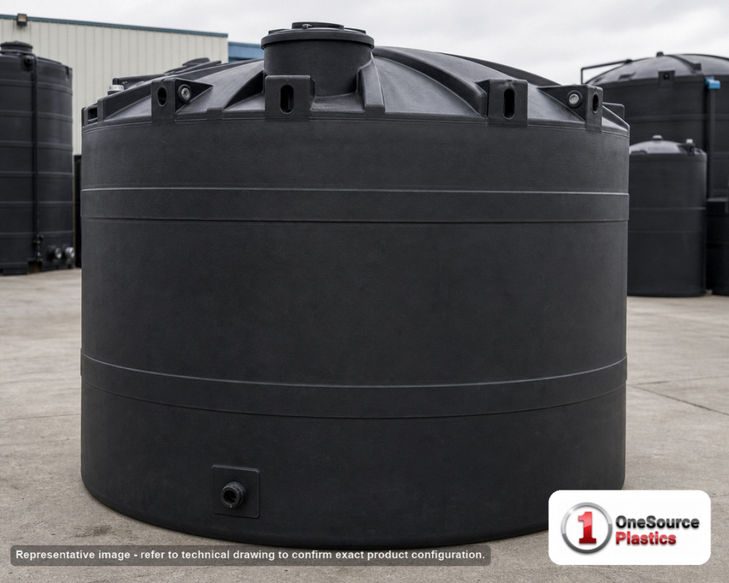
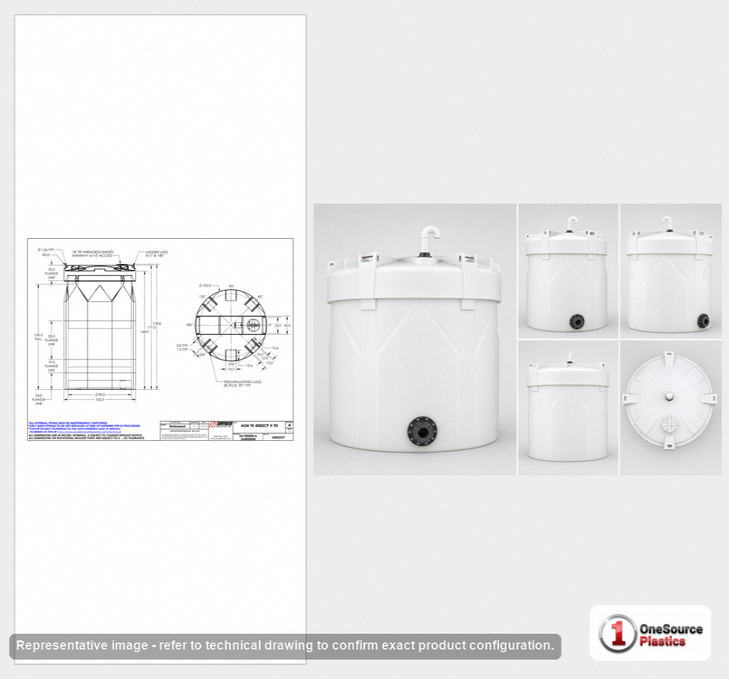
A 4,500 gallon double wall chemical tank, sixteen feet tall
The Snyder 5620000N52 is a double wall chemical storage tank: a 4,500 gallon white high density polyethylene primary rated for a specific gravity of 1.9, or 71,307 pounds of contents against 37,530 for water, standing inside its own secondary containment in a shell 102 inches across and 197 inches tall, weighing 3,800 pounds. It is bulk storage for a treatment plant's caustic, ferric, alum or acid with the berm built in, sized to take a full tanker and hold a reserve, on the same 102 inch footprint as Snyder's other large double walls. An 18 inch threaded, vented manway on the primary, and a 3 year warranty.
Ordering for a plant or a bid? Request a written quote with freight to your ZIP for the file; a single 4500 gallon tank goes straight to the cart above.
The double wall case
Put a regulated chemical in a single wall tank and the berm has to hold all of it, and at 4,500 gallons that is a concrete basin, a sump, a drain valve that must stay closed, and a rain problem. The containment lives inside the outer shell, so the tank's 102 inch footprint is the entire footprint; the SPCC 40 CFR 112 compliance walkthrough shows where the double wall alone satisfies the plan. The wall itself is sized under ASTM D1998; the HDPE tank wall thickness guide explains that logic and why a wall this tall is inspected in the headspace, not at the liquid line. The list below is the resin's rated chemistry; check the liquid at its concentration in the chemical compatibility database, and work out the usable volume with the Captor double wall freeboard sizing guide. The tank sizing calculator sizes the volume to feed rate and delivery interval, and the tank sizing guide covers the reserve.
Grades on the 102 x 197 inch double wall, and the sizes beside it
| Part | Gallons | Diameter x height | Empty weight |
|---|---|---|---|
| 5620000N52 (this tank) | 4,500 | 102 x 197 in | 3,800 lb |
| 5620000N30 (sulfuric grade) | 4,500 | 102 x 197 in | 3,800 lb |
| 5620000N42 (XLPE) | 4,500 | 102 x 197 in | 3,800 lb |
| 5620000N40 (XLPE) | 4,500 | 102 x 197 in | 3,000 lb |
| 5610000N30 (sulfuric grade) | 4,000 | 102 x 178 in | 3,200 lb |
| 5630000N40 (XLPE) | 5,000 | 102 x 216 in | 3,600 lb |
The N30 is the sulfuric acid grade and the N42 is cross-linked polyethylene for oxidizers, both at this tank's weight; the N40 is a lighter cross-linked wall at 3,000 pounds. The 5610000N30 is the 4,000 gallon double wall, 19 inches shorter on the same base, and the 5630000N40 is the 5,000 gallon step up at 216 inches. All share the 102 inch footprint, so a slab poured for one takes the next.
Still deciding between these? Freight to your ZIP often settles it; the wider tanks ship differently. Or call 866-418-1777 and we will walk the table with you.
Openings and the alarm layers
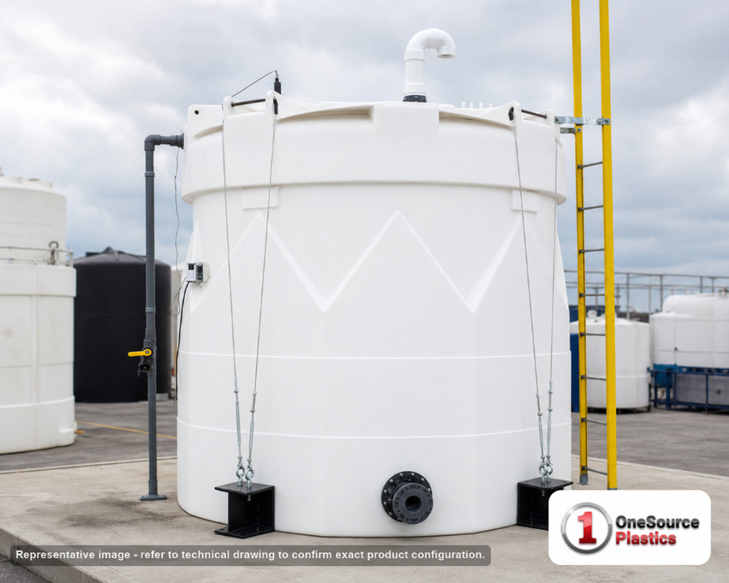
- Access: 18 inch threaded, vented manway on the primary, 197 inches up; on caustic or acid the vent goes outdoors, the fill goes down a dip tube, and the vent is sized to the tanker pump.
- Outlet: both walls together at one flanged penetration, expansion joint after it, valve supported from the slab; name the chemical when ordering so the fitting matches it.
- Service limit: 120 F / 48 C.
Two levels need watching: the primary, with a sender chosen for the chemical per the level gauge selection guide, and the interstitial space, which is the leak alarm and gets a float or conductivity switch, a look into the port each shift, and a logged check each week. Liquid in the space means the primary has failed, and the tank is emptied that day. Full, the tank loads a 102 inch circle to 71,307 pounds at the rating: an engineered, full-contact slab under all of the floor, with straps holding the empty tank against wind, and at 197 inches the manway is reached from a fixed platform with a rail, never a ladder.
Fill day
The truck's pump outruns the manway vent, so size the vent for the unload rate or give the fill its own top bulkhead and vent line. The fill pipe runs to the floor so caustic or coagulant does not free-fall and foam. Dense liquids heat up when diluted, so a tank topped off with water for a batch is filled water first, chemical second. Somebody stands at the tank for the whole of the first delivery, checking the slab edge, the outlet fitting and the interstitial port as the level rises.
Put to use
Caustic, coagulant and acid bulk storage at water systems that cannot build a berm, chemical storage inside tall process buildings, and any regulated liquid at plant scale at a site an inspector visits. One chemical per tank; label it once for both inspectors; keep the manway shut so nothing escapes as vapor.
Chemicals this resin is rated for, with the fitting and gasket to order
These are the chemicals listed for this tank at the concentrations shown. Each links to the full compatibility page; confirm your exact concentration and temperature there or in the chemical compatibility database before ordering.
- Acetic Acid (60%) - PP/PVC fittings, EPDM gaskets
- Aluminum Sulfate (50%) - PVC fittings, EPDM gaskets
- Calcium Chloride (40%) - PVC fittings, EPDM gaskets
- DEF (32.5%) - 316SS fittings, EPDM gaskets
- Ethylene Glycol (100%) - PVC fittings, EPDM gaskets
- Ferric Chloride (50%) - PVC fittings, EPDM gaskets
- Ferric Sulfate (60%) - PVC fittings, EPDM gaskets
- Ferrous Sulfate (20%) - PVC fittings, EPDM gaskets
- Hydrochloric Acid (37%) - PVC fittings, Viton gaskets
- Hydrofluoric Acid (48%) - PP/PVC fittings, Viton gaskets
- Hydrofluosilicic Acid (26%) - PP/PVC fittings, Viton gaskets
- Hydrogen Peroxide (50%) - PVC fittings, Viton gaskets
- Magnesium Chloride (30%) - PVC fittings, EPDM gaskets
- Peracetic Acid (30%) - 316SS fittings, Aflas gaskets
- Phosphoric Acid (85%) - PVC fittings, Viton gaskets
- Polyaluminum Chloride - PVC fittings, EPDM gaskets
- Potassium Carbonate (50%) - PVC fittings, EPDM gaskets
- Potassium Hydroxide (saturated) - PVC fittings, EPDM gaskets
- Propylene Glycol - PP/316SS fittings, EPDM gaskets
- Sodium Bisulfate - PVC/PP fittings, EPDM gaskets
- Sodium Bisulfite - PVC/PP fittings, EPDM gaskets
- Sodium Carbonate (30%) - PVC fittings, EPDM gaskets
- Sodium Hypochlorite (
- Sodium Thiosulfate (40%) - PVC fittings, EPDM gaskets
- Sulfuric Acid (98%) - CPVC fittings, Viton gaskets
- Urea Solution (50%) - PP/PVC fittings, EPDM gaskets
- Zinc Orthophosphate - PP/316SS fittings, EPDM gaskets
How it ships
At 102 inches across and 197 inches long on the deck the 5620000N52 is oversize freight (NMFC 156600) on a flatbed at a lane rate; the freight cost estimator prices the move to your ZIP, and the price on this page is before freight. A crane sets 3,800 pounds upright on the slab; a forklift can take it off the deck, not raise it. Hold a water test on the primary with the interstitial port watched, then drain and dry ahead of the first chemical. A strap that is checked once a season is a strap that holds; put it on the same calendar as the gutters.
Freight and documents
Ships from: Lincoln, NE. LTL freight is quoted to your ZIP with the freight cost estimator or by phone at 866-418-1777. The listed price is before freight.
Technical drawing (PDF) for Snyder Industries 5620000N52.
See this tank
Interactive 3D model with live fill. This tank has an interactive 3D model built to its manufacturer dimensions. Rotate it, and set a fill level to see how much liquid it holds at any height. Open the 3D view on the product photo above. Download the 3D model (GLB).
Product video. Watch the Snyder Industries 4500 Gallon HDPE Vertical Double Wall Liquid Chemical Storage Tank in White video (71 seconds) with dimensions, fittings and shipping notes.
Ready to order?
Add it to your cart at the top of this page, get LTL freight to your ZIP, request a written quote, or call 866-418-1777. The listed price is before freight.