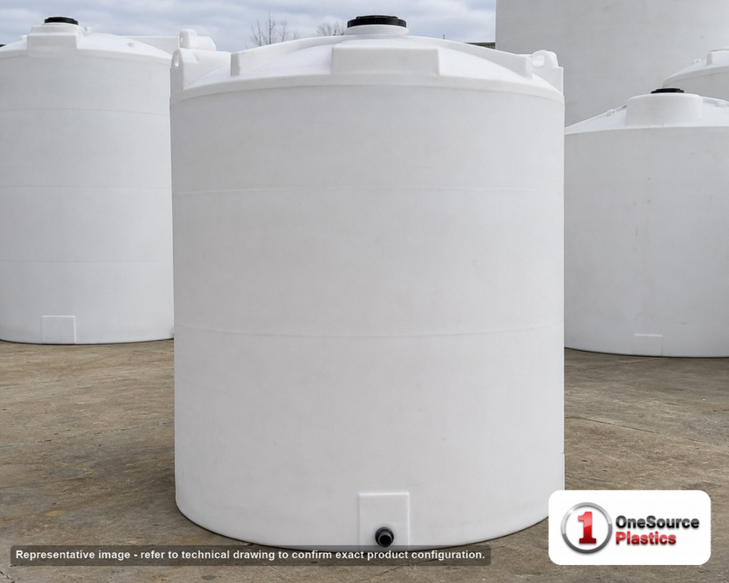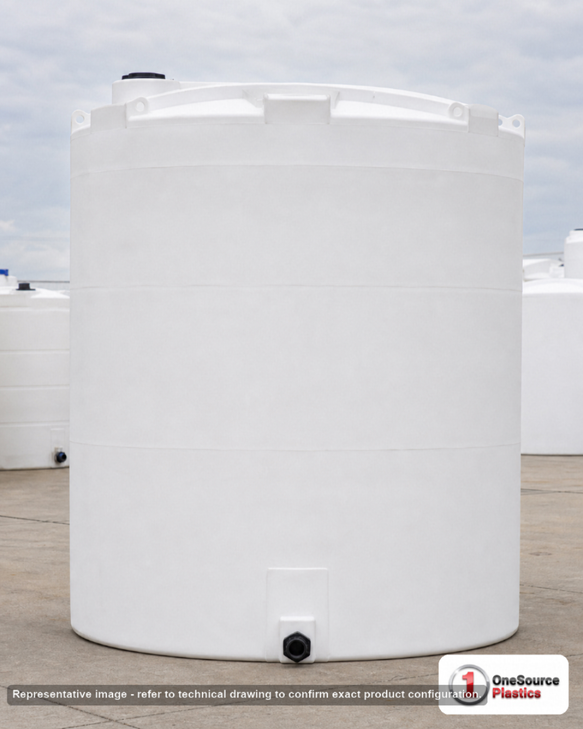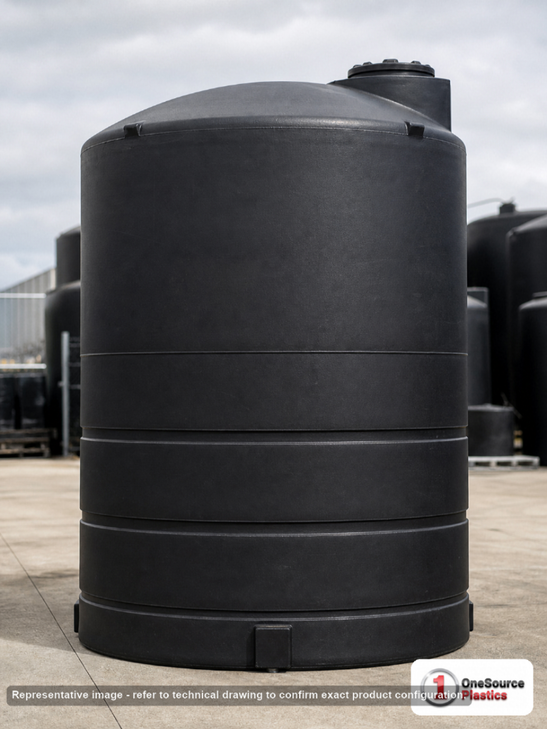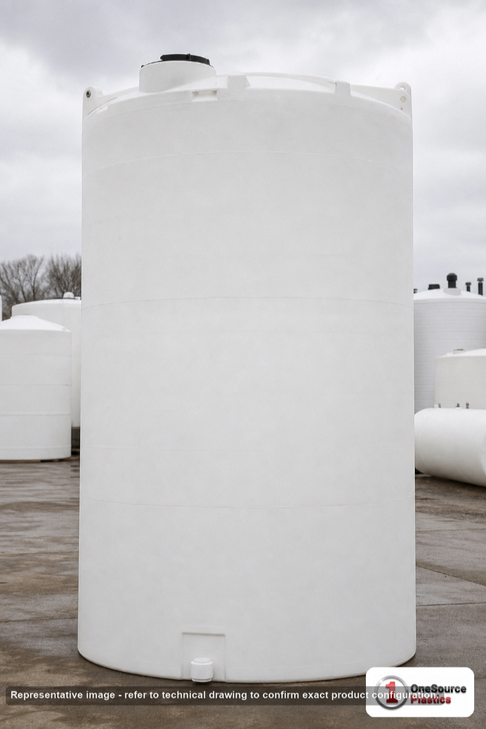
4,900 gallons of chemical storage on a 90 inch base, ASTM certified
The Snyder 5480000N43 is a white high density linear polyethylene vertical chemical storage tank, 90 inches across and 202 inches tall, holding 4,900 gallons at 1,450 pounds. Its wall is rated for a specific gravity of 1.5, or 61,299 pounds of contents against 40,866 for water, which covers coagulants, brines, caustic and hypochlorite as delivered, it is sold with ASTM certification, and the seven and a half foot base puts a full tanker load on a pad smaller than the tanker, seventeen feet up. The manway is 18 inches, threaded and vented, the warranty is 3 years, and the freight is oversize.
Ready for the pad? Quote freight to your ZIP, add the 4900 gallon tank to your cart above, and 866-418-1777 will confirm the truck and the unload.
A tanker load on the small pad
A tank's specific gravity rating is the density of the heaviest liquid its wall is sized to hold; alum and ferric solutions, brines and most caustic and hypochlorite as delivered are all lighter than a 1.5 wall is sized for, so it carries them with margin without paying for the 1.9 wall that concentrated sulfuric acid needs. The certification is against ASTM D1998; the HDPE tank wall thickness guide explains the sizing logic and why a wall this tall is inspected from the top, in the headspace. The list below is the resin's rated chemistry; check the liquid at its concentration in the chemical compatibility database; the weight rating and the chemical rating are two different questions. A single wall tank of regulated chemical needs a berm sized to its volume; the Snyder Captor 110 percent containment comparison covers when a double wall tank is the cleaner answer than a basin. The tank sizing calculator sizes the volume to feed rate and delivery interval, and the tank sizing guide covers the reserve.
Grades on the 90 x 202 inch tank, and the sizes beside it
| Part | Gallons | Diameter x height | Empty weight |
|---|---|---|---|
| 5480000N43 (this tank, 1.5 SG, ASTM certified) | 4,900 | 90 x 202 in | 1,450 lb |
| 5480000N45 (1.9 SG, ASTM certified) | 4,900 | 90 x 202 in | 2,000 lb |
| 5480000N42 (XLPE, heavy wall) | 4,900 | 90 x 202 in | 2,000 lb |
| 5480000N40 (XLPE) | 4,900 | 90 x 202 in | 1,450 lb |
| 5480000N46 | 4,900 | 90 x 202 in | 1,450 lb |
| 8210000N40 (XLPE) | 4,650 | 102 x 154 in | 1,200 lb |
| 1002100C34 | 5,000 | 102 x 154 in | 950 lb |
The N45 is the certified 1.9 wall, 550 pounds heavier, for ferric at strength and the heavy brines; the N42 is the heavy cross-linked tank at that weight, and the N40 and N46 the lighter cross-linked and linear grades at this tank's weight. The 8210000N40 and 1002100C34 hold 4,650 and 5,000 gallons on a 102 inch base at 154 inches, 48 inches shorter, for a site with a bigger pad and less height.
Still deciding between these? Freight to your ZIP often settles it; the wider tanks ship differently. Or call 866-418-1777 and we will walk the table with you.
Openings, sampling and labels
- Access: 18 inch threaded, vented manway, 202 inches up; dip-tube fill; vent line to the outside on caustic and hypochlorite, sized for a tanker's unload rate.
- Outlet: the bulkhead fitting is chosen for the chemical at order time; a flanged transition, an expansion joint, and a valve supported off the slab.
- Service limit: 120 F / 48 C.
- Listing: ASTM certification.
Choose the level sender for the chemical with the level gauge selection guide; on a tank this tall a sender read at ground level keeps everyone off the platform. Label it so the fire inspector and the workplace inspector read the same thing, NFPA 704 diamond and GHS pictograms reconciled as the tank label and signage compliance guide describes, at a height a person on the ground can read. Full, the tank loads a 90 inch circle to 61,299 pounds at the rating: an engineered slab in full contact under the whole floor, inside a berm, the tank strapped against wind when empty, with the manway reached from a fixed platform with a rail, never a ladder.
Fill day
The truck's pump outruns the manway vent, so size the vent for the unload rate or give the fill its own top bulkhead and vent line. The fill pipe reaches the floor, so caustic or coagulant enters below the surface instead of free-falling and foaming. Somebody stands at the tank for the whole of the first delivery, watching the slab edge and the outlet fitting as the level rises, and the log takes the date and strength of every load that follows; for hypochlorite the log is also the turnover schedule.
Put to use
Coagulant, caustic, brine and hypochlorite bulk storage at water and wastewater plants with a berm and a small pad, chemical storage inside tall process buildings, and any regulated liquid of moderate density at plant scale where the certification has to be on file. One chemical per tank; label it once for both inspectors; keep the manway shut so nothing escapes as vapor.
Chemical service ratings
The resin is rated for the liquids below at the concentrations shown; the fitting and gasket called out are the ones to order with the tank. Verify the exact service on the linked page or in the chemical compatibility database before ordering.
- Acetic Acid (60%, PP/PVC fittings, EPDM gaskets)
- Aluminum Sulfate (50%, PVC, EPDM)
- Calcium Chloride (40%, PVC, EPDM)
- DEF (32.5%, 316SS fittings, EPDM) - making this a practical diesel exhaust fluid storage tank -
- Ferrous Sulfate (20%, PVC, EPDM)
- Magnesium Chloride (30%, PVC, EPDM)
- Sodium Carbonate (30%, PVC, EPDM)
- Urea Solution (50%, PP/PVC, EPDM), and Ozonated Water (up to 10 PPM, PVC, EPDM - no dedicated page yet, so confirm against the chart). Browse the full
- Ethylene Glycol
- Ferric Chloride
- Ferric Sulfate
- Hydrochloric Acid (Viton gaskets)
- Hydrofluoric Acid
- Hydrofluosilicic Acid
- Hydrogen Peroxide
- Peracetic Acid (316SS fittings, Aflas gaskets)
- Phosphoric Acid
- Polyaluminum Chloride
- Potassium Carbonate
- Potassium Hydroxide
- Propylene Glycol
- Sodium Bisulfate
- Sodium Bisulfite
- Sodium Hypochlorite (Viton)
- Sodium Thiosulfate
- Sulfuric Acid (CPVC fittings, Viton), and
- Zinc Orthophosphate. If your service is on this list, ask us about the 1.9 SG version before you buy.
How it ships
At 90 inches across and 202 inches long on the deck the 5480000N43 is oversize freight (NMFC 156600) on a flatbed at a lane rate; the freight cost estimator prices the move to your ZIP, and the price on this page is before freight. A crane sets 1,450 pounds upright on the slab; a forklift can take it off the deck, not raise it. Water-fill it once to the manway, hold it, check the outlet fitting, and keep the certification paperwork with the project file. A strap that is checked once a season is a strap that holds; put it on the same calendar as the gutters.
Freight and documents
Ships from: Lincoln, NE. LTL freight is quoted to your ZIP with the freight cost estimator or by phone at 866-418-1777. The listed price is before freight.
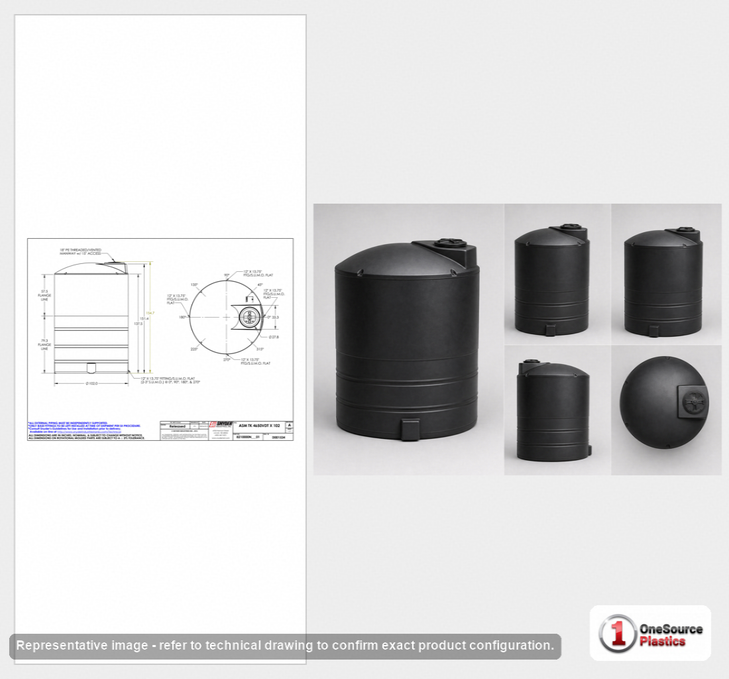
Technical drawing (PDF) for Snyder Industries 5480000N43.
See this tank
Interactive 3D model with live fill. This tank has an interactive 3D model built to its manufacturer dimensions. Rotate it, and set a fill level to see how much liquid it holds at any height. Open the 3D view on the product photo above. Download the 3D model (GLB).
Product video. Watch the Snyder Industries 4900 Gallon HDPE Vertical Liquid Chemical Storage Tank with ASTM Certification video (77 seconds) with dimensions, fittings and shipping notes.
Ready to order?
Add it to your cart at the top of this page, get LTL freight to your ZIP, request a written quote, or call 866-418-1777. The listed price is before freight.